
Managing a multi-branch plumbing business means giving up what got your small business off the ground: You, personally, catching every problem before it gets expensive. Your shop ran on instincts built over years, like when a dispatcher knows which customers pay on time.
But when you open a second location, nothing transfers automatically. The new branch has its own crew, customer list, and version of "how we do things." If you don't standardize quickly, this new branch will develop its own version of "how we lose money," too.
That's the shift this guide is built around: moving from a single location that runs on your instincts to a multi-branch operation that runs on systems. Some of what follows matters most the moment you're deciding whether to open location two. Other parts matter more once you're already running four or five branches and starting to notice the cracks between them. Either way, it's the same underlying problem: instincts don't scale, systems do.
This is the operational reality behind most stalled expansions: The first location ran clean for years, but the second one drags down margins while the owner is too busy putting out fires to notice.
The eight practices below separate plumbing companies that add profitable locations from those that just add locations. Plus, we'll give straight answers on when you're ready to expand and how to launch a new branch without repeating the same mistakes.
Know When Your Plumbing Business Is Ready to Expand
Most plumbing companies expand because the phone won't stop ringing, not because the business is ready to run two locations at once. Confusing busyness for readiness is how a profitable single-location shop becomes two locations losing money.
Three signals matter more than call volume:
- Your current territory runs near capacity. Technicians are booked on plumbing jobs year-round, not just during a seasonal spike.
- Your pricing, dispatching, and invoicing run on documented processes. Importantly, they don't need your sign-off on every job. If you're the bottleneck at one location, you'll be a worse one at two.
- Your margins have held steady for at least two years. Profitability Partners puts the threshold at EBITDA margins of 15-20% or better for two straight years, enough cash flow cushion to absorb a new location's break-even year without starving the original branch.
That last one gets skipped constantly. Owners look at revenue instead of margin when deciding they're ready to grow. Revenue growth from a new branch is easy. Profitable revenue growth depends on knowing your real booking rate, not what your field service software reports.
Real booking rates tell a similar story. Profitability Partners puts booking rates for strong-performing inbound call centers at 25-35%, which is often lower than what shows up after unbooked calls get reclassified as "non-leads." If you don't know that number cold for your existing branch, reclassifying it gives you two blind spots instead of one.
The operational fix: Pull your last 24 months of monthly P&Ls, real booking rate, and technician utilization before signing a lease. If any of those numbers surprise you, fix the first branch first.
Related: Most branch problems are about the fundamentals. Plumbing management best practices from Simpro® break down what to fix first.
Choose the Right Route Into a New Plumbing Market
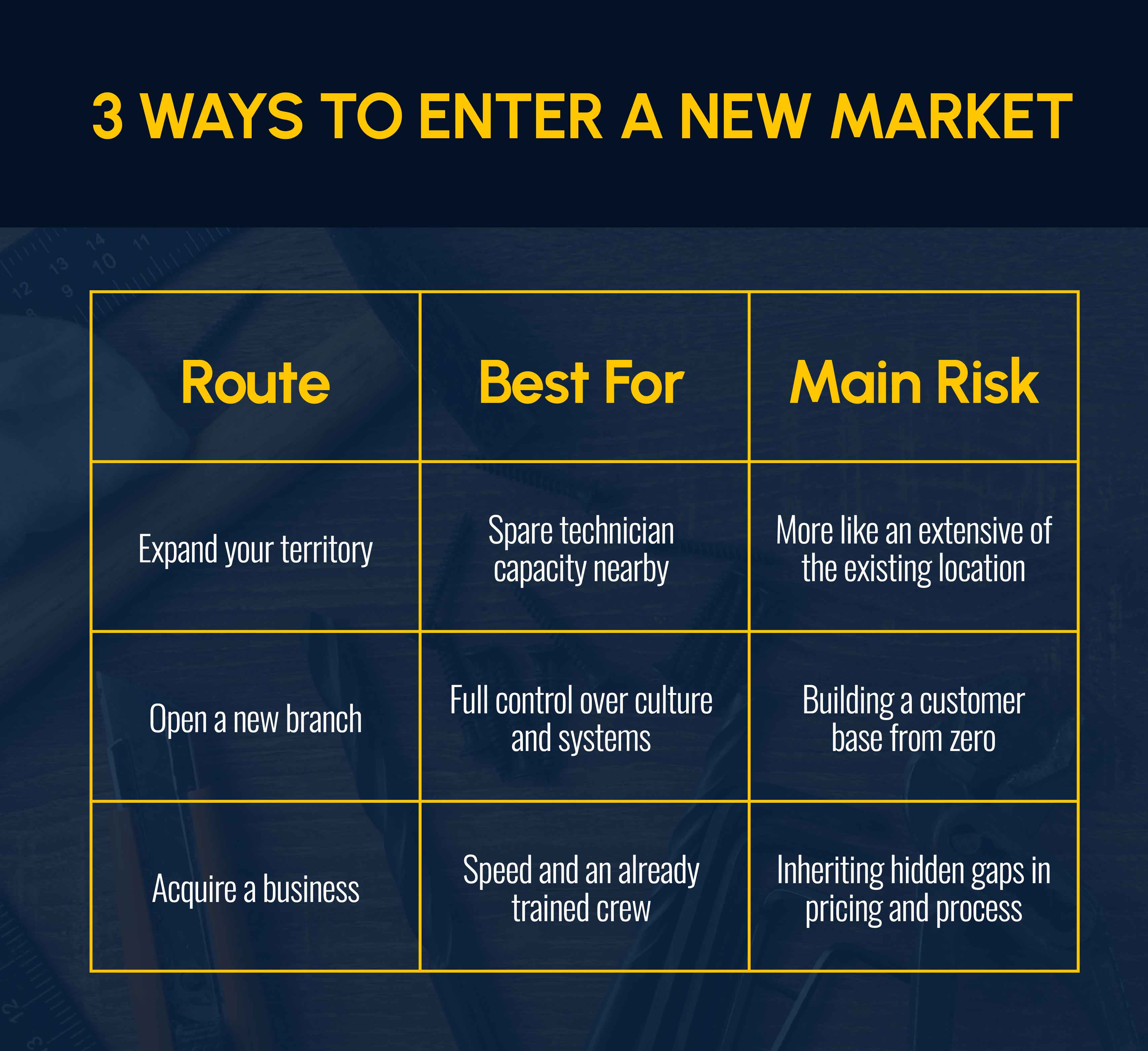
Determining how to scale a plumbing business to multiple locations is more than just a real estate question. Each option comes with a different speed, cost, and risk profile:
- Expand your current service territory. The lowest-risk option if you have spare technician capacity and the new area is close enough to dispatch from your existing shop. This is less of a second independent location and more of a wider radius on the first. It's also the cheapest way to test demand before committing to a lease.
- Open a company-owned branch. You get more control over culture, pricing, and systems from day one, but you're building a customer base and a trained crew from scratch.
- Acquire an existing plumbing business. Realize revenue faster and inherit an already trained crew, but you also inherit existing pricing habits and process gaps. Due diligence has to go deeper than the P&L, since blended statements often obscure margin gaps.
Your decision often comes down to staffing constraints. This is commonly outside your control and often underestimated by plumbing business owners until they're living it. The skilled trades are short on people right now, and acquisitions buy you a trained crew on day one. Building from scratch means your hiring timeline determines branch growth, not your marketing plan.
Related: Building a branch from scratch takes longer than most owners plan for. Simpro's guide on how to grow a plumbing business shows how to sequence growth without cannibalizing existing demand.
8 Ways to Keep Every Plumbing Branch Profitable and Connected
Whether you just opened location two or you're five branches deep and losing track of which one's actually profitable, here are essential tips for running a multi-location plumbing business that protects margin. This advice boils down to eight operational disciplines, not eight pieces of software. Get these right, and the software becomes the easy part.
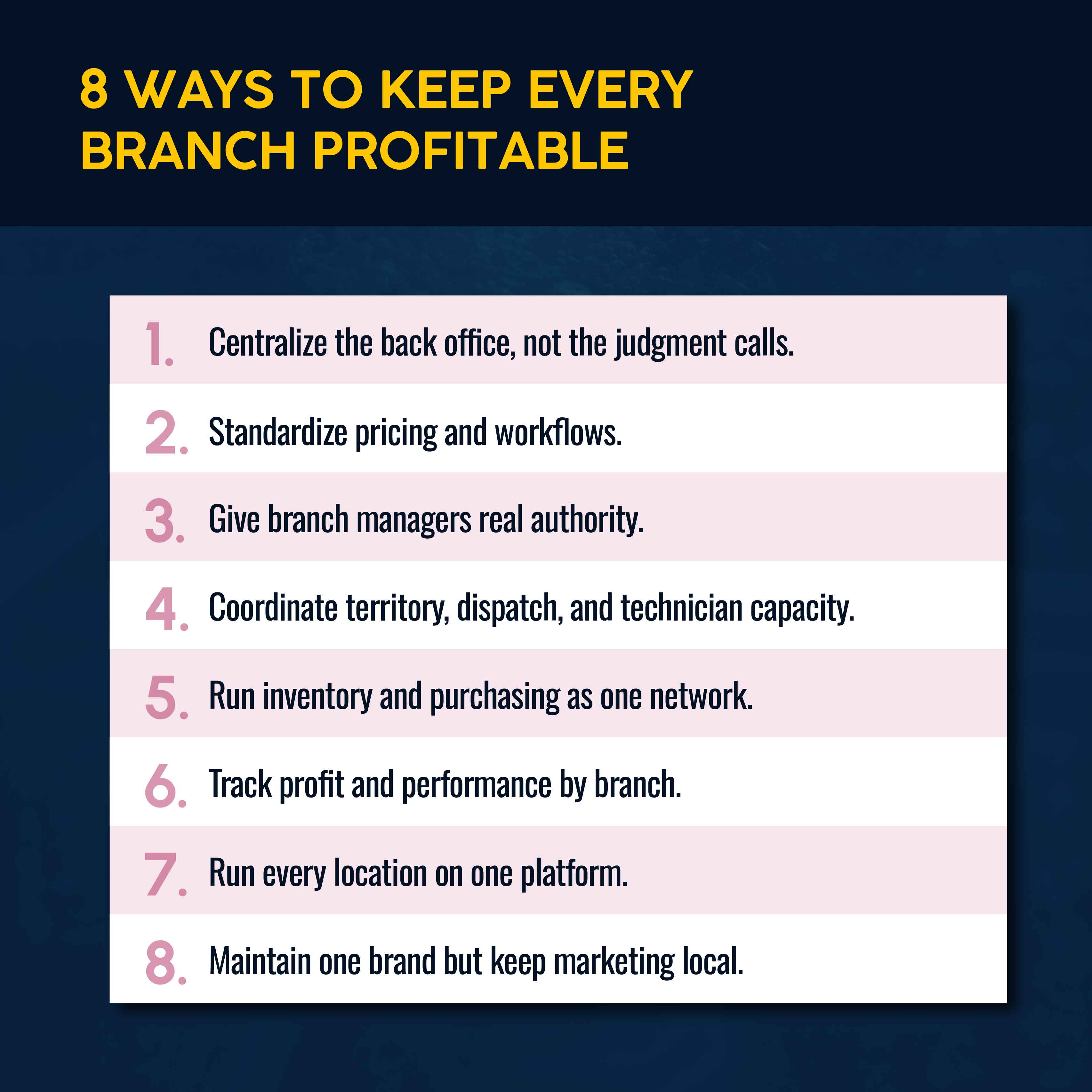
1. Centralize the Functions That Benefit the Whole Business
Some functions get cheaper and more consistent the moment you centralize them: accounting, vendor negotiations, software administration, and marketing production. Others get worse: dispatch, customer relationships, and anything that depends on knowing the local market. The mistake most multi-branch plumbing companies make is either making everything centralized or everything local. The better approach is going function by function to ensure consistent quality.
Kiely Plumbing centralized its scheduling, invoicing, and inventory on Simpro, cutting admin time by 63% and freeing up hours that used to go into duplicate data entry. That's the pattern worth emulating: Centralize the paperwork, not the judgment calls only a branch manager can make.
2. Standardize Pricing, Workflows, and Customer Service
A water heater installation that runs $1,200 in your original territory shouldn't quote at $950 or $1,500 depending on which branch's technician shows up. Same goes for a routine drain cleaning call. Inconsistent pricing means you're providing two customer experiences. You might have two branches, but all they really share is a logo.
Prebuilt pricing templates make this close to automatic. Standardization means the base price is identical, with technicians able to use judgment on the details.
Zebra Plumbing used Simpro's standardized quoting templates to cut estimate time from up to 45 minutes down to under a minute, a 20x improvement that means every technician quotes off the same price book instead of guessing.
3. Give Branch Managers Clear Authority and Accountability
A branch manager who has to call you for approval on a $300 discount will eventually stop calling and just lose the job instead. Set clear limits: A manager can approve discounts up to a dollar amount, adjust a schedule, or handle a complaint without a call to headquarters. They remain accountable for the branch's margin and callback rate.
The failure mode runs both ways. Too much central control, and you become the bottleneck for each branch. Too much autonomy, and pricing, scheduling, and service drift apart until branches barely resemble each other. The fix: Give a documented range of authority per role, reviewed against real performance data every month.
4. Coordinate Territories, Dispatch, and Technician Capacity
Separate calendars per branch feel simpler until an emergency service call comes in outside Branch B's usual service area while Branch A has three idle technicians. Nobody sees it happening. A single master schedule lets a dispatcher route the closest available technician instead of the closest one on that branch's roster.
That single schedule only works if it's real. A shared calendar that still requires a phone call to Branch A to check who's free is centralized in name only. The dispatchers who pull this off well are working from software that shows every technician's location, job status, and availability across every branch on one screen, so routing the closest available tech is a drag-and-drop decision instead of a round of calls.
Capacity visibility matters even more once you're comparing branches, as technician performance varies more than most owners assume. Profitability Partners has tracked ratios of better than 3:1, with a top performer generating $80,000 a month in revenue, for example, and the lowest performer bringing in only $25,000. Multiply that variance across three branches with no shared view of who's booked, and you're paying full overhead on capacity nobody's using.
5. Manage Inventory, Vehicles and Purchasing as One Network
A part is a part, whether it's on the truck, going into a water heater, or deep inside a customer's plumbing system. But your count on hand is different. Treat your product catalog, pricing, and part numbers as a shared list, with specific stock quantities for each location and truck.
The payoff shows up two ways:
- Purchasing power. Buying parts for three branches at once beats three separate small orders with the same wholesaler.
- Fewer emergency runs. When technicians can check real-time stock at every branch before heading to a job, they're less likely to show up unprepared.
Related: Simpro's plumbing inventory management best practices cover the specifics of keeping accurate stock without counting shelves by hand.
6. Track Profitability and Performance by Branch
One blended P&L for the whole company is the single easiest way to lose money without noticing, and it's a mistake all service businesses make, not just plumbing. Here's just one example: A plumbing services division runs 22% margins while HVAC division only has an 8% margin, but that difference isn't caught until someone breaks out the P&L by department.
Pull an automated, branch-level P&L, measuring revenue, cost of goods, labor, and overhead down to gross profit. Review it monthly, not annually. Track the same core numbers at the branch and technician level so a "good month" means the same thing regardless of location.
Related: Once you're tracking by branch, the next question is which numbers matter. Simpro's plumbing business KPIs break down which metrics are worth reviewing every month.
7. Connect Every Location Through One Field Service Platform
Each practice above has an underlying dependency: A single field service management software platform that every branch runs on, versus separate tools, spreadsheets, and software accounts stitched together after the fact. Disconnected systems lead to manual exports and time wasted reconciling numbers that should already match.
Simpro Premium's Multi-Company option is built for exactly this. One platform runs multiple branches, franchises, or legal entities, with roll-up reporting at the company level and entity-specific control over pricing, permissions, and job workflows. DC Electrical implemented Simpro Multi-Company to strengthen accountability and surface synergies across its three businesses.
Related: Choosing the right platform is the decision everything else here depends on. Simpro's guide to the best plumbing software walks through what to look for.
8. Keep Local Marketing Relevant Without Splitting the Brand
Each branch needs to be active in the community, surfacing to potential customers who've never heard of you. That might mean sponsoring the local youth baseball team, showing up at chamber of commerce meetings, and keeping their Google Business Profile current and earning positive reviews. What you can't have is branches becoming their own brands with a different voice.
What works is a shared brand identity, pricing, and reputation, paired with a local budget and a local point of contact at each branch. Customers think about the name on the truck, not which branch answered the phone.
Launch Each New Plumbing Branch With a Repeatable 90-Day Plan
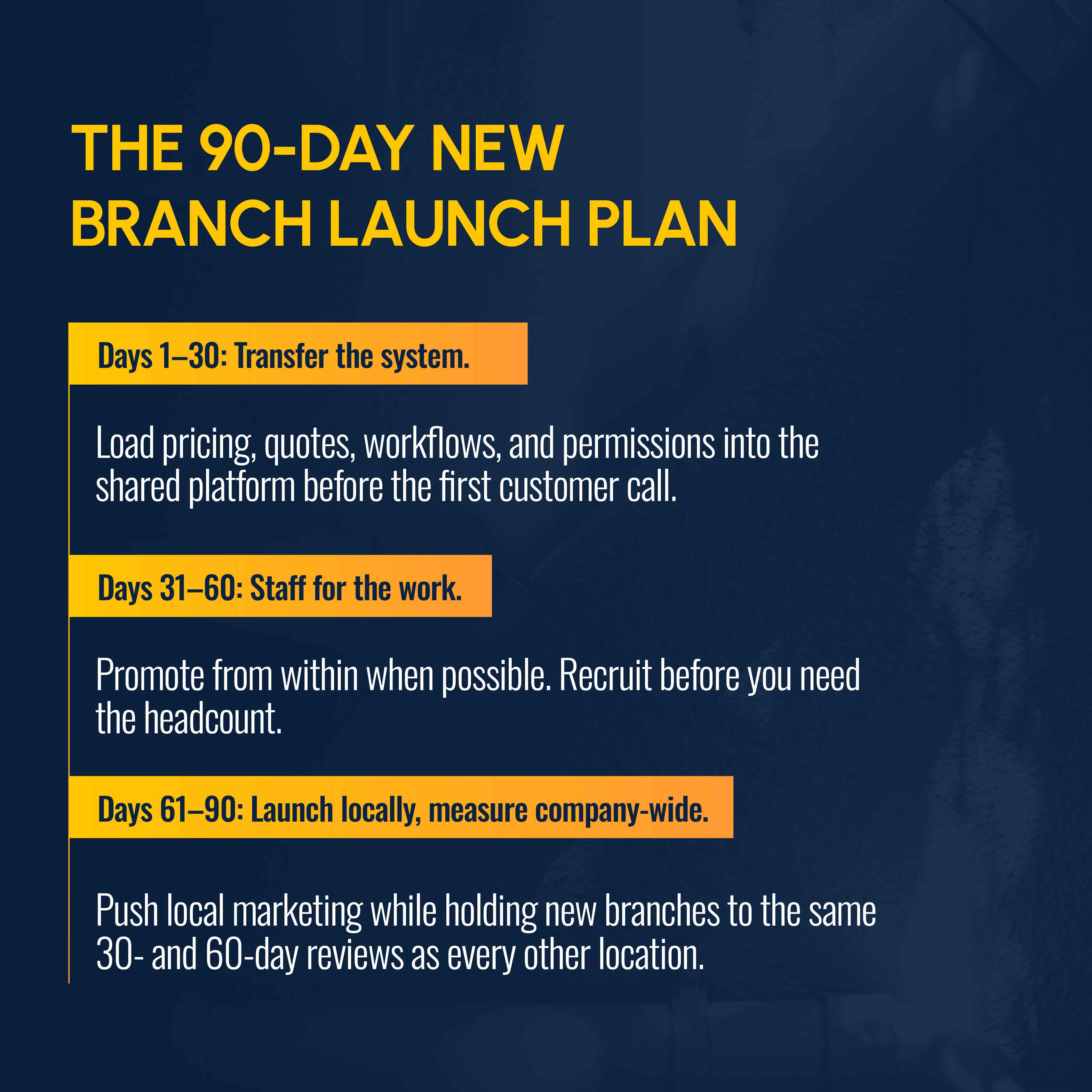
The problems that show up during expansion only get worse the longer they go unaddressed. Think culture drift, pricing inconsistency, and under-resourced local marketing. The fix is a written-down, repeatable plan to ensure branch three launches faster and cleaner than branch two, instead of starting from scratch again.
Days 1 to 30: Transfer the system, not just the idea. Load your existing pricing, prebuilt quotes, workflows, and permissions into the shared platform before a single customer call comes in. The new branch should quote off the same price book on day one, rather than build its own.
Days 31 to 60: Staff for the work you can already see. Skilled trades face a real hiring constraint, including in the plumbing industry. The U.S. Bureau of Labor Statistics estimates that roughly 44,000 plumber, pipefitter, and steamfitter openings become available every year, and not all get filled. Finding great talent gets even tougher when every other contractor is hiring from the same small pool. Start recruiting before you need the headcount, and promote from within where you can.
Days 61 to 90: Launch locally, measure companywide. Put a real marketing push behind the opening: chambers of commerce, local trade groups, and community presence, not just a wider radius on your ads. Hold the new branch to the same 30- and 60-day review every other location gets.
Communicate the plan to your existing crew before they hear about it from a customer. You want your team to see why a new branch benefits them, rather than seeing the new location as a competitor for scarce resources.
Bring Multi-Branch Plumbing Operations Together With Simpro
The best practices above work best on a connected platform, and that's where Simpro Premium comes in. Contract Profitability and BI Reporting replace blended reporting with branch-level and technician-level margin visibility.
Dispatch works the same way: Every technician's schedule is visible across every branch. Travel time is factored in to reduce windshield hours. Two branches can't double-book the same job.
Inventory gets similar treatment: Stock gets tracked by location and by truck, including transfers between branches, so a missing part doesn't turn into an emergency wholesaler run.
The results show up in the numbers. Zebra Plumbing doubled profitability to 70% and increased per-job output while now collecting same-day payment on 90% of jobs. Kiely Plumbing grew revenue 35% while cutting admin time 63%, with billable hours per technician up 25%.
Across the platform, Simpro customers report an average 25% increase in revenue, the kind of gain that compounds once it's happening at every branch instead of just one.
Build More Locations Without Building More Complexity
Managing multiple plumbing branches profitably means running an operating model built on standardized pricing and centralized, branch-level visibility. Companies operating this way can expand without growing their back office or sacrificing customer satisfaction. Revenue and branch count go up; admin headcount and reconciliation work don't have to.
How confident are you in your second location's numbers compared to your first? If the answer is "not very," your business can benefit from standardized systems and branch-level reporting. Simpro gives multi-branch plumbing companies one platform for pricing, dispatch, inventory, and profitability, so growth adds revenue instead of new places where things can go wrong.
Schedule a demo to see how Simpro handles multi-branch plumbing operations.


 Back to top