
Tracking costs on a commercial plumbing job is all about timing. Waiting for an outside audit means what you're assessing could be 2–3 months behind the project. To catch budget overruns while you still have time to act, you need real-time job-cost tracking on commercial plumbing projects.
While that's an extreme case, you can find similar lag throughout most plumbing jobs because both sides of the estimate are moving. Plumbing estimates price labor and materials down to the linear foot, which assumes a crew that's more stable and experienced than what you actually have, while material prices are soaring.
Commercial work adds a twist you don't see with residential service calls because you're bidding as a subcontractor, not the schedule owner. For plumbing businesses running several crews on someone else's schedule, catching cost overruns before closeout requires a real-time job cost picture, not a monthly check-in.
7 Cost Signals to Track in Real Time on Commercial Plumbing Projects
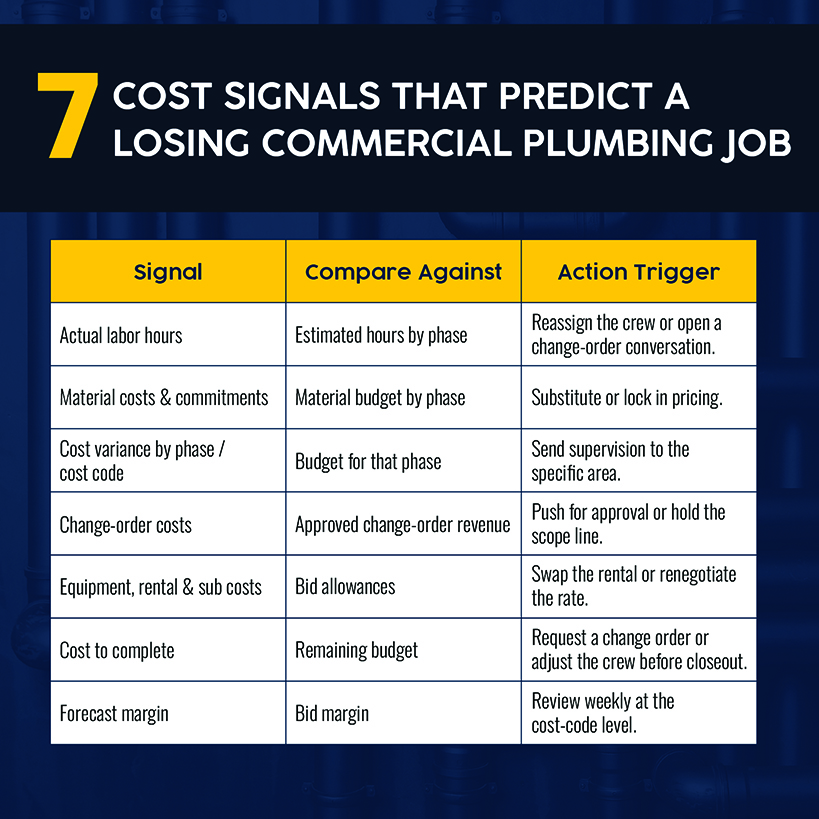
Not every line on a job-cost report deserves the same attention. Some move slowly enough that a monthly review is sufficient. Below are seven metrics you need to track in real time on each specific job. Each reveals something different about how a commercial plumbing project is progressing.
1. Actual Labor Hours vs. Estimated Hours
Some plumbing contractors track labor weekly against a single job number. Do this instead: Track labor hours on a daily basis, and code them to the phase or cost code. Most crews already log hours through mobile apps, which makes daily time tracking a habit and removes the challenge of adopting a new tool.
That said, encourage your technicians to be specific. A crew report that reads "40 hours on the downtown medical office job" tells you the spend rate. But "40 hours against a 32-hour estimate on level 3 east domestic water rough-in" tells you exactly where the estimate broke down.
Labor hours can drift across commercial job sites for many reasons, including many unaccounted for in the original bid, such as apprentice-heavy crews, unfamiliar logistics, stacked trades sharing a riser chase, or a foreman covering two areas at once. The Mechanical Contractors Association of America (MCAA) built its labor productivity factors to solve this problem. In most cases, a given loss has 3–6 factors, all additive. MCAA's worked example shows how fast they compound:
- 2,000 change-order hours
- 10% crew-size inefficiency factor
- 10% learning-curve factor
- 5% reassignment-of-manpower factor
- Total: 500 additional hours, or 2,500 total hours.
The operational fix: Compare actual hours against the estimate's unit basis for the specific phase, not the job total. An early variance points to one of three problems: productivity, scope, or crew composition. Each calls for a different response: Reassign the supervisor for a productivity problem, open a change-order conversation for a scope problem, or adjust the crew mix on the next floor before a composition problem recurs.
Related: Our guide to commercial plumbing project phases shows why labor variances trace to a specific stage instead of the whole job.
2. Material Costs and Commitments vs. the Material Budget
Two key numbers to track are what's been paid thus far and what's been committed. Mixing those up can be costly, especially on long-lead items like fixtures, carriers, specialty valves and backflow assemblies, which typically get bought early.
Job-cost reporting that doesn't recognize spend until the vendor invoice gets keyed in is typically lagging 30–60 days after delivery, and that lag is expensive right now. The July 2026 producer price index shows year-over-year gains of 12.2%, 18.4% for copper and brass mill shapes, and 22.5% for steel mill products. Assuming delivered material is already reflected in your cost-to-date is a specific trap the Construction Financial Management Association (CFMA) flags in its guidance on work in progress (WIP).
The operational fix: Every period, add up what's been delivered but not invoiced, as well as committed purchase orders (POs) that haven't posted. Compare the running total against the material budget for the relevant phase. The variance tells you whether you're facing a problem of price, quantity, or both — and whether there's room to substitute materials or lock in pricing before the rest of the order ships.
Related: Our guide to plumbing inventory management practices includes how to gain visibility into committed costs before the invoice arrives.
3. Cost Variances by Project Phase or Cost Code
Job-level costing can hide variance, especially on multi-crew commercial jobs where your people work on different systems at once. The blended figure might look fine, but it's masking a phase running 15% over budget because another phase is under budget. That averaging effect gets worse as the project adds phases and crews, which is exactly when cost-code discipline matters most.
CSI's MasterFormat gives commercial plumbing a ready-made structure:
- Underground sanitary and storm work
- Domestic water distribution
- Plumbing equipment and water heaters
- Fixture set, split between commercial and healthcare applications
- Lab gas and vacuum systems, when relevant
Go further and sub-code each of those by area and level. An overrun should localize to, say, "level 3 east domestic water rough-in" instead of "the hospital job."
The operational fix: Compare cumulative actual cost, by phase, against the budget for that phase. Update it whenever labor and material data come in. The variance tells you where to send supervision, so you don't waste time reviewing the whole job while still guessing where the problem lives. A superintendent who knows the underground phase is running hot on a run of cast iron can intervene immediately instead of auditing four phases.
4. Change-Order Costs vs. Approved Revenue
Reviewing change-order costs after the paperwork clears is a good way to miss work that's already completed, with no opportunity to recapture margin.
This happens because field crews often start work before paperwork is finalized. On a commercial job routed through a general contractor, plumbing technicians might rework piping before the change order is approved. The gap between incurred costs and approved revenue can widen further when the added scope disrupts a sequence planned around the original drawings.
If you aren't measuring productivity, you're less likely to predict the cumulative labor impact of change orders, much less prove what the change actually cost when it comes time to bill.
The operational fix: Track change-order hours and cost from day one, not from whenever the change order gets signed. Compare that running cost against approved change-order revenue (or pending revenue if nothing's signed yet). Use the gap to decide whether to push harder for a timely approval or hold the line on scope until you get sign-off.
5. Equipment, Rental and Subcontractor Costs vs. Allowances
Trench boxes, pipe threaders, fusion machines, lifts and welding rigs are cost centers on commercial plumbing projects, rather than overhead costs that fold into a general budget line. These cost centers are unreliable because a superintendent or foreman often books them directly with a rental yard, outside the normal purchasing process. The cost doesn't hit the job-cost report until the invoice arrives, usually weeks later.
Closing that gap requires pulling equipment managers, subcontractors and purchasing into the same data flow as job costing. Otherwise, accounting is solely responsible for tracking equipment costs, and you'll only find out after the fact.
The operational fix: Compare actual equipment, rental and subcontractor costs against the per-category allowance built into the bid. A variance here often shows up before other variances, as teams rent or subcontract equipment in response to a schedule problem. Catching it early gives you a chance to swap a rental for owned equipment, renegotiate a sub rate, or flag the schedule slip before it compounds.
6. Cost to Complete vs. the Remaining Budget
The first rule of calculating the cost to complete versus your remaining budget? Don't extrapolate from whatever burn rate you've seen so far. Instead, reforecast each job on its own merits: Measure the work completed, cost it accurately, and calculate what remains.
Then, factor in whether your cash on hand can cover the next phase, whether newly identified site conditions raise material costs, and whether your crew needs more hours or equipment than assumed under the original plan. If the figures don't match, you still have time to request a change order, adjust the crew, or make the call. Dealing with a problem early is far better than being surprised at closeout.
A 2025 study compared three project-forecasting methods — earned duration, earned schedule, and planned value — across 30 construction projects, including a commercial-project subset. Earned schedule was more accurate in the first 50% of projects, while earned duration outperformed after the 50% mark, especially for commercial and industrial projects.
The operational fix: Treat an early-project forecast as a signal to investigate a phase, not a number to act on by itself. The further into the job you are, the more reliable that signal will likely be.
Related: Our job costing formula breakdown walks through calculating cost to complete at the phase level.
7. Forecast Project Margin vs. the Margin You Bid
Profit projections on WIP reports aren't always accurate. In fact, a study spanning five years and thousands of audited contractor financial statements reveals a profit bleed of over 1%—especially significant compared with typical profit margins. At best, operating off of a monthly close won't catch this type of profit bleed until the job is nearly or completely closed.
A better way to track bid margin versus project margin is to bring stakeholders together. Every month, have your finance team and regional managers go over WIP reports together, with the managers discussing matters ahead of time with project leaders.
The operational fix: Forecast gross margin using current cost-to-complete data, rather than relying on the original bid's projected margin. Compare that forecast against what you bid, and review it weekly at the cost code level, feeding those findings into the monthly stakeholder review.
Related: This guide to plumbing profit margins breaks down what a healthy margin looks like by project type.
What Real-Time Plumbing Project Cost Tracking Should Look Like in Practice
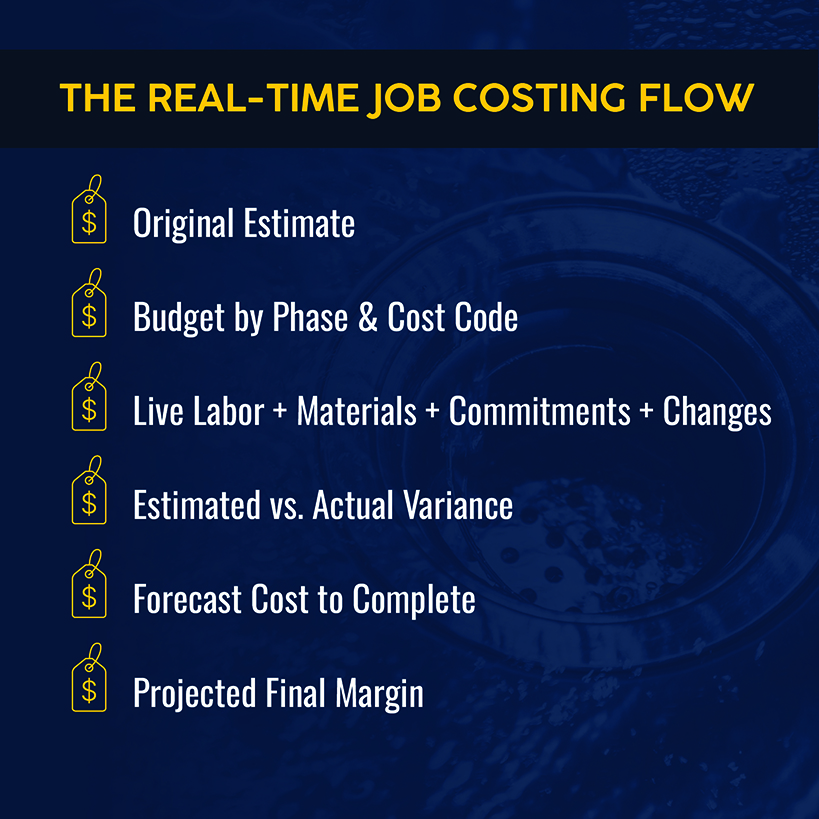
Good plumbing job cost tracking follows one flow with all data in a single system, rather than disconnected reports pulled from separate job costing software or spreadsheets. Each stage feeds the next:
- Original estimate
- Budget by phase and cost code
- Live labor, materials, commitments and change costs
- Estimated vs. actual variance
- Forecast cost to complete
- Projected final margin
Real-time job costing for plumbing contractors depends on the cadence, which varies by area. Labor and material commitments should update daily — if your system tracks one measure daily and the other monthly, you're making decisions on stale data. Variance, forecast and margin numbers, meanwhile, should roll up at least weekly.
Cadence matters much more for commercial work than for a routine repair call. You don't control the schedule on commercial projects. When the general contractor moves an inspection or a pour date, your project data needs to catch up quickly, not at the end of the month.
Simpro® structures project job costing around four areas: purchase order commitments, delivered-but-uninvoiced material accrual, subcontract commitments, and actual-versus-estimated hours by phase. All of it lives in one project management workflow, not three spreadsheets that are constantly out of sync. Simpro offers a QuickBooks integration that keeps data flowing into your accounting software without requiring re-entry, while real-time field reporting immediately surfaces changes in variance and forecast numbers so you can react quickly.
Use Real-Time Cost Data to Keep Plumbing Projects Profitable
Look at your latest job-cost report. When was it generated? If it's three weeks old, it's describing a job that no longer exists in the field.
Monthly-only cost tracking was built for a slower materials market and a less compressed bidding schedule, not for today's conditions. Simpro is built for trade and field service businesses that need the latest movements in labor, material commitments, change orders and margin. Simpro customers running project-based work have reported productivity gains of up to 30% once cost data stops lagging the job by weeks.
To build and maintain a stable, profitable plumbing business, you need a system that helps you protect margin while the project is still running, not after the fact.
Schedule a demo to see how Simpro handles job costing on commercial plumbing projects.


 Back to top