
A facility manager reading your maintenance proposal checks one thing first: Will you be the reason their building shows up in next year's compliance report — or the reason it doesn't? That's the test for how to win commercial plumbing maintenance contracts, and it has little to do with your price sheet.
The buyer might be a hospital engineering director who needs backflow test records on file, a facility manager overseeing a Legionella water management plan, or a federal contracting officer scoring your proposal against a performance work statement. All three want proof you can run a compliance program and document it every month.
This guide walks through the eight steps plumbing contractors use to land recurring commercial maintenance work instead of chasing one-off service calls. Learn which opportunities to target, how to qualify and scope them before pricing the visit, and how to write a proposal that centers you as the lower-risk choice, not just the cheaper one.
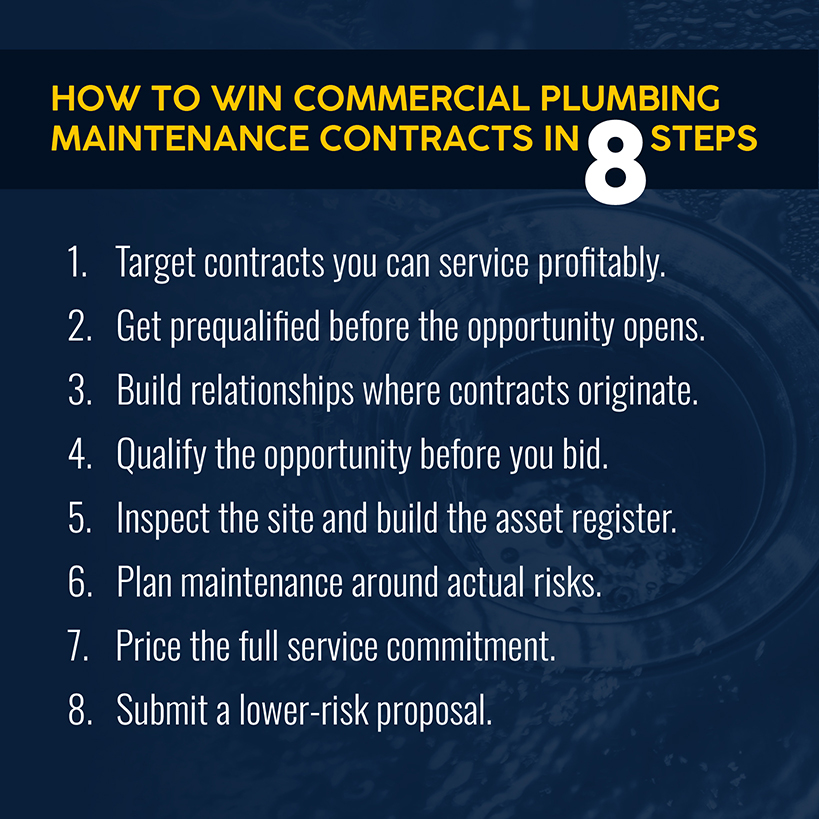
How to Win Commercial Plumbing Maintenance Contracts in 8 Steps
The eight steps below mirror how an opportunity moves through the cycle, from picking your ideal customer to securing a signed agreement. Skip one, and you'll waste hours bidding work that's either a bad fit for your services or that you can't reliably make money on.
1. Target Maintenance Contracts Your Business Can Service Profitably
Not every account is worth chasing. Some commercial properties, like a single-tenant office with two restrooms and one water heater, will never generate enough recurring revenue to justify a maintenance contract. Start by identifying which commercial buildings in your market have the plumbing system density that makes recurring service worthwhile.
Water use is a decent proxy for density. The commercial and institutional sector accounts for 17% of withdrawals from public water supplies. Within that sector, hotels and food service combine for roughly 30% of use, with offices at 9%, healthcare at 7%, and education at 6%. Compared with office buildings, hotels, restaurants, and healthcare facilities carry more fixtures and backflow devices. Meanwhile, food service has higher grease loads per square foot. All of this means more billable tasks per site and a stronger case for a multi-year agreement.
The operational fix: Before prospecting, write down your ideal contract. Decide on minimum building size, your target verticals, a geographic radius that protects margin against drive time, and a minimum annual contract value. That sets you up for commercial plumbing maintenance that's profitable and recurring, rather than a lucky one-off.
2. Get Prequalified Before the Contract Opportunity Opens
Most institutional buyers and nearly all government buyers work from an approved vendor list. As a commercial plumber, your business license, certificate of insurance, bonding capacity, and safety documentation need to be on file with a property management company, hospital system, or municipal procurement office. Otherwise, you won't even see the request for proposal (RFP), let alone get invited to bid.
Build a standing prequalification packet that includes:
- Current insurance certificates
- Proof of workers' compensation coverage
- Trade licenses for each technician on the contract
- Backflow tester certification numbers
- References from comparable accounts
Update this list before it expires instead of scrambling after a procurement office asks. Larger portfolios and public agencies often run a vendor registration process, with its own renewal cycle. Missing that cycle means sitting out a bid round, regardless of how strong your proposal would have been.
3. Build Relationships Where Commercial Maintenance Contracts Originate
Knowing how to get plumbing contracts in the commercial space is all about relationships. Opportunities originate well before the RFP, and in a small number of predictable places:
- Property management companies budgeting for the next fiscal year
- General contractors handing a building off after occupancy
- Facility engineers at hospitals and campuses who control the day-to-day vendor relationship
- Association chapter meetings where those same buyers compare notes on contractors.
You need to get in front of these buyers early. Property and facility organizations plan maintenance budgets on annual cycles, and they look to contractors they already know when writing a specification.
Ask existing commercial customers to introduce you to the property managers who oversee their other buildings. Building relationships inside a management company can unlock access to many buildings over time, turning what would be a one-off into steady commercial plumbing services work and longer-term contracts.
4. Qualify the Opportunity Before You Spend Time Bidding
Not every posted opportunity is worth a proposal. Before your team invests hours building a bid, run it against the standard you set in step one. Does the building match your target vertical and size? Does the timeline give you enough runway to build a real scope instead of a guess? Is the incumbent contractor entrenched, or is this a genuine rebid?
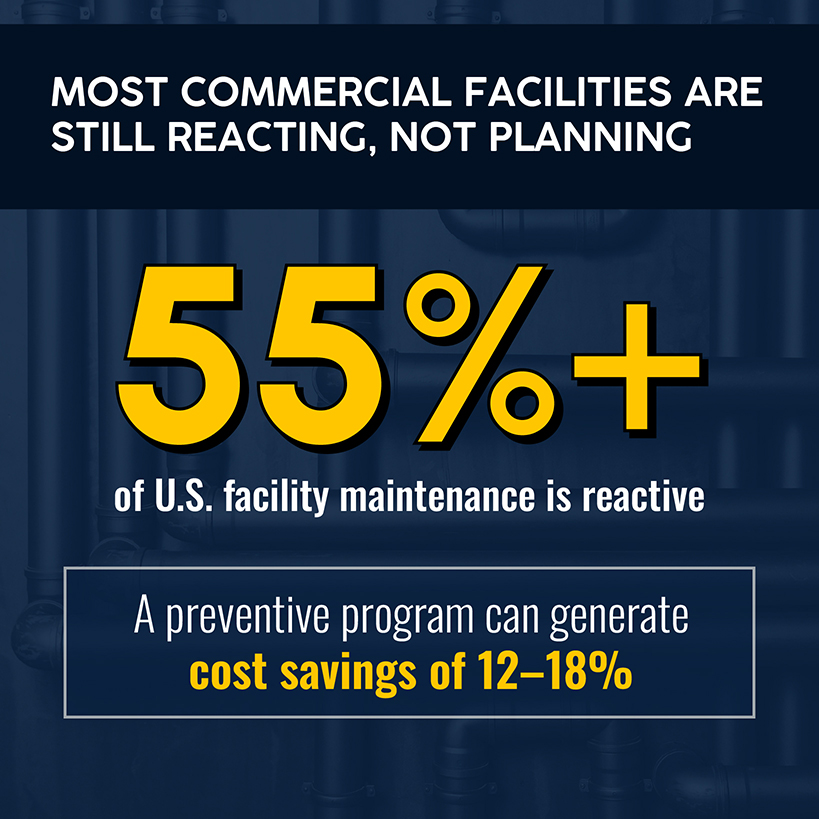
Here's an essential diagnostic question: How reactive is this building's maintenance history? Federal data historically indicates that the average facility maintenance program is more than 55% reactive maintenance, 31% preventive, and 12% predictive. A mostly reactive building running presents the strongest financial argument for switching.
That same federal data suggests that preventive maintenance generates 12–18% cost savings over a reactive program. During the qualifying conversation, try to get even a rough estimate of the prospect's last 12 months of emergency service costs. Then, compare that number to what a scheduled contract would cost.
The operational fix: Build a one-page bid/no-bid scorecard that covers vertical fit, size, timeline, incumbent status, and reactive-spend evidence. Score each opportunity against it before building the proposal.
5. Inspect the Site and Build the Maintenance Scope Before Pricing
You can't price what you haven't counted. Use the site walk to build the asset register that guides the entire contract. Examine every mechanical room, the roof, the kitchen, and more. Log each piece of covered equipment, including backflow assemblies by make, model, and serial number; water heaters and their mixing valves; grease interceptors and their rated capacity; sump pumps; and any fixture group large enough to warrant its own line.
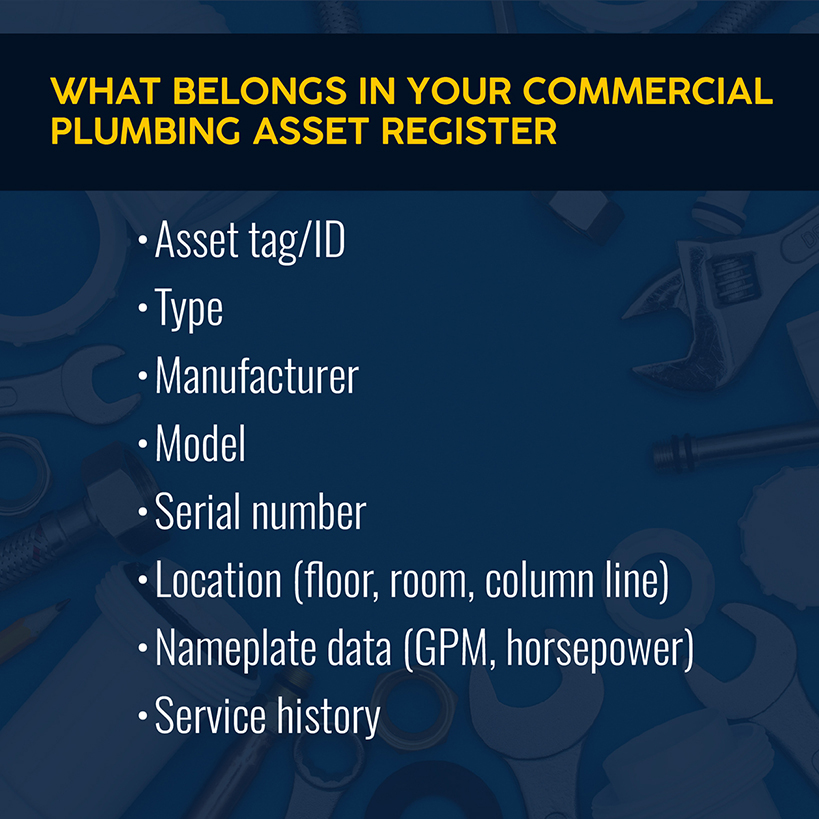
The General Services Administration (GSA) maintenance specification offers an example of the detail required. It calls for contractors to provide an asset management plan within 60 days of contract start. At a minimum, required data fields include asset tag, type, manufacturer, model, serial number, and location, including the floor, room, and column line.
When you follow such guidelines and show up with a tagging method and a workflow for mobile data capture, you're demonstrating your capability even before winning the deal.
The operational fix: Photograph everything as you go, and tie each photo to the asset it documents. Months later, when a technician schedules the first service visit, that record ensures the scope is accurate.
6. Build a Preventive Maintenance Plan Around the Customer's Actual Risks
Commercial plumbing systems face a handful of pressure points when it comes to risk and regulation. Build your maintenance plan around what applies to the jobsite, not a generic checklist. Three common drivers are:
- Legionella risk. Warm, stagnant water in cooling towers, hot tubs, decorative fountains, and large domestic hot water loops is where Legionnaires' disease outbreaks originate. The Centers for Disease Control and Prevention (CDC) reports that about 1 in 10 people who contract the disease die, and that climbs to roughly 1 in 4 for sufferers in healthcare environments. Over a 15-year period, the CDC found at least one water-system maintenance deficiency whenever it had sufficient information to investigate.
- Backflow compliance. Cross-connection control ordinances vary by jurisdiction. At the federal levels, EPA's model ordinance sets a semiannual testing interval for reduced-pressure-principle devices, while GSA defaults to annual backflow-prevention testing in the absence of local requirements. Confirm applicable regulations before you write the schedule into the contract.
- Grease (fats, oils, and grease). Grease remains the biggest cause of reported sewer blockages, at 47%. Left unmanaged, it causes clogged drains long before a full blockage. Clearing drains often requires high-pressure jetting, not just a routine pump-out. Any building with a commercial kitchen needs to pump grease traps or interceptors on a frequency based on actual generation data.
The operational fix: For any building requiring a water management plan, structure your maintenance plan around the CDC's water management framework. Assemble a team, describe the system, and identify hazards. Then set control limits, define interventions, and verify results while documenting every step. Each maintenance visit contributes to the paper trail required for the customer's compliance program.
7. Price the Full Service Commitment, Not Just Scheduled Visits
Price the contract by task and asset. List each recurring task against the relevant equipment, along with frequency, reference standard, labor minutes, and materials. For example, each of these is a separate line item and cost:
- A quarterly grease interceptor pump-out
- Four semi-annual backflow tests
- A monthly temperature and disinfectant log
Price each individually rather than folding them into one lump maintenance visit fee.
Build your labor rate from the ground up rather than relying on a vague market rate. Account for payroll burden, nonbillable time, supervision, vehicle and tooling costs, and relevant certifications and recertifications, including backflow tester credentials.
The Department of Energy found that every dollar invested in operations and maintenance (O&M) measures saves $3.83 — roughly 20 times more than the savings from capital retrofit projects. That's just one more reason to give a properly loaded rate to a buyer.
Whichever format you use, don't bury your findings in your base price. When a technician finds a failing pressure relief valve, a water heater past its service life, or sewer lines needing a camera inspection during a scheduled visit, those become quoted change orders, not absorbed labor.
A reminder: Maintenance pricing is separate from larger commercial and construction-scale plumbing work, which adds its own takeoff quantities, subcontractor scope, and bid risk.
Related: Simpro® offers a free plumbing bid template that breaks labor, materials, and payment terms out by category, saving you from rebuilding proposals from scratch every time.
8. Submit a Proposal That Makes You the Lower-Risk Contractor
Most contractors that submit bids can technically perform the work. What separates the winners is whether they feel like a safe choice.
Help your cause by writing service level agreements (SLAs) that the buyer can audit, such as: tiered response times by priority, a named escalation contact, and a monthly report covering completed visits, open findings, and asset condition trends. Then, build your operation so you can hit those numbers.
Your deliverable should offer proof of what the buyer will receive, not just a list of tasks. For example, a grease interceptor pump-out schedule comes with a manifest. A Legionella monitoring visit generates a temperature and disinfectant reading that gets logged against a limit.
Emphasize qualifications, not just price. If you've properly targeted your ideal buyer, they're looking for more than just the cheapest option.
Related: Simpro's guide to bidding commercial plumbing jobs walks through takeoffs, labor costing, and commercial bidding risk for teams still building this muscle.
What Should a Commercial Plumbing Maintenance Contract Include?
A plumbing maintenance contract is only as strong as the documentation. At a minimum, put these five elements in writing:
| Element | What it covers |
|---|---|
| Scope of work | Each covered system and piece of equipment, broken out by asset, each with tasks and frequency listed |
| Service level agreement | Response times by priority, named escalation contact, and what counts as a missed visit |
| Pricing and payment terms | Rates for scheduled work, how change orders are quoted, billing frequency, and late payment terms |
| Reporting cadence | What gets documented after every visit and how often the customer receives a rollup report |
| Renewal and cancellation terms | How pricing adjusts at renewal, and the notice window for either party to exit |
Disputes over commercial plumbing maintenance are often about vague terms. A scope that says "maintain plumbing systems" instead of naming the covered assets gives both sides room to disagree about what's included.
Manage Commercial Plumbing Maintenance Contracts With Simpro
Running a maintenance contract is an operations problem. Simpro is built to run your maintenance program from end to end, from the site walk to the monthly report.
The Maintenance Planner add-on lets you assign service levels and testing frequency to individual assets, ensuring your team's recurring jobs originate from the schedule built during your site walk, not a stale spreadsheet.
Field technicians can scan a barcode or QR code on-site to pull an asset's service history, log test results, and attach photos. The compliance record gets built during the visit instead of getting reconstructed from memory later.
Job costing tools give you a real-time view of estimated versus actual cost on every maintenance task, so the margin you built into your pricing in step seven is the margin you keep.
More than 24,000 businesses run their operations on Simpro, including Heron Plumbing, a commercial and residential plumbing business. Heron needed a system that could handle maintenance jobs, larger contracting work, and multiple cost centers. Nine years after implementing Simpro, the company has tripled its turnover without adding office staff, freeing up their team for safety audits instead of paperwork.
Win Contracts You Can Keep Profitable
If you're bidding on commercial maintenance work, look beyond price. Can you prove your capability without being asked, document what happened at every visit, and price your services so the contract is still worth having in year two?
Top-performing contractors show up to the site walk with an asset register already built. They write a scope that the buyer's compliance team can audit, and they price the commitment instead of just the visits they can see coming.
You can build a successful operation by hand, on spreadsheets and paper, for a few contracts. You can't do it for 10 sites or dozens of sites. Simpro gives you the maintenance scheduling, asset records, and job costing to scale your business without losing the documentation that won you the contract.
Schedule a demo to see how it runs on your next proposal.


 Back to top