
Quick Answer: The 10 plumbing inventory management best practices are: build a master inventory list, organize stock by category and location, set min/max thresholds, standardize truck stock, treat each van as its own inventory location, tie parts to job costs, use barcode scanning, log materials at job closeout, run cycle counts, and automate reorder alerts. According to IFS research, 41% of service leaders cite missing parts as a top driver of repeat visits — each incident costing roughly $285 in downtime and disruption. These practices close that gap across warehouse, van, and jobsite.
A tech drives 40 minutes to a water heater swap, pulls a flex connector from the van, and finds the shutoff valve on the truck is the wrong size. Half an hour later, they're back from the supply house. The job gets done, but you just burned two hours of billable time on a parts problem that shouldn't have happened.
Multiply that across a 10-truck fleet running five calls a day, and the effects of not following plumbing inventory management best practices become clear: unbilled labor, emergency supply runs, and parts that go unlogged and end up buried in overhead rather than COGS.
This guide covers the 10 practices that close those gaps, with concrete steps for how to manage plumbing inventory from supplier to warehouse, truck to jobsite, and every handoff in between.
Related: The plumbing industry stats you need on technician productivity, stockout costs, and how much the average plumbing company loses on parts-related delays.
What Is Plumbing Inventory Management?
Plumbing inventory management is the systematic process of tracking, ordering, storing, and deploying materials: pipes, fittings, valves, fixtures, water heaters, and consumables across every location your business operates. That means your warehouse, every service van, and active jobsites.
Knowing how to track plumbing inventory starts by documenting what you have, where it is, and when to reorder. At scale, it means every fitting pulled from a van shelf is tied to the job that consumed it, reorder alerts fire before a critical item hits zero, and your estimated material costs are built from current supplier pricing instead of memory or last quarter's price list.
The problems that surface when plumbing business inventory management breaks down fall into three categories.
- Stockouts and return trips. A tech arrives at a job without the right part. They make a supply house run, or the job gets rescheduled. IFS research finds that 41% of service leaders cite missing parts as a top reason for repeat visits. Let's say each incident costs $285 in technician downtime, return trip expenses, and scheduling disruption. A company experiencing 15–25 of these incidents per month absorbs $51,300–$85,500 in direct annual cost.
- Excess and dead stock. You get no return from slow-moving inventory that languishes on shelves or inside vans. Inventory carrying costs can run up to 25% of total inventory value, while the rule of thumb is that 20–30% of inventory is dead or out of date.
- Invisible material leakage. Parts get used on jobs but aren't logged to them. They show up in overhead rather than in job-level cost of goods sold (COGS), which not only compresses margins on individual jobs but also hides them until someone pulls a detailed job cost analysis. By then, the damage is done.
The 10 practices below address all three of these common challenges.
10 Plumbing Inventory Management Best Practices for Better Tracking And Control
These practices build a connected system, from what you stock and how it's organized, through how it moves to the field and how it ties back to job cost. They're ordered to build on each other, not to rank in importance.
1. Build a Master Plumbing Inventory List
Before you can track inventory, you need a complete record of what you carry. That means a SKU-level list for every item your business stocks regularly. The list should include item name, description, unit of measure, unit cost, preferred supplier, storage location, and reorder threshold.
List Items exactly as they appear on supplier invoices. When a ball valve is cataloged three different ways across purchase orders (POs), you create duplicate records that lead to phantom stock counts and missed reorders. Vendor-aligned naming prevents the "we have it in the system but under a different name" problem before it starts.
The operational fix: Pull your last three months of purchase orders and cross-reference them against your inventory system. Note every line item that appears on invoices but isn't in the system — those are gaps that drain margin.
2. Organize Inventory by Category, Usage, and Location
Group your inventory so it maps to how your techs work. Common structures include:
- By product line (fittings, valves, fixtures, water heaters)
- By job type (service vs. install vs. repair)
- By storage location (warehouse shelf, van 1, van 2)
For the warehouse, label bins with part names and SKUs, not just item codes, as those require a separate lookup. For vans, a first-grab system works well. Place the highest-frequency items (compression fittings, shutoff valves, Teflon tape) near the side door; bulkier or job-specific materials go farther back.
Standardize bin labels and van layout across all trucks. Any tech should be able to pull from any vehicle without a 10-minute hunt.
The operational fix: Walk through one van with your most experienced tech, and let them organize it from scratch. That layout becomes your template. Photograph it, build a check sheet, and replicate across the fleet.
3. Set Minimum and Maximum Stock Levels
For every regularly used item, define a minimum quantity threshold. Stock falling below that number should trigger a reorder — automatically if your system supports it, or manually via a standing weekly review.
The formula: (Average daily usage × supplier lead time in days) + safety stock = reorder point (ROP).
Set minimum stock levels in your plumbing software so the alert fires before you're caught short.
Here's an example: A ball valve used 10 times per week with a three-day supplier lead time needs a minimum threshold of approximately seven units on hand before reordering. Restock-to quantity might be 20.
Moving from visual checks to automated threshold alerts can significantly reduce stockouts, while adding demand forecasting reduces them further. As you move from manual checks to automated systems, you can measure the decline in stockouts and see the difference.
The operational fix: Set minimums and restock quantities for your top 50 SKUs this week. Those 50 line items should account for roughly 80% of your parts volume, so adding automation covers most of your exposure.

4. Standardize Truck Stock for Every Service Vehicle
Each service van should carry the same core stock. Every tech should be able to access any van and find it loaded and organized in the same way.
Standard residential service van stock typically includes compression fittings across common sizes, ball valves and angle stops, supply lines, wax rings, fill and flush valves, drain assemblies, P-traps, Teflon tape, pipe dope, and common copper fittings. Adjust based on your call mix.
Separate long-term van stock (what's always there) from job-specific materials staged for particular calls. Mixing them makes it harder to track what came off the truck versus what was preloaded for a specific job.
The operational fix: Build a standard van stock list for your most common call type. Load it into your inventory system as a template. Techs should restock against that template at the end of each shift.
5. Treat Each Truck as Its Own Inventory Location
The van is a mobile warehouse. Track it just as you would a warehouse: items in, items out, and reconcile after each shift.
Treating each vehicle as a warehouse-like location unlocks field-level demand data. You can see which tech burns through PVC fittings fastest, which vans consistently run short on shutoff valves, and whether your standard van loadout matches in-the-field demand. That data, plus human judgment, leads to smarter reorder quantities and more accurate estimates over time.
The operational fix: In your inventory system, create a separate storage location for each truck. Assign your standard van stock to each vehicle and require a daily reconciliation, either at the end of the current shift or the beginning of the next one.
6. Track Parts From Supplier to Warehouse, Truck, and Job
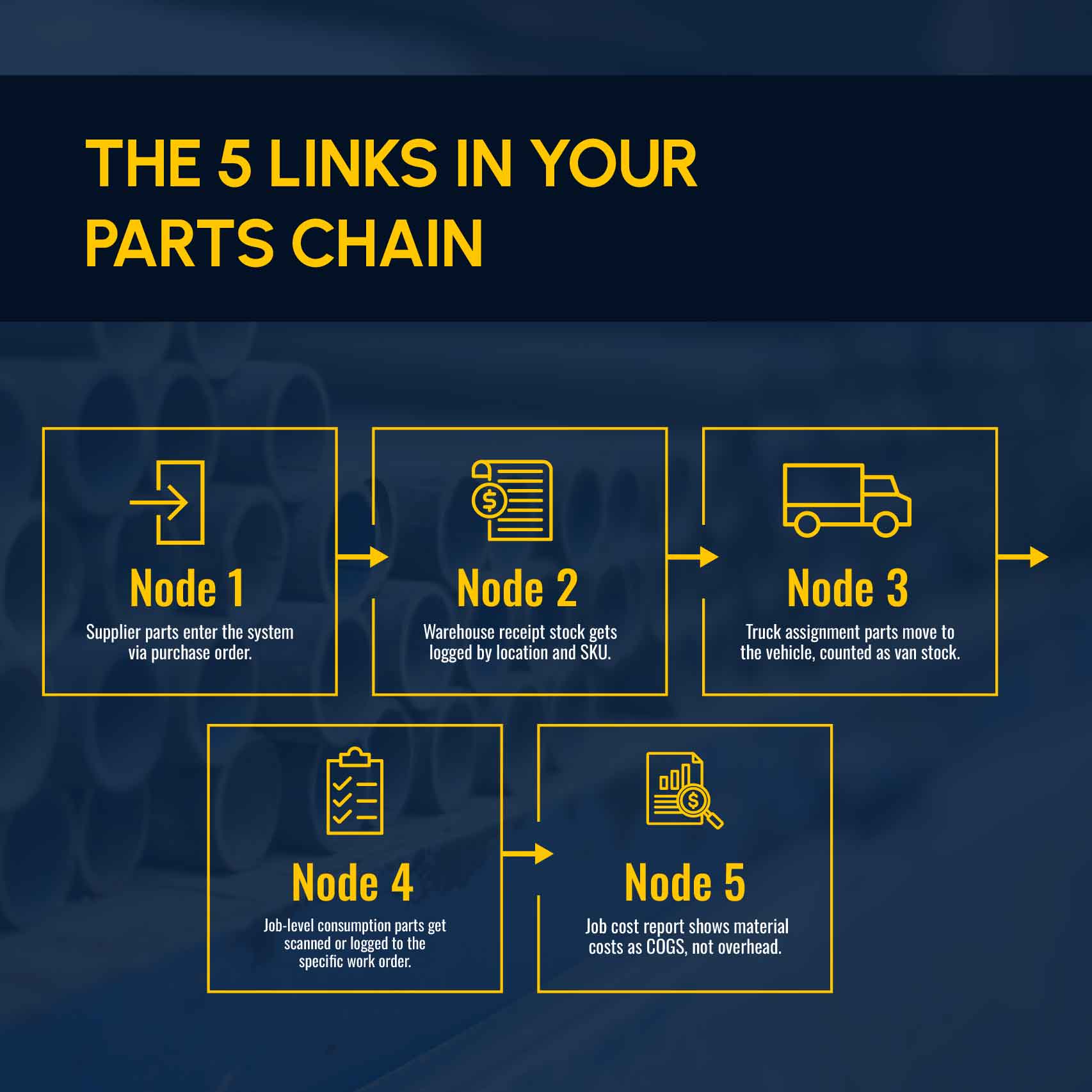
The full chain matters: Supplier → warehouse receipt → truck assignment → job-level consumption.
When any link breaks, you end up with inaccurate inventory counts or parts costs that never appear on job records.
The job-level connection is where parts hit the P&L. Every part used on a job should be logged against that job's work order. Doing so gives you real job costing instead of blended margin numbers that hide which job types are profitable. Over time, your estimates for future similar jobs get sharper.
For a plumbing company running 10 trucks and 25 service calls per week, unlogged parts represent thousands of dollars per month that appear as overhead instead of job cost.
The operational fix: Audit five recently completed jobs. For each, compare the materials listed on the job record against the supply house invoice or warehouse withdrawal log. The gap represents your current leakage.
7. Use Barcode or QR Code Scanning When Possible
Research into warehouse inventory data entry finds manual error rates run from 15–37%. Barcode scanning brings that down to as little as 0.1%. For a busy service operation, barcode scanning can eliminate dozens of mistaken parts orders and incorrectly logged jobs per month — preserving margin with each save.
Apply barcodes to warehouse bin locations and van stock. Have techs scan parts when adding them to jobs, performing van counts, or transferring stock between locations. Most field service mobile apps support barcode scanning via a smartphone camera or Bluetooth scanner, without requiring dedicated hardware.
The operational fix: Start with your top 20 most-used items. Print labels, apply them to bin locations in the warehouse and on each van, and configure your field app to scan them. Once techs see how fast counts are, they quickly adopt the broader system.
8. Log Material Usage as Soon as the Job Is Complete
Inventory data degrades quickly. A tech who logs materials after each job will avoid mistakes and provide fresh data. Techs who only log weekly are relying on unreliable memory across dozens of jobs.
What real-time logging means: When the job wraps, used materials get entered into the mobile app before the tech drives to the next call. This closes the loop between field consumption and back-office records, as inventory updates get sent before the tech can forget, approximate, or skip.
Dispatchers can reinforce this: Don't assign the next call until the current job closeout is complete, including materials used.
The operational fix: Add a materials confirmation step to your job closeout workflow. If your field app supports it, make it a required field before the tech can mark the job complete.
9. Use Cycle Counts Instead of Relying Only on Annual Audits
A single annual physical count is the weakest form of inventory control. It's slow, disruptive, and immediately out of date. Cycle counts on a weekly or monthly schedule will catch errors and shrinkage early, without shutting down operations.
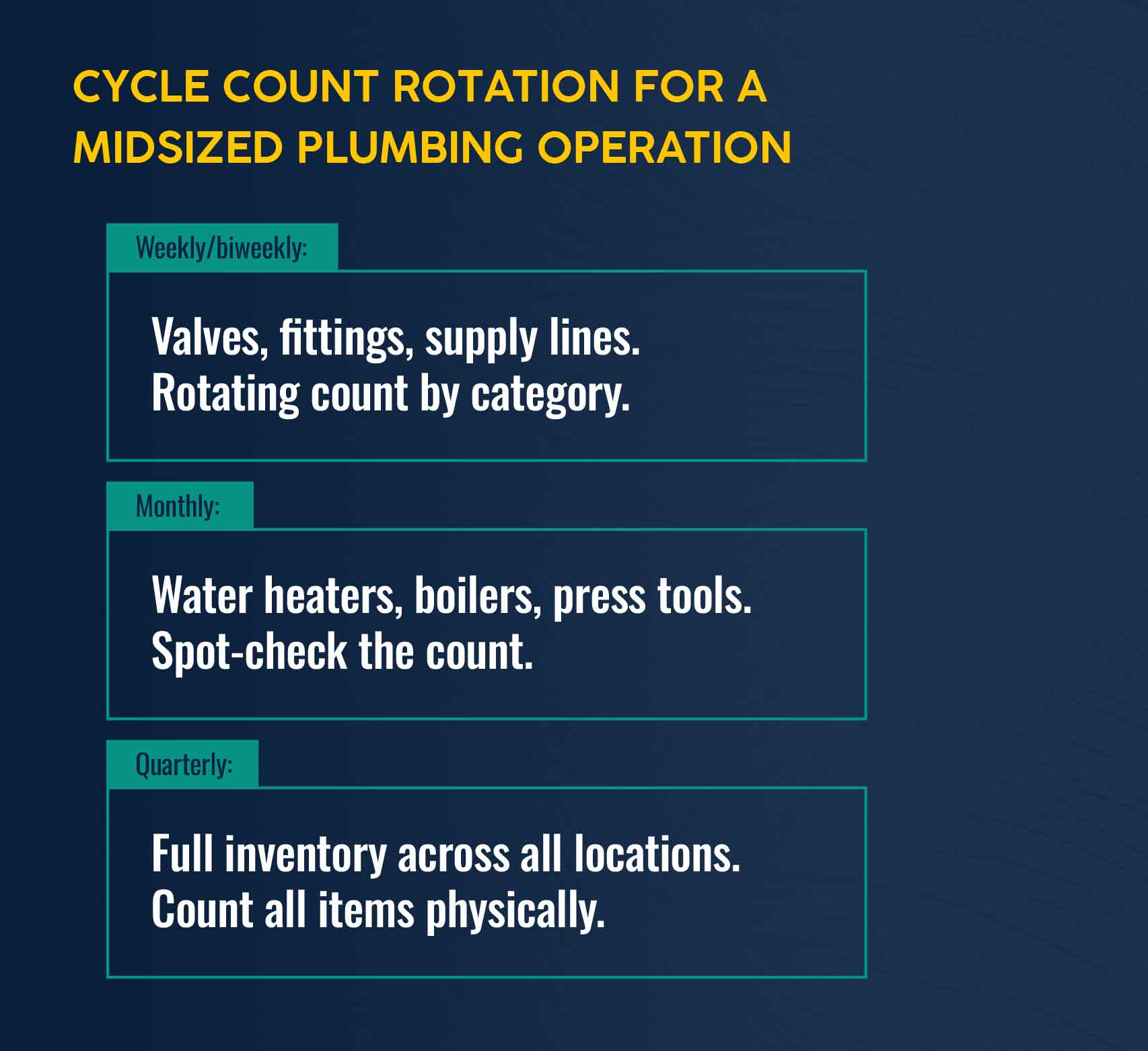
A workable rotation for a midsized plumbing operation:
- Weekly or biweekly, rotating by category: Common service parts (valves, fittings, supply lines)
- Monthly spot check: High-value items (water heaters, boilers, press tools)
- Quarterly: Full physical count
Consistently accurate Inventory counts ensure that reorder triggers fire at the right time, inventory levels stay current, and estimates rely on real numbers.
The operational fix: Block 20 minutes each Friday for a rotating cycle count across one item category. After four weeks, you'll have reviewed every major SKU at least once.
10. Automate Reorder Alerts and Purchase Orders
Manual reordering is the weakest link in most plumbing inventory setups. The wasted time on each order adds up fast: Visual checks are inconsistent, spreadsheet reviews get skipped, all while the person responsible juggles five other things.
The solution is automated low-stock alerts that fire when inventory reaches minimum thresholds. Look for inventory systems that pre-populate a PO with the restock quantity, supplier, and current catalog price. Your procurement person reviews and approves instead of building the order from scratch.
The time savings add up: Automated reorder processes can cut procurement admin time from an hour to mere minutes per order. TEAMWired saw "a significant reduction in missing parts because we plan a week at a time," said owner Jennifer Lambert.
The operational fix: Identify five items you've run out of in the last 90 days. Set automated low-stock alerts for those first, then expand the list.
Related: Plumbing management tips: How operations teams use connected workflows to reduce admin, tighten job costing, and scale without adding headcount.
What Plumbing Inventory Should You Track?
These are the standard item categories that residential and light commercial plumbing operations should have in their inventory system.
| Category | Common items |
|---|---|
| Fittings | Compression fittings, push-fit connectors, couplings, elbows, tees |
| Valves | Ball valves, gate valves, angle stops, shutoff valves |
| Pipe and tubing | Copper pipe, PEX, CPVC, PVC, flex connectors |
| Drain and waste | P-traps, drain assemblies, cleanout plugs, ABS fittings |
| Fixture parts | Wax rings, fill valves, flush valves, cartridges, aerators |
| Water heater components | Expansion tanks, T&P relief valves, anode rods, flex connectors |
| Sealants and consumables | Teflon tape, pipe dope, plumber's putty, flux, solder |
| Tools and equipment | Press tools, pipe cameras, leak detectors, threading machines |
Track tools and equipment in the same system as materials. When press tools walk off jobsites without accountability, the replacement can run into the thousands — a surprise expense most businesses can't afford.
How Plumbing Inventory Software Helps Growing Businesses
Plumbing businesses with two or three trucks can manage inventory on spreadsheets. When you have 5+ vehicles and a warehouse with real inventory volume, manual approaches break: Counts don't get done, reorders get missed, and parts costs stop flowing to jobs consistently.
Even generic software solutions have limits. Plumbing contractors using such software run into the same problems: Inventory tracking stops at the warehouse door, parts usage never flows to job cost, and the margin visibility problem persists.
The best plumbing inventory management software connects these best practices to a single workflow. The platforms worth evaluating give you real-time tracking across multiple storage locations (warehouse and each truck), low-stock alerts with automatic PO generation, supplier catalog integration so your estimates pull from current pricing, barcode scanning from the field via mobile app, and native job costing that ties parts consumption directly to work orders.
Improve Plumbing Inventory Management With Simpro
You can run these 10 practices off spreadsheets until your fleet grows, your warehouse becomes more complex, or you're losing enough on stockouts and unlogged parts that the cost can't be ignored. At that point, you need a system that connects inventory to the rest of your operation.
Simpro® is field service management software that's purpose-built for the trades and used by over 24,000 businesses. It tracks inventory across the full chain: supplier catalog → purchase order → warehouse receipt → truck assignment → job-level deduction → job cost report.
Technicians scan parts in the field, low-stock alerts fire automatically, and every fitting logged to a job shows up as a cost on the job breakdown — not as overhead. Operations that use the Simpro inventory module report up to 30% productivity gains from eliminating manual tracking and procurement time.
Your parts themselves aren't the problem. It's knowing their location and actual cost that determines whether your margins hold up at volume.
Schedule a demo to see how Simpro connects inventory, field operations, and job costing in one platform.


 Back to top