
A mechanical room wall can hide a leak's warning signs for months before anyone notices. That's the type of problem a plumbing maintenance schedule should catch before it sends water bills soaring or leads to water damage and an insurance claim.
Ordinary plumbing problems — a lapsed backflow certificate, hidden leaks, or an interceptor pump left unchecked — are much easier to catch at 10 accounts than at 200 accounts, especially when you're relying on spreadsheets, manual scheduling and people's memory. Managing recurring commercial plumbing maintenance at scale requires a better system, one that won't fail just because a couple of technicians call in sick or because no one flagged an expiring backflow certification.
This guide shows you how to develop a maintenance program that functions at 50, 200, or 2,000 sites. The foundation? A structure of asset records, recurring service rules, and maintenance plans that are built to keep working as the business scales.
Build a Plumbing Maintenance Schedule That Can Scale
For a single site, a maintenance schedule is little more than a professional plumber's list of tasks and dates. For a large portfolio, you need a set of independent compliance clocks, because the underlying obligations aren't on one cycle or under a single authority.
A single mixed-use building can owe the following all at once:
- An annual backflow assembly test to the water purveyor
- A 90-day grease interceptor pump-out, documented with a hauler manifest
- A monthly water management program monitoring event that's tied to Legionella control
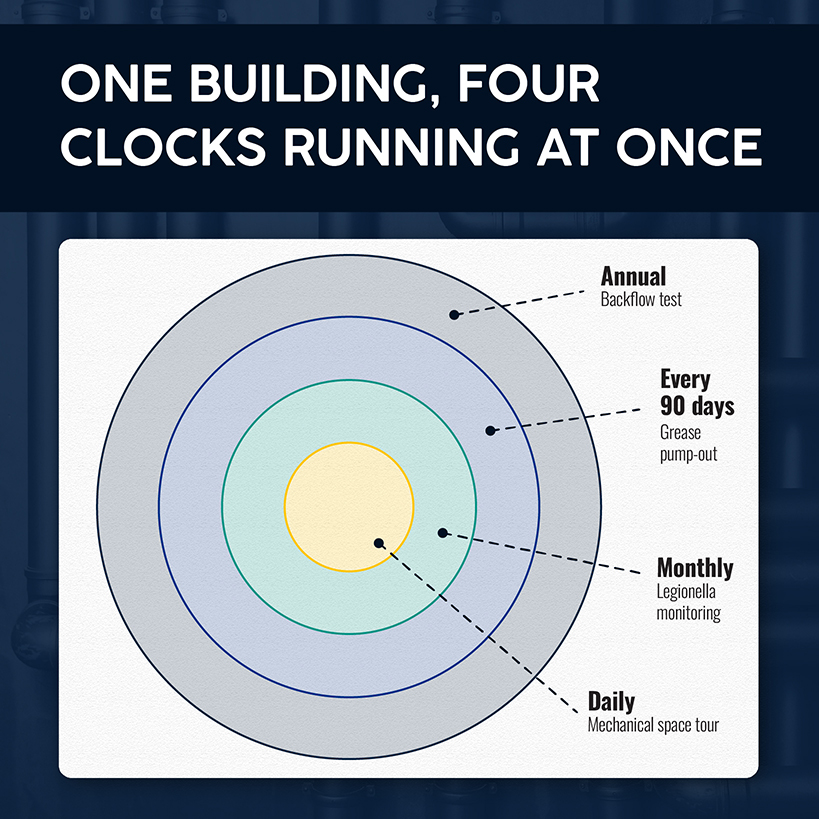
At the portfolio level, plumbing planned maintenance is more than a single calendar. It's dozens of independent timers running in parallel. Most plumbing work is built on ANSI/ASHRAE Standard 188, which sets minimum legionellosis risk management requirements for building water systems and uses enforceable language that's easy to translate into regulations.
Federal and state governments have adopted that standard in different ways. The Centers for Medicare & Medicaid Services has applied it to water management policies at Medicare-certified facilities since 2017. Michigan applies Standard 188 to health facilities, while New York requires cooling tower programs to comply with it.
Backflow prevention runs on its own compliance clock. Backflow assemblies protect the water supply from cross-connection. While many states set annual testing as the baseline, requirements vary by jurisdiction. In Minnesota, for example, assemblies must be tested on installation and at least annually thereafter by a tester certified to ASSE Standard 5110, with written records sent to the local authority and water purveyor within 30 days.
Related: This plumbing inspection checklist covers the task-by-task detail for each fixture type and system. What follows is the structure for managing dozens of individual schedules across a portfolio.
How to Manage Recurring Commercial Plumbing Maintenance at Scale
Below are nine pieces of operational infrastructure that make preventive plumbing maintenance repeatable, not reactive. Each step closes a scheduling gap, and many established contractors are using some of these in some form.
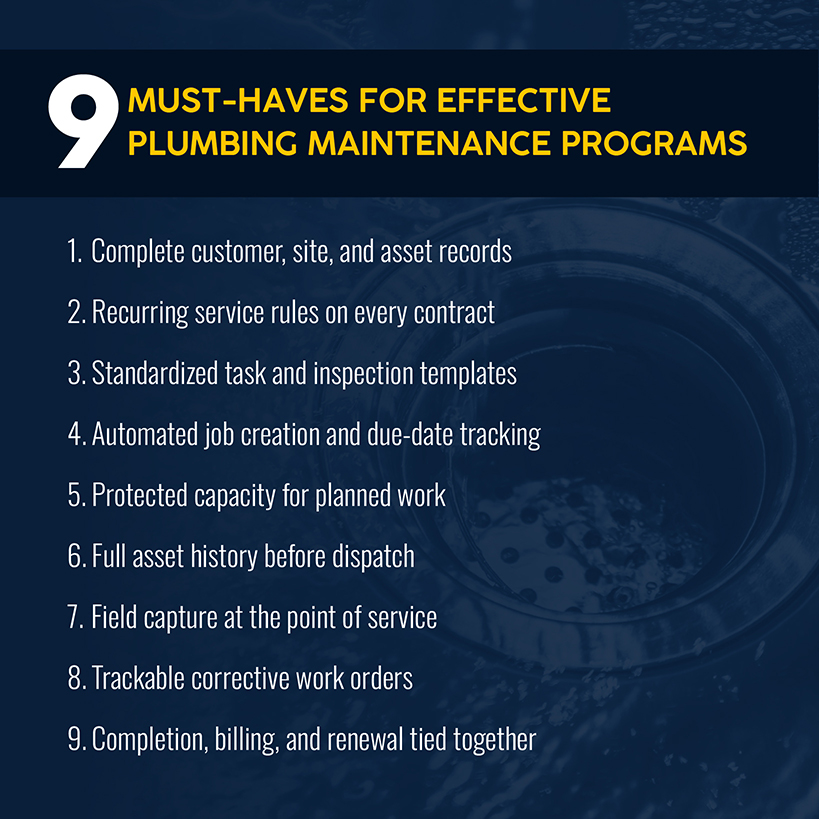
1. Create a Complete Record of Every Customer, Site, and Plumbing Asset
The Department of Energy's Federal Energy Management Program recommends that facilities build an inventory of water-using activities, walking each site to capture operating schedules, flow rates, model numbers, and equipment condition. Facilities should pay particular attention to drain lines in mechanical spaces and trace them to the equipment feeding them.
At portfolio scale, you need to build a hierarchy — site, building, system, and asset — that covers sewer lines, backflow devices, grease interceptors, and water heaters. Document every asset by make, model, serial number, install date, and compliance interval.
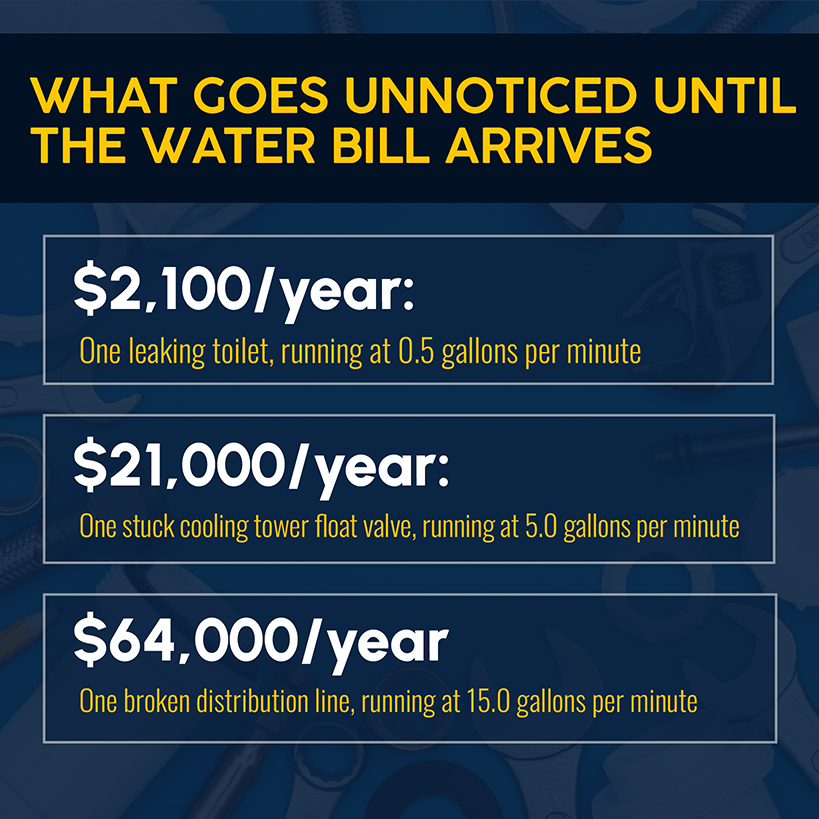
Don't overlook small leaks like toilets. A toilet leaking a half-gallon per minute can waste 21,600 gallons a month and cost roughly $2,100 a year, according to EPA WaterSense leak-cost modeling for commercial buildings. Track those as a line item rather than folding it into a blended bill. Doing so saves money because the cost shows up while it's still small.
2. Turn Each Maintenance Contract Into Clear Recurring Service Rules
A maintenance contract bundles multiple cycles that happen to bill under the same agreement. Make sure the frequency can be editable and versioned, rather than fixed at signing. For example, a grease trap cleaned every 30 days could move to every two weeks if accumulated fats, oils, and grease surpass 25% of capacity. Meanwhile, a regulating authority could order more frequent service or an equipment upgrade based on an inspection's findings.
By tying intervals to the asset rather than the overall contract, any frequency changes are a simple record update rather than triggering a renegotiated agreement.
Related: Learn how to build a signed maintenance agreement template before you scale.
3. Standardize Repeatable Maintenance Tasks and Inspection Requirements
Consider the following recurring cycles:
- Backflow testing with tag and submission
- Interceptor pumps with manifest capture
- Trap cleanings with capacity checks
- Annual certification inspections
- Water heater and mixing valve servicing for stored hot water
- Drain line jetting
They all map to a reusable template with a distinct task list, required parts, labor type, and certification requirements.
Templates make code-driven scopes repeatable across hundreds of sites without needing to rebuild task lists for every new customer. Done right, they also ensure that the next time there's backflow-prevention testing, dispatch sends only technicians with a current ASSE 5110 credential and the relevant state RPZ endorsement.
4. Automate Recurring Job Creation and Due-Date Tracking
The next step is having those templates generate their own work. Attach each maintenance frequency to the asset it governs — backflow assemblies, interceptors, water heaters, etc. — and let your software system create recurring jobs and track due dates automatically. Because each clock runs independently, you need software that projects every asset's upcoming due dates and generates a labor-demand forecast — and you need it months before busy season, not the week of.
Automation and forecasting increasingly matter as the licensed labor pool tightens. The Bureau of Labor Statistics expects 42,000 openings for plumber, pipefitter, and steamfitter jobs each year through 2035, with many resulting from retirements or people leaving the industry. Successful plumbing preventive maintenance programs will need to emphasize efficiency via automation, route density, and template reuse, rather than adding headcount.
5. Protect Planned Maintenance Capacity From Emergency Plumbing Work
Because each asset set has its own compliance clock, a dispatcher can deliberately cluster visits and send one truck to handle multiple tasks.
Here's an example: Batch every backflow device in a metro area into a single test season. That might mean pairing a 30-day trap service with a 90-day interceptor pump inspection on the same visit. For routes already running through an area, add lower-priority fixture inspections as fill work.
Route density is how plumbing contractors add capacity without hiring, and it creates slack to handle the emergency repairs that inevitably crop up.
Related: Scaling a recurring maintenance service business without protecting planned capacity first is how emergency work eats into your margin.
6. Give Technicians the Full Site and Asset History Before Dispatch
When technicians arrive at a job without the asset's make, model, install date, and service history, they can still troubleshoot plumbing issues. But they can't tell whether an equipment issue is a new problem or a recurring issue that might recommend a replacement.
Foster Plumbing, a commercial contractor that grew to $10 million in revenue in six years, credits technician access to field data with improving efficiency, reducing error rates, and allowing techs to preplan. With site history following the asset and accessible in real time, dispatch decisions are faster, and first-visit outcomes are more predictable.
Related: Check out these plumbing management tips, which cover dispatch discipline and capacity planning in more detail.
7. Capture Maintenance Results in the Field While the Work Happens
A maintenance visit is only complete once the paperwork matches the work. For backflow testing, that means tagging the device with the test date, tester signature, and certification number, as well as sending the record to relevant parties, such as the water purveyor.
Fats, oils, and grease (FOG) service is complete when the customer receives the hauler manifest, date, gallons, and facility details — and with those details ready to produce on your end.
Every plumbing maintenance program needs to track two dates per task: when the work was completed and when the document was submitted. Capture these dates on the tech's device in the field, rather than reconstructing them from memory at the office.
8. Turn Maintenance Deficiencies Into Trackable Corrective Work
A well-run inspection is only half the battle. When a deficiency is found, or a monitoring result comes back out of range, the system should generate a corrective work order that carries its own follow-up cycle until the issue is resolved.
The Centers for Disease Control and Prevention's Legionella monitoring loop offers a useful example: Define a control point and control limits, monitor on a routine cycle, and when a result is outside the limits, take corrective action to reestablish control. The same pattern applies to deficiencies in other areas. A failed backflow test should trigger a repair and retest, while a full grease interceptor generates an emergency pump-out and a shortened interval.
The follow-up is where many programs fall short. Whoever finds the deficiency isn't necessarily the person who verifies the fix weeks later. Corrective work orders need to live in the same system as preventive work — created, scheduled, and closed out automatically, with everything attached to the same asset record.
9. Connect Maintenance Completion, Billing, and Contract Renewals
The Department of Energy's Federal Energy Management Program recommends rolling up water use, cost, and inventory to the portfolio level, plotting monthly trends, and investigating unexpected deviations.
The contractor version is a per-client dashboard covering:
- Assets under contract
- Per-site preventive maintenance that's due or overdue
- Outstanding certificates
- Reactive callbacks, grouped by asset class
That data makes your operations more effective, informs the renewal conversation, and helps you quote recurring maintenance programs against real-life route capacity and wage costs instead of a flat annual number that could be out of date.
Track Whether Your Plumbing Preventive Maintenance Program Is Working
The whole point of automation is catching small issues before they compound. After you automate recurring plumbing inspections, you need to measure whether they're closing clean, on time, and with the right documentation. Here are some metrics that can help answer those questions without requiring a new reporting system:
| Metric | What It Measures | Where It Comes From |
|---|---|---|
| Schedule adherence | Share of recurring visits completed inside their due window | Job completion dates against due dates |
| Certificate currency | Share of contracted assets with a current, submitted compliance document | Asset register plus document tracking |
| First-time completion | Share of maintenance visits that close without a follow-up corrective work order | Job history linked to corrective work orders |
| Planned capacity ratio | Technician hours on scheduled maintenance versus emergency/reactive calls | Job type reporting |
| Reactive callback rate | Repeat emergency calls tied to an asset already under contract, grouped by asset class | Asset and job history linkage |
None of these require a target benchmark to be useful. What matters is the trend by asset class and by site. Don't rely on a blended number, because that won't tell you which sites or asset types are driving the most reactive calls.
Related: See which plumbing KPIs you should check weekly to protect margin.
Scale Recurring Plumbing Maintenance Without Adding More Admin
Managing recurring commercial plumbing maintenance at scale requires discipline, but it's not just about your people. You need a connected system that inherits that discipline, so growth adds sites instead of headcount.
Kiely Plumbing moved from paper-based scheduling, dispatch, and invoicing to a single connected system. The result? A 35% increase in revenue without increasing administrative work. That's what a recurring maintenance program can produce: more sites and more assets under contract without a matching increase in people tracking spreadsheets.
Simpro® connects the asset register, recurring job templates, field capture, and billing and renewal data into one system that's built for extending the life of every asset on it. That's why more than 24,000 businesses run their operations on Simpro instead of a patchwork of spreadsheets and paper files.
If your recurring plumbing maintenance program still relies on institutional memory, schedule a demo to see what a connected system looks like.
FAQs
How often should commercial plumbing maintenance be scheduled?
There is no single interval that covers a whole commercial plumbing system. It depends on the asset, not the building. Backflow devices, for example, need testing at installation and at least annually after. Grease interceptors are commonly pumped at least every 90 days (and at least 180 days with approved digital monitoring), while grease traps are cleaned at least every 30 days. Legionella water management programs generally call for a full review at least once a year.
What should a commercial plumbing preventive maintenance program include?
Preventive maintenance programs for plumbing start with a complete asset inventory that contains make, model, serial number, install date, and condition for each piece of equipment. Each asset should also have recurring service rules, as they can differ even within a customer's portfolio.
Contractors should also have standardized task templates that are tied to the relevant code cycle. In the field, test results, tags, and manifests should be captured at the point of service, with corrective work orders generated for anything that fails inspection. Finally, use a system that connects completion, billing, and contract renewal, so the program produces the evidence needed for your next renewal conversation.
How do you manage plumbing maintenance across multiple commercial sites?
By treating certification, geography, and compliance deadlines as scheduling inputs rather than afterthoughts. Give dispatch the latest information on tech certifications for backflow and FOG work. Cluster date-bound compliance visits by metro area to cut windshield time. Maintain a portfolio-level view of what is due, overdue, or outstanding by site, allowing gaps to surface before a building's certification lapses instead of after.


 Back to top