
What changes once you grow your plumbing business past $1 million in annual revenue? The skills that built the business — showing up, doing good work, building a reputation — still matter, but they aren’t enough.
At this level, plumbing management becomes an operational discipline. You need to master scheduling density, job costing, technician performance and cash flow, all while building systems that run properly without your constant presence.
Most plumbing companies at this stage boast a net profit of 5%–12%. Well-run operators at the same revenue range from 15%–20%+. The gap isn't about market conditions or pricing luck. It's about systems. We’re the best practices for running a plumbing business that the industry's top-quartile operators actually use.
If you're earlier in the journey, our guide on how to start a plumbing business covers the foundational steps. This article is for owners and operators who want to run their business better.
12 Plumbing Management Tips to Grow Your Plumbing Business
You already know how to run a successful plumbing business. But adding the next million in revenue (and beyond) takes a different set of skills, processes, and tools. Here is what the top plumbing industry operators are doing.
1. Set Up Job Costing Before Anything Else
Most plumbing companies run profit and loss (P\&L) analysis, but not job-level cost analysis. A P\&L tells you whether the business made money. But it doesn’t explain which job types made money — or didn’t.
Consider a $2.5 million plumbing operation at 8% net. A job cost breakdown might reveal:
- Slab leak repair: 42% gross margin
- Water heater replacements: 35%
- Drain cleaning: 28%
- Remodel rough-in: 12% after rework and material overruns
Without that breakdown, you’ll struggle to bid plumbing jobs that justify the effort.
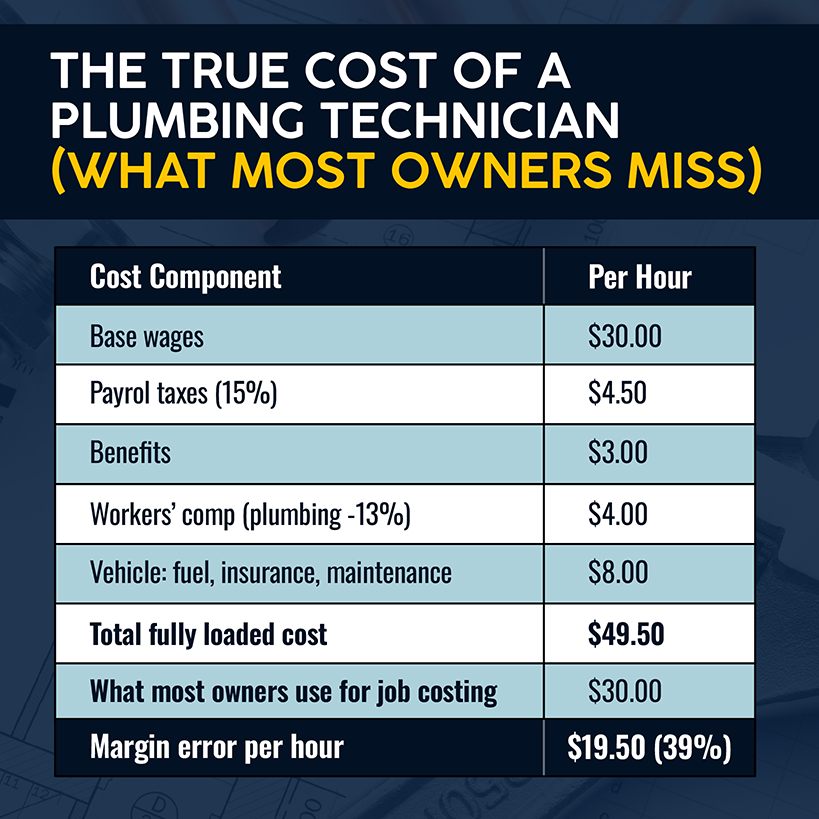
Another job-costing figure that plumbing businesses get wrong is the labor rate. The technician you pay $30/hour actually costs closer to $50/hour when you include payroll taxes, benefits, workers' compensation, and vehicle costs. Calculating labor at the wage rate understates true job cost by 40–60% and creates the illusion of higher profit margins.
The operational fix: Pull your last 90 days of jobs. Categorize by job type. Calculate gross margin per category. The answer tells you where to reprice, where to push volume, and what to stop doing.
2. Fix Your Scheduling Before You Add More Trucks
Plumbing businesses that want to protect margin will focus on scheduling, especially at scale. If a tech bills at $150/hr but loses 1.5 hours per day to routing inefficiency? That’s roughly $56,000 in missed billable capacity per year. With five techs, that's $280,000 left on the table from scheduling alone.
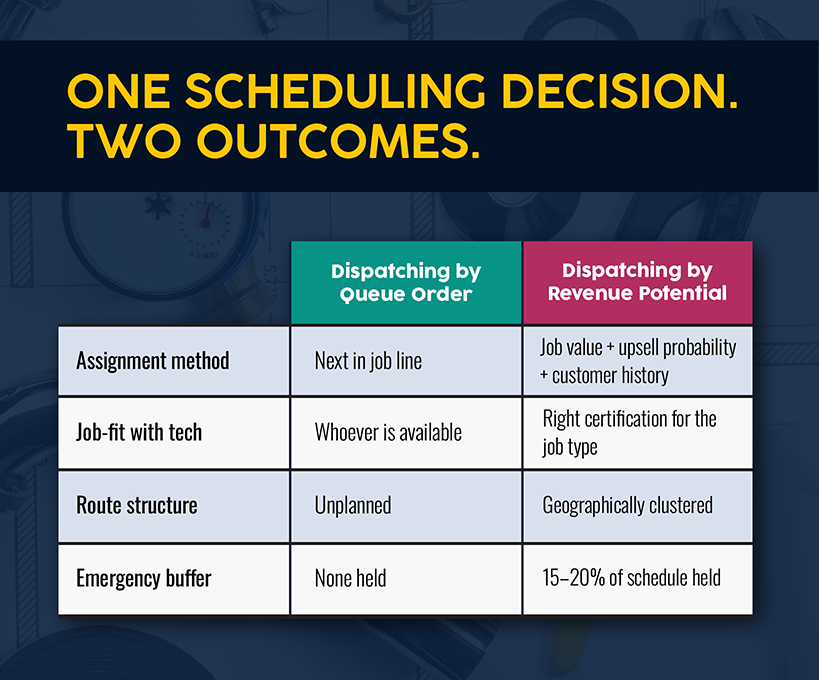
Top-performing plumbing businesses run more jobs per tech, per day. That gap isn’t about effort or willpower. Rather, it's dispatch discipline. Top operators rely on skill-based routing and proximity-based sequencing so your techs finish jobs on time and can move on to the next one. Most importantly, they hold back 15%–20% of schedule capacity for emergency calls, which in plumbing can command up to 2x standard rates.
Stop dispatching whatever job comes in first. Instead, when two jobs compete for the same slot, dispatch is based on job value, upsell probability, and customer history.
The operational fix: Calculate how many jobs per day your techs complete, on average. If it’s less than 3.5, fix your scheduling before making other growth investments.
3. Know Your Profit Margin by Job Type, Not Just Overall
Plumbing profit margins can mislead, depending on how you calculate them. Blended margin is a comfortable fiction. For example, healthy plumbing businesses should target 50–60%+ gross margin on service and repair work, but they might only make 20–30% on new construction.
If your blended gross margin is 40%, but you’re almost exclusively doing service and repair work, then you’re actually not making enough per job. Top operators identify their highest-margin job types, build pricing discipline around them, and stop subsidizing the rest.
Revenue per technician is the clearest signal of operational health. Top performers typically generate $200,000 to $300,000+ in annual revenue per tech. If your techs are below that range, examine your average ticket size, close rate on options, and scheduling utilization.
The operational fix: Build a margin table by job type. Update quarterly. Any category below your target gross margin gets repriced or deprioritized in dispatch and marketing.
4. Implement Flat-Rate Pricing on Residential Service Work
Time-and-material pricing on residential service calls means customers don't know what they're paying until you're done. Meanwhile, your margin varies by job. Flat-rate pricing fixes both challenges. The customer sees the price before saying yes, which increases close rates, while your margin becomes more transparent and predictable.
Setting flat rates requires job-costing data. Calculate your fully loaded labor cost per job type, add average material cost, apply your target gross margin, then benchmark against your local market.
The operational fix: Start with your top five job types by volume. Build flat rates for them, then track how your close rates change.
5. Build Technician Scorecards and Share Them With the Team
Plumbing techs might be paid on the same scale, but their actual performance can vary widely. Fortunately, the right metrics help your techs see what strong performance looks like.
Key performance indicators (KPIs) that you should track on a per-tech basis include:
- Average ticket value
- Revenue per day
- Callback rate (target under 3%)
- First-time fix rate (top performers approach 90%; industry average is around 80%)
Scorecards work when shared transparently and tied to compensation.
The operational fix: Build a weekly scorecard, and share it with your top performers first. Let them embrace KPIs as a competition before making it compulsory.
6. Track The Right KPIs And Review Them Weekly
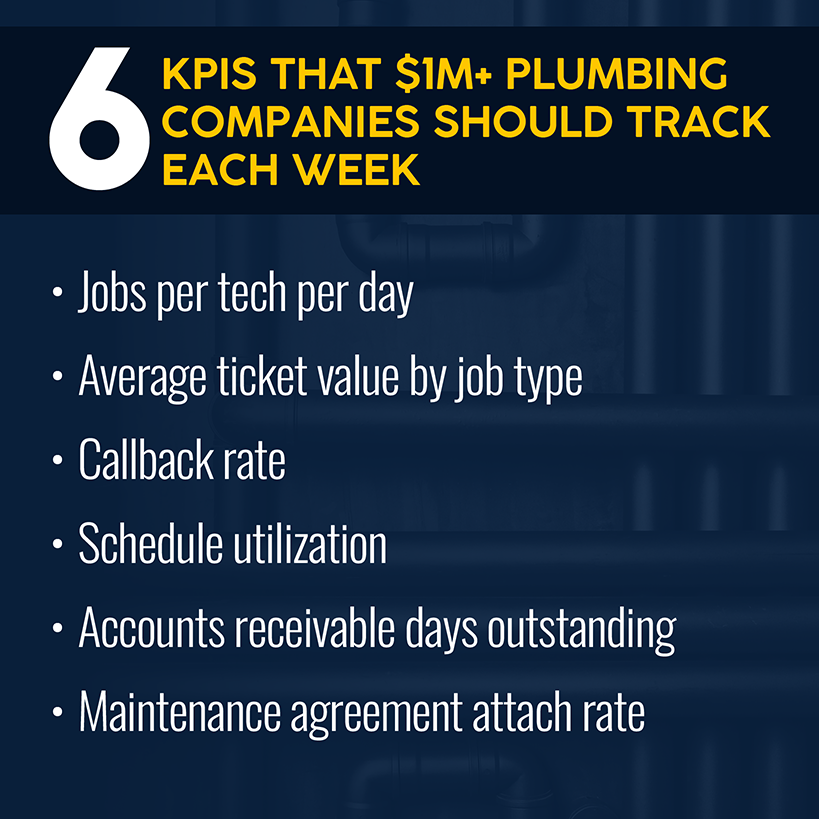
Every week, plumbing operations with $1+ million in revenue should review these six numbers:
- Jobs per tech per day
- Average ticket value by job type
- Callback rate
- Schedule utilization (target 75–85% booked)
- Accounts receivable days outstanding (target under 45 days on commercial)
- Maintenance agreement attach rate (target 20%+).
Revenue by itself mostly tells you about the past. Input metrics tell you where revenue is going to be in 30–60 days.
The operational fix: Pick three KPIs you don't currently track. Build a simple weekly dashboard. Review it at the start of every ops meeting.
7. Use Maintenance Agreements to Stabilize Cash Flow and Grow Your Customer Base
Emergency call volume spikes seasonally, and if your revenue follows that pattern, so does your cash flow. Maintenance agreements can smooth out your finances.
Recurring-agreement revenue is the most predictable lever available to plumbing companies. Contract customers generate 2x–4x more repair revenue than one-time callers.
Not only are existing customers better for revenue, they’re also easier to sell to. You have a 60–70% chance of turning them into repeat buyers, compared with just 5% to 20% for new prospects.
The operational fix: Train techs to present agreements on every service call, especially on systems over 10 years old. Track your maintenance agreement attach rate. Below 20% signals a process gap. Target 40%, and build it into tech compensation through a spiff structure.
8. Tighten Your Estimating Process to Reduce Scope Creep
Loose scoping makes your estimates less accurate and further risks margin leaks. A tight plumbing estimating process includes a standardized options presentation (good/better/best on every call), explicit inclusions and exclusions, and a consistent material cost baseline. For commercial work, add a concealed conditions clause, phase milestones, and exclusions for electrical and excavation by others.
Consider using field service management (FSM) software to build estimates from pre-loaded job templates, which gets proposals into client inboxes faster and closes more jobs. Simpro® customers report building estimates up to 10x faster when working from templated rates.
The operational fix: Review your last five commercial project jobs for scope variance. If any ran more than 10% over the estimated cost, reexamine your exclusion language and change-order protocols.
9. Systematize Customer Communication to Improve Customer Experience and Reviews
Most plumbing businesses primarily communicate with customers when there's a problem or an appointment. But proactive communication can turn a one-time plumbing services call into a long-term relationship. Here are some ways to reach out naturally:
- Seasonal emails to keep customers informed
- Annual maintenance reminders
- Automated post-job follow-ups
When you automatically text or email with two hours of job completion, including a link to your Google review form, you’ll generate three to five times more reviews than informal requests alone. BrightLocal data shows over 90% of potential customers check reviews before calling
When these inquiries are part of your FSM software’s service history, every customer interaction starts with context, which is at the heart of high-quality customer experience.
The operational fix: If your review request is taking more than two hours after job close, you're missing out on the reviews you need- and deserve to get.
10. Build a Referral System Instead of Waiting for Word of Mouth
Word of mouth is a powerful driver of new plumbing business, but it’s passive. The path to business growth requires an active marketing strategy, not just waiting for people to call you.
Marketing for plumbers should include search engine optimization, paid campaigns, and, critically, a formalized referral program. Offering a $50–$100 gift card for each referred customer can generate surprising ROI. If each new client is worth $800 on average, a $50 gift card generates a 16-to-1 return.
The operational fix: Build the referral ask into your post-job workflow. Track referral volume the same way you track any other lead source.
11. Address Inventory Management Before It Addresses You
Poor inventory management shows up as stockouts, overstock, and shrinkage. All create issues. Stockouts require techs to spend time driving instead of being on the job site. Overstock means you have to babysit parts and products that aren’t in demand. And shrinkage means you’re losing inventory to theft, damage, or other causes.
For a plumbing business carrying $60,000 to $100,000 in parts inventory, even modest improvements can free up $10,000 to $25,000 in working capital.
Every service truck should carry a standardized parts inventory that’s calibrated to the top 20 job types. Evaluate your supplier mix; consolidating to two or three primary suppliers with negotiated pricing can often reduce material costs.
The operational fix: Pull last month's return trips caused by missing parts. More than two or three per week means your truck stock levels need to be rebuilt.
12. Document Your SOPs Before Key People Leave
Systematized service businesses sell at 3x–5x EBITDA. Owner-dependent operators get 1x–2x. One way to get that premium is by having detailed documentation in the form of standard operating procedures (SOPs). These are the documents and processes that ensure your business operates smoothly, even when there’s turnover or the owner is away.
The highest-priority SOPs for a $1+ million plumbing business are:
- Dispatch decision frameworks
- Invoice creation
- Payment collection
- Post-job follow-up
- New-tech onboarding
- Options presentation script
The operational fix: Identify three processes your business would break without. Document those first. Remember that documentation doesn’t just have to be text-based. A three-minute video walkthrough can prove more useful than five pages of written procedure.
Common Plumbing Management Mistakes
Knowing the best practices for running a plumbing business is only half the battle. The other 50% is avoiding obvious mistakes. Most plumbing management problems have one of four root causes:
- Calculating labor at wage rate instead of fully loaded rate. This understates true job cost by 40–60%. Use a labor burden rate calculator to estimate the true cost.
- Tracking revenue but not the operational inputs that produce it. Jobs per tech per day, callback rate, and schedule utilization tell you where revenue is going before it arrives.
- Treating dispatch as logistics rather than revenue optimization. The dispatcher's job is to maximize revenue per truck per day, not just fill slots.
- Waiting until a system breaks to document it. Don’t wait until your best person walks out the door.
When Your Plumbing Business Needs a Software Solution
The inflection point for most plumbing operations is between $1.5 million and $2.5 million in annual revenue. At this stage, most dispatch decisions still flow through the owner. Job-cost data lives in spreadsheets and gets updated manually. Follow-up on unsold estimates isn’t automated and depends on someone remembering.
To implement the plumbing management tips we’ve discussed, you need plumbing software that connects field operations to job costing, scheduling to customer communication, and estimates to invoicing — all with unified data. The right software also improves customer-facing workflows. Automated review requests, proactive communication, and online booking all function better when hooked up to the same system.
Manage and Scale Your Plumbing Business With Simpro
Simpro is built for plumbing businesses at exactly this stage. Real-time job costing, a scheduling board with tech availability and location overlay, automated customer communication, truck-level inventory tracking, and weekly KPI reporting. Over 24,000 businesses use Simpro to manage operations, with users reporting 25% revenue increases and 30% productivity improvements.
If your plumbing company has outgrown the tools that got it here, schedule a demo to see what better plumbing management looks like in practice.


 Back to top