
Adding a second truck felt like the right move. The phone was ringing, you were turning down jobs, and revenue was climbing. A year later, revenue is still up, but you're working more hours, margins are thinner, and you're not entirely sure where the money went.
That's the growth trap, and it has nothing to do with leads. Figuring out how to grow your plumbing business sustainably — whether you're expanding your range of plumbing services, adding trucks, or moving into commercial work — means building the infrastructure that can handle volume before you pour more volume into it. The businesses that scale aren't the ones with the most marketing spend or the biggest service area. They're the ones that build systems first, then pour fuel on them.
3 Obstacles That Stop Plumbing Businesses From Scaling
There's a version of every plumbing company that gets to somewhere between $500K and $1.5M in revenue and hits a wall. For most plumbing business owners, this is where small businesses stall: the owner is maxed out, margins are thin, and adding another truck feels like a liability, not a win. Almost every business that gets stuck here is dealing with some combination of the same three problems — and they tend to compound each other.
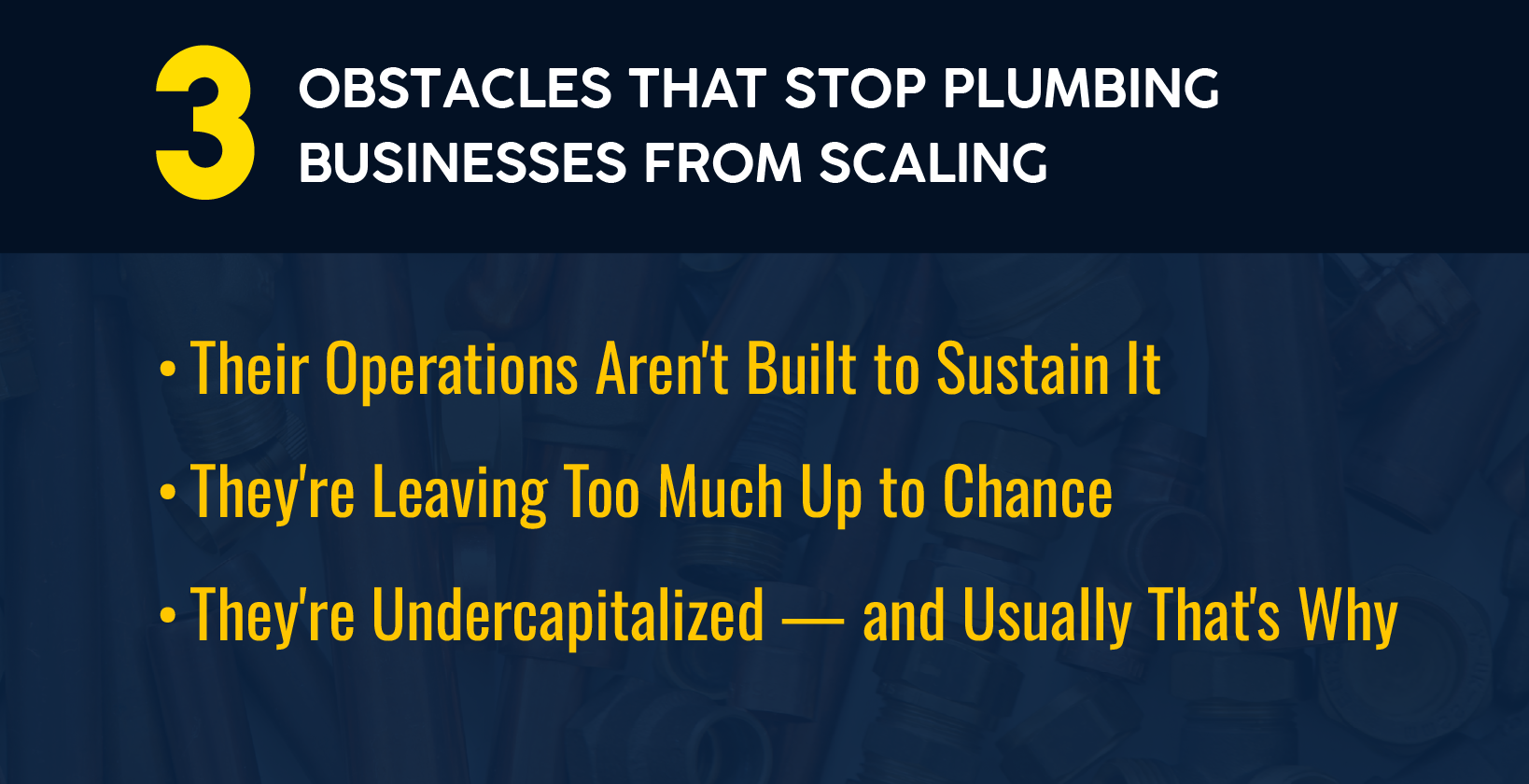
Their Operations Aren't Built to Sustain It
The systems that work when you have two trucks don't hold up at five. Scheduling is managed out of someone's head. Job costing is guesswork at best. Techs in the field can't access the information they need, so they call the office. The office calls the owner. The owner makes the call and tries to remember to write it down later.
The problem with this model isn't that it's chaotic — it's that it means you are the system. Every new job, every new hire, every new truck adds to the complexity that depends on you to function. That's not a business that can scale. That's a job with overhead. If the tools you started with are starting to feel like they're working against you, that's usually the first sign — here's how to know you've outgrown your plumbing CRM.
At around $1M in revenue, most plumbing owners need to make the transition from lead technician to operator — delegating fieldwork, putting real processes in place, and getting out of the day-to-day. Businesses that make this shift successfully can grow through the $3M and $5M thresholds. Those that don't tend to grind until the owner burns out.
They're Leaving Too Much Up to Chance
Word of mouth is a great way to start a plumbing business. It's a poor way to grow one. Referrals are unpredictable by nature — they're high when business is good and dry when you need them most.
The businesses that scale have a consistent, measurable way to generate demand that doesn't depend on chance. They know their cost per lead, their close rate, and which services drive the highest average ticket. When they want more revenue, they have levers to pull — not just hope.
If you can't answer "where will my next 20 jobs come from?" with something more specific than "usually just word of mouth," your growth is as unpredictable as the weather.
They're Undercapitalized — and Usually That's Why
A lack of capital is a real obstacle for plumbing business growth. Without adequate working capital, you can't hire ahead of demand, invest in equipment, weather a slow season, or take on larger commercial contracts that require materials up front.
But undercapitalization isn't usually a standalone problem. It's often what happens after a business with thin margins and unpredictable revenue tries to grow. When operations are leaking money through unbilled time, pricing mistakes, and missed jobs, and when revenue swings wildly because there's no consistent pipeline, capital runs out fast. Fix the first two problems, and capital either follows or becomes less necessary.
Stop Being the Business — Build One That Runs Without You
The ops side of growth isn't glamorous, but it's the foundation everything else is built on. Adding volume to a broken operation doesn't grow a business — it just creates faster-moving chaos. These are the systems worth investing in first.

Get Off the Tools and Into the Business
The $1M ceiling is almost always an owner ceiling. The first step in any real plumbing business strategy is deciding you're running a business, not working a job.
That means hiring a lead technician or field supervisor who can handle the work you're doing in the field. It means documenting your processes so jobs can run without you. It means spending time on scheduling, pricing, hiring, and marketing — the work that moves the needle on revenue and margin — instead of being the person who shows up when someone calls out sick.
This shift is uncomfortable, especially if your identity is tied up in being the best tech on the crew. But it's the prerequisite for everything else.
Hire Into a System, Not Into Chaos
A new technician joining a business with no price book, no documented workflows, and no job history to reference is a cost center before they're a revenue center. Training takes longer, callbacks happen more often, and the owner ends up managing more instead of less. The sequence matters: build the system first, then hire into it.
That said, the plumbing labor market doesn't make this easy. Skilled plumbers are in short supply, and the businesses that retain them tend to be the ones where techs aren't spending half their day calling the office for information they should already have. Clear career paths — apprentice to journeyman to lead tech to supervisor — give people a reason to stay. Competitive pay matters, but so does not making the job harder than it needs to be. A tech who starts their first day with a price book, a dispatch process, and mobile access to job details can contribute margin faster than one who's learning how the business operates while learning the trade at the same time.
Systemize Scheduling, Dispatch, and the Field
When dispatch is optimized — the right tech going to the right job with the right parts — you recover billable hours that would otherwise get eaten by windshield time, callbacks, and return visits for parts.
A five-tech operation losing an hour per day per tech to poor routing and scheduling is losing 25 hours of billable time per week. At a $150/hour average, that's $3,750 a week — nearly $195,000 a year. That's not a minor inefficiency. That's a hiring budget.
Build the systems: standardized job types, clear dispatch criteria, pre-stocked trucks for the jobs you run most often, and real-time mobile access to job details so techs aren't calling the office for information they should already have. Auditing one week of jobs for dispatch inefficiencies — return trips for parts, jobs that ran long due to missing info — puts a real number on what better scheduling is actually worth. If you're still coordinating through texts and a whiteboard, a plumbing field management app can centralize all of it.
Zebra Plumbing improved field productivity by 30% — not from working harder, but from managers being able to see what was actually happening across their operation for the first time.
Get Real About Job Costing
Most plumbing businesses know their revenue. Far fewer know their margin by job type. That's a problem, because blended margin numbers hide what's actually working — and what's quietly dragging everything else down.
New construction typically runs gross margins of 35–45%. Your service and repair work should be hitting 60–65%. A business doing 30% of its revenue in new construction at two trucks can offset those thin margins with high-margin service work. At five or six trucks, that same mix means the whole operation is subsidizing low-margin volume without anyone realizing it. If revenue is growing but your blended margin is flat or declining, work mix is usually the diagnosis.
A water heater replacement at a $1,200 ticket might carry a 45% gross margin. A service call for a running toilet at $150 might carry 20% — or nothing, once you account for drive time. If you're booking both without tracking the difference, you're making staffing and growth decisions against numbers that don't reflect reality.
Track estimated versus actual labor and materials on every job and use that data to set smarter plumbing pricing and build tighter plumbing estimates that reflect your real costs — not what you guessed last time. Pull your last 30 jobs and calculate gross margin by job type. If that data isn't available, that's the actual problem. Simpro® gives plumbing businesses end-to-end job management with job costing tools that compare estimated versus actual costs, so you can see exactly where margin is made or lost. That's also where purpose-built plumbing software earns its keep — tracking it automatically rather than waiting until month-end to find out where the money went.
McCarthy Plumbing Group did exactly this — after getting their operations into a single platform, they could finally see which jobs and technicians were actually driving margin and started making growth decisions accordingly.
Invoice Fast and Get Paid Faster
Every day between job completion and invoice sent is a day your cash flow gets tighter. But the bigger issue for growing plumbing businesses is the estimate-to-invoice gap: a job gets quoted, materials get added in the field, the invoice goes out from a different system, and the delta disappears into the space between them. Multiply that across 50 or 60 jobs a week and the margin leak adds up fast — and nobody can see it clearly enough to fix it.
Invoice immediately after job completion and make sure what's billed reflects what was actually used, not what was originally quoted. Use digital payment options — card on file, online payment links — to reduce friction. For larger jobs, require deposits and use progress billing so you're never completing $20,000 worth of work before seeing a dollar. Good plumbing invoicing practices won't just improve cash flow — they close the loop between what you estimated and what you actually made.
Stop Waiting for the Phone to Ring: How to Increase Plumbing Revenue
Good operations create capacity. But capacity only converts to growth if there's consistent demand to fill it. A strong marketing strategy covers both the long game and the short — channels that build over time and channels that generate leads now. These are the ones worth building first.
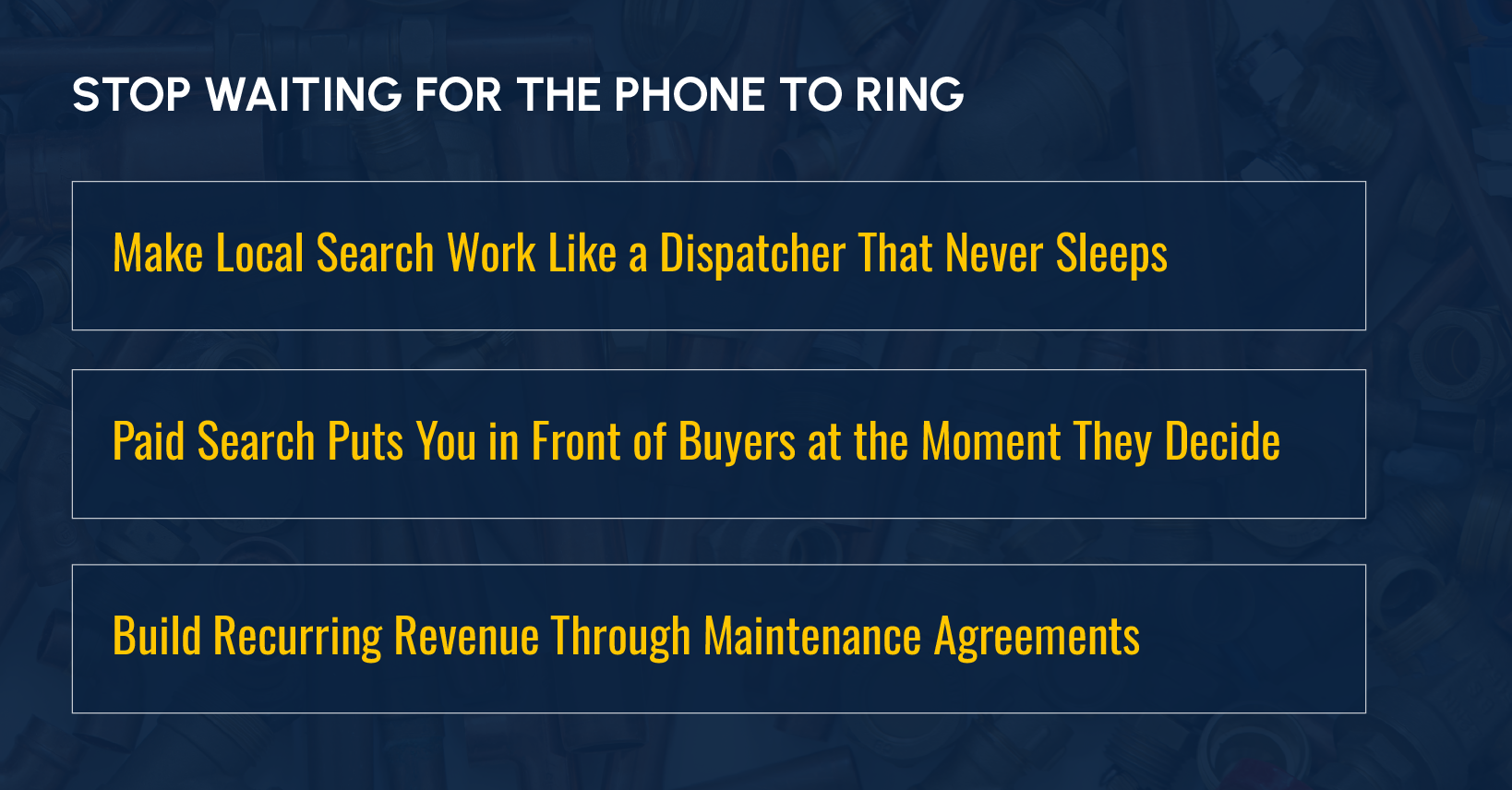
Make Local Search Work Like a Dispatcher That Never Sleeps
Most plumbing businesses acquire their first 50 customers through referrals and word of mouth. That's fine. The problem is that model has no lever — you can't turn it up when you want more volume or dial it back when you're at capacity.
Local search engine optimization (SEO) is different. A well-optimized Google Business Profile with consistent NAP (name, address, phone), current photos, active review responses, and service-area pages targeting your highest-value ZIP codes generates inbound leads at a fixed cost: the time it took to build it. For home services businesses, this is often the single highest-ROI channel to attract new customers — potential customers searching "plumber near me" at 9pm are ready to book, not browse. A business with 200 reviews and a 4.8 average will consistently outrank a competitor with a better website and a thinner review profile. That gap compounds — and can't be copied quickly. Automate the ask: a text goes out when the job closes, it includes a direct link, and volume takes care of itself.
Paid Search Puts You in Front of Buyers at the Moment They Decide
Organic search is a long game. Paid search gets you in front of high-intent buyers immediately. Google Local Services Ads (LSAs) are particularly effective for plumbing because they appear at the very top of results, carry a "Google Guaranteed" badge, and charge per lead rather than per click — meaning you're only paying when someone actually contacts you.
Pair LSAs with targeted Google Ads for specific services — tankless water heater installation, sewer line repair, commercial plumbing maintenance — and use geographic targeting to focus your budget on the service areas where you want to grow. Run a 90-day test with a defined budget and a single service focus. Track cost per lead and close rate. That data tells you whether to scale the channel or adjust the approach. AI is also changing how plumbers generate and qualify leads — here's how AI helps plumbers capture more value from every opportunity. And paid search doesn't have to do it alone: social media platforms like Facebook and Nextdoor are effective for residential plumbing awareness and neighborhood-level targeting, while email marketing to your existing customer base — service reminders, seasonal tips, maintenance agreement offers — keeps you top of mind between jobs at almost no cost.
One thing a competitor with a bigger ad budget can't buy: being the first to respond. Over 50% of customers hire the first business that calls them back. Paid ads can put you at the top of the results page, but if an inquiry sits unanswered for three hours, the ranking didn't matter. Fast response isn't a customer service policy — it's what happens when dispatch, job status, and scheduling run through a single platform and your office can see exactly what's available without hunting across three tools before committing to a time.
Build Recurring Revenue Through Maintenance Agreements
One of the fastest ways to stabilize revenue and reduce your dependence on unpredictable inbound demand is selling maintenance agreements to residential and light commercial customers.
An annual agreement that includes a plumbing inspection, priority service, and a discount on repairs might run $150–$250 per year per customer. For a 200-property commercial client, that's $30,000–$50,000 in contracted annual revenue before a single service call is logged. Those customers call you first, refer people they know, and rarely shop around for a second quote. Happy customers on maintenance agreements have a fundamentally different customer experience than one-time callers — they feel taken care of, and that translates into long-term retention and higher lifetime value without any additional acquisition cost.
Tropical Coast Plumbing scaled their maintenance agreement base using Simpro's Maintenance Planner to automate the scheduling and reminder side of the program. Recurring jobs generate automatically, assets are tracked with service history attached, and customers receive reminders without anyone in the office manually managing a spreadsheet. What typically becomes an administrative bottleneck at scale becomes a system that runs itself.
When Operations and Revenue Are Set, Capital Becomes Less of a Constraint
Most plumbing businesses that feel undercapitalized aren't only facing a financing problem — they're facing a margin and predictability problem. Fix those, and capital either becomes accessible or becomes less necessary. Here's what that looks like in practice as you figure out how to expand a plumbing business.
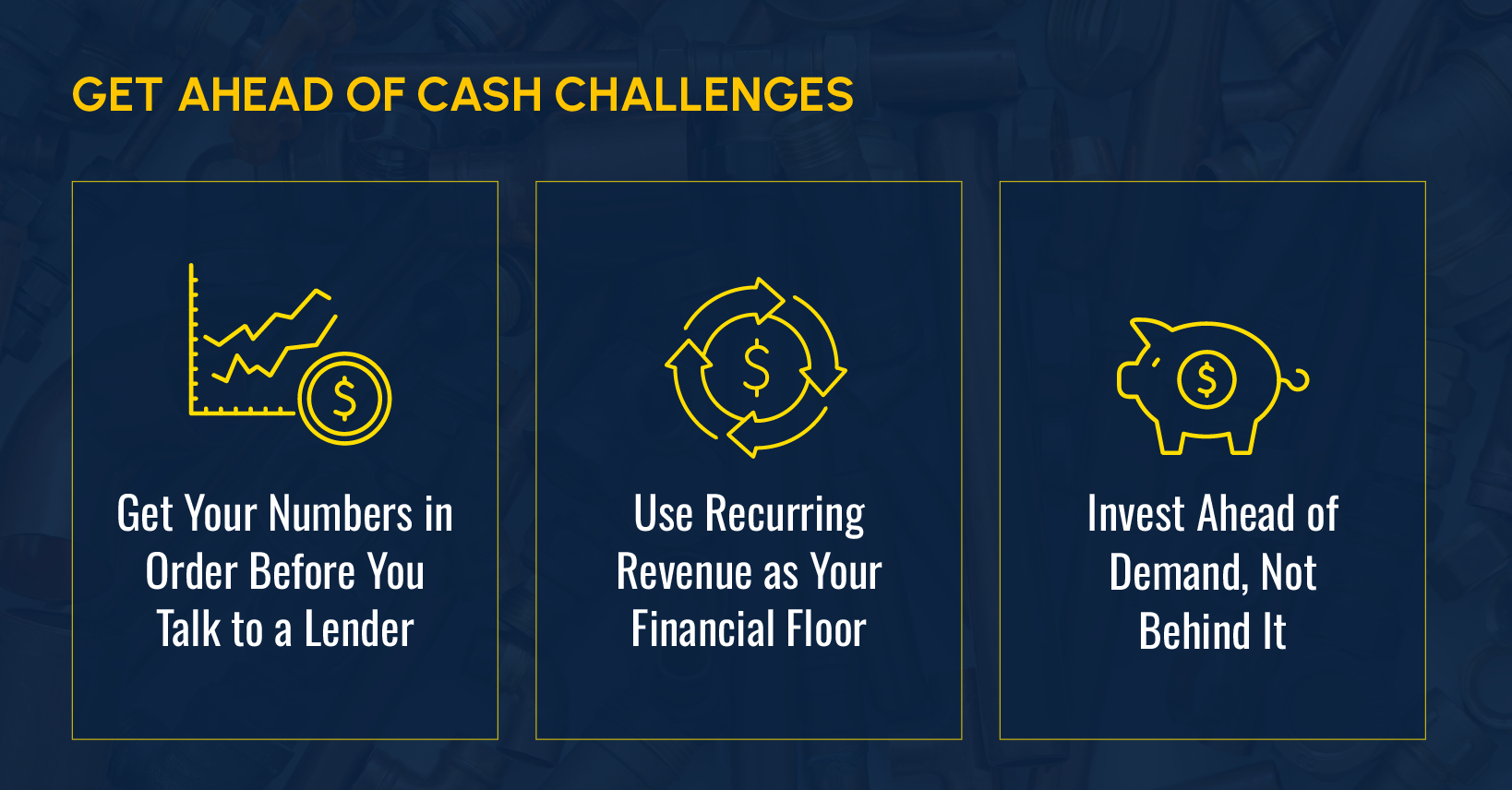
Get Your Numbers in Order Before You Talk to a Lender
Lenders aren't just evaluating your credit — they're evaluating whether your business is predictable. A clean set of books showing consistent gross margins, documented job costs, and steady revenue history makes a fundamentally different case than a business that can show revenue but can't explain where the profit went.
The groundwork is the same work described throughout this post: job costing by service type, estimated versus actual comparisons, margin visibility by technician. That data doesn't just help you run a better operation — it's the evidence a lender needs to see before they'll extend a line of credit or finance your next truck at a rate that doesn't hurt.
Use Recurring Revenue as Your Financial Floor
One of the least obvious advantages of maintenance agreements is what they do to your financial profile. Contracted recurring revenue is more bankable than job-by-job income — it's predictable, documentable, and tells a story about the business that one-time emergency calls can't. A business with $200K in annual maintenance contracts looks materially different to a lender than one generating the same revenue from unpredictable inbound volume.
It also changes how you manage cash internally. When you know what's coming in before the month starts, you can plan hiring and equipment decisions against real numbers instead of hoping the pipeline holds.
Invest Ahead of Demand, Not Behind It
The most expensive capital mistake growing plumbing businesses make is waiting until they're overwhelmed to act — then scrambling to fund a hire or a new truck under pressure. Reactive capital deployment almost always costs more: rushed decisions, worse financing terms, and the operational drag of onboarding someone while the business is already strained.
When your utilization data actually shows the bottleneck coming — technician hours maxed out, jobs being pushed, close rate slipping because you can't respond fast enough — you have the lead time to plan the next move and fund it on your terms. That's what clean ops data makes possible. Heron Plumbing used exactly this foundation to move into more complex commercial work without the chaos that usually comes with it — because the data told them when they were ready before the strain did.
Build the Business, Then Scale It
Most plumbing businesses don't stall because the work dried up. They stall because the infrastructure couldn't keep pace with the ambition — and by the time the owner noticed, they were already buried in it.
Whether you're figuring out how to scale a plumbing business past the $2M mark or how to expand into new service areas or commercial work, the foundation is the same: operations that can absorb the growth, and a revenue engine that doesn't depend on luck. Build those two things, and the capital problem usually takes care of itself.
Simpro® is built for plumbing businesses that have outgrown the tools they started with. Businesses using Simpro have seen up to a 30% productivity increase and a 25% revenue increase after bringing their operations into a single platform. Schedule a demo and see what that looks like for yours.
Not quite there yet? Our guide on how to start a plumbing business covers the foundation you'll want in place before you scale.


 Back to top