
TL;DR
- Build the list from the takeoff, not from memory.
- Give wire its own section, with a price date on every line.
- Pre-load the code items on panel upgrades, from the surge protective device to the circuit directory labels.
- Set waste from your own jobs, then round up to supply house units.
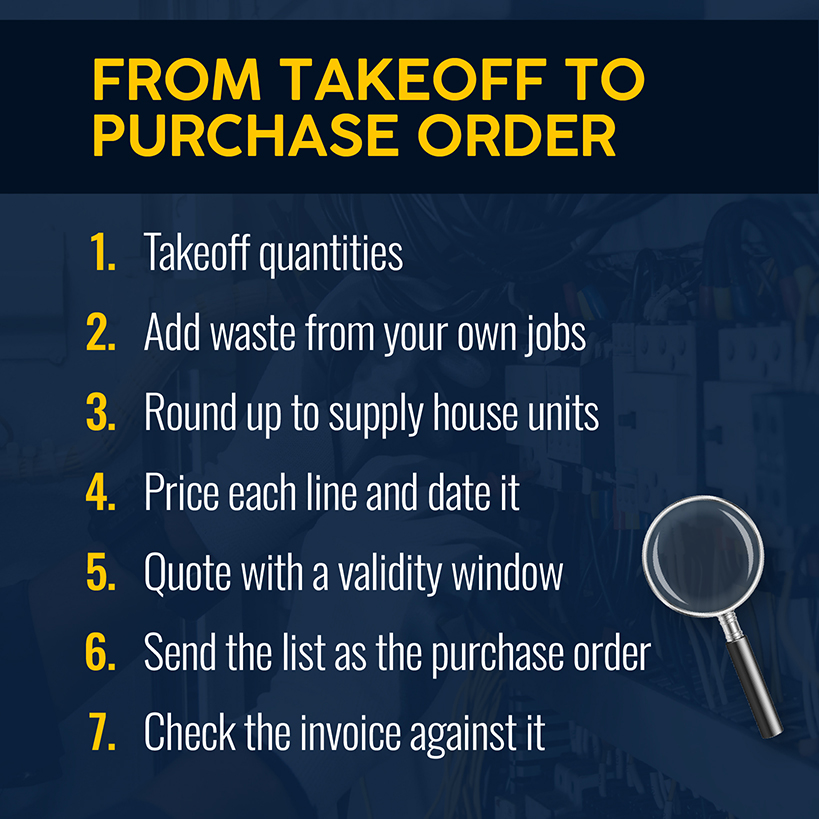
- Send the list as the purchase order and match the invoice.
A kitchen remodel's plan set marks every receptacle, and the 2023 NEC puts both arc-fault and ground-fault protection on the circuits behind them. An electrical material list template counts those dual-function breakers with every box and foot of wire before you quote. Each line gets a quantity and a price date.
Whatever the list leaves off gets bought after the quote is signed. You pay the supply house's price that day, and the difference comes out of your margin.
Build the list from the takeoff. Load the code items first, date every price, and catch most misses on paper before the quote goes out.
What Is an Electrical Material List?
An electrical material list is a per-job list of every item a takeoff calls for, each with a quantity and unit. It covers wire and cable, conduit and fittings, boxes and covers, devices and fixtures, panels and breakers, and consumables. It becomes the materials section of your quote and the purchase order you send to the supply house.
An inventory list tracks what sits in your warehouse and on your vans. An estimate is the priced document your customer sees, with labor and margin added to the material lines.
Related: Stock counts and priced quotes each get their own document. Set up electrical inventory management for the shelves, and build each quote from an electrical estimate template.
What to Include on an Electrical Material List
Every line on your electrical materials list traces back to a count or a measurement on the plans. Work in the takeoff's order, from devices to the panel.
How to Turn Your Takeoff Into Material Quantities
Go through the plan legend one symbol at a time and tally each device type you find. Every device needs a box and a cover, so box and plate counts follow the device counts. If the plans show junctions and fixtures, add extra boxes for those. Wire comes from measuring:
- Count devices by symbol, one type per pass.
- Match each device to its box, cover or mud ring, then add junction boxes.
- Measure each run along its planned route, including the drop to every box.
- Multiply each run by its conductor count to get wire footage.
- Add slack for terminations at every device and at the panel, based on what your crew has actually needed.
Take a 40-foot run of EMT carrying a hot, a neutral and a ground in 12 AWG. That's 120 feet of wire before any slack. Forget the multiplier on ten runs that length and you're 800 feet short on the truck.
Simpro® Takeoffs, an add-on for Simpro Premium, does the counting and measuring on plans you upload. It builds a list of required materials with fit times and updates your project cost centers directly.
Norberg Electric, a 20-person contractor in Elgin, Illinois, used to spend about 40 hours working through a full blueprint on bigger jobs. Since moving to Simpro, operations manager Erik Norberg says that work takes about four hours.
Related: To watch the counting and measuring happen on a real plan set, open Simpro's takeoffs, which start from preloaded electrical symbols or ones you upload.
Wire and Cable: Type, Gauge and Footage
List electrical wiring by type, gauge and footage. That means NM-B for house wiring, THHN in conduit, and MC where the job calls for it. Split THHN by color, since a spool of black won't finish a run that needs white and green. Round each line up to the spool or coil your supply house sells, so you know what to order.
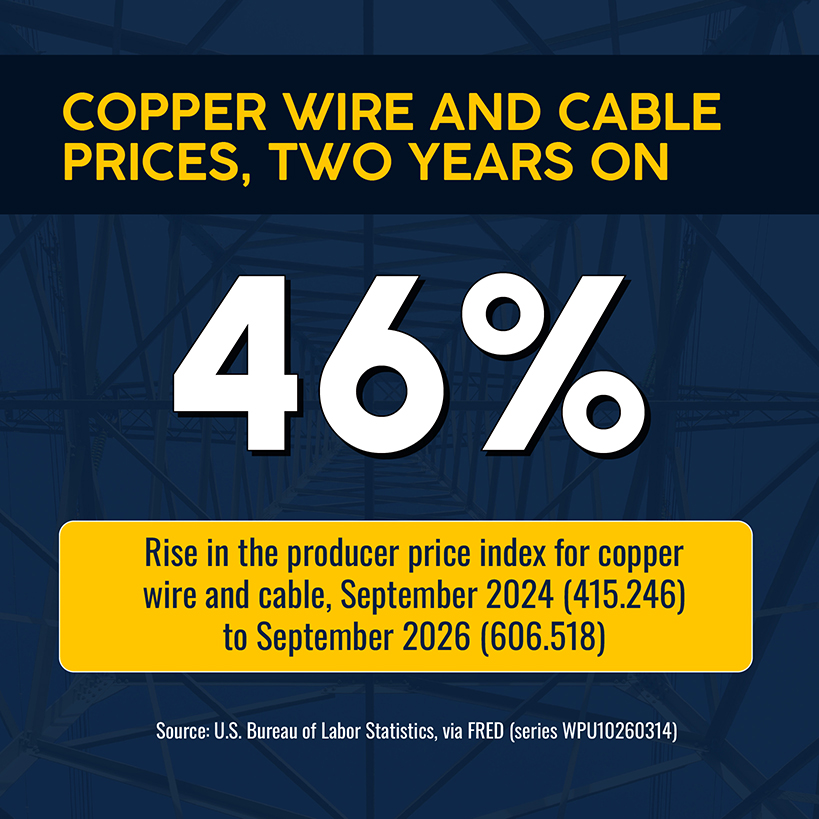
Give wire its own section with a price date on every line. The producer price index for copper wire and cable rose about 31%, from 464.522 in September 2025 to 606.518 in September 2026. About a fifth of that rise came in the last three months, from 577.166 in June, a gain of about 5%. Recheck any price you stamped a quarter ago.
Related: Wire prices that live in a spreadsheet nobody updates belong in an electrical price book, where each one carries a date.
Conduit, Fittings and Supports
Count conduit in the unit your supplier sells it in. EMT comes in 10-foot sticks, so a 45-foot run takes five sticks, because you can't buy 4.5. Then add the hardware that goes with those sticks: connectors at the boxes, couplings at the joints, straps along the run.
Boxes, Covers and Mud Rings
Every box needs a cover, and you need a mud ring that matches the drywall.
Box size comes from what goes inside it. NEC 314.16 sets box fill by counting conductors, devices and clamps. A box that holds two cables on paper may not hold four once the kitchen circuits land in it. Recheck fill when the conductor count changes. Put extension rings on the list before the rough-in inspection finds the problem.
Devices, Fixtures and Plates: Who Supplies What
When owners supply their own fixtures, add a Supplied By column with contractor or owner on every line. An owner-supplied pendant still needs a box and connectors from you. NEC 406.12 requires tamper-resistant receptacles in dwellings, so say so in the spec.
Panel, Breakers and Service Equipment
The panel section carries the code-driven lines. Eaton's reference chart for the 2023 NEC lists 125-volt kitchen receptacle circuits in dwellings as needing both arc-fault and ground-fault protection. A dual-function breaker covers both in one device. NAHB's summary of the 2023 changes adds that GFCI protection now covers every kitchen receptacle. It also reaches the circuits for electric ranges, wall ovens, cooktops, dryers and microwave ovens.
Service equipment adds the surge protective device. The City of St. Paul's 2023 NEC checklist says every dwelling service needs a Type 1 or Type 2 device. It can be built into or next to the service equipment, or sit at the nearest downstream distribution equipment. The 2023 edition also sets a 10 kA minimum nominal discharge current rating.
Your state decides which edition applies. North Carolina's fiscal note shows how much that varies: the state's 2020 code didn't require surge protection at the service at all. Confirm what your jurisdiction has adopted before these lines go into every quote.
Panel Upgrade Materials That Get Left Off the Quote
A panel upgrade quote built from the electrical panel and a handful of circuit breakers leaves off the parts an inspector checks. North Carolina's fiscal analysis put a whole-home surge protector at $79.52 per service. Quote ten flat-rate swaps without one, and you've bought $795.20 of surge protectors out of your own margin. For a dwelling service upgrade, these parts belong on the list:
- A Type 1 or Type 2 surge protective device at or next to the service equipment
- GFCI, AFCI or dual-function breakers for each circuit the 2023 code covers
- An outdoor emergency disconnect, which replacing service equipment triggers even at the same amperage
- Grounding and bonding parts, including a bonding jumper around the water meter and an intersystem bonding terminal with three open terminals
- Bushings for conductors 4 AWG and larger, plus listed antioxidant compound for aluminum terminations
- Circuit directory labels, since NEC 408.4 requires every circuit and every circuit change to be legibly identified there
- A meter base if your utility requires one, and the permit
The operational fix: Build those parts once as a panel-upgrade kit and copy it into every upgrade quote. The code items are then on the page before anyone starts pricing.
The kit covers the items that have a code section behind them. The cheaper items have no plan symbol at all.
The Small Items That Eat Margin: Connectors, Consumables and Permits
Wire connectors, staples and permit fees have no symbol on the plans, so the takeoff can't count them. Put them on the list by job type anyway:
- Wire connectors by size, and cable connectors for every box that takes MC or conduit
- Staples, straps and anchors sized to the wiring method
- Tape, cable ties and labels
- Permit fees, as their own line so they don't hide inside labor
Set an allowance based on your last few jobs of the same type, and the counter run for a box of connectors stops happening.
How to Add Waste and Round Up to What the Supply House Sells
Set waste from your own jobs. Compare what you ordered with what each electrical installation used over your last few jobs of the same type. Use that gap by material.
Add waste to the net quantity first, then round up to the unit the supply house sells: sticks of conduit, spools of wire, boxes of devices. Rounding first and padding second counts the same cushion twice.
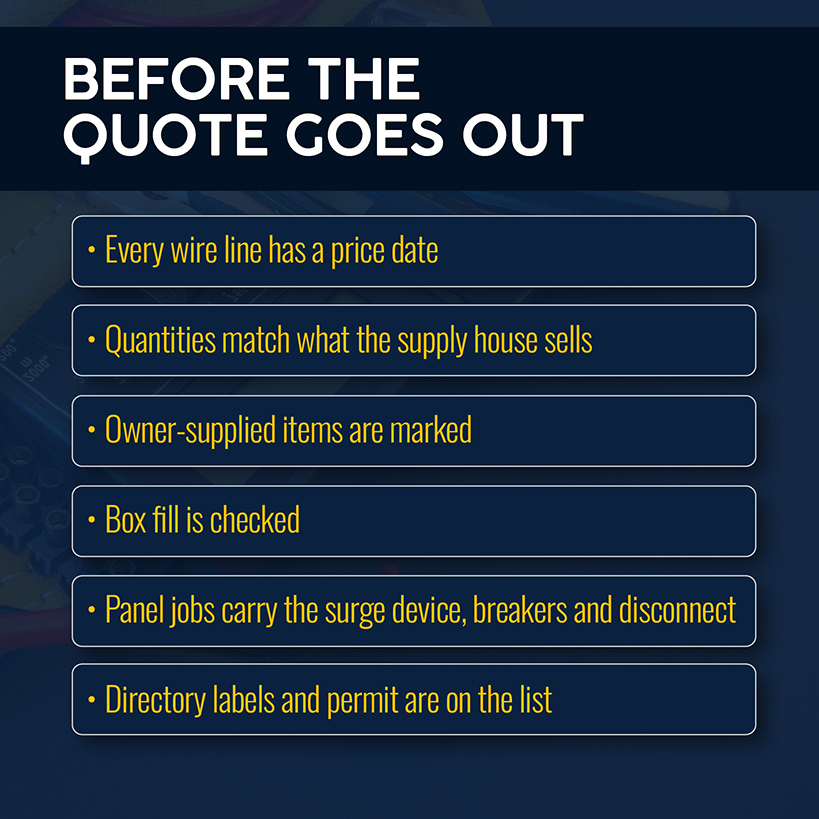
The same sections produce very different lists on a panel swap and an office fit-out.
Sample Electrical Material Lists by Job Type
Quantities are illustrative, and prices are left off because every price needs its own date.
A 200-amp residential panel upgrade pulls these lines:
| Item | Spec | Qty | Unit |
|---|---|---|---|
| Main breaker panel | 200A, 40-space | 1 | each |
| Surge protective device | Type 1 or 2, 10 kA rating | 1 | each |
| Outdoor emergency disconnect | Marked per NEC 230.85 | 1 | each |
| Grounding electrode conductor | Copper, per Table 250.66 | 25 | ft |
| Ground rod with clamp | 8 ft | 2 | each |
| Intersystem bonding terminal | Three open terminals | 1 | each |
| Dual-function breaker | 1-pole, 20A | 8 | each |
| GFCI breaker | 2-pole, range and dryer | 2 | each |
A kitchen remodel with a new range, dishwasher and microwave pulls these:
| Item | Spec | Qty | Unit |
|---|---|---|---|
| NM-B cable | 12/2 with ground | 300 | ft |
| NM-B cable | 14/2 with ground | 150 | ft |
| NM-B cable | 6/3, sized to range nameplate | 30 | ft |
| Single-gang box | Deep, new-work | 14 | each |
| Receptacle | 20A, tamper-resistant | 12 | each |
| Dual-function breaker | 1-pole, 20A | 5 | each |
| GFCI breaker | 2-pole, range | 1 | each |
A 2,500-square-foot office tenant improvement with lighting and power pulls these:
| Item | Spec | Qty | Unit |
|---|---|---|---|
| MC cable | 12/2 | 1,200 | ft |
| EMT | 3/4 in. | 40 | stick |
| THHN | 12 AWG, black, white and green | 800 | ft each |
| Square box and device ring | 4-11/16 in. | 45 | each |
| Duplex receptacle | 20A, commercial grade | 28 | each |
| LED troffer | 2x4 | 36 | each |
| Panelboard | 120/208V, 42-space | 1 | each |
Related: On a larger fit-out, the list is one piece of a plan for the building's electrical systems. Read up on commercial electrical project management.
A spreadsheet version carries those columns onto every job and does the arithmetic for you.
Free Electrical Material List Template for Excel
Download the free materials list template Excel file and fill it in from your own takeoff.
Each row carries these columns:
- Section, item or part number, and description or spec
- Net quantity, unit, waste % and supply house pack size
- Order quantity, rounded up to the pack
- Unit cost and price date, with old dates highlighted
- Line total, supplier and Supplied By
- Status: To Order, Ordered, Received or On Hand
Order quantity and line total calculate themselves, so a changed count or price updates the total. Once you fill in the unit costs and date them, the same sheet gives you your quote and your purchase order.
How to Turn a Material List Into a Quote and Purchase Order
Price each line from your price book and date it. Wire is the line most exposed to price swings, so ask your supplier for job pricing. Set a shorter quote validity than you would on a fixture swap. Once the customer signs off on the electrical work, the same list becomes the purchase order, and the supplier's invoice gets checked against both.
Related: Lists that end up in a formal proposal fit inside an electrical bid template.
In Simpro, you sync vendor catalogs to find the best material prices from your vendors. The inventory and purchasing tools let you raise purchase orders, compare vendors' prices side by side and update stock when orders are received. The Price Discrepancies Report flags invoice lines that differ from the purchase order or catalog price. Our guide to catching supplier overcharges covers the check.
Save Your Electrical Material Lists as Reusable Kits in Simpro
A list you rebuild on every job is a list you'll skip things on. In Simpro, you can save a finished list as a prebuild and sell it as a kit. Add the materials, the estimated time and a price, name it, and it's ready for future quotes. A panel upgrade kit starts every quote with the code items already on the page, so you save time on each one.
Related: Prebuilds, catalog items and takeoff templates go into a quote through Simpro's estimating tools. The full electrical feature set is on the Simpro for Electrical page.
A panel upgrade quote either starts from a kit you saved or gets rebuilt from scratch. A rebuilt one depends on someone remembering the surge protective device. Simpro, which supports 250,000+ users worldwide, keeps the kit with synced vendor catalogs behind it, so every quote starts with the code items priced. Schedule a demo today to learn how.


 Back to top
