
Most commercial electrical contractors have a system for building bids. The problem is that "system" usually means a Word doc from three years ago, a spreadsheet someone cobbled together, or a PDF pulled off the internet.
It works until it doesn't and it usually stops working on the job where the scope is unclear, the change orders pile up, and the client claims they never agreed to that line item.
A proper electrical bid template does more than just provide a number. It defines the scope, protects your margin, and gives the client a reason to sign. This article walks you through what to include, how to customize a template for your business, and where the free template approach runs out of road.
Best Free Electrical Bid Template (Download Here)
[Download the free electrical bid template →]
The template includes sections for company details, project scope, itemized labor and materials, payment terms, and a signature block. It's a working electrical bid template example you can adapt for commercial electrical work, construction projects, and large residential bids.
Before you use it, read through the sections below. A template is only as good as the information you include. The mistakes that cost contractors money aren't in the formatting, but rather what gets left out.
Electrical Bid Template vs. Electrical Estimate Template — Which One Should I Use?
These terms get used interchangeably, but they describe different documents for different situations.
An electrical bid is a formal proposal for a defined project. It's the document you submit in response to an RFP, an invitation to bid from a general contractor (GC), or a formal procurement process through a commercial client. The bid commits you to a price and scope. It includes legal protections: change-order provisions, payment terms, and warranty clauses. A bid is a business proposal with teeth.
An electrical estimate is a pricing document. It’s often used for service calls, residential work, or early-stage budget conversations. It's less formal, faster to produce, and doesn't carry the same contractual weight.
Use the bid template when:
- You're pricing commercial electrical work or construction projects.
- You're responding to an RFP or competing against other contractors and construction companies.
- The project involves multiple systems, phases, or trade coordination.
- You need a signed document before mobilizing.
Use an electrical estimate template when:
- You're quoting a service call or residential job.
- The client needs a rough number before committing to a full scope review.
- Speed matters more than contractual formality.
If you're doing both types of work — service and project — you need both templates. The documents aren't interchangeable, and using an estimate form for a commercial bid is a surefire way to lose margin on a project.
Once you understand which documents to use for a job, you need to know how to use them. In the next section, we’ll get into what goes into a solid electrical bid.
What to Include in an Electrical Bid
Not every winning bid protects your business. The difference lies in the details. Many construction disputes stem from unclear scope definitions in bid proposals — and most of those disputes are preventable.
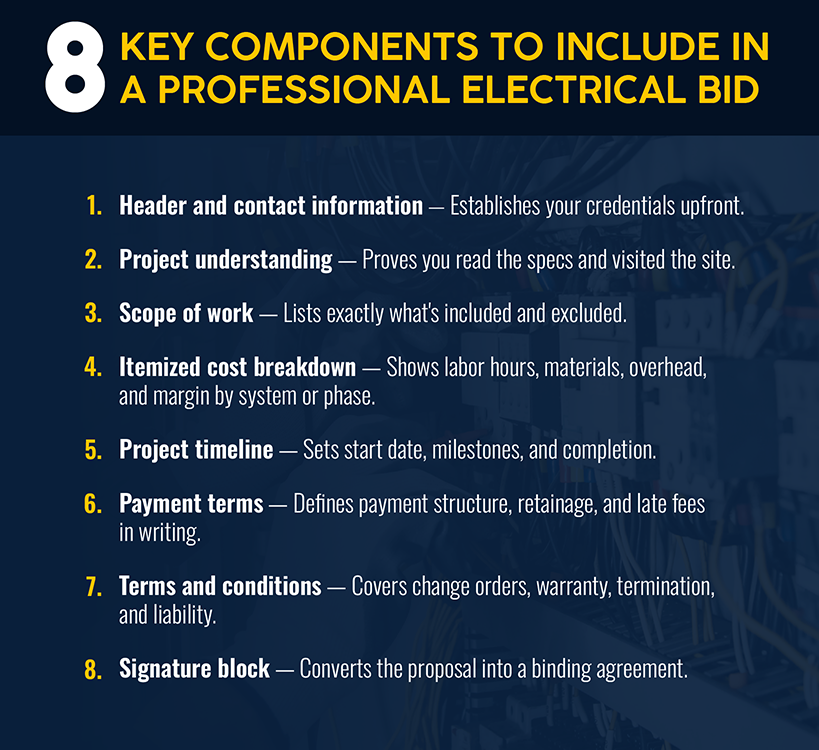
A complete electrical proposal template or commercial electrical bid covers eight areas:
- Header and contact information: Include the following: Contractor name, license number, address, phone, and email. Client name and project address. Proposal date, reference number, and validity period (30 days is standard).
- Project understanding: This short paragraph confirms your scope assumptions before pricing begins. It shows the client you reviewed the specs and visited the site.
- Scope of work: This is the most important section in the document. List every system and task included: power distribution, lighting, low voltage, panel work, conduit runs and code compliance items. Then list what's excluded. Scope gaps are where change orders happen. A tight scope-of-work definition prevents the "I thought that was included" conversation later on.
- Itemized cost breakdown: List labor hours by task, materials by quantity and unit cost, overhead allocation, and your margin. These projected costs need to be built from current data, not memory. For commercial electrical contractors bidding larger projects, break costs out by electrical system or phase. If you're doing a $280,000 tenant improvement across three floors, the GC needs to see where the money is going — and so do you.
- Project timeline: Start date, milestones, completion date. Note any conditions that could affect the schedule, such as permit lead times, material availability, client access, and coordination with other trades.
- Payment terms: Spell these out. A common structure for commercial electrical work is 40% upfront, 30% at the midpoint, and 30% upon completion. Include retainage terms for larger jobs, late-payment fees, and what payment methods you accept. Vague payment terms lead to you funding your client's cash flow problem.
- Terms and conditions: This list includes change-order provisions, warranty terms, termination clauses, liability language, and insurance and licensing references. This isn't boilerplate — it's what protects you when something goes sideways. If your current bid form doesn't have a change-order clause, you’ll probably lose every negotiation on out-of-scope work.
- Signature block: This contains the client signature, contractor signature, date, and project number. Digital signatures are increasingly standard. No signature means no binding agreement — and disputed bids are expensive.
Related: How to price electrical jobs — covering markup, overhead recovery, and labor costing in detail.
How to Customize the Template for Your Electrical Business
Now that you know what to put in the template, making it yours takes about an hour the first time, and less after that. Here’s what you need to do:
- Add your branding: Put your company name, logo, license number, and contact details in the header. A professional-looking bid form signals that your operation runs the same way.
- Update your labor rates: Use your fully loaded labor cost, not your base wage. If you haven't calculated your labor burden rate recently, do that first. Underbidding labor is the most common source of margin erosion on project work.
- Build your standard line items: Account for wiring, panels, breakers, outlets, switches, lighting fixtures and conduit. Add the materials and equipment you price most often so you're not rebuilding the list from scratch on every bid.
- Set your markup structure: This covers materials markup, equipment rental, subcontractor markups, permit and inspection fees. These should be consistent across bids.
- Build separate versions for different project types: A tenant improvement bid looks different from a new construction bid or a panel upgrade. Residential and commercial jobs have different scope complexity, code references, and legal requirements. Keep them in separate templates.
- Save reusable assemblies: Create repeatable line items for panel changeouts, lighting retrofits, and service upgrades. Doing so saves you an hour per bid that you can reallocate to field work.
Common Electrical Jobs That Need a Bid Template
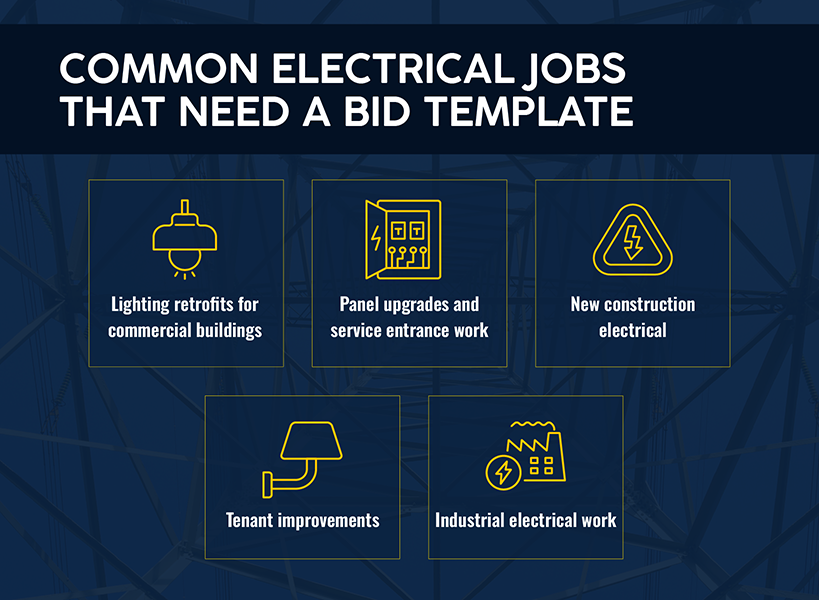
Not every electrical services job needs a formal bid. But sometimes, a standard commercial electrical bid template or electrical construction bid template is nonnegotiable:
- Tenant improvements — multiple systems, coordination with GC and other trades, phased work, milestone billing
- Panel upgrades and service entrance work — scope-intensive, permit-required, change order risk is high
- New construction electrical — multi-phase, multi-trade, often bonded; requires formal bid submission
- Lighting retrofits for commercial buildings — material-heavy, often with owner-furnished equipment that needs to be explicitly excluded
- Industrial electrical work — high labor cost, specialty equipment, safety compliance documentation required
For residential work orders and service calls, choose a lighter electrical estimate template. For anything hitting five figures or involving a GC, use the full bid form.
Related: Track the metrics that protect your margin with our guide to electrical business KPIs.
Win More Jobs With Professional Electrical Job Management Software
A static template gets bids out the door. What it can't do is price the job accurately, track whether the bid was accepted, or connect the approved proposal to the actual work.
That gap is where margin leaks. You win the job, then spend the first two weeks re-entering data, hunting down the right version of the template, and manually building a schedule from the bid you already wrote.
Simpro® replaces the manual bid workflow for electrical contractors handling both service and project work. Quote templates and pre-built assemblies — panel changeouts, lighting circuits, outlet installations — let you build a complete bid in minutes rather than hours. Supplier catalog integration pulls real-time pricing into materials costs, so you're not guessing at what wire costs this week.
The platform handles project management from bid to invoice: Once a client approves the bid, one-click quote-to-job conversion moves everything into scheduling, procurement, and invoicing without re-keying a line.
For commercial work specifically, Simpro's change-order management tracks every variation from the original scope, with client approval built in. Open quote reporting shows every outstanding bid, when it expires, and your win rate over time. That's the difference between a business proposal and a business system.
Over 24,000 businesses use Simpro to manage estimating, scheduling, and invoicing across the trades — without the manual steps that eat margin between winning a job and getting paid. If your bid process still lives in a folder of Word docs, you're working harder than you need to be.
Ready to see how it fits your operation? Schedule a demo with the team, and we'll show you what it means to have electrical job management software built specifically for contractors like you.


 Back to top