
An electrical contractor price book is the difference between quoting from a known number and quoting from memory.
Consider a job that comes in 15% over budget because labor was undercooked, material prices shifted between the estimate and the install, or the flat-rate price hadn't been updated since copper was cheaper. The work was fine. The pricing wasn't. A well-built electrician price book is how you catch those gaps — before the job starts.
Running an electrical business without a reliable price book means every estimate is a judgment call. That's manageable for a two-person shop quoting work you've done 100 times. It breaks down fast when you're running multiple crews, delegating quotes, or trying to bid more volume without sacrificing accuracy.
If you're seeing margin erosion and want to understand what's driving it and how to prevent it, keep reading.
What Is an Electrical Price Book and Why Do You Need One?
An electrical price book is the master reference document that underpins every quote and invoice you produce. It catalogs your labor rates, material costs, markups, and pre-built service packages. Pricing a panel upgrade or a commercial fit-out begins with a known baseline rather than a gut feel.
For any service business, pricing consistency compounds over time. In the short term, quoting from memory might feel fine. Long term, the margin leakage adds up. A price book is how you lock in the math once and pull from it every time.
Related: Protecting revenue and margins with AI in 2026 for electrical contractors.
How to Use an Electrical Contractor Price Book to Make More Money (It Depends on Your Pricing Model)
Your electrical pricing models determine how the book needs to be structured. When a price book doesn't match how you actually sell work, you’ll create as many problems as you solve. Moreover, the underlying cost data is often identical across all models. What differs is the structure.
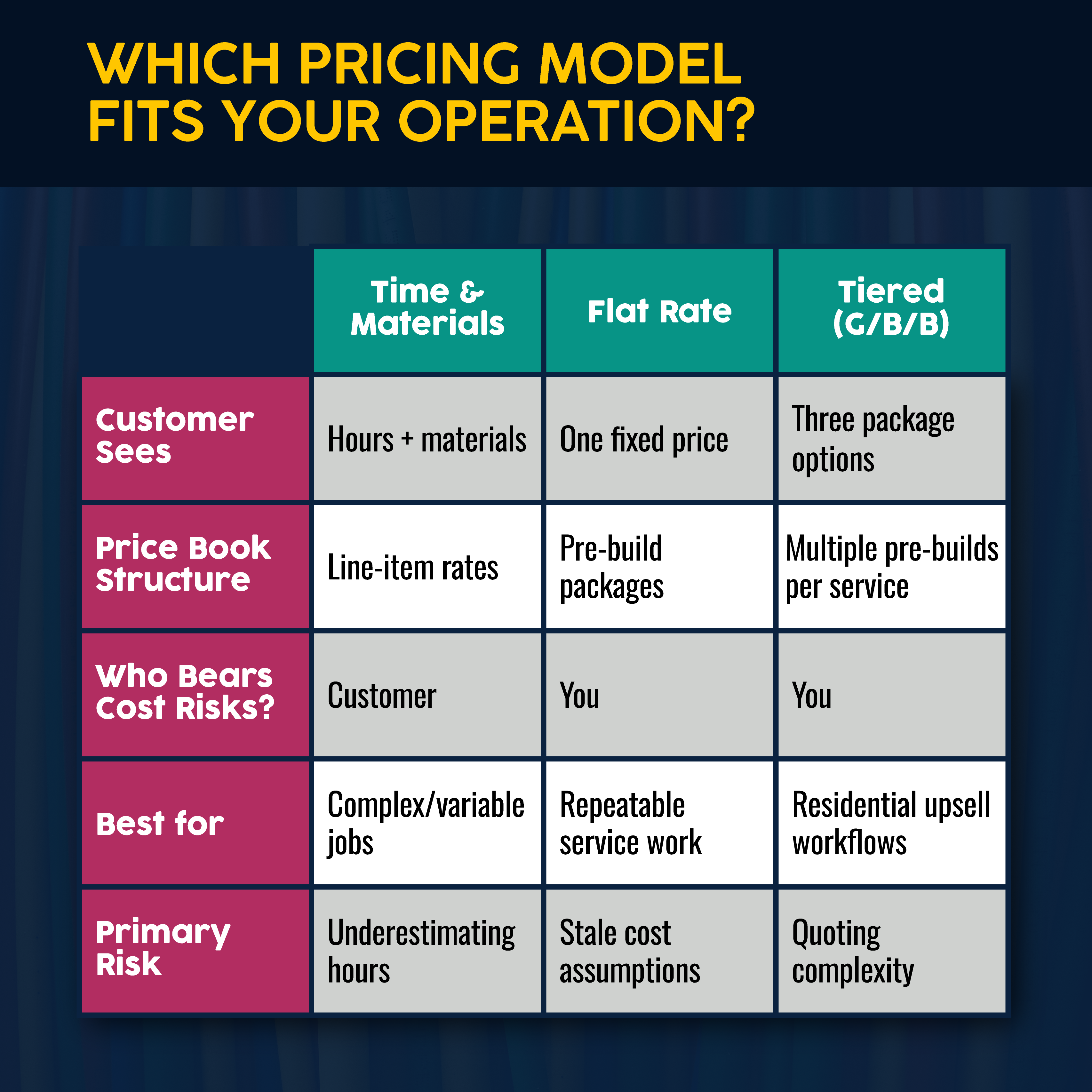
Time and Materials
Time-and-materials (T\&M) pricing means you charge for actual hours worked, plus a marked-up cost for materials. Your electrician price book needs accurate labor rates (loaded, not just base wage — more on that below) and a current supplier catalog. The total amount of time on each job informs the final invoice — when a four-hour panel swap runs 5.5 hours because the original install was a mess, the customer pays for it.
The downside: Customers can balk at variable final invoices, and your estimating accuracy has a hard ceiling on profitability.
Flat-Rate Pricing Model
A flat-rate price book sets a fixed price per task or service: $650 to install a ceiling fan, $1,200 for a 200A service upgrade, $4,500 for a whole-home rewire of a 1,500-square-foot house. The customer knows the number before you start. Your electrical service price book becomes a catalog of pre-priced jobs, each one covering labor, materials, overhead, and your target margin.
Flat-rate rewards efficiency: A tech who completes a three-hour job in two hours doesn't reduce your revenue. If your underlying cost assumptions are wrong, that's on you.
Tiered or Good/Better/Best Pricing
Good/better/best pricing involves three versions of a service at different price points, typically differentiated by materials quality, warranty length, and/or scope. A panel replacement might be: Standard (existing-grade breakers, 12-month labor warranty), Better (upgraded breakers, two-year warranty, arc-fault protection included), and Best (smart breaker panel, three-year warranty, full surge protection). Your price book needs a separate pre-build for each tier.
This approach works well for specific electrical service work and residential jobs where upselling is part of the workflow. For example, a service call for a tripped breaker is a natural opening for a whole-panel conversation.
How Your Pricing Model Shapes Your Price Book Structure
| Model | Price Book Structure | Primary Risk |
|---|---|---|
| Time & Materials | Line-item labor rates + live material costs | Underestimating hours |
| Flat Rate | Pre-built packages with margin baked in | Stale cost assumptions |
| Tiered (G/B/B) | Multiple pre-builds per service at different tiers | Complexity in quoting and explaining |
Once you know your model, you know what you're building, and you can price to protect your electrical business profit margin.
Building Your Own Electrical Price Book vs. Using Software
A spreadsheet-based price book works until it doesn't. For a solo operator with 20 standard services, a well-maintained Excel file is fine. For a 10-truck operation with hundreds of line items, three supplier relationships, and three estimators working from the same data, spreadsheets quickly become a maintenance liability.
The problems aren't theoretical: Material prices change without anyone updating row 47. One estimator works from last year's version because it's saved locally. A supplier gives you a new discount tier, but the markup math doesn't get adjusted until someone notices margins on commercial work are declining.
Related: Learn best practices for how to bid and estimate electrical jobs.
Simpro® handles things differently. More than 24,000 businesses use it to manage this kind of complexity, with contractors reporting that quote generation becomes up to 10x faster than manual methods. Here’s the core workflow:
- The catalogue establishes base costs for every part and material in your system. It's the single source of truth your quotes pull from, not a spreadsheet someone last edited two quarters ago.
- Pricing tiers and markups are set at the catalog level, so when a supplier raises copper pricing, you adjust it once. Every pre-build that uses it recalculates automatically.
- Pre-builds are your packaged jobs, either as T\&M templates with standard labor and materials pre-loaded, or as flat-rate packages with a fixed customer price. They can be built for any recurring electrical work: switchboard replacements, EV charger installs, safety inspections, data cabling runs.
- Take-off templates handle large-scale estimating for commercial and industrial jobs, where you're pricing by area or quantity across dozens of line items.
- Supplier catalogue importing lets you bring in supplier price lists and link multiple suppliers to a single line item. You can see price and discount comparisons side by side before confirming material costs.
What to Include in Your Electrical Contractor Price Book
A price book is built in layers, starting from your costs and working outward to what the customer sees. Here's how those layers stack.
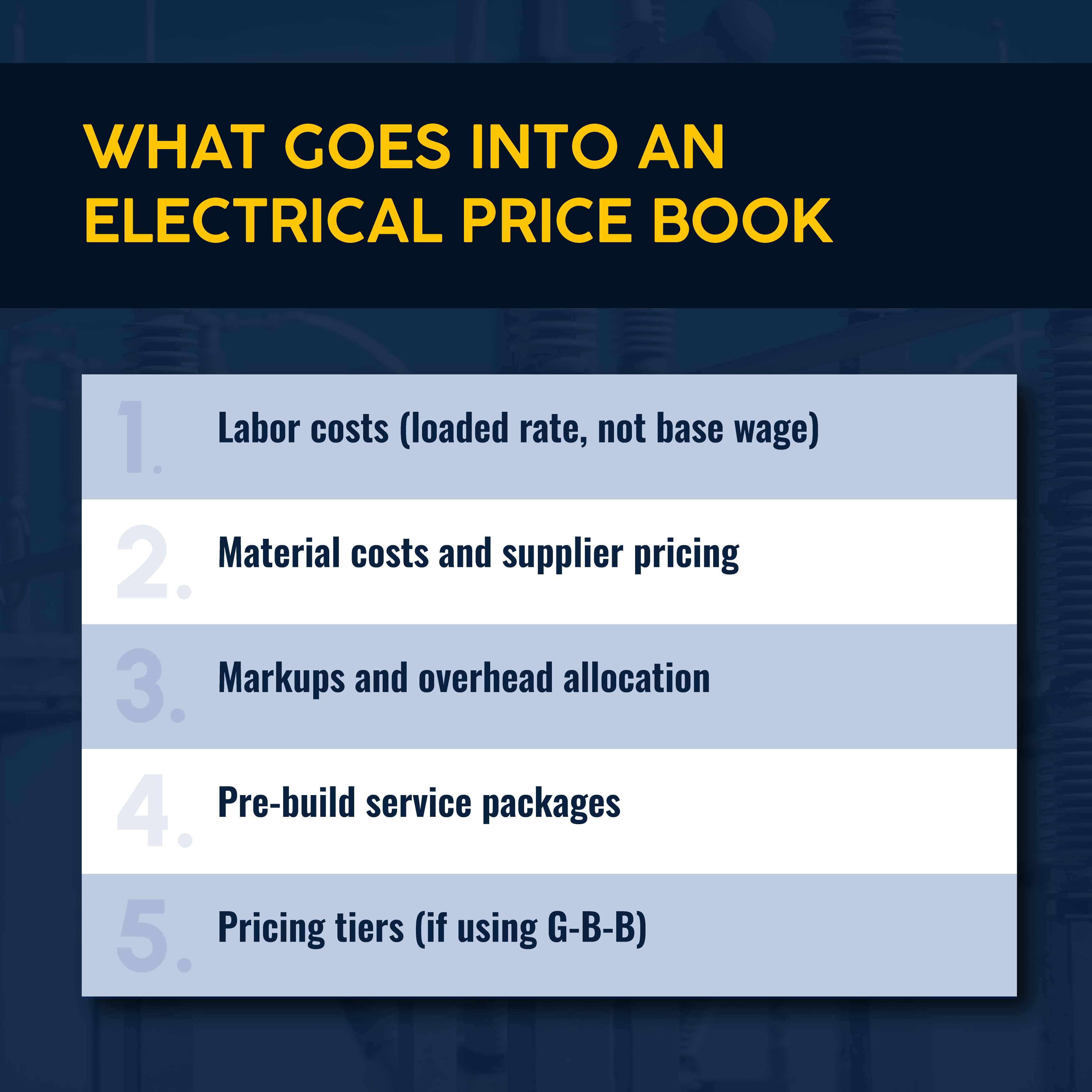
1. Labor Costs
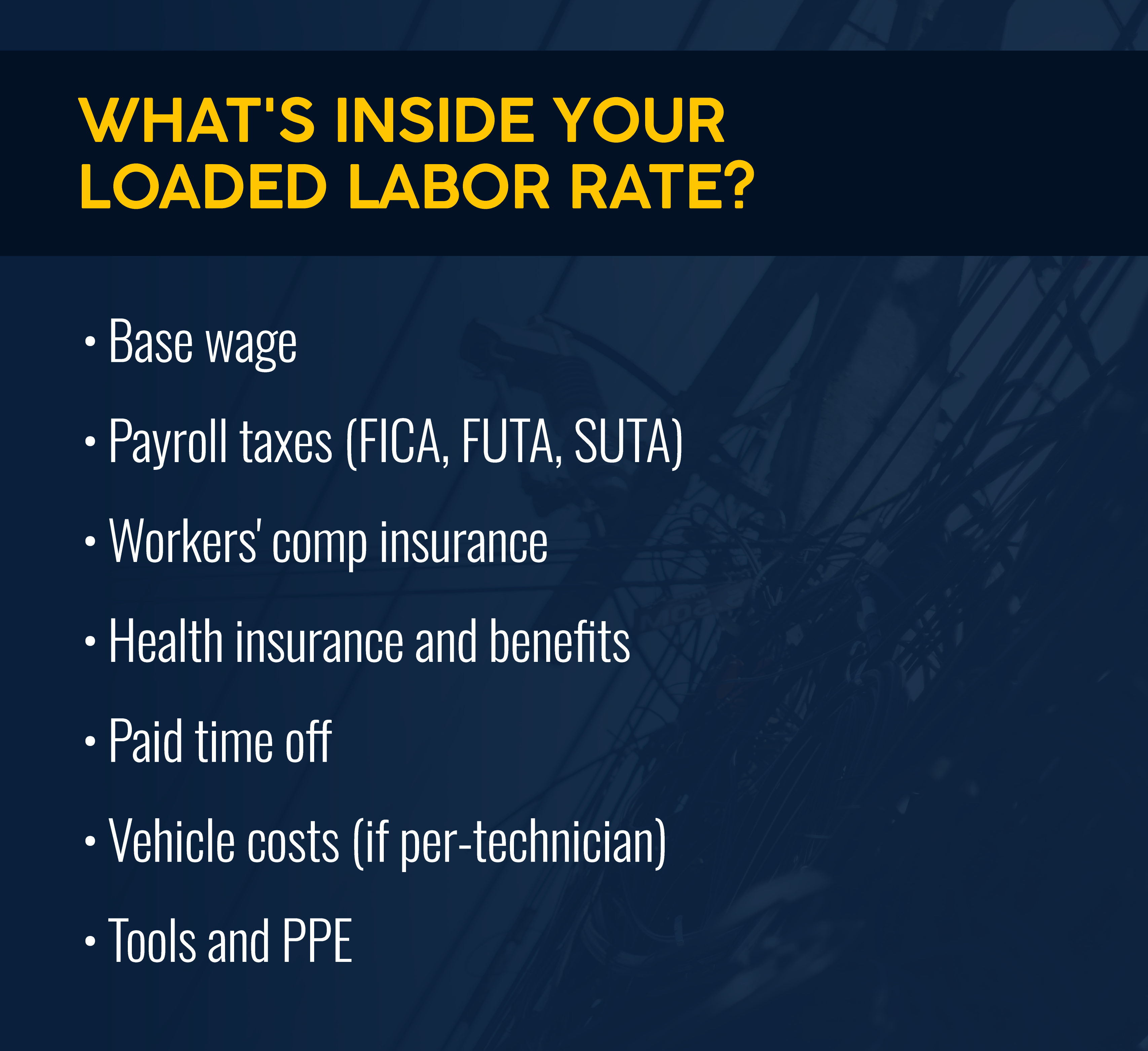
Base hourly wage is only part of the number. Your billable labor rates need to cover the full cost of having that technician on the job, which is what the labor burden rate accounts for. That includes:
- Base wage
- Payroll taxes (employer portion of FICA, FUTA, SUTA)
- Workers' compensation insurance
- Health insurance and other benefits
- Paid time off
- Vehicle costs, if allocated per technician
- Tools and PPE
For most electrical contractors, the loaded labor rate runs 1.25x–1.4x the base wage. A journeyman electrician at $38/hr base is costing you somewhere between $47.50 and $53.20 per hour before a single volt is moved. Your hourly rates need to reflect that loaded number, not the wage line on a pay stub.
Related: Try out our labor burden rate calculator.
The operational fix: Set your labor rate in the price book using your fully loaded cost, then apply your markup from there. Every flat-rate package and T\&M quote will accurately pull from that rate.
2. Material Costs and Supplier Pricing
Material costs in your price book should reflect what you actually pay your primary suppliers, after negotiated discounts. Not the list price. Not what you paid 18 months ago.
For common materials (wire, breakers, conduit, boxes, connectors), set a default supplier and a baseline price. For high-ticket or high-volatility items — copper conductors, panel boards, lighting fixtures — flag those line items for more frequent review, as commodity price swings hit them hardest.
Here's where failing to track material costs comes back to bite contractors: A 40-circuit panel replacement in August is quoted using February copper pricing, resulting in $300–$500 of additional materials costs on a midsize residential job.
If you're running multiple supplier relationships, use Simpro's side-by-side supplier comparison to pull the best price at the time of quoting, rather than defaulting to whoever you quoted last time.
3. Markups and Pricing Tiers
Your markup on materials needs to cover overhead that isn't captured in labor costs. This includes office staff, software, insurance, vehicles not allocated to individual techs, and the general cost of keeping the business running. The markup figure isn't arbitrary; it's derived from your actual numbers.
A common starting framework for electrical contractors:
- Standard materials markup: Set at the catalog level to hit your target gross margin across service work.
- Specialty or low-volume materials: Set a higher markup to account for carrying costs and order minimums. Adjust per item class in your pricing tiers.
- Subcontracted work: Typically, a 10–20% margin on pass-through covers coordination and risk.
For flat-rate pricing, your markup is implicit in the package price, but you still need to verify the math. A $650 panel switch package should be traced back to labor costs, material costs, overhead allocation, and target margin. If you set that price two years ago and haven't updated it, run the numbers.
Related: Try our electrical estimate template for structuring estimates consistently.
How to Maintain Your Electrical Price Book
When price books are ineffective, this is the most common pattern: A contractor builds a price book, uses it for six months, and then stops updating it while the underlying costs drift. A year later, the flat-rate prices are underpriced across the board, and nobody can figure out why margins are soft.
The maintenance schedule that works in practice:
- Quarterly review, at a minimum: Review all labor rates against current loaded costs. If wages went up at the start of the year, flat-rate prices need to adjust, too.
- After every significant job: Compare actual costs against estimated costs for jobs over a set threshold (say, any job over $5,000). Where the actuals consistently diverge from the estimates, the price book entry is wrong — either the labor hours are underestimated, or the material costs are off.
- When supplier pricing changes: In this instance, don't wait for the quarterly review. Update affected line items immediately. Flag any flat-rate packages that use those materials for recalculation.
- When overhead changes: New vehicle, additional admin staff, rent increase — these affect your required markup even if wages stay flat.
Simpro's price discrepancies report flags situations where invoices from a supplier differ from the price in your catalog. Supplier invoicing errors happen, and without an automatic alert, you’ll absorb those discrepancies without knowing it.
The operational fix: Put a recurring calendar block for a quarterly price book review. Treat it the same way you'd treat scheduled truck maintenance on a truck: It’s not optional, and skipping it adds unnecessary risk to your business.
How to Price Electrical Work: Essential Best Practices
An electrical contractor price book gives you the structure, but pricing decisions still require human judgment. Here are principles that apply regardless of which model you run:
- Price from costs, not competitors. Matching a competitor's flat rate without knowing their cost structure is how you end up winning jobs at a loss.
- Know your numbers before you set your price. What the market will bear and what margin you need are two separate questions. Settle the first, then answer the second.
- Don't underprice to win volume. More jobs at thin margins only exacerbate a pricing problem.
- Account for job complexity before defaulting to a pre-build. A pre-build for a standard 200A service upgrade assumes a standard install. If the panel is in a difficult location, access is constrained, or the existing wiring is noncompliant, the pre-built price becomes a starting point, not the quote.
Related: How to price electrical jobs.
Every electrical contractor reading this already knows their pricing needs tightening somewhere. The question is whether you apply a deliberate structure while everything’s going well or after a string of jobs comes in under margin.
Simpro is purpose-built for trade businesses like yours. The platform gives you a connected catalog, live supplier pricing, pre-built packages, and the reporting to catch cost drift before it hits your P\&L.
Ready to solidify your pricing? Schedule a demo to see how Simpro fits your workflow.


 Back to top