
The quote is good for 30 days, the wire ships on day 45, and the invoice carries the new price. A price discrepancy report shows which invoice lines changed before you pay.
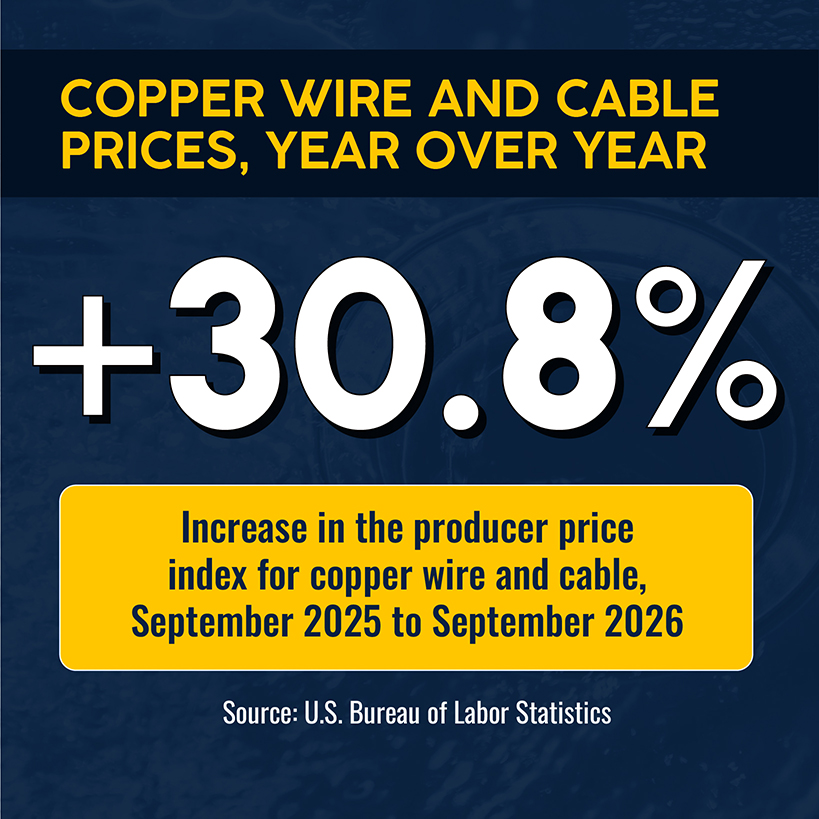
Producer prices for copper wire and cable rose 30.8% between September 2025 and September 2026, according to the preliminary BLS data. On a fixed-price job, no customer absorbs the difference between the quote and the invoice, so it comes out of your gross margin. It stays hidden when an invoice gets approved on its total, because a single line disappears into the sum.
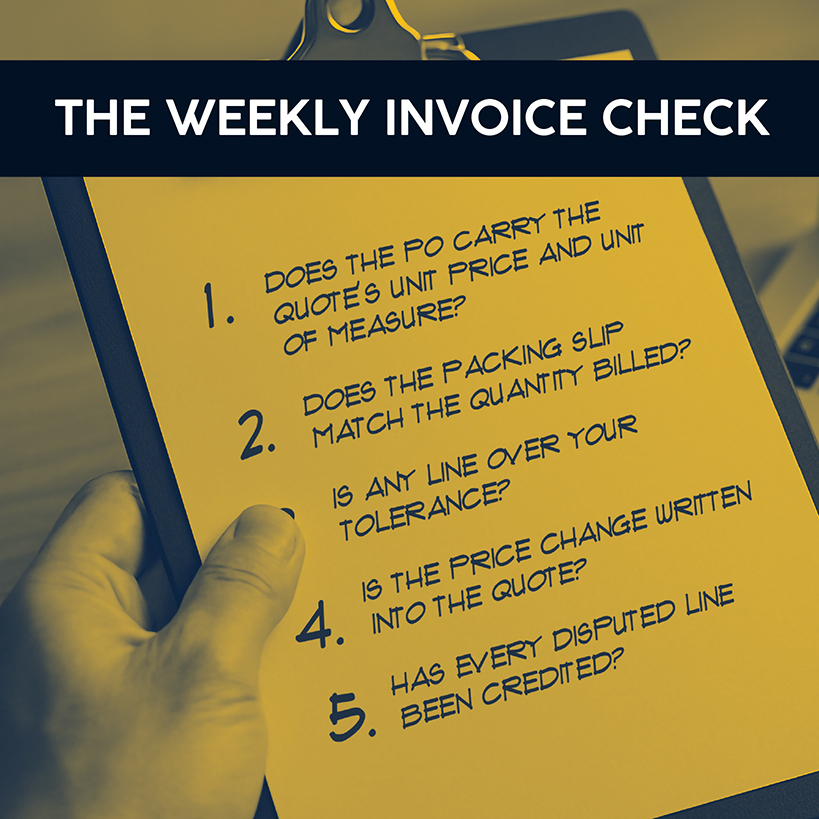
Compare the quote, the PO, the packing slip, and the invoice line by line, and supplier overcharging shows up in a short weekly exception list instead of a closeout surprise.
TL;DR
- A price discrepancy report lists every supplier invoice line billed above or below the PO or catalog price.
- Put the quote's unit price, unit of measure, and validity date on every PO.
- Run the report weekly and chase lines above your tolerance.
- Dispute with the quote attached, and get the supplier's agreement before you short-pay.
- Ask for escalation terms in writing on the next quote.
What Is a Price Discrepancy Report?
A price discrepancy report lists every supplier invoice line whose billed unit price differs from the price on the purchase order or catalog. It shows credits, updated pricing, overcharges and undercharges. Your office can approve, dispute or fix each one before payment.
A Simpro® Price Discrepancies Report compares supplier invoice costs to the PO or catalog price and lists the items that differ. Jason Wogoman, president of Middlebury Electric, said the company runs it about once a week. The company pays for Simpro with the money it saves "by catching mistakes that our suppliers have made," he said.
Related: Electrical contractors who want quoting, job costing and invoicing in one system can look at Simpro for Electrical.
Retail pricing has its own version of this gap, where the shelf tag and the register disagree. An energy supplier can overbill too. On project work, one bad price repeats across a whole bill of materials, which is why the damage runs larger there.
Why Supplier Overcharges Hurt Project Work Most
Project bids get priced from a supply house quote, often weeks before the material ships. Take a $186,000 electrical tenant buildout with $61,000 of materials. Invoices that run 3% over the quote across the bill of materials add $1,830 to cost of goods sold, about 1% of the job price. Two things make the gap bigger:
- Volume multiplies small errors. A few cents per foot of material price variance on wire, or a missing contractor discount on fittings, repeats across every release.
- Counter pickups without a PO number have nothing to match against.
Related: Read the guide to job cost variance to see how a material overrun looks once the job closes.
Under Section 2-607(3)(a) of the Uniform Commercial Code (UCC), a buyer who accepts goods has to notify the seller of a breach within a reasonable time. That time starts when the buyer discovers the breach or should have discovered it. Miss it, and you lose any remedy. An overcharge found at closeout, months after payment, is harder to recover.
How to Catch Supplier Overcharges Before You Pay
The steps run in order from quote to credit memo, and a PO without the quoted price gives the match nothing to check.
Put the Quoted Price on Every Purchase Order
The supplier's job quote sets the price, so raise every PO from it. Carry over the quote number, unit price, unit of measure and validity date, and give counter pickups a PO number too. The same UCC section says a buyer must pay "at the contract rate for any goods accepted." Write that rate on the PO so every invoice line has a price to match.
Match Each Invoice Line to the Quote, PO and Packing Slip
Lay the PO, the packing slip and the invoice side by side: the PO has the price you agreed to pay, the slip has what arrived, and the invoice has what you're being charged.
Check each line's unit price against the quote and its quantity against the packing slip, because a price-quantity mismatch on one line hides inside a total that looks right. Track partial invoices against what's left open on the PO.
Related: On the receiving side, these electrical inventory management practices cover how to track and cost materials.
Manual matching works for one supply house, but it only happens weekly when the system builds the list for you.
Run a Price Discrepancy Report Every Invoice Cycle
The report puts every line billed off the PO or catalog price in front of you, so you review exceptions instead of the whole invoice. Run it weekly. A monthly review lets a bad price repeat across several invoices before anyone sees it.
Set a tolerance worth chasing, such as $25 or 2%, and adjust it to your own volume. Say a line was quoted at $0.84 per foot and billed at $0.93 on 2,000 feet. The $180 supplier price variance on that one line is 10.7% over the quote, well past a $25 or 2% tolerance. Give the report one owner, such as the office manager at a small shop or a buyer on the procurement team at a larger shop.
In Simpro, importing and updating vendor catalogs keeps the prices the report checks against current, so the comparison runs on the POs and supplier invoices you already enter.
Related: To follow a PO from receipt to supplier invoice, look at Simpro's inventory and purchasing tools.
Some flagged lines are legitimate, and sorting those out first keeps you from disputing charges you'll lose.
Separate Real Overcharges From Legitimate Price Changes
Pricing discrepancies fall into six patterns, and each one needs a different check.
| What You See | What to Check | Treat It As |
|---|---|---|
| Expired quote | Quote validity date against the ship date | An overcharge if it shipped inside the window |
| Escalation on copper or wire | Whether the quote terms allow it and what notice you got | Legitimate only if it's written into the quote |
| Unit-of-measure mismatch | Priced per foot and billed per 100 ft, or per each and billed per box | A billing error to dispute |
| Freight or fuel surcharge | Whether the quote states freight terms | An overcharge if it's not on the quote |
| Missing contractor discount | Job-specific pricing on the quote | An overcharge to dispute |
| Duplicate billing | The same delivery invoiced twice against one packing slip | An error to send back for credit |
Escalation clauses on copper deserve the closest look, and the federal economic price adjustment clause, FAR 52.216-4, shows what a workable one contains. It calls for notice within 60 days of the change and allows no adjustment unless the net change reaches 3% of the contract price. Total increases cap at 10% of the original unit price.
Treat a line billed above the quote as an unfavorable price variance, and as an error until the supplier shows the escalation clause or written price change that covers it.
The operational fix: Tag each flagged line with one of the six reasons above, so the quarterly supplier review shows which reason repeats.
A real overcharge needs a written dispute.
Dispute the Line and Get a Credit Memo
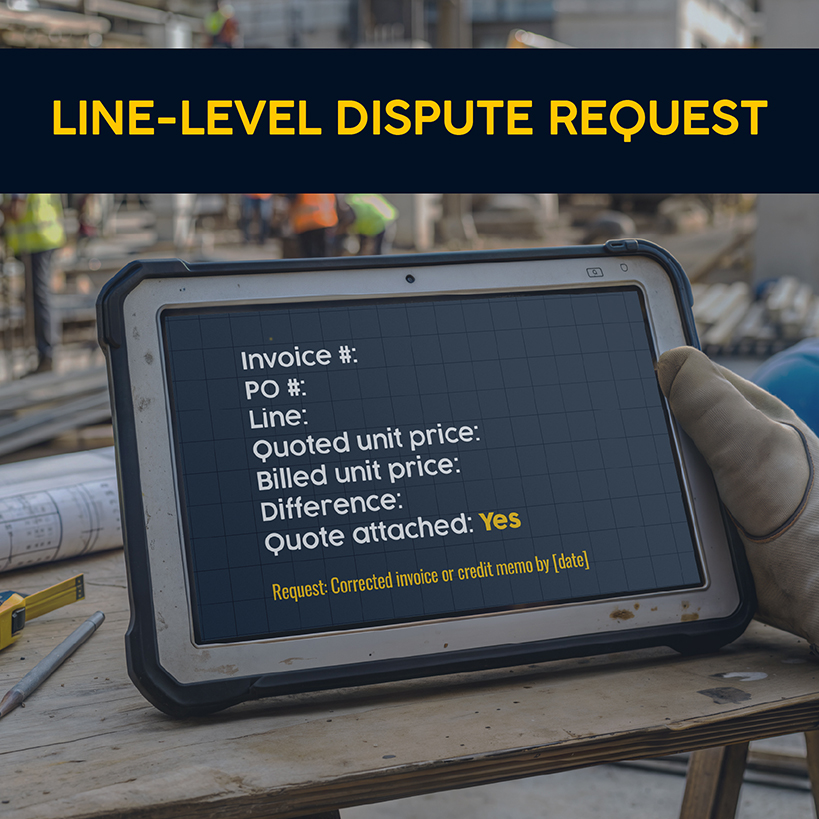
Send the dispute at the line level. Include the invoice number, PO number, line, quoted unit price, billed unit price, the difference and the quote itself. Ask for a corrected invoice or a credit memo by a specific date, and track the credit until it posts.
Get the supplier's agreement before you short-pay. UCC 2-717 lets a buyer who notifies the seller deduct damages from the price still due under the same contract. In practice, your credit terms and account agreement usually control, so read them before you deduct anything.
The operational fix: Keep one dispute template with those seven fields pre-labeled, so a flagged line becomes a dispute email with no rewriting.
The catalog needs correcting next.
Fix the Catalog So the Next Quote Is Right
If the change was legitimate, update the standard costs in your catalog or price book that same week. Otherwise, the next estimate carries yesterday's price.
Related: If your team doesn't keep one yet, start with this walkthrough of an electrical contractor price book.
Legitimate changes get easier to absorb once the supplier agrees to the terms before the job starts.
Write Price Protection Into the Supplier Quote
A quote that states its own terms leaves less to dispute later, so build these four into your pricing strategy for project bids, using the structure of FAR 52.216-4 as a model:
- A firm price for the job's duration, or a stated validity date tied to the release schedule
- Escalation only on named commodities such as copper or wire, tied to a published index, with written notice before shipment
- A threshold below which no adjustment applies, and a cap on total increases
- Freight terms and your contractor discount printed on the quote
A supply house may not agree to all four, so rank them by your exposure. On a copper-heavy job, start with the escalation terms and the validity date.
Related: Large jobs release material in stages, and this guide to commercial electrical project management covers how those schedules run.
Once those terms are in writing, every supplier invoice has something to be checked against.
Make Every Supplier Invoice Prove It Matches the Quote
Does anyone compare your next supplier invoice's unit prices to the quote before it gets paid?
Pick one open project. Run the comparison on its last three invoices. If lines come back above the quote, dispute any line the quote doesn't cover today to save money while notice is still timely.
Related: Browse the electrical supplier integrations to see which suppliers Simpro connects to.
At 3% over on $61,000 of materials, one job loses $1,830, and an invoice approved on its total never shows it.
More than 24,000 trade businesses run on Simpro. It lists the supplier invoice lines that differ from your PO or catalog price, so your office manager disputes them while the credit is still recoverable and the margin you bid stays on the job. To learn more, schedule a demo.
FAQs
What Is an Invoice Price Variance?
An invoice price variance is the dollar amount a supplier billed above or below the agreed price on a line. Accountants measure the same gap as purchase price variance (PPV). To calculate PPV, take the per-unit price gap and multiply it by the number of units on the invoice. In the PPV actual price/standard price formula, your quoted price is the standard and the billed price is the actual. On the 2,000-foot line above, that's $0.09 per foot, or $180.
What's the Difference Between a Two-Way and Three-Way Match?
A two-way match checks what the invoice charges against what the PO promised. A three-way match also checks the packing slip, so you pay only for material that reached the job. Project work needs the third check because deliveries ship in partial releases.
Can I Short-Pay a Supplier Invoice That Doesn't Match the Quote?
Get the supplier's agreement first. Dispute the line, ask for a credit memo, and read your account terms before you deduct anything.


 Back to top
