
HVAC contractors who quote installs at cost plus 40% aren’t keeping 40%. On an $8,000 install, that markup puts the quote at $11,200 and leaves a 28.6% margin. A free HVAC bid calculator that prices from margin divides the same cost by 0.60 and lands on $13,333. That’s a $2,133 difference on one install.
Markup applies to cost and margin applies to price, so the same 40% means two different amounts. The inputs widen the gap. Price a two-tech, six-hour changeout at the $29.33 paycheck wage, and the quote carries $352 of labor against $704 at the burdened rate. Spread overhead over 7,000 billable hours when you sell 6,000 and every job hour under-recovers by $9.17. Leave the permit and haul-away line off the quote, and you pay for both out of the margin you set.
A 3-ton split system changeout shows how those lines add up to one price.
How the HVAC Bid Calculator Works
An HVAC bid calculator adds equipment, materials, burdened labor, permits and disposal, and an overhead share to reach total job cost. It divides that cost by one minus your target margin to get the bid price, and it shows the markup that price implies and the break-even price, the point below which the job loses money.
Bid price = total job cost ÷ (1 − target margin)
A 3-ton split system changeout, two techs, six hours, illustrative inputs:
| Line item | Illustrative input | Cost |
|---|---|---|
| Equipment | 3-ton split system, mid-tier | $4,250 |
| Materials | Line set, pad, disconnect, whip, drain parts | $620 |
| Labor | 12 labor hours × $58.67 | $704 |
| Permit and disposal | Permit, recovery, haul-away | $350 |
| Overhead | 12 hours × $55 | $660 |
| Total cost (break-even price) | $6,584 | |
| Bid price at a 20% margin | $6,584 ÷ 0.80 | $8,230 |
| Implied markup on cost | 25.0% |
The same math works as an HVAC estimate calculator for a capacitor swap or a full system replacement, because only the line items change. Each row needs its own source, starting with equipment.
Related: Labor burden, flat rate versus time and materials, and margin targets each get their own section in our guide on how to price HVAC jobs.
How to Fill In Each Input for an Accurate HVAC Bid
Equipment and materials come off a supplier's price list. Labor, overhead and margin come from your own books.
What to Enter for Equipment Cost
Enter the delivered cost of the unit your Manual J load calculation calls for, and name the system by tonnage and refrigerant, along with its efficiency rating. EPA's May 2026 final rule lets residential and light commercial systems manufactured or imported before January 1, 2025 keep being installed until that inventory's gone.
A leftover pre-2025 unit and a current-production unit can ride on the same truck at different costs. Quote the one you'll set, since averaging the two misprices both. Materials get the same treatment, with a date attached to every price.
Related: To stop techs quoting from memory, start with an HVAC price book that standardizes pricing across every technician.
How to Get Your Materials Cost Right
List everything the install consumes at your latest supplier invoice price, and date it. BLS reports that final-demand goods prices rose 7.7% over the 12 months ended August 2026. That index covers goods broadly, but at that pace a spring price sheet's behind by November.
Related: Simpro® builds each quote from catalog items, take-off templates and pre-builds, and the estimating and quoting page shows how that works.
Labor takes more care than either, because the pay stub shows only part of what a tech costs.
How to Price Labor Using Your Burdened Rate
Multiply crew hours by a burdened labor rate, which some shops call the fully loaded rate. A crew of two on a six-hour changeout logs 12 labor hours. BLS puts the median HVAC mechanic wage at $29.33 an hour, and employers pay more.
Across private industry, BLS compensation data show $15.84 in benefits for every $36.13 in wages, about 44 cents per wage dollar, which takes $29.33 to $42.24. BLS counts employer payroll taxes inside benefits, so check the ratio against your own payroll costs before adding anything on top.
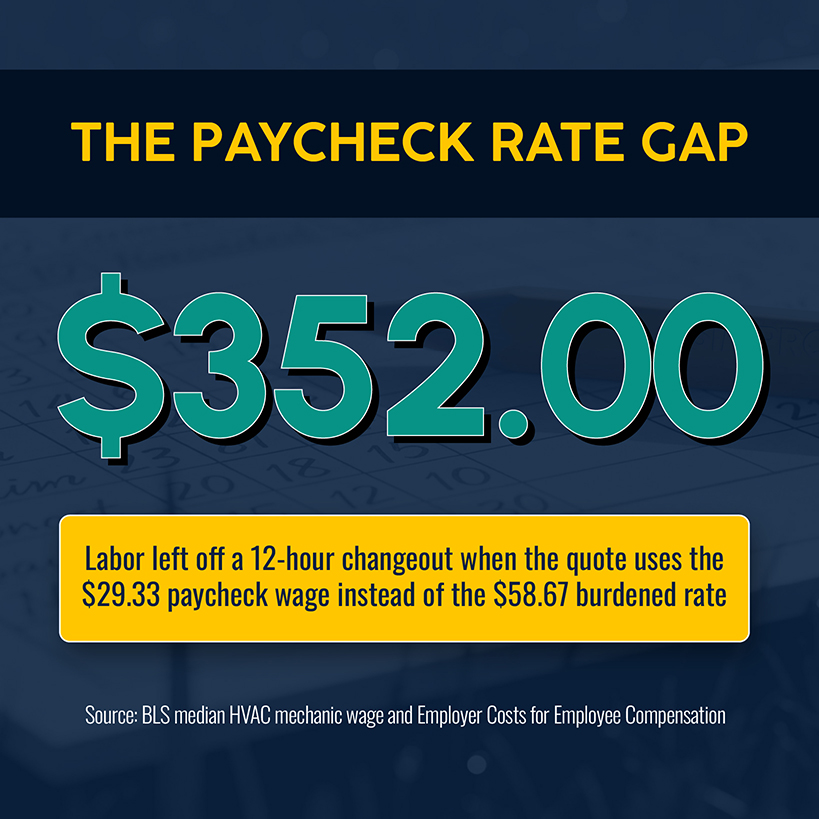
Then divide by the share of paid hours you bill. At a placeholder 72%, $42.24 becomes $58.67 per billable hour, so 12 hours cost $704. Enter the $29.33 paycheck rate and the quote carries $352 of labor, leaving $352 unpriced on one changeout. Overhead spreads across those same billable hours.
The operational fix: Pull last year's payroll register, add every employer cost per tech, divide by paid hours, then by billed hours. Rerun it each January.
How to Recover Overhead on Every Job
Divide annual overhead by annual billable hours. If your shop carries $385,000 in rent, trucks, insurance, office payroll and software across 7,000 billable hours, you need $55 from every hour sold, so the changeout carries $660. Let billable hours slip to 6,000, and the same overhead runs $64.17 an hour. Every quote still priced at $55 then under-recovers by $9.17 per job hour.
The operational fix: Pull 12 months of overhead from your P&L, divide by the billable hours on your timesheets, and enter the result. Recheck it every quarter.
A few job-specific costs still need lines of their own before the margin math starts.
Permits, Disposal and Other Costs That Belong in the Bid
Permit fees, refrigerant recovery, haul-away and a crane or lift for a rooftop set all add to the project cost before anyone touches the new unit. HVAC bids that skip them leave you absorbing the cost, and so do electrical panel upgrades when a larger unit needs more service capacity. The example carries $350 on a standard changeout, and permit and disposal fees vary based on your specific jurisdiction.
With every cost row filled, the margin field decides what the job pays you.
Related: To start with a line-item layout, use our HVAC estimate template and add permit and inspection fees as their own lines, as the page advises.
How to Choose a Target Margin, and Why It Isn't the Same as Markup
Margin is the share of the price you keep as profit. Markup is the percentage you add to cost. They connect through margin = markup ÷ (1 + markup), so the 40% markup on the $8,000 job lands at 28.6%. Overhead already sits in the job cost, so the margin you set is profit after overhead. No HVAC pricing calculator can pick your desired profit margin, so pull it from your P&L instead of whatever the last bid cleared.
| Target margin | Markup on cost | Bid on the $6,584 job |
|---|---|---|
| 20% | 25.0% | $8,230 |
| 30% | 42.9% | $9,406 |
| 40% | 66.7% | $10,973 |
Set separate targets for replacements, repairs and maintenance agreements, because a blended margin can look healthy while one division carries the rest. One block of cost rows can then price three options at once.
Related: Top performers see what each job costs before the invoice goes out, and our HVAC profit margins guide shows how.
How to Price Good-Better-Best Options in One Pass
Change only the equipment line, where a high-efficiency upgrade raises the HVAC replacement cost. Labor, permit and overhead stay put unless a higher tier adds crew hours. Every option holds a 20% margin.
| Option | Equipment | Total cost | Bid price |
|---|---|---|---|
| Good | $3,450 | $5,784 | $7,230 |
| Better | $4,250 | $6,584 | $8,230 |
| Best | $5,650 | $7,984 | $9,980 |
Profit dollars climb from $1,446 on Good to $1,996 on Best. A customer who moves from Good to Best pays $2,750 more, and you keep $550 of it at the same 20% margin. Three prices on the table invite a negotiation, so set the floor before the customer sees them.
How to Use Your Break-Even Price When a Customer Pushes Back
Break-even is total job cost at zero margin, $6,584 on the Better option. Anything above it's profit. Anything below it comes out of your pocket. If a customer asks for $7,500 on the $8,230 bid, the margin drops to 12.2% and you still clear $916 over cost. At $7,000, it's 5.9%. At $6,584 the job covers its costs and nothing more, and at $6,200 it costs you $384 to complete.
Related: The Simpro for HVAC page shows how reporting tracks estimated versus actual costs and project margins as work progresses.

Download the HVAC Bid Calculator for Excel
The Excel calculator runs the same inputs and formulas as the worked example, plus a good-better-best tab that prices all three tiers. Download the Excel calculator and keep one copy per division.
A spreadsheet carries the formula well and the price list poorly, since every supplier change means retyping a cell.
Related: Drop the final price into our HVAC bid template, which includes a scope-of-work section.
Build Every HVAC Quote From Your Price Book in Simpro
BGE Digital, a UK fire and security contractor, quoted from spreadsheets before it moved to Simpro. Its director said quotes can probably go out ten times faster than they did from spreadsheets.
Related: If you're weighing software against a spreadsheet, our roundup of the best HVAC estimating apps compares the options.
Simpro's HVAC estimating connects labor, equipment, supplier pricing and approval workflows in one quoting process. Pre-built assemblies bundle labor and equipment, so HVAC estimates can go out before the tech leaves the site. Budgeted labor and material costs show their effect on gross margin, net margin and profit and loss on each quote. With 250,000+ users, Simpro is built for the trades, including HVAC contractors.
The math prices one job, and the harder part is every quote after it, when supplier costs change on a Tuesday and your tech's quoting from the truck. Simpro puts the price book, labor cost and margin impact inside the quote, so your price tracks supplier changes without anyone updating a spreadsheet. Schedule a demo to see how.


 Back to top
