
When electrical inventory goes missing, isn't right for the job, or gets used without being billed back, the damage doesn't show up as a line item. Instead, it surprises you as a finished job that didn't make money.
The potential hit to profit can be significant: Materials typically run 25–45% of total electrical project revenue. On commercial bid work, that number hits 35–45%.
This article explains what's involved in electrical inventory management and shares 10 practices that protect job costs and reduce emergency runs. Plus, you'll learn about the mistakes that eat into margin and how a purpose-built platform solves for that.
What Is Electrical Inventory Management?
Electrical inventory management is the system you use to track, move, replenish, and cost any materials, tools, and equipment flowing through your business. This system covers the full cycle, from the warehouse shelf to the service van to the active jobsite.
Knowing how to manage electrical business inventory can be relatively low-tech for a small crew doing residential service calls — a van stock checklist and a supplier you call when you run low. But a business with five technicians, multiple vans, and concurrent commercial and service work needs more: visibility into what's on each truck, what's been pulled for which job, what needs reordering, and what each job consumed versus what you quoted.
Let's say you have a spool of thermoplastic high heat-resistant nylon-coated (THHN) wire in the warehouse. Eventually, it goes to the truck and gets pulled for a job, but if it's not logged, it might as well have disappeared. At a median net margin of 5–6%, a 2% material waste rate on $2 million spending is a $40,000 hit to the bottom line. Per National Electrical Contractors Association (NECA) estimates, poorly managed operations incur 8–12% waste, compounding the financial hit.

Related: See how the right electrician marketing strategies bring in new business for you to manage.
10 Electrical Inventory Management Best Practices
Here are the key features of operators who know how to manage electrical business inventory.
1. Standardize Your Electrical Inventory List
Before you can track inventory, you need to determine what that means. This sounds obvious until you look at how most shops actually run. The same connector gets entered under three part numbers. THHN wire gets logged by the foot in one system and by the spool in another. Duplicate stock-keeping units (SKUs) are scattered across years of supplier invoices.
The gold standard: A standardized list with consistent part numbers, units of measure, and descriptions. Start with your fast-moving items: THHN/THWN-2 wire, electrical metallic tubing (EMT) conduit and fittings, electrical boxes and covers, outlets, switches, breakers by panel series, connectors, and consumables.
The operational fix: Build your catalogue once, the right way. Consolidate duplicate SKUs, fix unit-of-measure mismatches, and establish a naming convention. Only then should you scan or count anything.
2. Organize Inventory by Warehouse, Van, and Jobsite
Your inventory doesn't live in one place, and your system shouldn't treat it that way. Bulk replenishment and staged materials live in the warehouse or shop. Daily service work is for vans. Active jobs are for jobsite staging in labeled totes or gang boxes.
Expensive, slow-moving parts belong in the warehouse under tighter inventory control. Common, high-turnover items belong on the truck. The mistake most growing electrical businesses make is treating the warehouse as the only real inventory location, which means every van is an untracked hole in your stock data.
The operational fix: Create a separate inventory location in your system for each truck and each active job-staging area. Assign techs to their vans. Stock that can't be tied to a location can't be assigned to a job.
3. Treat Service Vans as Mobile Warehouses
More than 40% of service leaders cite missing parts as a top reason for repeat visits, per IFS data. When a tech arrives at a panel upgrade without the right breakers, you're paying for a second trip, additional labor, and the delayed close. With a single truck roll costing roughly $150–$300, the costs add up.
Take a five-tech service operation where each van carries 300–400 line items. Without tracking, usage goes unrecorded, and replenishment is reactive. One tech runs lean. Another has $800 in slow-moving parts sitting in the back for six months. Neither shows up on inventory reports because vans aren't tracked.
Top-performing field service organizations consistently outperform on parts availability. The gap between them and average operations is significant, and it's almost entirely about van stock discipline.
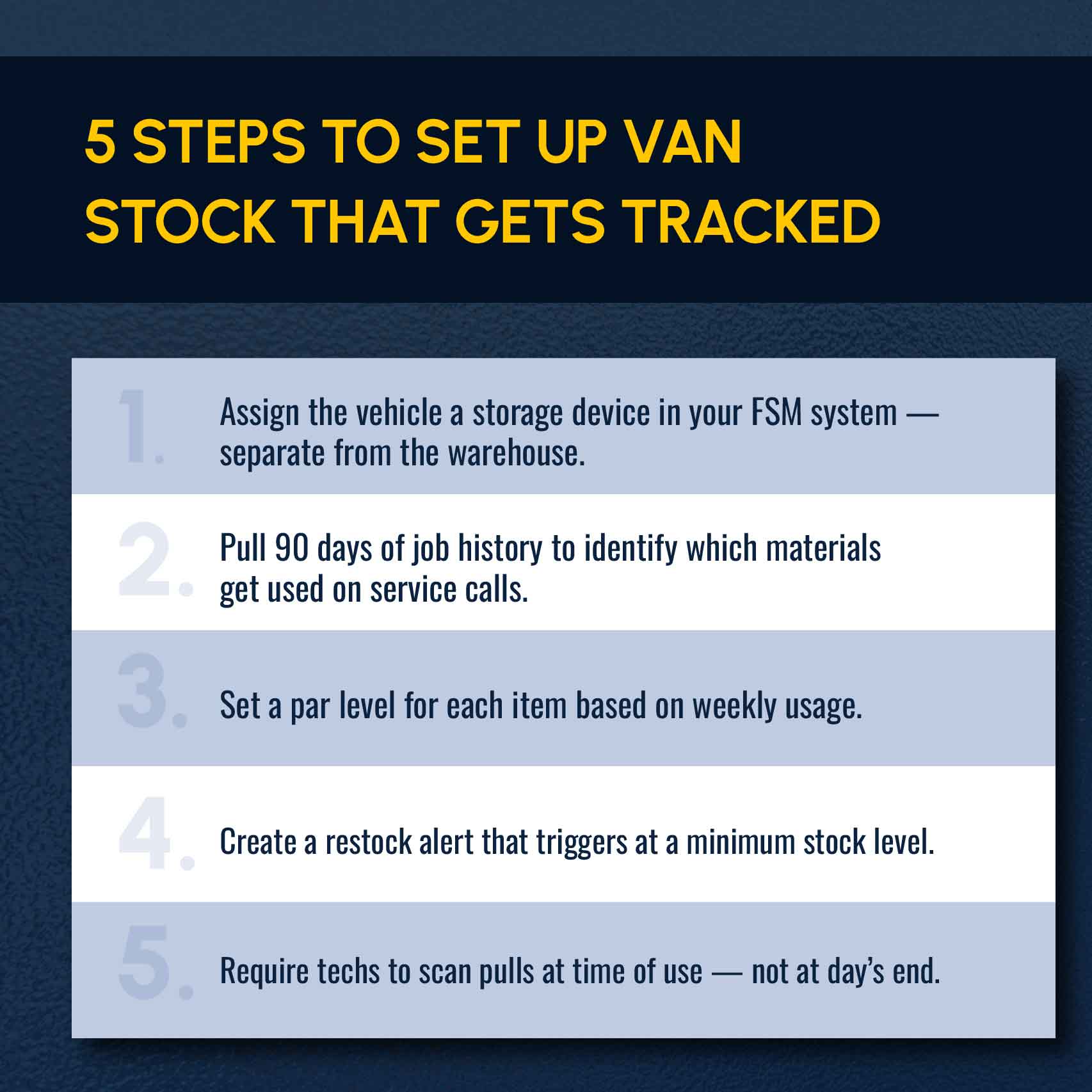
The operational fix: Set par levels for each van, assign a storage device to each vehicle in your system, and require techs to log pulls at the jobsite, rather than at the end of the day.
4. Set Min/Max Levels for High-Use Materials
Reorder decisions based on stale counts are already baked in for many operations. What that looks like in practice: Running out of THWN-2 on a Friday afternoon, which means making a premium buy and adding markup you didn't budget for, all while a tech sits idle. Prevent most of this via a min/max system of your top 50 items.
Set a minimum stock level (the quantity at which the system fires stock alerts) and a restock level (the quantity you order back to). For a 95% service level with weekly demand of 18 spools and a 16-day lead time, safety stock runs roughly 10 spools, and your reorder point is 52. Your system should surface that alert automatically. The industry average inventory accuracy rate sits around 91%, with the worst performers at 67%.
The operational fix: Set minimum and restock levels for every A-class item in your warehouse and every truck. Treat any alert as a workflow trigger: Create the product order or adjust the minimum. Clearing an alert without taking action is the same as ignoring it.
5. Link Inventory Usage to Work Orders
If materials aren't assigned to specific jobs, you're estimating margins rather than measuring them. A 12-tech business running residential alongside commercial fit-outs might have dozens of active jobs. When a tech pulls wire for a service call and doesn't log it to a work order, that cost disappears. The job invoices. The margin looks clean until quarter's end, when material purchases don't reconcile with the cost of goods.
Every part used, from connectors to conduit, must be tagged to a work order. Otherwise, you break inventory tracking and job costing. The companies running at 10–12% net margin almost certainly track materials more rigorously than those running at 5–6%.
The operational fix: Build logging into the job workflow, not end-of-day reconciliation. Techs should record materials at the time of use, on their mobile device, at the jobsite. First-in, first-out (FIFO) cost accounting ensures the correct purchase cost follows the material into the job, rather than defaulting to a catalogue price that may no longer reflect what you paid.
6. Use Barcodes or QR Codes to Speed Up Tracking
Manual stock entries are slow and produce errors. Barcode scanning at receiving, picking, stock transfer, and stocktake eliminates the human error inevitably generated by manual systems.
A warehouse manager counting 150 A and B items by hand will make errors. A tech logging 12 van pulls every day will miss some. Most importantly, scanning forces a discipline that manual logging doesn't. If a tech has to scan a part to pull it from van stock, the pull gets recorded. If they're allowed to "deal with it later," they often won't.
The operational fix: Print barcode labels at receiving, directly from purchase orders (POs). Set up mobile scanning so techs can log pulls from their phones at the jobsite. Run weekly stocktakes by scan, not clipboard.
7. Create Material Kits for Common Electrical Jobs
Most electrical businesses run the same job types repeatedly. Pre-packing kits for recurring service types saves prep time, ensures nothing gets forgotten, and cuts scrap from partial materials left over on one-off pulls.
A pre-packed residential panel upgrade kit contains the correct breakers, wire connectors, labels, and personal protective equipment (PPE) for a standard install. It's staged in a labeled tote before the tech leaves the shop. The kit invoices as a unit. Materials cost accurately, and the job moves faster.
The operational fix: Identify your five most common job types. Build pre-build assemblies or take-off templates for each in your system. Stage kits in the warehouse for same-day pickup. Techs load and go.
8. Run Regular Cycle Counts Instead of One Annual Stocktake
One annual inventory count tells you how bad things got. Regular cycle counts catch discrepancies before they compound.
The schedule follows ABC classification. A items (breakers, conductors, panels) are counted weekly, B items monthly, and C items quarterly. A contractor doing $2 million in annual material spend with 10% variance in A items has a $40,000–$60,000 accuracy problem — if that accumulates for months without detection.
The operational fix: Schedule cycle counts as standing tasks on a recurring calendar. When variance exceeds the threshold on A items, investigate immediately. Loss, miscounting, and systematic assignment errors can look identical until you dig in.
9. Track Supplier Lead Times and Material Costs
With copper, aluminum, and steel facing ongoing tariff pressures, what you paid for wire six months ago might not be what you'll pay next month. If your system assigns materials to jobs at a flat catalogue price, your job costing is wrong before the job starts.
Track actual lead times by supplier and item. Track purchase price history, too. In electrical contracting, a 3% price variation across suppliers on a $300,000 project is $9,000 of cost control that didn't happen.
The operational fix: Attach POs to jobs rather than creating standalone orders. Compare supplier prices at order time. When a material's FIFO cost exceeds its sell price on an unlocked job, update the price before the invoice goes out.
10. Use Inventory Reports to Improve Purchasing and Profitability
Your stock data is only valuable if people read it. A business with 250 active SKUs and six vans can discover patterns in usage data, such as which items consistently run out, which vans are overstocked, and which job types consume more material than estimated.
Watch these three metrics: Monthly review of stock value by location, usage variance by job type, and low-stock alert closure rate. They'll tell you where to tighten minimums, renegotiate supplier terms, and update pre-build templates. If a job type shows actual materials cost persistently exceeds the quoted cost, that's a pricing problem. The report surfaces it.
The operational fix: Build a standing monthly review into your schedule. Flag any item where actual job cost consistently beats quoted cost. That's your next margin problem.
Related: Electrical job management software handles job costing, scheduling, and quoting in one place.
Common Electrical Inventory Management Mistakes to Avoid
Most inventory failures build over time, rather than suddenly. And a few patterns account for most of the margin erosion experienced by electrical businesses.
- Not tracking van stock. The most common gap in service-heavy businesses. If it's not in the system, it's not attached to a job, and your margin suffers.
- Running one annual stocktake. By the time you catch a variance in December, you've been invoicing incorrectly for months. Class-based cycle counts keep this from compounding.
- Clearing low-stock alerts without creating a PO. Alerts only work if they drive action. If your team dismisses them to clear the dashboard, your stockout problem remains.
- Mixing breaker families in panels. NEC 110.3(B) prohibits mixing breaker brands or series in a panel. Stock breakers by the specific series installed in your customer base. This is a code issue that creates return trips.
- Creating POs outside of jobs. A standalone PO doesn't assign material cost to the job that triggered it. Your committed costs land in the wrong place, and job-level margin reporting breaks down.
- Not tracking tool and equipment inventory. A missing multimeter or an unreturned knockout set won't show up in a materials count. When tools move between techs and jobsites without accountability, they can disappear.
Related: See how AI for electrical contracting businesses is changing how contractors manage jobs, costs, and growth.

Manage Electrical Inventory With Simpro®
Over 24,000 trade businesses run on Simpro® because it treats inventory as a connected layer of the full job life cycle, not a separate module to maintain alongside jobs, quotes, and invoices.
Every truck gets its own storage device, linked to the assigned tech. Automatic alerts trigger the moment stock falls below minimum and restock thresholds. Instead of the warehouse used by many small electrical firms, you get a standing alert that fires when it matters.
POs are created within jobs, with committed costs that attach automatically. When creating a PO, Simpro surfaces potential savings from supplier price comparisons and can apply the cheapest option or consolidate across suppliers with one click. Barcode scanning works in the warehouse and in the field via mobile apps. Stocktakes run through the Barcoding website with a phone camera.
FIFO cost accounting assigns the earliest purchased goods to jobs at their original receipted cost. When that cost exceeds the sell price on an unlocked job, Simpro fires an alert before the invoice goes out.
Most electrical businesses lose margin on good jobs where the materials weren't tracked. Schedule a demo to see how Simpro connects stock, vans, and jobs into one system.
FAQs
How do electrical contractors track inventory?
Most start with spreadsheets or supplier invoices for tracking inventory, then move to purpose-built field service management software as they scale. Understanding how to track electrical business inventory at scale means switching to barcode scanning for all stock movements. Whether it's receiving, van pulls, job transfers, or stocktakes, barcode scanning ties it directly to work orders. Every part gets costed to the job where it was used.
Why is van inventory important for electrical businesses?
Parts on vans that go untracked don't get billed back to jobs, don't get replenished on a predictable schedule, and contribute to return trips that eliminate profit on service calls. Van stock discipline (par levels, scanning, storage device tracking) is one of the most important aspects of managing inventory, especially for service-heavy electrical businesses.
What are the most important electrical inventory items to track?
Prioritize items that appear on nearly every job and carry high replacement cost or code compliance implications: THHN/THWN-2 wire, EMT conduit and fittings, electrical boxes and covers, panel-specific breakers, outlets, switches, connectors, and PPE. Copper conductors and aluminum wire warrant extra attention, given the price volatility and risk of theft.


 Back to top