You run a plumbing business, and your tech calls from the driveway to say the new water heater is set, but the install needs an expansion tank that never made it onto the quote. In a plumbing estimate calculator, that tank gets its own line item, and the customer's price covers it.
Pricing from hourly rates plus a parts markup covers only what someone remembered to list, and anything else comes out of profit. Pricing from the full cost works the other way around. You total parts, materials, burdened labor, permits, disposal and overhead, choose the margin you want, and the price follows.
Work the last water heater job you quoted through those steps and compare the result with what you charged.
How the Plumbing Estimate Calculator Works
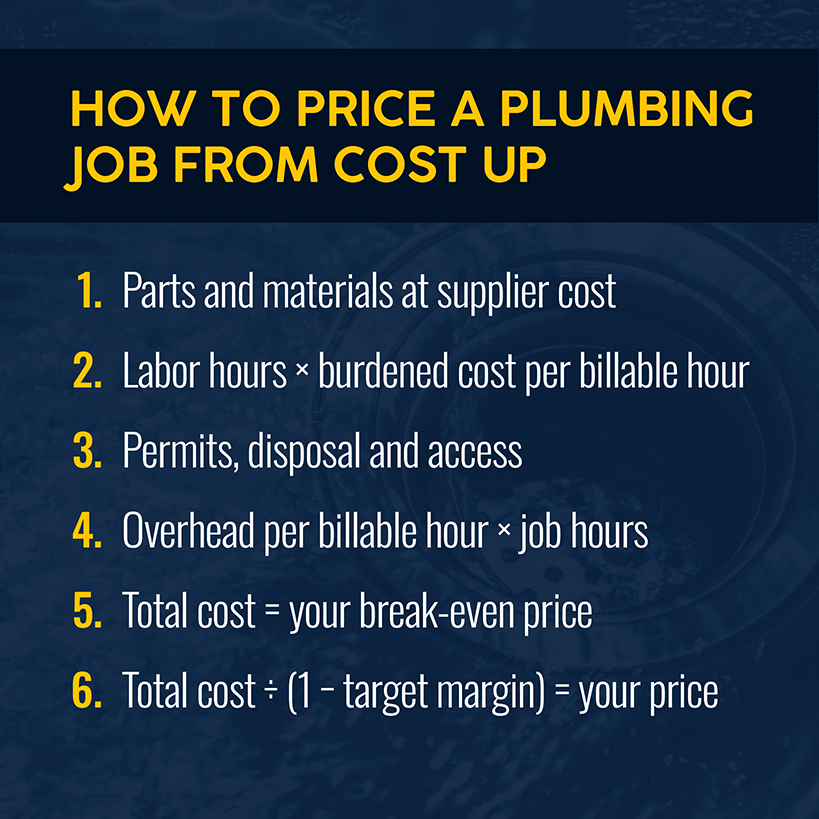
A plumbing estimate calculator totals what a job costs you (parts, materials, burdened labor, permits, disposal and overhead). It divides that total by one minus your target margin to get the price. It also reports the markup that margin implies and the break-even price. Break-even is your floor before any discount.
Price = total cost ÷ (1 − margin)
How to Fill In Each Input for an Accurate Plumbing Estimate
Each input answers one of the frequently asked questions behind a price. Each also feeds the cost the formula divides, so a number left out comes straight out of your margin.
What to Enter for Parts and Equipment Cost
Enter equipment at what your supplier charges you, then add every part the code requires for that job type. On a water heater replacement, that includes a thermal expansion device wherever a check valve, pressure reducing valve or backflow preventer sits on the supply line. The North Carolina Office of State Fire Marshal applies section 607.3 of the 2018 Plumbing Code to replacements as well as new installs. Leave the tank off the estimate, and you'll pay for it on site. Check your local code to be sure.
Refresh costs before each quote. BLS reported final demand goods prices up 7.7% for the 12 months ended August 2026. That broad goods measure isn't a plumbing index, but last quarter's invoice may already be low.
Related: To keep task prices consistent across estimators, build a plumbing price book that stores each task's labor hours and flat rate.
How to Capture Every Material the Job Needs
Capture every material by walking the job in install order, from the shutoff valve to the last fitting, and writing down every piece you'd touch. The list includes the fittings, solder, flux, thread tape, hangers and gas flex connector. Items like these typically cost too little to list on a quote, yet together they add up too fast to ignore. Price the list at cost.
Leave $30 of fittings off the water heater job, and it earns 33.6% against the 35% you've quoted.
How to Price Labor Using Your Burdened Rate
Burdened labor costs start with the base wage and add employer payroll taxes, benefits, workers' compensation and unemployment insurance. BLS reports a median wage of $30.67 an hour for plumbers as of May 2025. Its second-quarter 2026 data for construction employers, a group that includes plumbing contractors, shows $15.84 per hour worked in benefits against $36.13 in wages.
Employer Social Security tax is 6.2% on wages up to $184,500 in 2026, plus 1.45% Medicare with no wage cap. Workers' comp and state unemployment vary by state and class code, so take those from your payroll records. If you start from the BLS ratio, skip the tax rates. BLS counts legally required benefits such as Social Security and workers' comp inside its benefits total.
The BLS ratio adds about $13.45 to the $30.67 median wage, which gives $44.12 per paid hour. Divide that by the share of paid hours you bill. At 75% billable, an hour costs $58.83. At 60%, the same hour costs $73.53. Use your own time records instead of 75%.
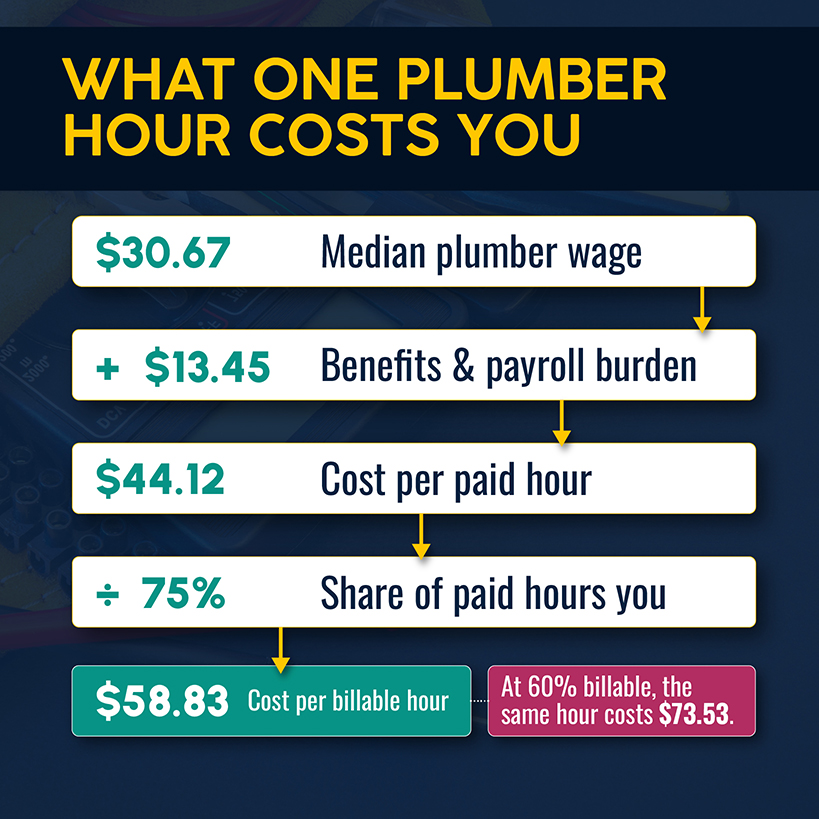
The operational fix: Pull last year's payroll register and time records, total the burden for each tech, and divide by billed hours. Enter that number as your labor rate.
Permits, Disposal and Other Costs That Belong in the Estimate
The permit fee, haul-away of the old unit, access work, patching and any drive time you don't recover through a trip fee all belong here. On the water heater job, the permit and disposal come to $125, or 5.7% of the price. Leave them off, and the price comes to $2,015. The job then keeps 28.8%, against the 35% you planned.
How to Choose a Target Margin, and Why It Isn't the Same as Markup
Choose the target from your overhead and the profit the business needs, then check it by job type, from water heater replacements to sewer line repairs. A blended margin can look healthy while some plumbing services run thin and replacements carry the quarter.
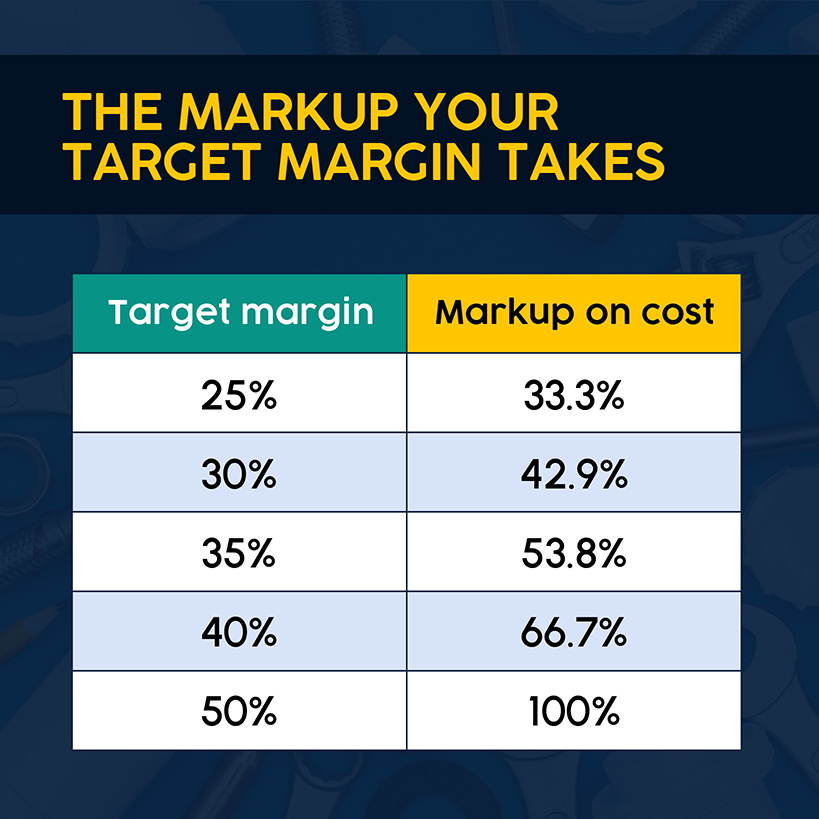
Margin is profit as a share of the price. Markup is profit as a share of cost. To convert, margin equals markup ÷ (1 + markup), and markup equals margin ÷ (1 − margin). A 35% margin is a 53.8% markup, and a 50% markup is only a 33.3% margin. Mark up the $1,435 job by 35% and you charge $1,937. That's a 25.9% margin, $270 short of a true 35%.
Related: Gross margin looks different on service work than on new construction, as this guide to plumbing profit margins explains.
How to Price Flat-Rate Service Tasks With the Same Calculator
Flat rate pricing suits common repairs, where the scope repeats. Run the formula on fixed inputs: flat price = (task parts + task hours × burdened billable rate + task hours × overhead rate) ÷ (1 − margin). Take a toilet swap, a 1.5-hour fixture replacement with $152 in parts (illustrative), labor at $58.83 an hour and overhead at $33.65 an hour. It costs $290.72 and prices at $447.26 for a 35% margin.
The hours input carries the risk. If the tech finishes in an hour, the job earns 45.3%. If it runs 2.5 hours, it's down to 14.3%. Time the task on your last ten completions before you publish the price, and pre-load code-required parts into each kit.
Related: This guide on how to price plumbing jobs covers choosing between hourly and flat-rate pricing once you know your costs.
How to Use Your Break-Even Price When a Customer Pushes Back
Use break-even as your discount floor, the price below which the job loses money. Break-even is the total job cost, including overhead, at zero margin. On the water heater job, that's $1,434.92. A customer who asks for 10% off takes $220.76 of it and pulls the margin down to 27.8%.
Decide that floor before the conversation starts.
Plumbing Estimate Calculator Example
This is the full water heater replacement run through the plumbing bid calculator. Every line item is illustrative. Labor uses the $58.83 billable cost per hour, and overhead assumes $210,000 a year across 6,240 billable hours (four technicians, 75% billable), or $33.65 an hour.
| Line | Calculation | Amount |
|---|---|---|
| 50-gallon gas water heater | $780.00 | |
| Expansion tank (code) | $65.00 | |
| Materials (fittings, gas flex, vent parts) | $95.00 | |
| Labor | 4.0 hours × $58.83 | $235.32 |
| Permit | $85.00 | |
| Disposal of old unit | $40.00 | |
| Overhead | 4.0 hours × $33.65 | $134.60 |
| Total cost (break-even) | $1,434.92 | |
| Price at 35% margin | $1,434.92 ÷ 0.65 | $2,207.57 |
| Profit | $2,207.57 − $1,434.92 | $772.65 |
| Implied markup | $772.65 ÷ $1,434.92 | 53.8% |
At $110 an hour for 4 hours plus a 30% markup on $940 of parts and materials, the hourly-plus-markup quote comes to $1,787. The $110 rate is only $17.52 above the $92.48-an-hour the job costs with overhead. So the quote keeps $352, a 19.7% margin, where the calculator's price keeps $773.
Related: Commercial jobs that go out as binding offers call for a plumbing bid template with a formal scope and payment schedule.
Download the Plumbing Estimate Calculator for Excel
The workbook is a cost calculator with an input for each cost in the formula and a price at your target margin. A flat-rate task tab lets you build prices for repeat jobs once and reuse them. It's a plumbing pricing calculator you keep in a file.
Related: Once the workbook returns a price, send it to the customer using a free plumbing estimate template in your preferred format.
Any spreadsheet has an upkeep problem: supplier costs change in the file only when someone re-enters them. Plumbing estimating software such as Simpro® imports supplier price files directly, so the material cost behind each estimate updates automatically.
Build Every Plumbing Quote From Your Price Book in Simpro
Simpro's estimating and quoting tools hold these inputs as catalog items, takeoff templates and pre-builds. Pre-built assemblies bundle labor and materials for common work like water heater replacements, so plumbers can quote in the field. Estimators view budgeted labor and material costs to see the impact on gross and net margin.
Related: If you're weighing tools, this comparison of plumbing estimating apps matches each one to the size and type of shop.
Foster Plumbing in Colorado built a catalog of more than 7,000 items in Simpro. Its estimators produced up to 25 tenant improvement bids a week. Amy Carnrick, the former CEO, said the team stopped losing money on projects almost entirely once it could watch costs in real time.
Tomorrow's quote will only use the price you just worked out if your costs are in front of the estimator while they price the plumbing work. Inside Simpro for plumbing, those assemblies sit alongside live supplier pricing and cost visibility while the quote takes shape. Plumbing companies are among the more than 24,000 businesses that already use Simpro to run their operations. Schedule a demo to learn more.


 Back to top
