
Your project manager finds out a job is bleeding margin only three weeks before closeout, staring at a work-in-progress report that doesn't match the agreed-upon number. Worse still, there's no obvious moment they can point to and say, "That's where it went wrong."
This commercial electrical project management guide is meant to prevent this situation from happening to you with 12 controls that catch problems before they compound at every stage, from the estimate handoff through the final invoice.
You'll come away knowing how to manage commercial electrical projects at any scale, whether you're managing multi-site projects or running a single crew.
12 Ways to Manage Commercial Electrical Projects With Greater Control
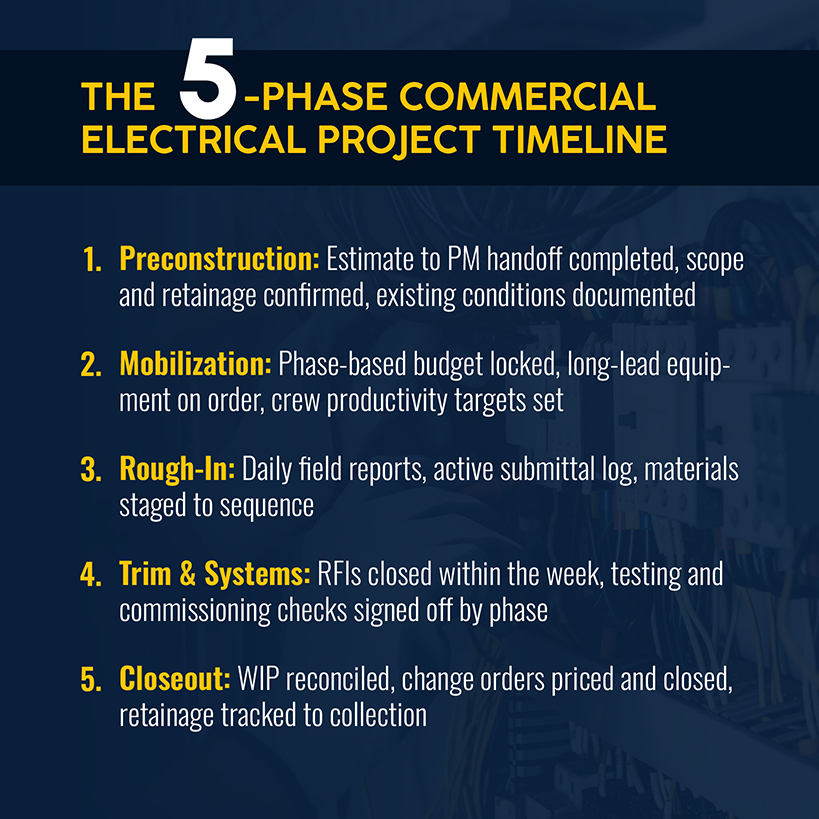
This list follows the chronology of a commercial job, because a gap at step one will keep showing up in later phases as a number nobody can explain.
1. Start With a Formal Estimate-to-Project Handoff
Estimating errors cause 32% of cost overruns industry-wide, according to cost overrun analysis research. Many of these overruns don't surface until the crew examines the approved plans.
Prevent that gap with a formal handoff where the estimator walks the project manager through bid assumptions, unit pricing, and excluded scope in a sit-down meeting. This catches problems before crews mobilize and aligns every team member on the same numbers. Add a second handoff from the project manager (PM) to the field supervisor once the schedule is set; this meeting covers crew size, sequencing, and site-specific safety requirements.
Consider a $1.8 million office build-out. In that second handoff, a foreman learns that the ceiling grid isn't in yet and that metal clad whip lengths need to change. The problem gets fixed before work begins, not two weeks into rough-in.
The operational fix: Before the crew mobilizes, have the PM confirm unit pricing and excluded scope directly against the bid documents, not from memory or a hallway conversation. With Simpro®, your quoting module keeps that pricebook and cost history attached to the estimate, so the PM works from the same numbers the bid was built on instead of reconstructing them after the fact.
Related: If your team is still rebuilding estimates by hand, learn how to standardize the electrical estimating process.
2. Confirm the Scope, Contract Terms, and Project Responsibilities
Before mobilizing a crew, confirm the electrical scope on the drawings, including what's excluded (temporary power, low voltage, fire alarm if it's a separate sub), and who owns coordination with mechanical, plumbing, and fire protection.
Retainage terms (typically 5% to 10% withheld from every progress payment until substantial completion) get locked in at this stage, along with the request for information (RFI) turnaround time as noted in writing by the general contractor (GC). Finalizing these terms early helps build trust with a GC before the job gets difficult.
The operational fix: Before work begins, make sure to get accurate documentation of existing conditions. Reduce RFIs by verifying dimensions, agreeing on mechanical, electrical, and plumbing (MEP) routing, and photographing and logging structural elements before closing up walls.
3. Convert the Estimate Into a Phase-Based Project Budget
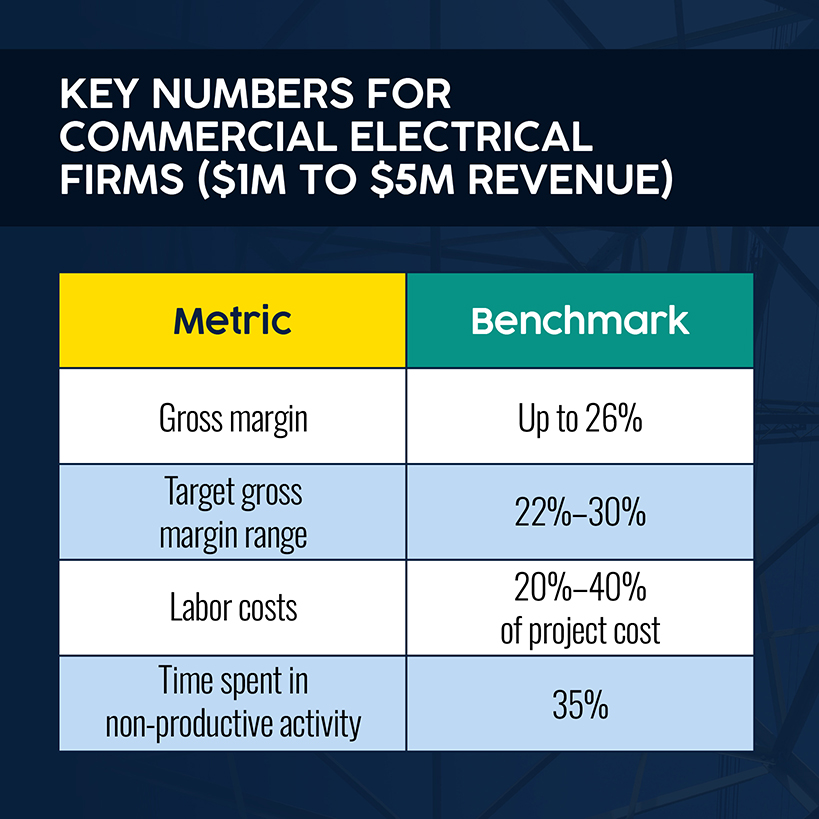
Gross margin on commercial electrical work runs about 25% for firms at $1 million to $5 million in revenue before accounting for overhead, according to gross margin benchmarking for commercial subcontractors. But those numbers only hold if you separately price rough-in, trim, gear, and underground work. A single blended rate hides which phases are profitable and which hurt the job's margin.
Break the estimate into phase-based budgets before the first purchase order goes out — each with distinct labor hours, material allowance, and target margin — so you control costs at every phase instead of guessing at closeout.
The operational fix: Track cost and revenue against budget by phase and cost code, not just by job total, so a money-losing phase shows up in week three instead of at closeout. Simpro's job costing tracks actuals against budget at the phase and cost-code level, which gives electrical contractors the long-term discipline required to maintain high gross margins instead of wondering why they're sliding toward break-even.
4. Build the Schedule Around Electrical Dependencies
Roughly 60% of major construction projects miss their cost and scheduling goals, according to research into cost overruns. One common reason is that the schedule is built around the GC's master schedule rather than the electrical trade's sequence of dependencies.
Here's an example worth flagging: Drywall is scheduled two days after rough-in inspection, but the inspector isn't due on-site until the following week. That's a scheduling conflict you need to raise before the GC blames you for missing a milestone.
The operational fix: Build a three-week look-ahead that ties every electrical milestone (rough-in, trim, gear set, testing) to the trade it depends on and the trade waiting on it. A project schedule that accounts for those dependencies keeps the project on track even when the GC's master schedule shifts.
5. Plan Labor by Phase, Crew, and Productivity Targets
Labor typically runs 20%–40% of total project cost, depending on complexity. Complex commercial work with heavy MEP coordination (such as healthcare and lab projects) runs near the top of that range at 35%–45%, according to research into construction labor costs. This makes labor the largest controllable line item on almost every bid — and the hardest one to control right now.
The U.S. employed 818,700 electricians in 2024 and will see 81,000 electrician openings every year through 2034 — a 9% growth rate not being met by today's apprentice pipeline. Replacing departed or retired electricians is tough enough, but replacing their technical expertise takes years even for the best apprentices.
The operational fix: Treat crew availability as a planned schedule input. Before mobilizing, set a productivity target by phase (labor hours per fixture, per panel, per linear foot of conduit) using your own job history. Staff each phase to that target instead of whoever's available that week.
For example, a six-person crew running rough-in on a 60,000-square-foot office build-out needs a different productivity target than the same crew running trim. Budgeting both phases at one blended labor rate leads to poor planning that shrinks margin.
6. Order Long-Lead Equipment Before It Threatens the Schedule
Electrical equipment lead times are increasing, with panelboards carrying lead times of 20+ weeks and switchgear running 40+ weeks — and the clock doesn't start until the order is placed.
The wave of data center construction makes managing large electrical construction projects even more important. Electrical work already accounts for 45%–70% of data center construction spending, and that demand is pulling manufacturing capacity and labor availability toward megaprojects and away from standard commercial work.
Consider a $650,000 healthcare renovation with a single main switchgear replacement. Ordering the week that submittals are approved instead of waiting until the purchase order can shave weeks or even months off the close. The difference shows up in the project timeline you gave the GC at kickoff.
The operational fix: Build long-lead procurement into the schedule at the estimate stage. Flag every item with a lead time over eight weeks, and get it on order the moment the submittal comes back rather than when the field crew is ready to set it.
7. Organize Materials Around the Installation Sequence
Prefabrication is one of the best ways to offset both the labor shortage and shrinking crew availability. Controlled shop environments can improve labor productivity to 70%–80%, compared with field averages of 45%–60%. And increasing prefab utilization to even 20% can lift profit margin from 13% to 17.3%, according to ELECTRI International research on prefabrication.
Many contractors know this but don't act on it because they assume prefab requires a dedicated facility and capital, which most shops with $2 million to $5 million in revenue don't have sitting around.
Here's what to do instead: Pilot the repeatable assemblies (MC whips, device boxes, stub-ups) for the electrical systems you build most often and run it out of underused warehouse space. Assign this to a supervisor who wants to make it work rather than whoever has the most tenure.
The operational fix: Stage materials by installation sequence rather than by delivery date. Rough-in materials should hit the site as the work begins, not three weeks earlier.
8. Control Drawings, Submittals, RFIs, and Field Changes
Nearly half (48%) of construction rework traces back to poor field-to-office communication and subpar project data, according to research on construction communication breakdowns. One of the most common causes is when crews work from outdated drawings.
Start closing this gap by creating a submittal log with sequential numbering to track every product data sheet, shop drawing, and panel schedule from the moment the PM reviews the plans. The other half? Pushing the current drawing set to every field device in real time instead of relying on the crew to check for updates.
The operational fix: For RFIs, standardize the template, reference the precise drawing and detail number, and hold a weekly review to answer questions rather than letting them linger. Use formal MEP coordination and clash detection to flag conflicts before they hit the job site, such as a ceiling-plenum clash between electrical, mechanical, and fire protection.
9. Keep the Office Informed With Daily Field Reporting
Across construction, professionals lose 35% of their time to unproductive activities, according to research on construction productivity. Much of that lost time involves information that exists somewhere (text chains, a photo on someone's phone, a note in a foreman's truck) but never makes it into a shared system that the office can access.
You need faster, real-time data capture, such as daily field reports (crew present, hours worked, work completed, materials used, delays encountered) captured on the job rather than reconstructed days later.
The operational fix: Standardize the daily field report into a five-minute form the foreman fills out before leaving the site, including the crew present, hours, work completed, materials used, and any delays. Require it the same day, not the next morning. Simpro's mobile app captures that report from the field, so the data lands in the same system the PM and office are already working from, instead of getting reconstructed from a text chain two days later.
10. Protect Safety and Quality Throughout Installation
A code violation that's missed at rough-in and not caught until final inspection means reopening a wall. Meanwhile, a near-miss that turns into a recordable incident can shut down a crew while OSHA paperwork gets filed.
Build code compliance checks and testing (megger testing, torque verification, panel labeling) into the schedule at the phase where the work happens, rather than as a punch list item at closeout. Assign one person, usually the field supervisor, to sign off on each phase before moving on to the next one.
The operational fix: Catching a mislabeled circuit during trim costs an hour. Catching it during commissioning after the ceiling is closed costs a lot more. Build these checks into the schedule to ensure successful projects that stay on track, on time, and on budget.
11. Document and Approve Change Orders Before Extra Work Expands
Tight control of change orders and material procurement is one of the best ways to control gross margin. Fixing this drift usually requires one simple habit: sending a change order whenever site conditions differ from what was bid, rather than absorbing small deviations as goodwill and letting them compound.
A $40,000 conduit reroute absorbed as a favor on month two of a 10-month job doesn't feel like much in isolation. But 10 of those throughout the project create a margin problem that shows up at closeout without a paper trail. Document the change and get it priced and approved before the extra work starts, not after.
The operational fix: Track every open change order the same way you track an unpaid invoice, using project management software that flags anything left unpriced for more than a few days.
Related: For a deeper look at where margin leaks on electrical jobs, check out Simpro's guide to protecting revenue and margins with AI.
12. Track Financial Performance Through Billing and Closeout
A work-in-progress (WIP) report shows contract value, estimated cost, costs incurred to date, and billings to date for every open job. It's possibly the most important financial report in construction accounting, and updating it monthly rather than annually makes it useful instead of a historical record.
In construction management, a job's financial position still matches its physical progress. The real value of the WIP report lies in catching an underbilled job before it becomes a cash problem.
Bill stored materials and gear deposits as they're incurred, rather than carrying that cost until the next milestone. Price long-lead procurement into your payment terms rather than accepting them by default. Retainage is one of the biggest cash drains for growing electrical contractors — tracking it by job and by GC is just as important as tracking labor cost.
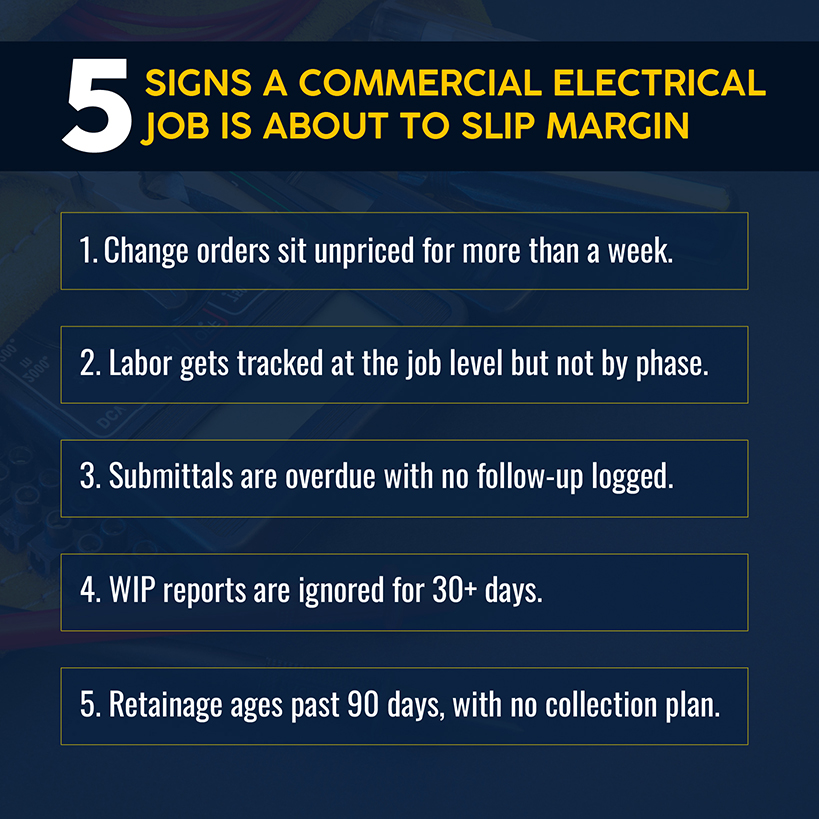
The operational fix: Update the WIP report monthly for every open job, and flag any job where billed-to-date falls more than one billing cycle behind percent-complete. That gap is the earliest signal of an underbilled job, weeks before it shows up as a cash problem. Simpro's invoicing supports milestone and percentage-of-completion billing along with retainage tracking, so that WIP position is visible without needing multiple spreadsheet pulls to reconstruct it.
Related: DC Electrical Group moved from paper processes to a single platform that enables seamless internal reporting across three businesses and more than 60 employees.
Commercial Electrical Project Management KPIs to Review Every Week
Electrical project planning doesn't stop at kickoff. These commercial electrical project management tips only work when someone monitors progress each week rather than letting issues linger until month-end.
Here are key performance indicators (KPs) that are worth five minutes in Monday's PM meeting.
| KPI | What It Tells You | Why Weekly Matters |
|---|---|---|
| Labor hours vs. budget, by phase | Which phase is drifting from its productivity target | Catch an overrun in week two versus phase closeout. |
| Open RFI count and age | Whether field-to-office communication is keeping pace | An RFI open for more than a week becomes a schedule risk. |
| Change orders pending pricing or approval | Unbilled scope sitting in limbo | Every unpriced week is margin exposure without an invoice behind it. |
| Submittal status (submitted, approved, outstanding) | Whether long-lead items are on track | A missed submittal window can delay already long lead times. |
| Billed vs. earned (WIP position) | Whether the job is overbilled or underbilled relative to progress | Underbilling compounds every week it goes uncorrected. |
| Retainage outstanding by job | Cash tied up and not yet collectible | Aging retainage is the clearest early signal of a cash-flow squeeze. |
Related: Simpro's electrical business KPIs guide covers the full set of margin-protecting metrics, especially if you're building a dashboard from scratch.
Build a Repeatable System for More Profitable Electrical Projects
Many PMs already know how to manage commercial electrical projects. The gap is usually consistency. PMs might enforce estimate handoffs on the $400,000 jobs but skip them on the $80,000 jobs. Perhaps they track WIP for projects deemed risky but let it slide on the "easy" jobs. That inconsistency opens the door to margin leaks across the portfolio.
A connected operating platform turns best practices into a consistent system that your PMs can apply across the project lifecycle, rather than remembering them each time. When quoting, scheduling, job costing, inventory, and invoicing are live on one platform, the numbers on the estimate remain the same at closeout. Simpro customers report 25% revenue increases and 10x faster estimates on average, and those gains come from removing manual entry and rekeying that create discrepancies and slow down your people.
Project success in commercial electrical work comes down to following these 12 practices the same way on every job, whether it's worth $80,000 or $8 million. Schedule a demo to see how Simpro keeps that consistency without adding headcount to your back office.


 Back to top