
This guide covers the top options for HVAC contractors and technicians in 2026: what each tool does well, who it's built for, and what to watch out for.
These apps turn a process that once took 2–4 hours into something a technician can complete on-site in 15 minutes. Customers can approve a professional proposal with accurate labor rates and live material pricing — all before the tech departs.
There’s a platform that fits your needs, whether you're running a residential service business, managing commercial HVAC projects, or something in between.
TL;DR Comparison Table
| App | Best For | Key Strengths | Pricing |
|---|---|---|---|
| Simpro® | All in one: service + projects | Full job life cycle, job costing, takeoffs | Priced for your workflow |
| Service Fusion | Multi-tech teams on a budget | Flat-rate pricing, GPS fleet tracking | Depends on tier |
| QuoteSoft | Mechanical/ductwork estimators | Precision ductwork takeoffs | Custom |
| Trimble Accubid | Large commercial MEP | 40,000+ item database, live extensions | Depends on tier |
| Housecall Pro | Small residential teams | Ease of use, fast mobile quoting | From $59/mo |
| Jobber | Budget-conscious SMBs | Simplicity, affordability, automations | From $29/mo |
| FieldEdge | Flat-rate + service agreements | Pricebook depth, QuickBooks integration | ~$100-$125/user/mo |
| BuildOps | Commercial-only contractors | Multi-crew, commercial-specific workflows | Custom |
Compare the Best HVAC Estimating Apps
Pricing transparency matters. Where published pricing exists, it's included. Where it doesn't, that's noted.
Top HVAC Estimating App Choices for 2026
Simpro — Best All-in-One HVAC Estimating Platform
Simpro is a purpose-built field service management (FSM) platform for the trades: HVAC, plumbing, electrical, and fire protection. Where most tools help you build an estimate, Simpro connects that estimate to everything thereafter: scheduling, purchase orders, field execution, invoicing, and financial reporting. That's not a marketing claim — it's the architecture. When a quote becomes a job in Simpro, the data flows forward automatically.
For HVAC businesses managing residential service calls, maintenance contracts, and larger HVAC projects, that connectivity is what protects your margin. Whether you're quoting a single HVAC system replacement or a multi-phase commercial install, you enter labor rates just once. Plus, you save time previously spent reconciling what was quoted versus what was spent.
Key estimating features:
- Quote templates and pre-builds for faster, more consistent proposals
- Catalog-based material pricing, with labor and materials in one view
- Simpro Takeoffs add-on: digital blueprint markup, symbol recognition, and material quantity extraction that syncs directly to quotes, purpose-built takeoff software for HVAC, plumbing, and electrical
- Breakdown Table showing actual vs. estimated margins in real time
- Full quote-to-job-to-invoice life cycle that eliminates manual data re-entry
- Copy Quote/Job function for repeat jobs, saving estimators from re-creating familiar work
- Simpro Mobile for building and updating quotes from the field
Job costing and reporting: Simpro's reporting gives you margin visibility at every stage of the job. On a $100,000 install, a five-point miss is a big deal, considering commercial HVAC profit margins typically run 10% to 18%.
The numbers back it up. Businesses using Simpro report 10x faster estimates and a 30% productivity increase compared to manual processes. Ben Edwards of BGE Digital put it succinctly: "We can probably put a quote out 10 times quicker than what we were doing from spreadsheets."
Best for: HVAC contractors with mixed workflows, including residential service, heating and cooling maintenance contracts, and commercial or project-based work. Ideal for businesses that have outgrown lightweight tools and run both service and project work.
Pricing: Priced for your workflow.
The trade-off: Simpro isn’t the fastest onboarding process. The breadth of features requires real setup investment. If your entire operation is small residential service with no commercial complexity, a lighter tool may get you to market faster.
Related: See how Simpro's estimating software connects quoting to job costing and reporting.
Service Fusion
Service Fusion's differentiator is flat-rate platform pricing: one monthly fee for unlimited users, which becomes cost-effective once you hit a critical mass of technicians.
Key features: Estimate creation with pre-populated line items, one-click estimate-to-job conversion, and a scheduling and dispatch grid. Also includes GPS fleet tracking and QuickBooks and VoIP integrations.
Pricing: Tier-based. Higher tiers required for inventory management and job costing features.
Best for: Growing HVAC teams (five to 20+ technicians) who need to control software solutions costs without sacrificing core FSM functionality.
The trade-off: Fewer advanced estimating features for complex jobs. Users report no offline access.
QuoteSoft (ConstructConnect)
QuoteSoft is not an FSM platform — it's a dedicated takeoff software for mechanical contractors doing commercial ductwork and piping estimating. Can be a strong option for companies where precision bid work is core.
Key features:
- On-screen takeoff for HVAC ductwork, piping, and plumbing
- Pre-built material database with labor tables
- CAD/BIM integration
- Used by 3,000+ contractors across North America
Pricing: Custom, requires annual subscription.
Best for: Commercial HVAC and mechanical estimators who need dedicated precision tooling for competitive bid work. Best paired with a separate FSM platform for operations.
The trade-off: Significant database setup time. Doesn’t include scheduling, dispatch, or invoicing.
Trimble Accubid Anywhere
Trimble Accubid is the industry-standard tool for large commercial and mechanical, electrical, and plumbing (MEP) contractors. The cloud-hosted Anywhere version brings it into the SaaS era without abandoning depth.
Key features: 40,000+ item material database, 9,500 assemblies, dynamic takeoffs, live pricing extensions, bi-directional link to Trimble LiveCount graphical takeoff.
Pricing: Contact for subscription details.
Best for: Large commercial HVAC and MEP contractors running high-volume competitive bid work where precision outweighs cost.
The trade-off: Expensive. Steeper learning curve. Not a full FSM platform.
Housecall Pro
Housecall Pro is the most accessible platform in this group: easy to learn, fast to deploy, and priced for smaller teams. It's a strong fit for residential contractors who need a clean mobile app for on-site quoting but don't require deep commercial capabilities.
Key features: Pre-set estimate templates with flat-rate pricing, good/better/best package presentation, built-in financing options, and automated follow-ups on open estimates. Other features include e-signatures, deposit collection, and mobile estimating in English and Spanish.
Pricing: From $79/month.
Best for: Small residential HVAC teams prioritizing ease of use and fast deployment over advanced reporting.
The trade-off: Limited customization for complex commercial jobs. Fewer advanced job costing and reporting features as you scale.
Jobber
Jobber is the most affordable option on this list: solid quoting tools, clean mobile experience, and good automation for follow-ups and notifications.
Key features:
- Quote creation with photos, line items, and optional add-ons
- One-click quote-to-job conversion
- Client hub for customer self-service approvals
- Fleet routing
- QuickBooks and Xero integration
Best for: HVAC contractors with revenue between $500,000 and $2 million who manage residential service and light commercial HVAC jobs.
The trade-off: Lacks HVAC-specific calculations (e.g., load calculations, ductwork takeoffs). Some users find the features too limited for scaling operations.
FieldEdge
FieldEdge is built specifically for HVAC, plumbing, and electrical contractors, with a focus on flat-rate pricing, pricebook management, and in-the-field upselling. Its strength is in the service agreement and repeat-customer parts of the business.
Key features: Flat-rate pricing with a pre-built database of thousands of HVAC parts, multi-option quote presentation, and advanced service agreements management. Also features a QuickBooks integration and mobile quoting with customer history.
Pricing: Approximately $100 to $125/user/month, depending on plan, plus setup fees.
Best for: Residential HVAC businesses focused on growing average ticket size through in-field upselling, as well as operations with QuickBooks-first workflows.
The trade-off: Less comprehensive for commercial project management. Advanced proposal features are locked behind the higher-cost Elite tier.
BuildOps
BuildOps is purpose-built for commercial contractors. If the bulk of your HVAC service work is multi-site, multi-crew commercial jobs — not residential service calls — take a close look.
Key features: Commercial-specific estimating tied to supplier pricing, real-time job costing, automated labor rate and material calculations, EPA compliance and refrigerant logging, and change-order management. Includes AI-driven pricing insights.
Pricing: Contact for a quote.
Best for: Commercial HVAC contractors (typically $2 million or more in revenue) managing complex, multi-phase jobs and maintenance contracts.
The trade-off: Minimal relevance for residential-focused businesses.
How to Choose the Best HVAC Estimating App
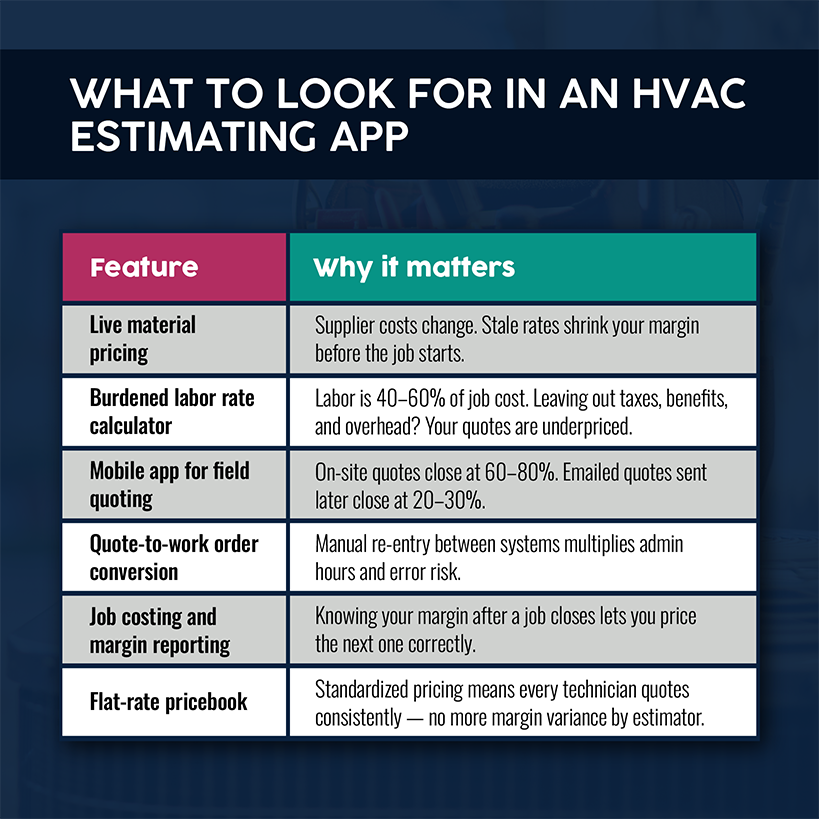
As you assess the options, ask about these key features, regardless of category:
- Does the app calculate costs using live supplier pricing, or do you update material rates manually?
- Does it connect estimating to work orders, scheduling, and invoicing — or do you re-enter data?
- Does it show real-time margin during a job, or only after invoicing?
- Can a technician use the mobile app to build and close a quote while still on-site?
Related: Build a good/better/best HVAC proposal that closes more jobs.
Labor accounts for 40% to 60% of total HVAC job cost. If your estimating tool doesn’t capture fully burdened rates (payroll taxes, benefits, overhead, vehicle costs), every quote will understate your true cost of delivery.
Related: How to set the right HVAC pricing for your market.
Why Simpro Is the Best HVAC Estimating App for Contractors and Businesses
Most HVAC estimating tools solve one problem: They help you build a quote faster. Simpro also solves downstream problems — the ones that determine whether a job makes money.
Here's what that looks like operationally: A residential replacement comes in. Your estimator opens Simpro, pulls from a pre-built template, adds catalog items with current material pricing, sets the labor rate, and sends a proposal — all in under 20 minutes.
Next, the customer approves the proposal, triggering a job in Simpro. The platform generates a schedule, notifies the technician, and creates a purchase order for materials. When the job closes, Simpro compares actual costs to the estimate. You see margin in real time — not two weeks later when the books get reconciled.
That's not an edge-case workflow. That's the standard operating model for HVAC businesses using Simpro across 24,000+ businesses and 250,000+ users globally.
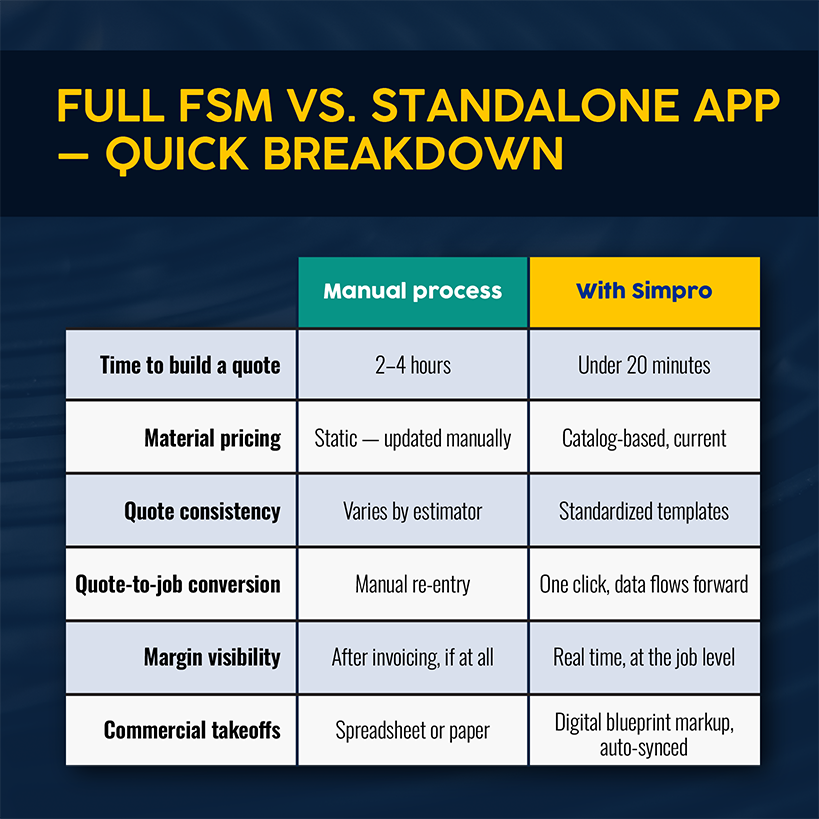
Simpro handles residential heating and cooling service calls and larger HVAC projects from the same platform. Service calls and multi-phase commercial jobs share the same reporting layer, so you get one view of where the business stands.
Job costing reporting matters most when margins are thin. Blended margin reporting can skew your HVAC profit margin figures, as you don’t know which work actually makes money. Simpro's Breakdown Table shows actual vs. estimated margins at the job level, telling you which job types are worth bidding.
Managing field work orders, maintenance contracts, and service call volume alongside project bids? Simpro's HVAC software platform covers all of it in one system.
Schedule a demo to see how Simpro handles estimating, job costing, and project management for HVAC contractors.
How HVAC Estimating Software Helps Improve Margins
The HVAC estimating software market is likely to grow as contractors move away from generic tools toward trade-specific platforms.
The numbers on adoption back that up. Companies average a 24% productivity bump in the first 12 months after installing comprehensive FSM software. For a shop running 10 bids a week on spreadsheets, that's roughly 15 recovered hours a week — worth around $78,000 annually at a $100/hour billing rate.
Find the HVAC Estimating App That’s Right for You
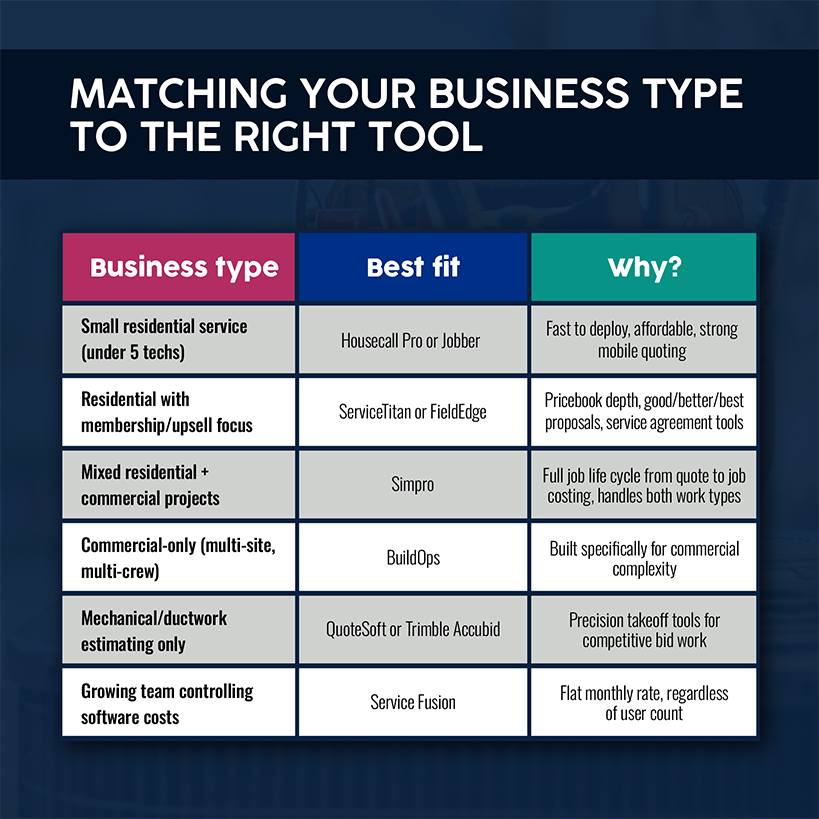
The best HVAC estimating app isn't necessarily the most feature-rich or the cheapest. Select the one that fits how your business operates today and can scale alongside you.
For small residential teams, Housecall Pro and Jobber get the job done at an accessible price point. For commercial-focused operations, BuildOps, QuoteSoft, and Trimble Accubid Anywhere offer depth. But for most HVAC businesses — and especially those managing a mix of service calls, maintenance contracts, and project work — Simpro connects estimating to the full job life cycle in a way that standalone quoting tools don't.
Don’t forget what happens after the quote. Winning jobs matters. But knowing your margin on every job you win, in real time, is what separates a growing HVAC operation from one that's busy and broke. If your current estimating process isn't giving you that visibility, let’s fix it.
Schedule a demo with Simpro and see how the full workflow performs end to end.
Best HVAC Estimating App FAQs
What is an HVAC estimating app?
An HVAC estimating app is software that digitizes the process of building cost estimates and job quotes, from material pricing and labor burden rate calculations through proposal generation and customer approval. The best platforms go further, connecting the estimate to scheduling, procurement, invoicing, and reporting. Instead of an isolated document, the quote becomes the starting point for the entire job life cycle.
What should I look for in an HVAC estimating app?
The non-negotiables:
- Live or regularly updated material pricing, so quotes aren't based on stale supplier rates
- Accurate labor rate tools that capture fully burdened costs
- A mobile app that lets technicians build and present quotes on-site
- Direct connectivity between estimates and work orders, scheduling, and invoicing
For businesses managing HVAC projects alongside service work, job costing and margin reporting are equally important. When you know the post-close margin, you’ll price the next estimate correctly.
How does Simpro handle HVAC estimating?
Simpro handles estimating as part of a full job life cycle. Estimators build quotes from pre-built templates and catalog items with current pricing, add labor rate calculations, and send proposals from the office or field via mobile app.
When a quote is approved, it converts directly to a job: Simpro triggers scheduling, purchase orders, and field assignments automatically. The Simpro Takeoffs add-on handles HVAC projects requiring digital blueprint markup or material quantity calculations. Throughout the job, the Breakdown Table tracks actual vs. estimated costs in real time, giving contractors a running margin view from quote to closeout.


 Back to top