
Most HVAC contractors don't lose jobs on price. They lose on presentation. Building professional estimates for HVAC work starts with having the right structure in place.
A professional HVAC estimate template changes everything. It gives every job a consistent structure, accounts for your labor costs and materials, and shows customers that you run a real operation.
Download the free HVAC estimate template below, then keep reading to learn how to customize it for your business — and where contractors go wrong when preparing estimates.
Best HVAC Estimate Template (Free Download Here)
Download the free HVAC estimate template →
This template covers the core fields every professional estimate needs:
- Company branding, contact details, and license information
- Client name and job site address
- A unique estimate number, issue date, and expiry date
- Line-item breakdown with description, quantity, unit price, and amount
- Subtotal, tax rate, and total
- Space for additional notes and payment terms
It's a general-purpose starting point. The sections below walk you through customizing it for HVAC jobs.
How to Customize the Template for Your HVAC Business
Out of the box, the template handles the basics. To make it work for HVAC projects, you'll need to tailor it to how your business actually runs.
Start with your company information — logo, license number, insurance certificate reference, and contact details. Your trades customers look for license numbers before they sign anything, so fill out that field.
From there, build out line items for the types of jobs you do most often:
- Update your labor rates for each role — install tech, service tech, maintenance call — so you're not recalculating every time.
- Enter your most common materials and equipment (condensers, air handlers, thermostats, line sets, refrigerant) with current unit pricing.
- Add markup for equipment, subcontractors, and specialty components. Make them as separate line items so your margin is visible at a glance.
- Include permit and inspection fees. These are the costs most likely to be overlooked on residential replacements.
- Build separate templates for residential installs, commercial HVAC jobs, and seasonal maintenance so you're not starting from scratch on every estimate.
- Save a version for mini-split systems, which have different material lists and labor hour estimates than ducted equipment.
- Take a snapshot of the existing system. Record the brand, model, age, and SEER rating of what you're replacing. This protects you in change-order conversations and gives the customer a clear before/after reference.
What Is an HVAC Estimate Template?
An HVAC estimate template is a pre-formatted spreadsheet, Word file, or PDF that structures the estimating process for HVAC work. A template standardizes how you present the scope of work, materials, labor rate, overhead, and profit margin on every job. Estimates go out faster and are more accurate.
Our template uses a line-item format: Each cost gets its own row with a description, quantity, unit price, and calculated total. That structure makes it easier for customers to understand what they're paying for — and easier for you to track your money after a job is done.
Why HVAC Estimate Templates Matter for Contractors
Inconsistent estimates are bad news for HVAC companies for two reasons. One, they lose jobs because the quote looked unprofessional. Two, they bleed margin on wins because they’re missing critical information.
Here’s an example: Equipment pricing shifts with copper, aluminum, and refrigerant costs. R-454B became the standard refrigerant for new residential systems in 2026, but pricing hasn't stabilized. The spreadsheet you built two years ago likely has stale numbers. If you're not updating unit costs before each estimate, you're absorbing the difference.
The operational fix: Within your workflow, schedule a template refresh at least quarterly. Update equipment pricing, use a labor burden rate calculator to verify your labor rate, and check that your overhead percentage reflects your actual spend.
How to Estimate HVAC Work Accurately and Consistently
Accurate estimates come down to one habit: every cost gets a line. Not a blended number, not a rough guess based on square footage. Each material, labor task, permit, and overhead dollar must be accounted for before the estimate leaves your desk.
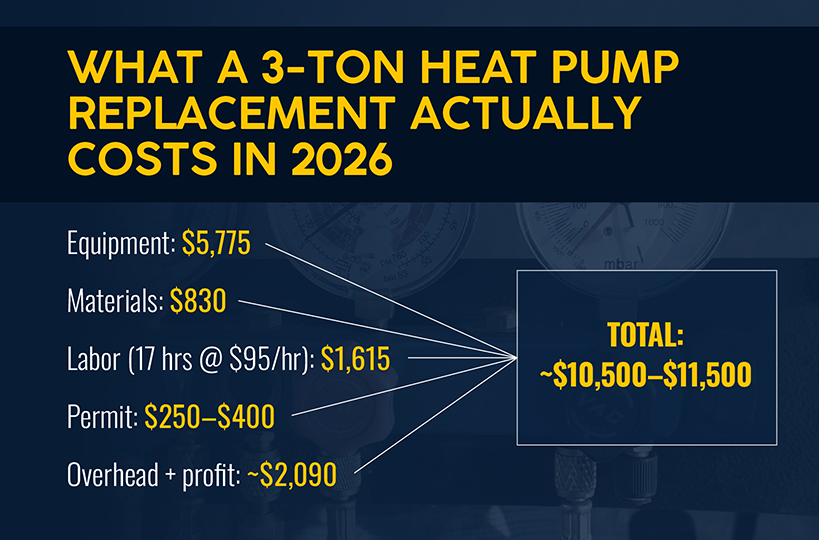
Residential system replacement is where most estimates fall apart, because the job looks straightforward until it isn't. To illustrate how to estimate HVAC jobs, here's what a complete three-ton heat pump replacement looks like in 2026:
| Category | Example Cost |
|---|---|
| Equipment (condenser, air handler, thermostat) | $5,775 |
| Materials (line set, refrigerant, fittings, pad) | $830 |
| Labor (~17 hrs at $95/hr) | $1,615 |
| Permit | $250–$400 |
| Overhead (12%)* | ~$985 |
| Profit (12%)* | ~$1,105 |
| Estimated Total | ~$10,500–$11,500 |
*Not including permit costs.
That math only holds if every cost is accounted for. The most common mistakes in the HVAC estimating process include missing job-specific materials, skipping overhead in job-level pricing, and guessing on square footage instead of using Manual J load calculations.
Our guide to how to price HVAC jobs covers the full calculation, from which pricing strategy makes sense to the final sell price.
Common Items to Include in an HVAC Estimate
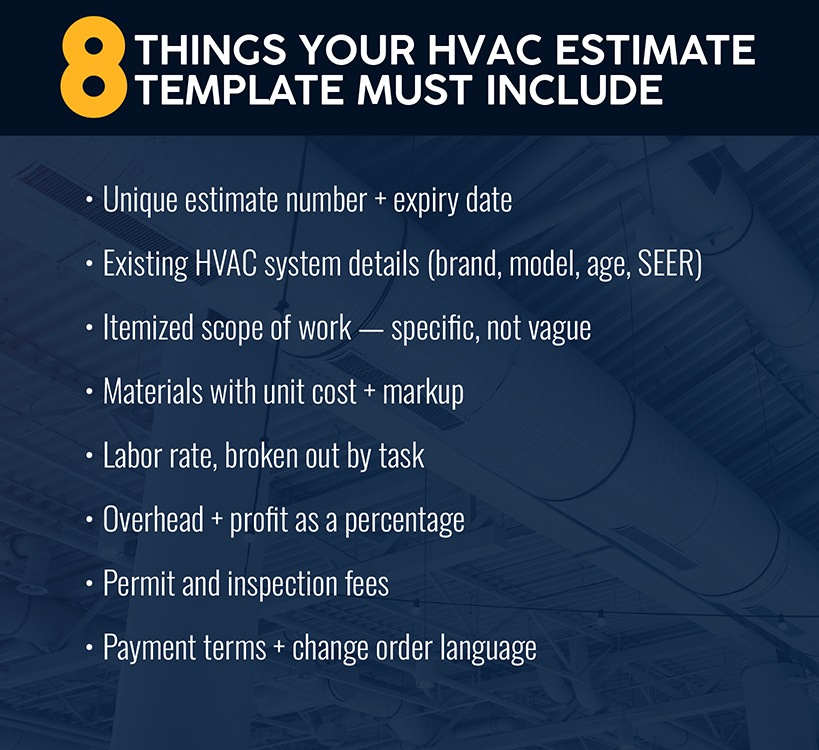
A complete HVAC estimate covers more than parts and labor. Use this as a checklist for every job:
- Header and contact details — company name, license number, unique estimate number, expiry date
- Customer and job site info — billing address, service address, site access notes
- Existing HVAC system details — brand, model, age, tonnage, SEER rating
- Scope of work — specific equipment being removed and installed, not just "HVAC replacement"
- Itemized materials — all components, with unit cost and markup applied
- Labor breakdown — tasks, hours per task, labor rate
- Overhead and profit — applied as a percentage to the direct cost subtotal
- Permit and inspection fees — accounts for any jurisdiction-specific requirements
- Warranties and payment terms — includes change-order language
- Signature/acceptance line — converts the estimate into an agreement
For jobs where you're offering options, consider a good/better/best HVAC proposal format. Presenting efficiency tiers — 14 SEER2, 16 SEER2, 18+ SEER2 — with clear cost differences gives customers real choices and increases your average ticket.
To understand how these decisions affect your bottom line, our HVAC profit margins guide breaks it down in detail.
Win More Jobs With Clear, Accurate HVAC Estimates
Your spreadsheet template can’t scale forever. When you’re not using HVAC estimating software, your team is stuck manually building estimates, tracking which ones got accepted, following up on open quotes, and re-entering data into work orders.
If you're building estimates by hand and running more than a handful of technicians and still building every estimate by hand, you’re losing hours of nonbillable admin work every week.
Simpro® is built specifically for HVAC companies running service calls, project work, or both. The estimating software creates quotes from pre-built templates with your labor rates and materials already loaded — allowing techs to save time by quoting on-site from their phone. Quotes convert to work orders in one click, and the system flags open estimates that need follow-up.
BGE Digital, a Simpro customer, put it simply: Producing a quote has become “10 times quicker than what we were doing from spreadsheets.”
Ready to see what that looks like for your operation? Schedule a demo.


 Back to top