
Commercial HVAC projects don't leave room for ballpark numbers. Whether it’s a rooftop unit replacement for a multi-tenant office building, a new construction mechanical package, or a chiller retrofit, these are jobs where your HVAC bid template is the difference between winning the contract and funding your competitor's growth.
Download the free template below, then keep reading for a breakdown of what to include, how to customize it for your business, and how to make HVAC bids that actually win.
Best Free HVAC Construction Bid Template (Download Here)
DOWNLOAD: Free HVAC Bid Template
This template is built for commercial and construction HVAC work. It covers formal project proposals, competitive tenders, and large installs where a handwritten quote or loose estimate won't cut it.
The template includes scope of work, equipment and materials itemization, labor hours, payment schedule, and terms and conditions — and it’s in a format general contractors (GCs) and facility managers expect to see.
It’s available in Google Docs, Excel, and PDF formats for quick access. Customize it with your company branding, license number, and contact details, including address and phone number.
HVAC Commercial Bid Template vs. HVAC Estimate Template — Which One Should I Use?
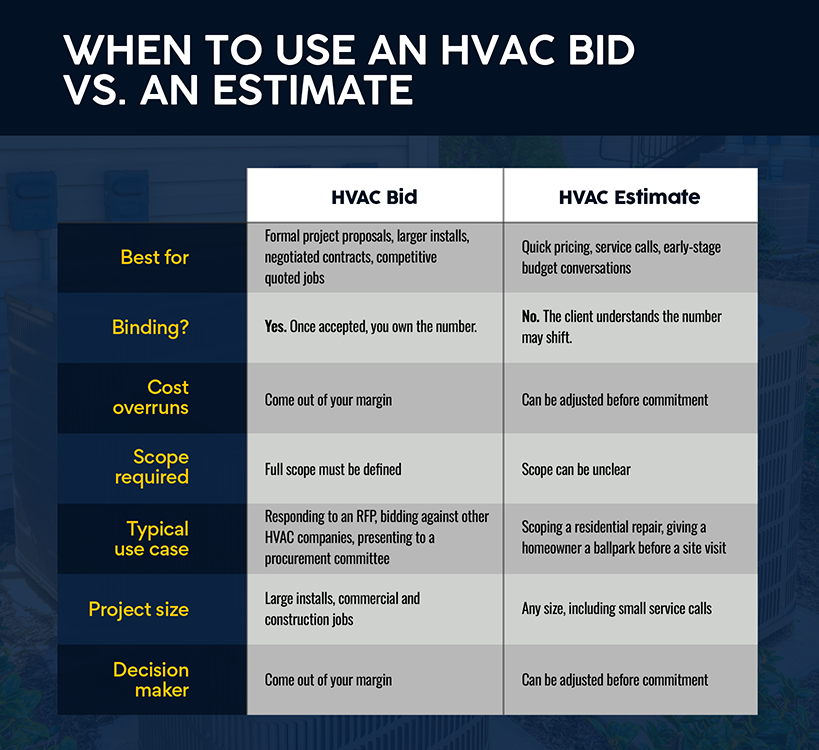
These two documents serve different purposes. Using the wrong type costs you credibility or money.
Use a bid template for formal project proposals, larger installs, negotiated contracts, and competitive quoted jobs where you're committing to a fixed price. Once a client accepts, you own the number. Cost overruns come out of your margin.
Use an HVAC estimate template for quick pricing, early-stage budget conversations, service calls, and situations where the full scope isn't defined yet. Estimates are nonbinding. The client understands the number may shift.
Follow this practical rule:
- Use a bid when you're responding to a formal request for proposal (RFP), bidding against other HVAC companies, or putting a price in front of a procurement committee.
- Use an estimate when you're scoping a residential repair or giving a homeowner a ballpark figure before a site visit.
What to Include in an HVAC Bid
A professional HVAC bid proposal covers more ground than a price summary. Here's what goes in a complete document:
- Company info: Name, logo, license number, address/phone number
- Project details: Client name, project address, bid date, bid number, validity period
- Scope of work: What’s included and explicitly excluded; change-order language
- Equipment and materials: Brand, model, capacity, efficiency rating, quantities, unit costs, and extended totals.
- Line items for HVAC system components: Air conditioning units, furnaces, heat pumps, ductwork, thermostats, refrigerant, and fittings
- Labor hours: Broken out by phase or trade for commercial work (sheet metal, piping, controls, commissioning)
- Permits and fees: Inspection, permit pulling, and disposal charges itemized separately
- Payment schedule: Deposit, progress billing milestones, and retainage terms for commercial projects
- Terms and conditions: Warranty on labor and equipment, dispute resolution, and insurance and bonding
- Signature/acceptance block: Converts the bid into a contract once signed
For commercial HVAC jobs, you'll also need to review Division 23 specifications and Division 01 contractor requirements before finalizing your numbers. These govern equipment specs, compliance standards, and payment rules on most commercial construction projects.
How to Customize the Template for Your HVAC Business
The template is a starting point. Before you submit bids for any job, tailor the template to reflect how your business operates.
Start with the basics: Company branding, contractor license number, and contact details. Then update your pricing structure to reflect your current equipment costs, subcontractor rates, and labor burden. If you haven't recently audited your loaded labor costs, run your numbers through a labor burden rate calculator. Most HVAC contractors underestimate their labor burden rate by 20% to 30%.
From there, build out your service line coverage. Common HVAC services you can include as line-item categories are installation, replacement, repair, and maintenance. Set up separate equipment sections for furnaces, air conditioners, heat pumps, ductwork, and thermostats, each with your standard markup applied.
Build separate template versions for residential and commercial work. The commercial version needs more detail. It should include phased timelines, Division 23 compliance language, retainage terms, and bonding documentation. Save reusable versions for the job types you bid most often, such as retrofit jobs, system changeouts, and new construction bids.
How to Create an Accurate HVAC Bid
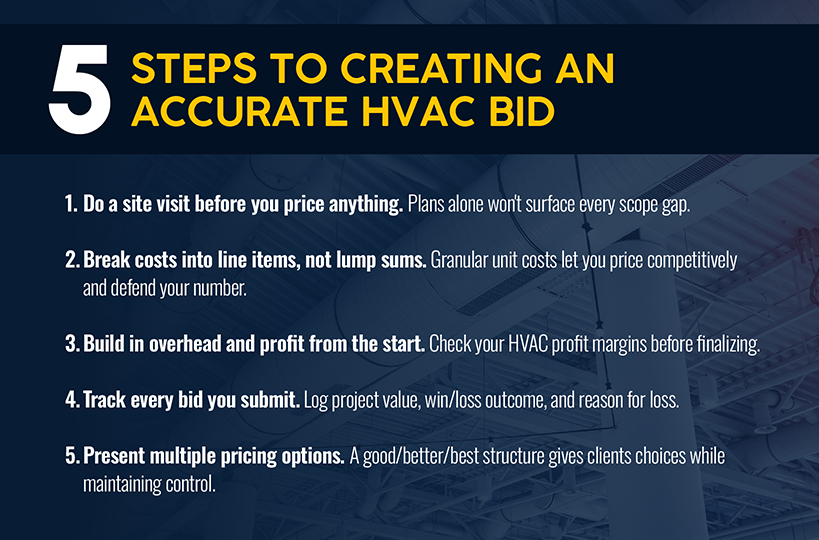
Accurate bids start with a site visit. For commercial HVAC work, you need to see the mechanical room, existing infrastructure, and access conditions before committing to a number. Bidding from plans alone leaves you exposed to scope gaps that don't surface until you're already on the job.
From there, break costs into granular units rather than rolled-up totals. Detailed line items let you price competitively without sacrificing margin, and they give you defensible numbers when a GC pushes back. Refer to your HVAC profit margins guide to make sure your overhead allocation and profit targets are built into every bid rather than added as an afterthought.
Win rates on competitive commercial HVAC bids run between 10% to 20% on hard public tenders and 30% to 50% on negotiated work. If your numbers are outside that range, you need to identify where you're getting undercut or overpriced. Find out by tracking your bids by project value, win/loss outcome, and reason for loss.
When you apply the good/ better/best HVAC proposal structure to larger bids, you give your procurement contacts options without opening a price negotiation you can't control.
Common HVAC Jobs That Need a Bid Template
Only some service calls need a formal bid. These are the job types where showing up without a structured proposal costs you the work:
- New construction HVAC. Mechanical packages on commercial builds require compliance documentation, phased scheduling, and formal acceptance.
- HVAC system replacement. Rooftop units, chillers, and air handling units on commercial properties involve procurement committees and formal approval chains.
- Tenant improvement projects. One example is a new HVAC installation in retrofit commercial spaces, where a GC is managing the overall project.
- Preventive maintenance contracts. Multi-year HVAC maintenance agreements for commercial facilities are procured through a bid process.
- Government and municipal work. Open bids on public projects require formal documentation and bonding.
For jobs that are earlier in the sales cycle or residential in nature, check out our guides for how to estimate HVAC jobs and how to price HVAC jobs.
Win More Jobs With Professional HVAC Job Management Software
You've got the template, and now you need to act quickly. First-in on a bid is often perceived as most interested, and slow proposals hand the job to whoever moves faster.
Simpro® gives successful HVAC companies a purpose-built platform to build, track, and manage bids from the same system you use to run jobs. Pre-built quote templates and cost libraries cut build time. Open bids are flagged automatically for follow-up. WIP reporting tracks margin from proposal to final invoice. Over 24,000 businesses use Simpro to run their operations. Our HVAC software and estimating software are built for trade contractors, not generic small business workflows.
Ready to build bids that win and jobs that stay profitable? Schedule a demo to see how Simpro handles the full cycle, from first proposal to final payment.


 Back to top