
TL;DR
- Standard 180 calls for a uniquely identified equipment inventory and a maintenance plan written against it.
- EPA's leak-repair rule has been in effect since January 1, 2026. It requires repairs, verification tests and three-year records. It covers many commercial appliances holding 15 pounds or more of HFC refrigerant.
- Build the register in seven steps, from the first site audit to the renewal review.
- Move off spreadsheets when technicians need the record on a phone. The same goes for rising site counts and refrigerant history that must hold up.
Pull up your HVAC equipment list for maintenance contracts and find the rooftop unit your technician topped off last month. Look for two numbers: the unit's full charge and the pounds of refrigerant added before. If either one is missing, nobody can run the leak-rate math that federal rules have required since January 1, 2026. A top-off on a covered commercial appliance over its leak rate starts a 30-day repair deadline. That clock doesn't wait while someone hunts for a paper ticket.
EPA's fact sheet says owners, operators and certified technicians must all comply. The rule adds per-appliance service records, which owners and operators keep for at least three years and contractors have to supply. ANSI/ASHRAE/ACCA Standard 180 also asks for a uniquely identified equipment inventory as the foundation of a commercial maintenance plan. Put those together and the equipment list becomes a register with three jobs. It's the scope exhibit for the service agreement, the refrigerant record and the file you price the renewal from.
That raises the bar on what your register holds and who keeps it current.
What Is an HVAC Asset Register?
An HVAC asset register records every machine you service for a customer. A technician who has never seen the building can use it to find a unit. They can also see what the last crew did.
On a commercial account, that record carries more weight than a note in the customer file. The agreement promises work on equipment. The register names that equipment and counts it.
Building one for a commercial account takes seven steps, and the first happens before you quote a price.
How to Build an HVAC Asset Register for a Commercial Maintenance Contract
Each step produces something the next uses, and the last feeds back into the first. A renewal review that turns up 12 units nobody tracked sends you back to the audit.
1. Audit Every HVAC Asset at the Customer Site
Walk the whole property before you price anything. Standard 180 covers HVAC systems and equipment that affect comfort, energy efficiency and indoor air quality. Exhaust fans, makeup air units, VAV boxes, unit heaters and a server closet's air conditioning system all count.
Say you're bidding a six-building medical office park. The customer's list shows 38 rooftop units. Your walk-through turns up 14 more units: six ductless splits, four makeup air units and four exhaust fans. Figure 1.5 hours per unit per quarterly visit at a $90 loaded labor rate. Those 14 units add 84 hours and $7,560 in maintenance costs a year to an agreement priced for 38. If you find them before you sign, you can price them. If you find them in month three, you eat the cost or open an awkward conversation.
Related: The survey sits inside a longer bid. Our guide to winning commercial HVAC maintenance contracts covers it from qualification to negotiation.
Photograph every data plate during the walk. Log what the customer's list leaves out. That means roof access limits, units behind locked tenant doors and equipment the landlord may own.
The operational fix: Reconcile your survey against the equipment list the customer's facilities teams keep before you submit a price. Put every difference in writing, so the scope in the agreement matches the register.
2. Organize Assets by Customer, Site, and Location
A flat list of 80 units is a spreadsheet nobody trusts. Build the hierarchy the way your dispatcher thinks: customer, site, building, floor or room, system, then asset. Add the billing entity at the building level too. That's where purchase orders and tenant reimbursements split. File 22 units under the landlord's name and nobody can tell which visits belong on building B's PO. The same hierarchy rolls history up to the portfolio or down to a single compressor.
Related: A hierarchy pays off when recurring visits generate from it. Our guide to managing recurring commercial HVAC maintenance shows how.
Pick one asset ID format and tag the unit. A tag such as A-R-03, for Building A, roof, unit 3, outlasts staff turnover and reads off a sticker without opening a phone. Standard 180 requires every inventoried item to be uniquely identified, and a physical tag does that job in the field.
3. Record the Information Needed to Identify and Service Each Asset
Standard 180 sets a floor of manufacturer information, location, capacity and a maintenance program identifier. A commercial agreement needs more than that. Capture these fields for every asset:
- Unique asset ID and where the tag sits
- Equipment type, manufacturer, model and serial number
- Capacity in tons, CFM or MBH, whichever applies
- Refrigerant type and full charge in pounds
- Install date and warranty details
- Location and access notes, such as roof hatch, ladder, badge or tenant escort
- Photos of the unit and its data plate
- Maintenance plan ID
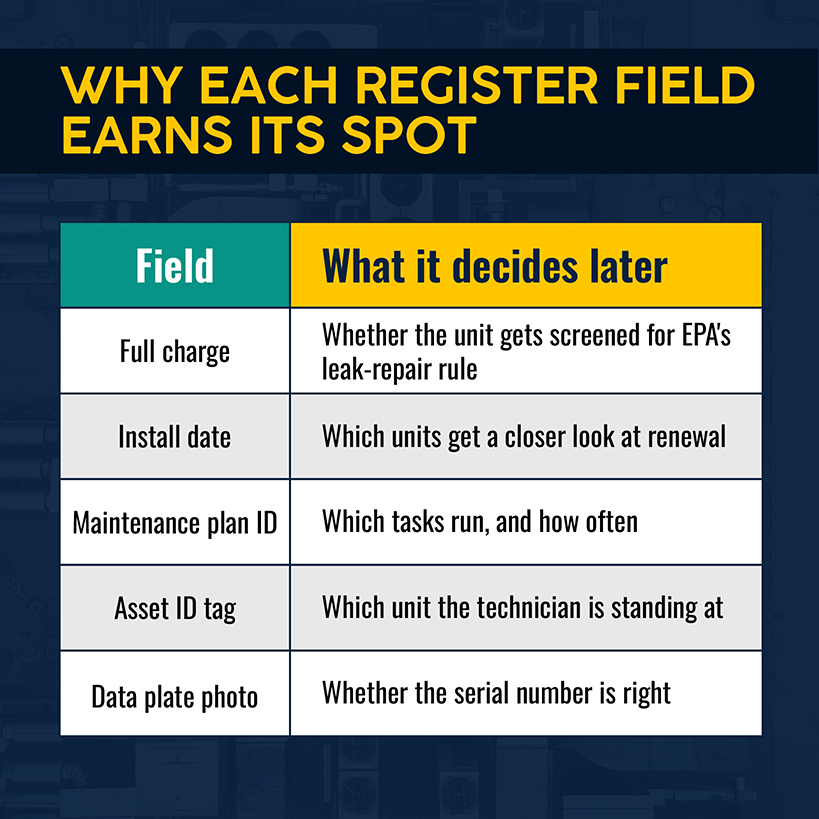
You'll use two of those fields long after the survey. Full charge screens a unit for EPA's leak-repair rule, which reaches certain appliances holding 15 pounds or more of an HFC. The rule also covers substitutes with a global warming potential above 53. Install dates feed the renewal review in Step 7.
Residential and light commercial air conditioning and heat pumps are exempt. Whether a given rooftop unit falls inside that exemption depends on EPA's definitions in 40 CFR Part 84. Record the refrigerant and charge, then check the unit against the rule.
Related: Equipment age, model and service frequency also drive scheduling and replacement decisions. Our piece on HVAC equipment data and AI-ready operations explains how.
A serial number typed from memory is a serial number you correct later. Require the data plate photo before a unit counts as complete.
4. Define the Maintenance Scope for Each Asset
A register becomes a contract document when every row carries its maintenance tasks and a frequency. Write maintenance schedules by equipment type, so a rooftop unit gets the rooftop plan wherever it sits. Give exceptions their own frequency. A split system in a server closet runs every hour of the year. The office rooftop unit above it carries a seasonal load. Standard 180 expects the maintenance plan to document work at scheduled intervals on the inventory. If a row lacks a frequency, you haven't planned that unit.
Mark every row that may fall under EPA's leak-repair rule. That way you schedule and log refrigerant checks as their own task. They don't get lost inside a general service visit.
Related: Our guide to selling HVAC maintenance agreements covers the agreement language that goes with this scope.
The customer will eventually test where the fee ends and a repair quote begins. Say a customer disputes a $3,800 invoice for a condenser fan motor. The unit is covered by an HVAC preventative maintenance plan. The register row names the plan, notes that repairs are quoted separately and lists the signed exclusion. The conversation takes five minutes.
The operational fix: Attach a maintenance plan ID to every row before the agreement is signed. List any unit you've excluded in the agreement exhibit, so nobody discovers the gap during a failure.
5. Build the Service History Against the Asset
Every visit adds to the asset's maintenance record, so log the date, technician, readings, replacement parts, refrigerant added or recovered and any deficiency. File that record against the asset instead of the invoice or the customer. That way the next technician can read it before arriving.
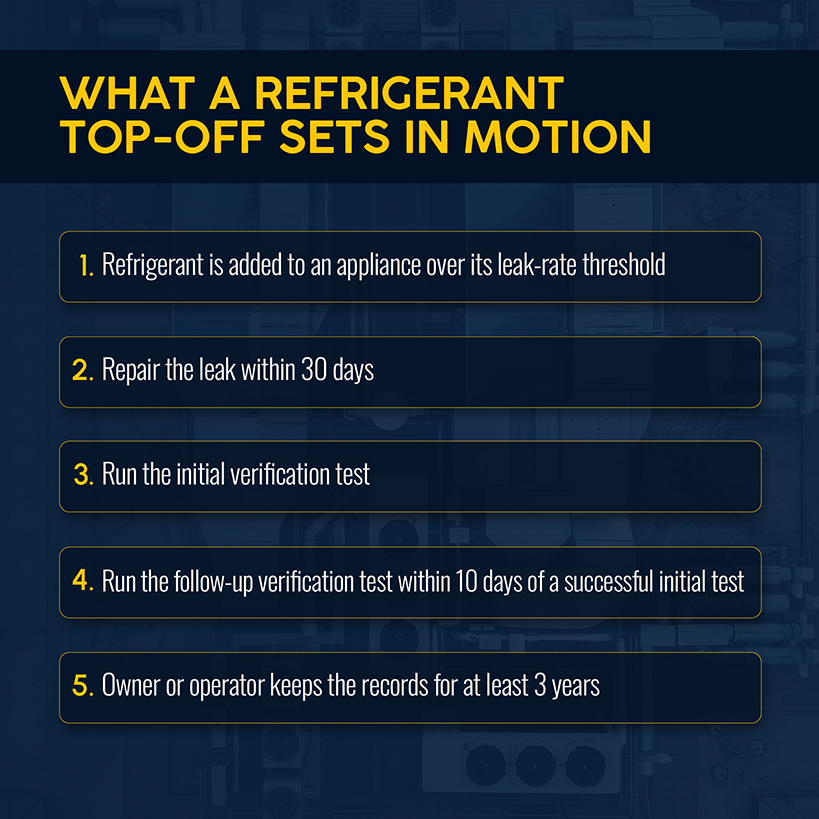
Picture a technician adding 30 pounds of refrigerant to CH-01 on a Tuesday in October. Seven months earlier, a different technician added 25 pounds and wrote it on a paper ticket. The ticket went into another truck's binder. The leak-rate calculation runs every time refrigerant is added, and it depends on the additions logged for that appliance. The 30-day repair clock starts when refrigerant goes into an appliance over its threshold. The owner or operator must keep those records for at least three years.
Related: Our guide to HVAC inventory management software covers asset tracking and service history alongside parts inventory.
Log the deficiency in real time, before the van leaves the lot. A finding that lives in a technician's head becomes a repeat diagnostic on the next visit. At renewal, it's a missed repair proposal.
6. Update the Register Whenever the Customer's Equipment Changes
Customers replace units, build out tenant space and abandon equipment in place. A register that records installs and never removals drifts until you can't trust the count. Add new assets with the same survey-quality record. Link a replacement unit to the one it replaced. Retire old units without deleting them, because their history can still answer your warranty questions.
Take a tenant buildout that adds two ductless splits and removes a three-ton package unit. Skip the update and next quarter's route sends a technician to a unit that's gone. It also skips the two that aren't.
The operational fix: Add "register updated" to the close-out checklist for every work order that installs or removes a unit. Review the retired-unit list each quarter.
7. Review the Register Before Renewing the Maintenance Agreement
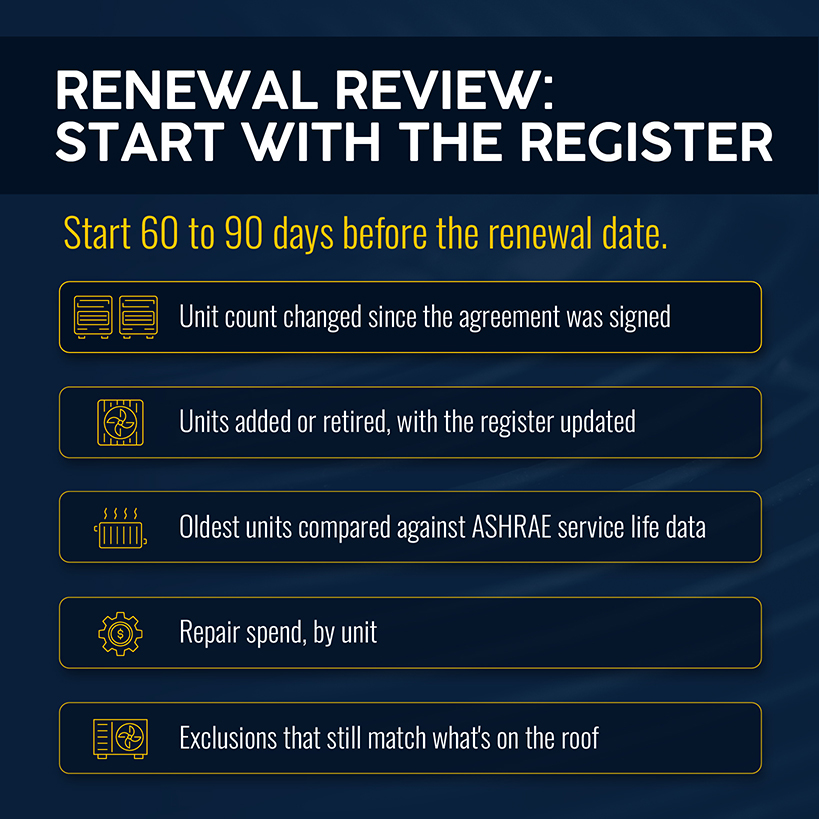
Start the review 60 to 90 days before the agreement renews. Compare the register to the agreement line by line, starting with asset count and maintenance frequency. A higher count means a higher price. If it's lower, explain why before the customer asks for a discount.
ASHRAE's service life database reports median service lives by equipment type. Once you pick a system type, it shows the unit count behind each median. Some medians rest on a handful of units, so check the count. If a unit is past the median, inspect it.
Suppose nine of your 52 units went in before 2010. Pull the repair spend on each since the agreement began. Say a 2009 rooftop unit has cost the customer $4,200 in repairs against $1,100 a year in plan fees. Put that spend next to a replacement quote and send both before the renewal letter goes out.
Related: Our 2026 trends roundup covers data-driven asset management, including agreements tied to asset records instead of spreadsheets.
By a second renewal, the long-term record outgrows the file it started in.
HVAC Asset Register Example
Put identification, scope, compliance and history in one row per asset. The sample below shows three rows with illustrative values.
| Asset ID | Type and location | Refrigerant / full charge | Plan ID / frequency | Last service |
|---|---|---|---|---|
| RTU-03 | Packaged rooftop unit, Bldg A roof | R-410A / 24 lbs, check exemption category | PM-RTU / quarterly | 2026-07-14 |
| CH-01 | Air-cooled chiller, Bldg A mechanical room | R-134a / 380 lbs, leak-repair rule applies | PM-CHW / monthly checks, annual service | 2026-08-02 |
| AHU-12 | Air handler, Bldg B 2nd-floor mechanical room | None (chilled water) | PM-AHU / quarterly filters, semiannual belts | 2026-07-21 |
Make, model, serial number, capacity and install date stay on the full record from Step 3. A spreadsheet struggles to keep two of these columns honest once the count passes a few hundred rows. Those are the refrigerant column and the last-service column.
When an HVAC Asset Register Becomes Difficult to Manage in Spreadsheets
A spreadsheet can carry a customer with one building and 20 units without much strain. Four conditions break it:
- Multiple sites and hundreds of assets, with history needed at every visit
- Technicians who need the record at the unit, not in a file on an office computer
- Refrigerant additions that must roll up per appliance for leak-rate records
- Renewal pricing that depends on asset counts and condition data matching what's on the roofs
The second condition shows up first. Your technician needs a customer equipment register HVAC crews can open on a phone, with the history and data plate photo attached. A file on the office server can't do that.
Blue Flame Heating Solutions is an 86-employee heating and electrical contractor in Cornwall, UK. It used to keep job and asset information in spreadsheets. It now runs on Simpro®. Director Mark Bolitho said the company uses "custom fields to keep track of our assets."
At that point, you're deciding where the register should live.
Manage HVAC Assets and Maintenance Contracts in Simpro
If your register lives in a spreadsheet, Simpro's Professional Services team can help with setup and import of your assets. Simpro has more than 250,000 users worldwide, and its Maintenance Planner add-on is built for asset-driven jobs at sites with multiple service-level agreements. Service levels and testing frequency attach to each asset, which puts the plan from Step 4 on the row where it belongs. Alerts fire when an asset is due or fails testing.
In the field, technicians use Simpro Mobile to scan barcodes or QR codes on assets and review each asset's test results and notes. With Maintenance Planner, they also see failure points and recommendations. The history from Step 5 is in their hands before they open the unit.
Simpro gives you one asset record to work from. The leak-rate math and the requirements in 40 CFR Part 84 stay with you and your customer.
When your next renewal lands, could you name every unit you maintain, what each one holds and when someone last touched it? An agreement priced from a register that answers those questions holds the margin you quoted. Schedule a demo to see the register, the planner and each unit's history working from one record.


 Back to top
