
Most plumbing companies don't figure out how to sell plumbing maintenance agreements. A technician mentions the plan if there's time, hands over a flyer, and moves on to the next call. That approach gets a few enrollments, but mostly from people who were already interested.
Creating meaningful recurring revenue for your plumbing business requires a system: A maintenance plan that's priced for margin, a script technicians will use without being told twice, and back-office automation that catches renewals before they lapse. We're sharing eight steps that cover that system end to end, from what belongs in the agreement to how you'll know the program is actually profitable.
What Customers Are Buying With a Plumbing Service Plan
For the customer, an agreement buys certainty and peace of mind for their home plumbing systems. One or two scheduled visits a year catch a slow drain, a water heater with too much sediment, or a shutoff valve starting to seize — all of these preventing a Saturday night emergency call. When the maintenance plan includes a waived trip fee and a discount on whatever repair results from the visit, the plan pays for itself the first time a technician catches something before it fails.
The math is different for plumbing businesses, which is why maintenance agreements have become the primary lever for turning a reactive shop into a growth business. Membership work runs 75–85% gross margin against 35–45% for one-off service calls, as routine-visit labor and material costs barely change whether the water heater fails next year or in five.
Bain & Company research found that a 5% improvement in customer retention can lift profits by up to 95%. That checks out in real life: A maintenance plan member calls the company they already trust instead of searching for a plumber at 11 p.m.
That loyalty shows up on the bottom line, too: Plumbing businesses with a strong base of recurring agreements are trading at 7–10 times EBITDA, according to 2025 deal data, versus 3–4 times EBITDA for shops with little or no recurring revenue. This is why maintenance agreements are part of almost every strategy to grow a plumbing business.
8 Steps to Sell Plumbing Maintenance Agreements Profitably
Consistently selling plumbing maintenance contracts is less about your closing line and more about building a program where the plan, the pitch, and the paperwork all point in the same direction. The eight steps below run from the first pricing decision to the report that tells you whether the program is actually working.
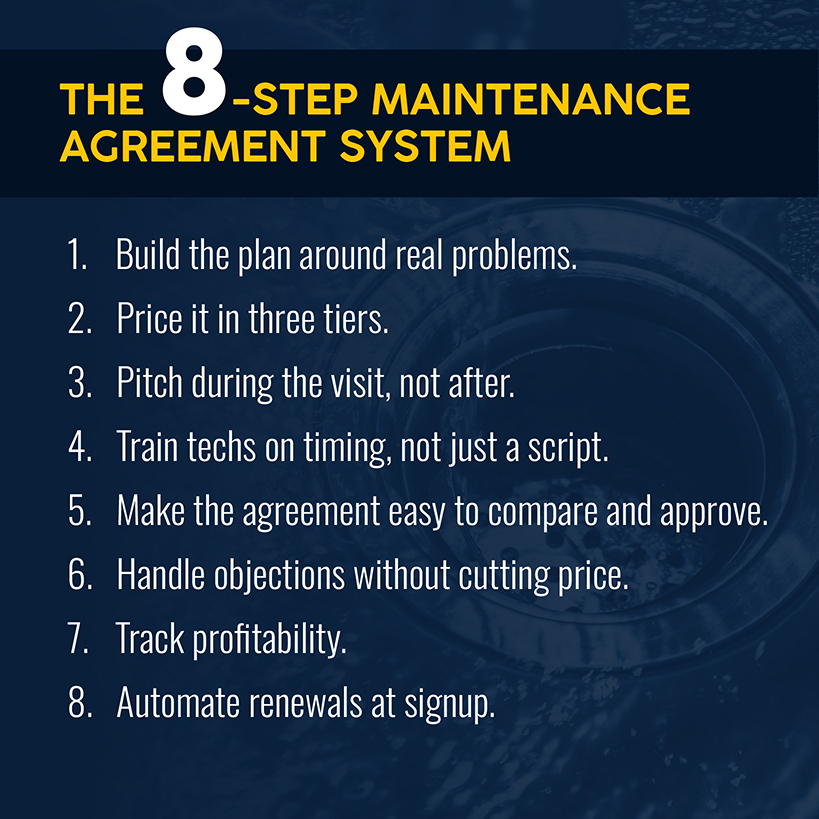
1. Build the Plan Around Problems Your Customers Already Want to Solve
The strongest plans bundle a small number of concrete benefits instead of a long list nobody reads.
Start with an annual or biannual inspection that includes the water heater, main water lines, shutoff valves, faucets, drains, and sump pumps (when the home has one). These are the components most likely to fail without warning.
Add a water heater flush and sediment check (annually for most homes, every six months in hard-water markets) and an anode rod inspection every two to three years, since both extend the water heater's life. Round out the visit with drain-flow checks, or a full drain cleaning when buildup warrants it. Layer on a repair discount (typically 10–15% off flat-rate pricing rather than hourly rates), waive the diagnostic/trip fee, and offer priority scheduling for peak season.
Here's a secret for learning how to sell plumbing service agreements: Call it an agreement or membership, not a contract. "Agreement" reads as a mutual arrangement the customer chose. "Contract" reads as something they got talked into, and that resistance shows up before you've explained a single benefit.
The operational fix: Write the plan's contents on a one-page internal reference before pricing it. If a benefit needs a paragraph to explain, cut it.
2. Price Each Plumbing Service Plan for Cost, Margin, and Value
Knowing how to price plumbing service plans is about creating accurate estimates with a defined structure. Offering three tiers is better than two or four. Two reads as cheap-versus-expensive, and four can create decision paralysis, causing some would-be customers to walk away. Offering three choices under a good/better/best pricing model lets a homeowner self-select — and they'll often choose the middle tier.
Residential plumbing agreements range from roughly $150 to $500 a year, depending on what's included, such as the number of visits, repair discount, and priority scheduling status. A three-tier structure might look like this:
| Plan | Visits/Year | Repair Discount | Trip Fee | Priority Scheduling |
|---|---|---|---|---|
| Essential | 1 | 5% (up to $1,000) | Waived | Standard |
| Priority | 2 | 10% (up to $2,000) | Waived | Front of line |
| Complete | 2 | 15%, uncapped | Waived | Same-day where available |
Price the entry tier as a loss leader for enrollments, but not too low. Otherwise, you get members who join for the discount but cancel at the first renewal.
Meanwhile, frame the price in monthly terms even if you bill annually. A $189 annual plan presented as "about $16 a month" outperforms because it reads like a subscription, not a bill.
Related: For a full breakdown of tiered pricing across your service lines, see our plumbing price book guide.
3. Give Customers a Clear Reason to Join During the Current Visit
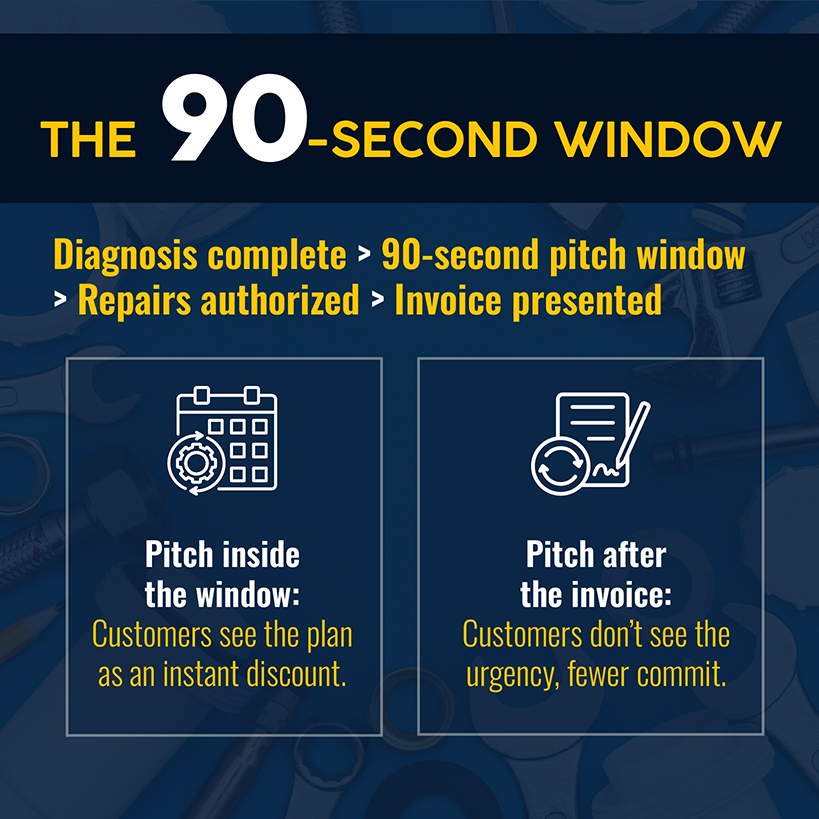
Timing is more important than your script. The best window to offer maintenance plans is roughly 90 seconds after a technician diagnoses the problem. Pitch the membership then, tying it explicitly to the invoice. When you say, "Members save 15% on this repair, which is about $87 off today," the plan reads as an immediate discount rather than an abstract future benefit.
Imagine a $1,400 water heater replacement, which is well above the average ticket for a routine call. When the tech diagnoses the problem and pitches the maintenance agreement, the customer sees the difference between a $1,400 bill and a $1,190 one, and enrollment takes about a minute. When pitched after the invoice is signed, it feels like a second pitch the customer didn't ask for.
The operational fix: Build the pitch into the technician's existing workflow for invoicing rather than as a separate script. If they have to remember to pitch, they'll forget much of the time.
4. Train Technicians to Recommend the Plan Without Delivering a Hard Sell
While timing is crucial, scripts still matter. Your techs are capable, but they need direction. Shops that simply ask technicians to mention the plan convert far fewer eligible customers than shops that track a daily attach-rate scoreboard by technician.
The script doesn't need to be complicated. It can be a four-line structure that does the following:
- Restates the problem
- Ties the maintenance plan to today's dollar savings
- Quotes the monthly price first, then the annual cost
- Closes with an assumptive question like, "Want me to add it to today's invoice?"
The operational fix: Create a plumbing maintenance agreement that your technicians believe in and want to sell. When they feel they've had input to the structure and understand the benefits, they're already incentivized to sell. Add in spiffs to solidify that motivation.
5. Make the Agreement Easy to Compare, Understand, and Approve
A homeowner standing in their kitchen isn't going to read three paragraphs of plan language on a phone screen. Carry a physical, one-page sell sheet that lays out the tiers, side by side, as many customers process visuals faster than paragraphs of text.
Again, make sure your techs present this sell sheet during the visit. A follow-up call or email a few days later is less likely to convert because the urgency is gone, and the homeowner doesn't benefit from the in-person trust from a technician who's helping them.
Related: Build a plumbing maintenance agreement template that matches the sell sheet so nothing gets lost between the field and follow-up paperwork.
6. Answer Common Objections Without Immediately Reducing the Price
The most common stall from would-be customers is, "Let me check with my spouse." One way for techs to address this is via a quick three-way call. If the customer has real interest, you can capture it immediately rather than waiting for a next-day follow-up call.
Other common objections are about the perceived value:
- "I've never had a problem" is answered with the inspection findings from similar homes.
- "I can just call when something breaks" is answered by pointing out that trip fees are waived and that priority scheduling is available.
Try these routes first. Dropping the price trains the customer to expect a discount at every renewal, undercutting the program's profit margins.
7. Automate Recurring Work and Track Whether the Program Is Profitable
Your maintenance program can live in a spreadsheet at 40 members, but try scaling that to 400. This is usually when plumbing contractors start looking seriously at plumbing job management software.
The right software links recurring visits to the customer's equipment, so the tech knows whether they're servicing a water heater that's under warranty or overdue for replacement. Simpro®'s Maintenance Planner schedules assets and recurring jobs, assigns the right technician, and gives office staff a forward-looking view of every plan visit coming due. This approach supports scale far more than sticky notes and a shared calendar.
Blue Flame Heating Solutions, a Simpro customer running more than 28,000 jobs a year, says the platform handles all invoicing and shares that data directly with its accounting software. Plan revenue stays visible instead of buried in a separate system nobody reconciles.
To track profitability, make sure you have a single definition of attach rate, track new agreements sold against eligible service calls, and display the data on a team scoreboard for visibility. Track profitability against delivery cost, too, not just member count.
Related: For more numbers worth watching, check out our guide to plumbing business KPIs.
8. Make Auto-Renewal the Default
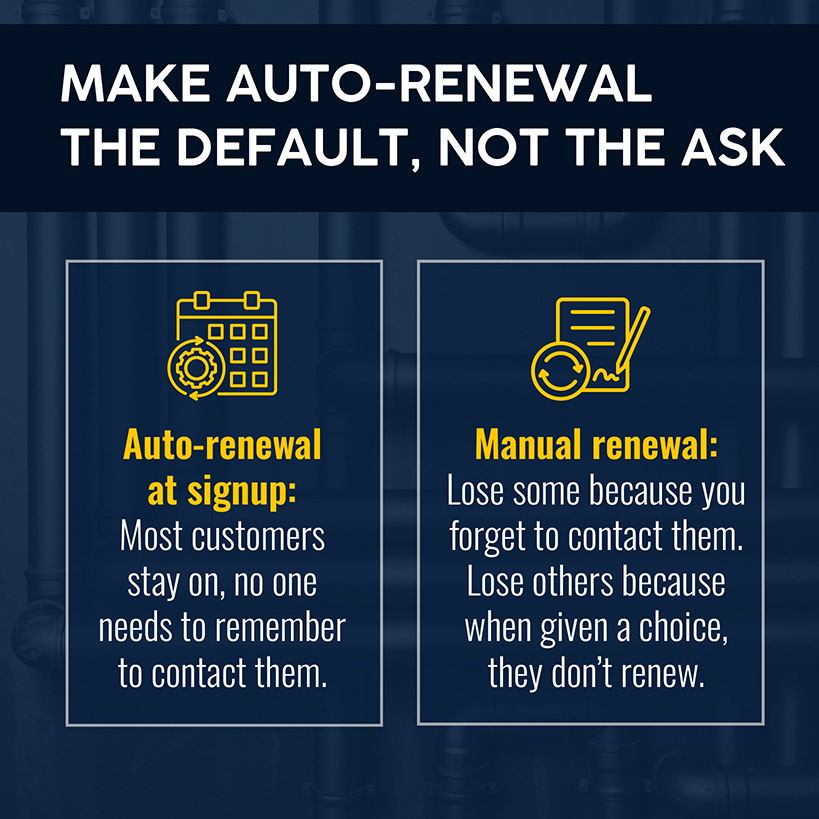
When customers sign up for a maintenance agreement, they should be defaulted to auto-renewal with the card already on file. Trying to upgrade customers later on adds friction and comes across like a big ask.
Auto-renewal with a card on file dramatically improves retention, too. A manual renewal depends on someone in your office remembering to reach out and the customer choosing to act on it — two chances for maintenance agreements to lapse for reasons that have nothing to do with customer satisfaction. Close that gap by defaulting new members into auto-renewal at signup with an easy opt-out.
Build a Maintenance Program Customers Want to Renew
A maintenance agreement program isn't a side offer bolted onto the service call. It's the growth mechanism that graduates your plumbing business from one-off jobs into a recurring-revenue engine with predictable visits, steadier cash flow, and a customer base that calls you first.
The eight steps above don't work in isolation. You can have a well-priced plan, but without training your technicians, it sits on a shelf. A great pitch without auto-renewals leaks too many members every year. The businesses that thrive will treat pricing, sales, and fulfillment as one connected system.
Simpro Mobile puts that system in the technician's hands during the visit, letting them pull job history, present the plan, and collect payment on the spot. Simpro supports over 250,000 users across HVAC, plumbing, and electrical businesses — many running successful maintenance programs. The biggest gap in many businesses right now isn't demand but rather the systems connecting pricing, scheduling, and billing. Schedule a demo to see how Simpro handles it end to end.
Frequently Asked Questions
How long should a plumbing maintenance agreement last?
Most residential plumbing agreements run on a one-year term, with automatic renewal. A full year allows for the seasonal visits, typically spring and fall, that catch the most likely issues — demonstrating the plan's value and lining up with an annual billing cycle. Multi-year terms can work for larger commercial accounts, but for residential customers, a one-year agreement with a strong auto-renewal capture rate outperforms a longer commitment that's harder to sell in the first place.
Can a plumbing maintenance agreement transfer to a new property owner?
It depends on how the agreement is written. Make a decision for your business before you're put on the spot during a home sale. Some companies build in a one-time transfer to the new owner at the same address, which turns the plan into a selling point for the departing homeowner. Others tie the plan to the original signer and require a new agreement at the next owner's first service call. Either works, but the agreement should say which applies.
Can customers cancel a plumbing service plan early?
Most agreements allow cancellation with some form of notice, typically 30 days, as an overly restrictive clause creates resistance at the point of sale. What matters even more than the cancellation terms is training your CSRs to ask what happened before processing the request. Many cancellation calls are reactions to a bad experience or a confusing bill — a short, genuine conversation can flag those problems and potentially address them, preventing the cancellation.
Should renters be offered plumbing maintenance plans?
Generally, no. The maintenance benefit belongs to the property, not the tenant, and a renter usually isn't the one authorizing repairs or paying for equipment replacement. Instead, market directly to the property owner or management company. A portfolio-level agreement covering plumbing services across several properties creates a larger account than offering one-off renter agreements.


 Back to top