
A plumbing maintenance agreement template is one of the most underused tools in the trade. For most plumbing businesses, it can be the single biggest revenue lever they've never pulled.
The right template helps you build a well-structured recurring service agreement. It commits you to scheduled, proactive care at a property in exchange for a fixed annual or monthly fee. Effective templates can simultaneously increase revenue predictability, customer retention, and your business valuation.
The best plumbing maintenance agreement template doesn’t have to be the most comprehensive. Rather, it’s the one that gets your customers and that your company can deliver on.
The contract is sometimes the easy part. It’s the decisions leading up to the contract that matter most, such as what you're covering, how you're pricing it, and how the language protects your business. This is where most operators either build something that scales or end up with a document they're embarrassed to show to customers.
What Is a Plumbing Maintenance Agreement?
A plumbing maintenance agreement is a contract between your business and a property owner — residential or commercial — in which you commit to delivering scheduled preventive plumbing services over a set period in exchange for a recurring fee.
A basic residential plan typically covers one or two visits per year with a defined checklist of tasks (water heater flush, pressure test, shutoff exercise, leak inspection, etc.). This plan often includes priority emergency dispatching and a repair discount for members.
There is a distinction, however. A maintenance agreement is a revenue structure, not just a service offering. The fee covers the visit, but the profit comes from what you find during it.
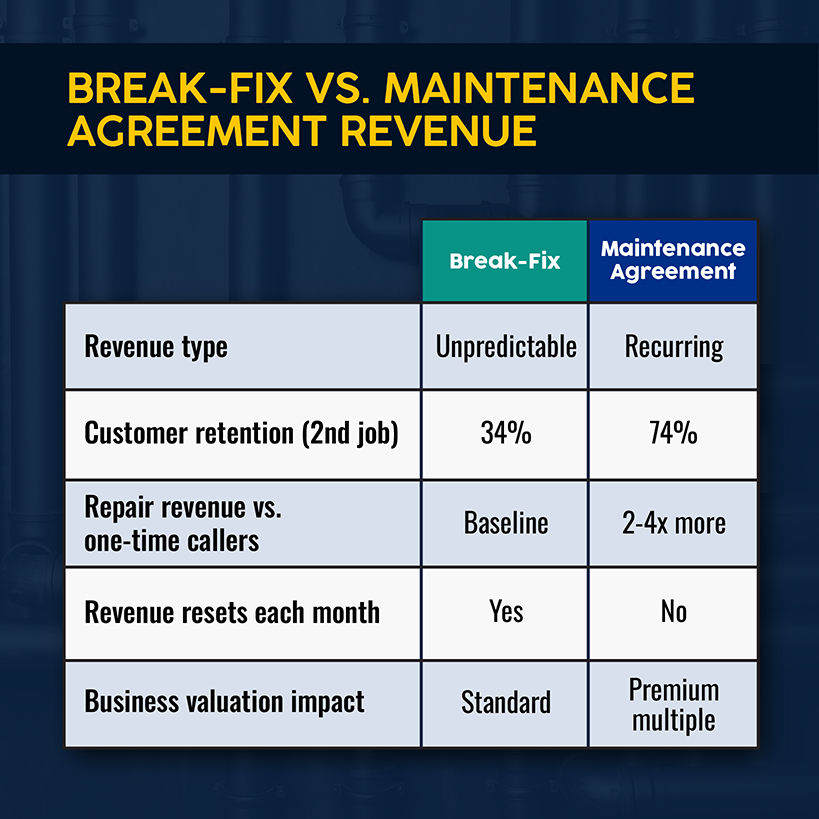
Contract customers generate two to four times more repair revenue than one-time callers, because every scheduled visit surfaces legitimate work. Whether it’s a pressure relief valve due for replacement, a water heater past its useful life, or corroded shutoffs that haven't been turned in a decade, it’s this downstream repair revenue that boosts your margin.
Related: Maintenance planning explained: how proactive scheduling changes the operational picture.
When Should You Use a Plumbing Maintenance Agreement?
Not every customer is a good candidate for a service plan, and not every plan fits every property type. Here's where maintenance agreements earn their place.
Residential Service Plans
The single-family homeowner who called you for a burst valve, had a good experience, and left a five-star review is your best maintenance agreement prospect. They already trust you. They've seen why preventive plumbing feels worth the investment.
A residential plan at $200–$350 per year typically covers one or two annual visits and gives the customer priority dispatch, a trip fee waiver, and a 10–15% repair discount. For the customer, this means roughly $17–$29 per month for peace of mind and guaranteed access to a plumber they already like. For your business, it's a recurring revenue line that keeps you from reacquiring the same customer on the next service call.
The retention math is stark: Customers with a maintenance plan return for a second job 74% of the time, versus a 34% average retention rate. Every plan you convert is a customer who doesn't have to be won over again next year.
Commercial or Multi-Property Agreements
A restaurant, multifamily property, or 60-unit homeowners association presents a different profile. The agreement value is higher, and the scope is more complex.
Commercial agreements often require a tiered scope, with a base visit for inspection and additional service events priced separately. They also require more negotiation than a residential plan. A property manager vetting a plumbing contractor wants a documented scope, response guarantees, and pricing they can put in a budget.
Commercial deals tend to close from October through December, when commercial property managers finalize their annual budgets. Starting a conversation in September with a smaller engagement can establish you at a property and create leverage when the renewal discussion arises.
What to Include in a Plumbing Maintenance Agreement Template
A well-built plumbing maintenance agreement protects your business legally and communicates the plan’s value clearly, helping the customer feel confident about signing it.
Business and Customer Information
Start with the basics: Your legal business name, license number, and contact information, and the customer's name, property address, billing address, and phone. Add the effective start date and the contract terms; 12 months is standard for residential. Evergreen auto-renew is the cleanest structure for ongoing plans.
This section establishes who the agreement covers and at which job site. If a customer tries to extend coverage to a second property, you have a clear reference point.
Scope of Maintenance Services
This is the heart of the agreement. It defines the scope of work your technician will complete on each scheduled visit. That specificity protects you as much as it informs the customer.
For a standard residential annual visit, a well-written scope includes specific tasks such as:
- Water heater flush and anode rod inspection
- Water pressure testing and pressure-reducing valve inspection
- Dye test on toilet tanks for silent leaks
- Exercising the main shutoff valve and all accessible fixture shutoffs
- Inspecting exposed supply and drain lines for leaks, corrosion, or joint wear
- Checking faucets and showerheads for flow and drip
- Assessing drain flow speed across fixtures
- Sump pump testing and inspection
- Visual inspection of accessible pipe runs for mineral buildup or corrosion indicators
For commercial agreements, add backflow preventer testing (with documentation for code compliance), grease trap and drain jetting intervals, multi-unit water heater service, and fixture count records.
List the specific systems covered under the agreement. If it's not in the scope, it's not covered.
For residential, that covers the full plumbing system, including interior supply and drain lines, water heater, sump pump, and the pressure-reducing valve. If a property has specialty equipment like a tankless heater or water softener, name it explicitly. If you let the customer assume something is covered, that’s a billing argument waiting to happen.
Service Frequency and Schedule
State how many visits the plan includes per year, what each visit covers, how far in advance you'll contact the customer to schedule, and what the rescheduling process looks like. For residential biannual plans, splitting tasks between visits — drain inspection in spring, water heater service in fall — makes operational sense and gives each visit a clear identity.
Build in a reasonable scheduling window. Standard advance notice from your side is 30 days; requiring confirmation within two weeks protects your dispatch calendar.
Pricing and Payment Terms
State the total plan price, billing method (monthly auto-debit or annual upfront), payment due dates, and accepted payment methods. If you're using monthly billing, note how you treat missed payments — a grace period, a late fee, or suspension of service. If annual billing includes a discount, show the math.
Speaking of pricing, monthly billing can convert more prospects than annual upfront pricing. A customer who balks at $240 upfront will often sign on $20 per month without a second thought, even though the annual total is the same. The lower psychological barrier at signup is real.
Related: How Simpro® structures recurring asset maintenance contracts at the account level.
What Is Excluded
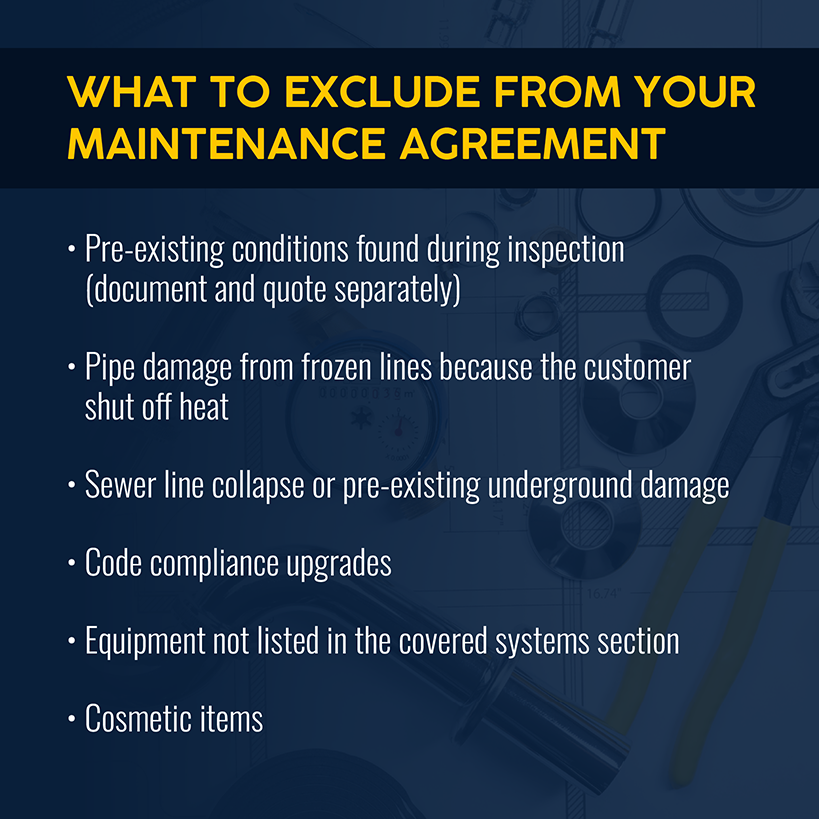
The exclusions section is as important as the scope. If your agreement doesn't rule out specific services, a customer can reasonably argue that anything found during a visit is your responsibility. Name these specifically:
- Pre-existing conditions found during inspection (which you document and quote separately)
- Damage from frozen pipes because the customer shut off the property's heat
- Sewer line collapse or pre-existing underground damage
- Code compliance upgrades
- Equipment not listed in the covered systems section
- Cosmetic items
Anything that sits outside your normal service visit but might show up during an inspection needs to be named here. This is your protection against a customer who interprets "full plumbing inspection" as a blanket repair commitment.
Emergency Service Terms
Define what "priority dispatch" actually means. A vague priority claim creates unrealistic expectations. Basic service contracts offer no response guarantees. Your contract might include a clause giving members priority scheduling within four hours during business hours, along with after-hours emergency response at a specified rate. This gives both parties something concrete.
If you waive the trip fee for members, which is one of the most effective retention levers in residential agreements, say so here. Define what the trip fee is for nonmembers, making the discount visible.
Liability, Warranty, and Dispute Terms
Include a workmanship warranty on labor (one to two years is standard), a manufacturer warranty pass-through on parts, and a liability cap for incidental damage discovered during inspection that pre-existed the visit. This last clause protects you when an inspection reveals a failing valve that you didn't cause, even if the customer assumes the inspection itself precipitated the failure.
For dispute resolution: Specify the jurisdiction (your operating state), and build in a process of negotiation, then arbitration. Binding arbitration is cleaner than litigation, given the dollar amounts that typically arise from residential service disputes.
Signatures and Acceptance
Both parties sign with printed names and dates. Digital signatures via DocuSign or similar platforms are legally binding under the ESIGN Act in all U.S. states and significantly accelerate enrollment. For instance, a customer who might delay executing a physical plumbing contract for two weeks will often sign digitally the same day.
Attach the service schedule, covered equipment list, and payment schedule as referenced exhibits so the main agreement body stays readable.
How to Create a Plumbing Maintenance Agreement Step by Step
The decisions you make before offering a contract matter. What you're offering, how you're pricing it, and the included terms will determine whether the agreement scales or creates problems. These four steps cover the process.
Step 1: Define the Service Plan You're Offering
Before you write a contract, decide what you're selling. A maintenance agreement is only as clear as the plan behind it. Answer these questions first:
- How many visits per year?
- What tasks will you complete on each visit?
- What's included versus billed separately when found?
- Will you offer monthly or annual billing, or both?
- What member benefits come with the plan (trip fee waiver, repair discount, priority dispatch, etc.)?
A well-defined plan outperforms a confusing menu of four tiers. Start with one option each for residential and commercial jobs. You can add tiers later, once you understand where customers are asking for more coverage.
Step 2: Price the Agreement So It's Sustainable
Here's where most operators go wrong. Maintenance agreement pricing should be set against your actual cost to deliver the visit — burdened labor, truck time, overhead allocation — not just what feels reasonable.
For example, at a $200 annual fee, a single residential visit might cost approximately $240 all-in for plumbing businesses. The agreement breaks roughly even on the visit itself. The margin comes from pull-through repair revenue.
Two additional considerations:
- Reprice every 12 to 24 months. Agreements priced in 2022 and never adjusted through two rounds of cost inflation are running negative margins.
- Build in renewal price language. If you reserve the right to adjust pricing at renewal with 60 days' notice, put it in the contract.
Related: Check out our plumbing profit margins guide to get benchmarks for what your maintenance book should look like on a per-plan basis.
Step 3: Add Terms for Renewal, Cancellation, and Nonpayment
Include these specific maintenance agreement terms:
- Auto-renew language: The agreement renews annually unless either party provides written notice within 30 days of the renewal date. This keeps your book from quietly lapsing without active reenrollment.
- Cancellation and clawback: if a customer cancels midterm, you claw back any discounts they received during the active period. This clause protects your margin and acts as a retention lever by making cancellation financially visible.
- Nonpayment: Define the grace period, late fees, and when service is suspended. Most operators give 10 days, then suspend, then terminate after 30.
Step 4: Review the Agreement Before Using It
Have your attorney review the final contract before you use it at scale. Liability clauses, arbitration terms, and cancellation language vary by state. A 30-minute legal review on the front end is cheaper than a dispute on the back end.
After legal review, have a non-plumber read it. If they can't follow what's covered and what isn't, rewrite those sections in plainer language.
Common Mistakes to Avoid in a Plumbing Maintenance Agreement
Most of these show up gradually over time, as scaling up reveals gaps in the agreement that start costing you. Fix these quickly:
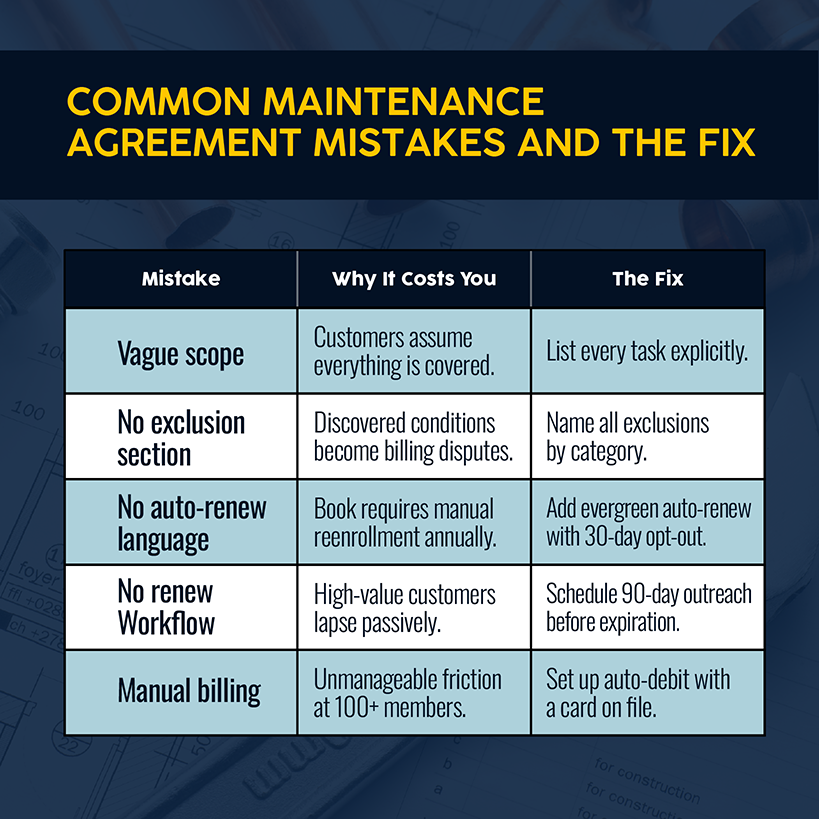
- Vague scope definitions. "Full plumbing inspection" doesn’t say what plumbing work is actually included — or isn’t. Customers fill in vague language with their own assumptions. Write down every task.
- No exclusions section. If your agreement doesn't name exclusions, anything discovered during a visit is arguably covered. Pre-existing conditions, underground damage, and code compliance work need to be explicitly carved out.
- No auto-renew language. Without it, your agreement book requires manual reenrollment every year. Most customers who intend to continue won't bother filling out another form. Auto-renew with an opt-out is the standard for scaling maintenance programs.
- No renewal workflow. Even with auto-renew language, customers with expired credit cards, billing changes, or unresolved service complaints will lapse. A proactive 90-day renewal outreach — automated or manual — pushes renewal rates from the industry median of 70–75% toward 85% and above. The customers with the highest expired agreement value are often your most profitable customers, which makes passive lapses expensive.
- Manual billing. Paper invoices and manual follow-up introduce friction that becomes unmanageable at 100+ members. The operational baseline is auto-debit, with a card on file, especially for maintenance programs you intend to grow.
Build and Manage Plumbing Maintenance Agreements With Simpro
Writing a solid plumbing maintenance agreement is the first step. Managing 200, 500, or 2,000 of them without adding proportional admin overhead is where most programs stall.
Simpro's plumbing field service software connects the full maintenance agreement life cycle — contract setup, recurring job scheduling, technician dispatch, automated invoicing, and payment collection — in one system.
The Maintenance Planner automatically generates future jobs from contract parameters and tracks asset inspection dates across commercial properties. Recurring Jobs handles residential visit scheduling in bulk, with pre-loaded task lists so technicians arrive knowing exactly what the visit covers.
Automated invoicing runs on a configured billing cycle with no manual intervention, including card-on-file recurring payments. Contract profitability reporting links invoice revenue to visit costs at the agreement level. The diagnostic catches pricing problems before they compound into preventable margin loss.
Simpro is used by more than 250,000 field service professionals across 24,000+ businesses. For plumbing operators running or building a maintenance program, schedule a demo to see how the platform handles the operational side of recurring revenue at scale.


 Back to top