
Useful AI in field service management is part of a real operating workflow, where office and field teams evaluate it against the work they already do. Choose a platform that uses job, customer, asset and business context to support decisions, not another disconnected tool that produces generic prompts without reflecting how your operation runs. Treat software selection as a practical exercise: map the work that creates delays, test the AI with realistic data and confirm that people remain in control. Do not treat the longest feature list as the goal. Choose a system your team trusts, adopts and measures.
The Nitty Gritty
Evaluate AI-powered field service management software by job-type fit, connected workflows, business context, and human oversight.
Test AI at each stage of the job lifecycle with your own jobs, devices, and exceptions.
Record a baseline and pair one operational measure with one control measure before a pilot.
Resolve six rollout gaps, from data quality to ownership, before you buy.
What is the best AI-powered field service management software?
The best AI-powered field service management software matches your job types, operating model and team. Look for connected core workflows, relevant business and job context, clear human oversight, a usable field experience, dependable integrations and a credible implementation plan. Judge value against a documented baseline rather than a polished demo promise.
What is the best AI-powered software for trades and field service companies?
For trade businesses, start with job-type fit, not the number of AI features. Test emergency service, planned maintenance, inspections, quoted work, projects and recurring service. HVAC, electrical, plumbing and fire/security teams need their scheduling constraints, field records, approvals and invoicing handoffs preserved. Mixed operations also need distinct rules for each line of work.
| Selection criterion | What to verify in a demo | Red flag |
|---|---|---|
| Connected FSM workflow coverage | Run one representative job from estimate and schedule through field completion, invoice and reporting. | AI sits in a separate interface, with job context split across the lifecycle. |
| Trade and job-type fit | Run an urgent service call, a planned-maintenance visit, an inspection and a quoted or project job that match your work mix. For mixed operations, test each workflow and approval path. | The demo uses one clean job type, while different work follows the same forced process. |
| AI grounded in business and job context | Ask which customer, asset, technician, contract and job-history data the system uses for each recommendation. | The vendor gives generic outputs with no explanation of the operating data behind them. |
| Mobile and field usability | Have a technician complete the workflow on the devices and network conditions they encounter. | The office demo looks polished, but field users re-enter data or return to a desktop. |
| Human oversight, permissions and trust | Confirm who reviews, approves, edits, rejects and audits an AI-supported action. | Recommendations become actions without clear permissions, review points or history. |
| Integrations and data readiness | Test the accounting, supplier, CRM and other connections your business depends on, including error handling. | The vendor calls integration possible but leaves ownership, setup effort and data-quality requirements vague. |
| Implementation, training and adoption | Request the implementation sequence, data responsibilities, role-based training and adoption support. | The sales process treats configuration, data cleanup and behavior change as afterthoughts. |
| Baseline metrics, cost and value measurement | Document the current workflow baseline, pilot scope, resource commitment and review cadence before buying. | No baseline or named owner for the value review. |
Treat broad performance promises as claims to verify. Request evidence tied to the exact capability, workflow and result shown in the demo.
Where Simpro fits
Simpro is a shortlist fit when your criteria include AI inside connected office and field workflows. Its broader field service management software context covers work from estimating and scheduling through job delivery, invoicing and reporting.
Review Simpro Lightning for current product context, then test the fit against your job mix, integrations, data and adoption needs.
What is AI in field service management?
For this buying decision, define AI in field service management by the tasks under evaluation: identifying patterns, generating useful outputs or recommending actions inside a field service workflow. Examples include summarizing job information, evaluating scheduling options and presenting documentation steps to a field user. The responsible person retains responsibility for understanding, reviewing and owning the final decision.
Run the demo with your own dispatch inputs and have the presenter explain the context behind each recommendation.
The NIST AI Risk Management Framework is a voluntary framework for incorporating trustworthiness considerations into the design, development, use and evaluation of AI systems.
Use that structure as a buyer check. Identify the decision owner, approval point and exception path for each AI-assisted workflow. Give security, compliance and finance owners the details they need for their assessment.
Where AI fits across the field service job lifecycle
Prioritize handoffs where teams wait for information, duplicate it or receive incomplete records. Test whether AI removes that friction without weakening oversight. Start with one representative job and trace every office, field and commercial handoff before judging the feature live. Track exception paths, approval owners and downstream records during testing.
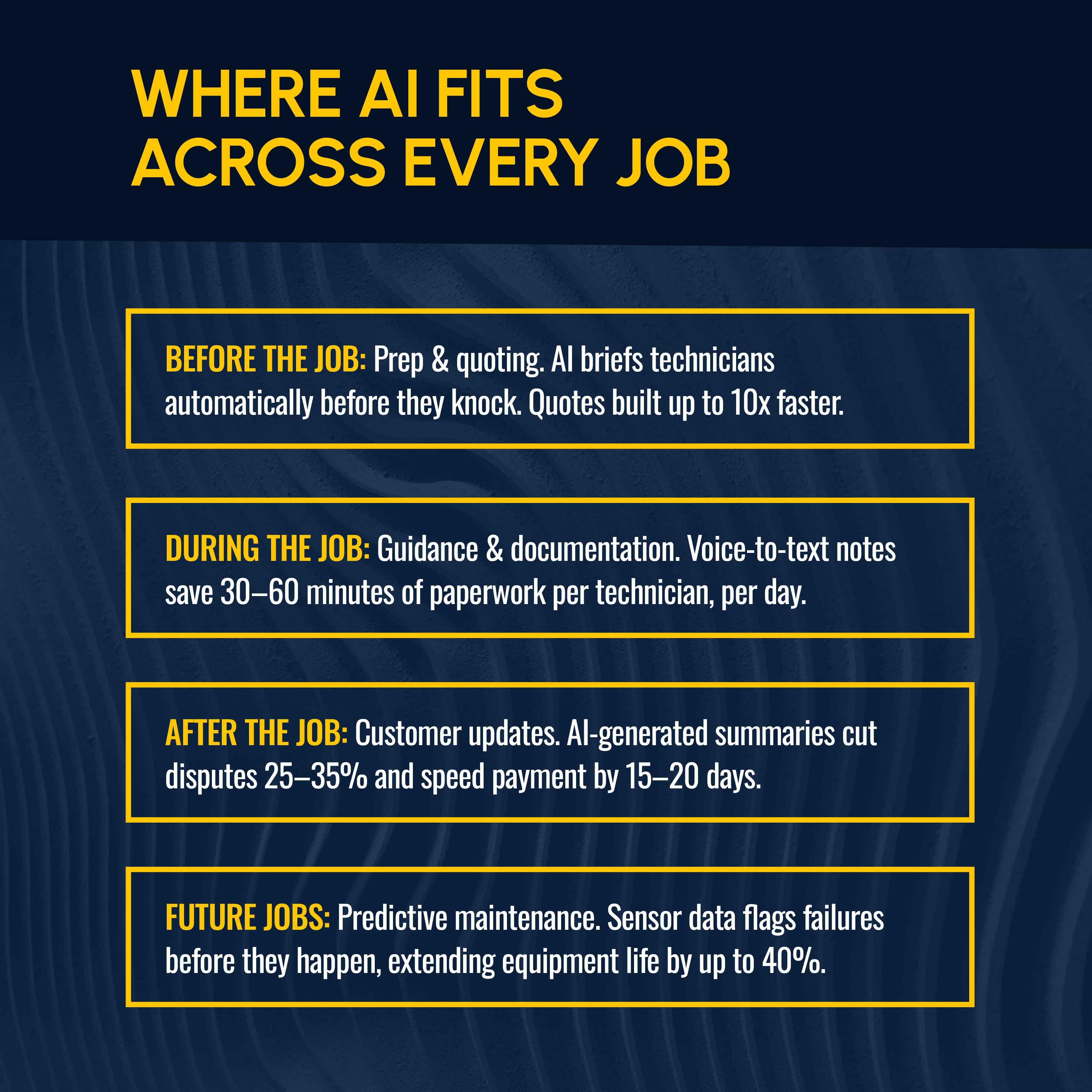
Before the job: estimating, prioritization and scheduling
For estimating, ask the system to organize relevant job history, flag missing inputs and prepare a draft summary for review. For scheduling, give the dispatcher stated constraints such as skills, availability, geography and priority, then inspect the options.
Use one demanding scheduling conflict as the buyer test. Check whether the dispatcher understands the recommendation, changes the assumptions and makes the final decision. A fast answer isn't useful if it ignores the constraint that matters most.
During the job: preparation, guidance and capture
Before work begins, give the technician a realistic set of site history, asset information, scope, forms and customer notes. In a demo, test how the software presents that information and handles the documentation steps selected for the trial. Use the actual field device and connectivity conditions to expose friction in reviewing or recording the work.
Test with intended users. Give them a job to prepare, a work record to complete and an exception to handle. Observe where they hesitate, switch tools or enter the same detail twice.
After the job: review, documentation and commercial handoff
After the job, test whether the software organizes field notes, identifies missing information and prepares material for office review. The objective is a cleaner handoff, not automatic approval. Keep supervisors and office teams responsible for reviewing technical records, customer-facing communication, billable items and exceptions according to your controls.
For the commercial handoff test, use the job record, time, materials, forms and invoice preparation, and track each transfer.
Across future jobs: trends and proactive work
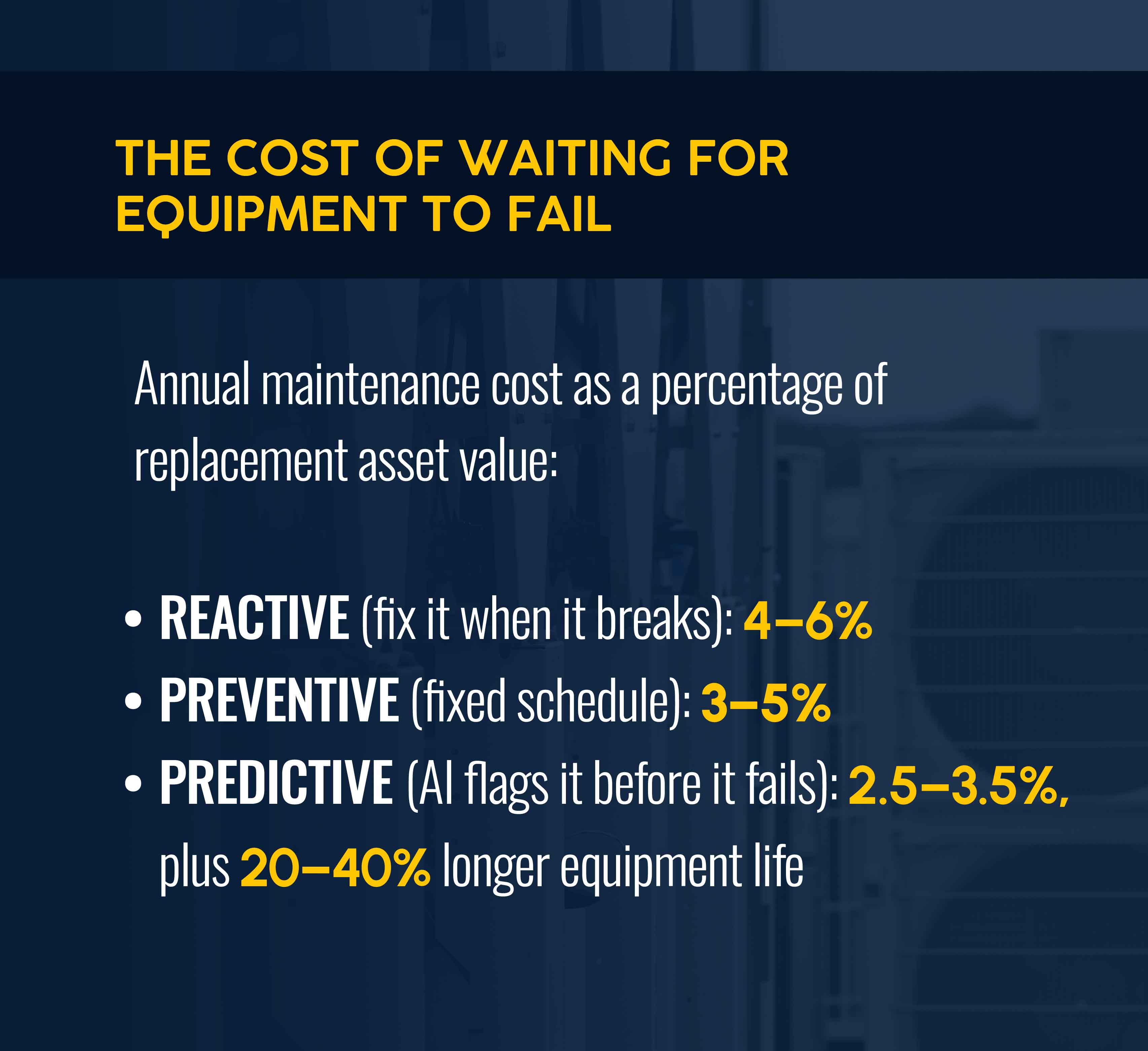
For future planning, inspect recurring faults, repeat visits, incomplete records and maintenance patterns. Build the demo around your actual assets, operating context, risk and maintenance approach. Then give the software a defined analysis task and review its output with the person who owns that decision.
Related: See real contractor results from Simpro customers who offer predictive service programs.
Seven practical AI use cases for field service operations
Start with one narrow use case that has a clear owner, usable data and a measurable baseline. Use representative records and one difficult exception with the responsible staff members who will accept, edit or reject the final recommendation. Review the result before expanding the pilot. Evaluate these practical areas next:
- Schedule option support: compare possible assignments against the operating constraints your dispatcher already uses.
- Job preparation: surface relevant customer, site, asset and prior-job information before arrival.
- Estimate assistance: organize inputs, identify missing details and prepare material for an estimator to review.
- Field documentation test: check how the workflow prompts for selected steps, notes, photos or forms while the technician is still on site.
- Post-job review: identify missing or inconsistent information before the record moves to invoicing or reporting.
- Knowledge retrieval: ask office and field users to find approved procedures or job information across the connected workflow.
- Operational pattern detection: flag recurring issues or workflow bottlenecks for a manager to investigate.
Use these as evaluation categories, not a shopping list. Prioritize strong support for your two highest-friction workflows over a long set of disconnected AI features. The related guide to evaluating AI features in field service software provides a feature-level demo framework.
How to measure AI in field service management
Before the pilot, record the current workflow and define a useful change. Pair one operational measure with one quality or control measure. Name the owner, review date and decision rule. Keep the test narrow enough to investigate unexpected results, and compare the same workflow before and after the trial under similar operating conditions.
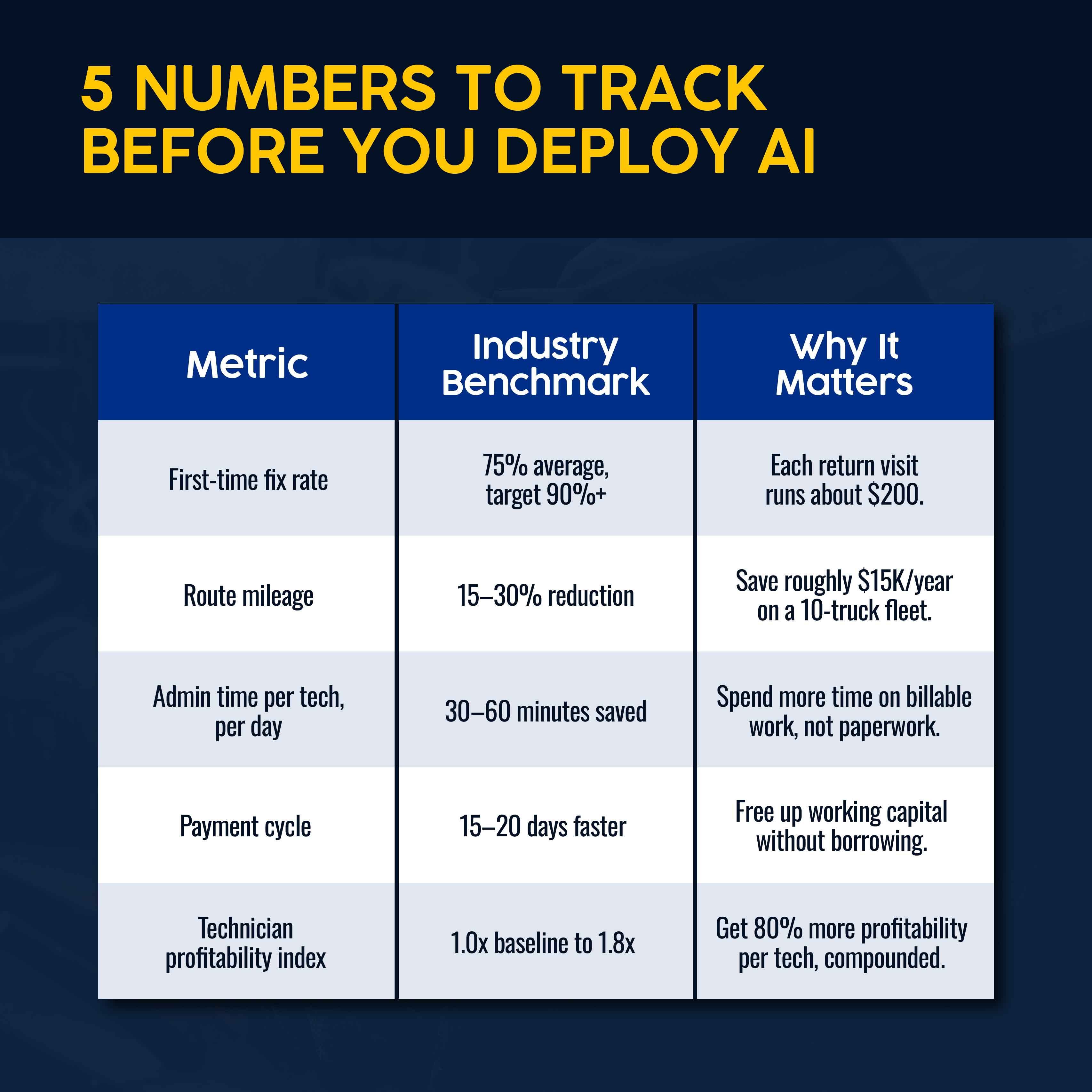
| Workflow | Baseline to record | Pilot measure | Control measure |
|---|---|---|---|
| Scheduling | Time spent building or revising a schedule | Time to produce an acceptable schedule option | Dispatcher overrides and reasons |
| Job preparation | Time spent finding job and asset information | Time to assemble the job brief | Missing or irrelevant information |
| Field documentation | Time between work completion and complete records | Same-workflow completion time | Records returned for correction |
| Post-job review | Queue age before commercial review | Time from field completion to review-ready record | Missed billable items or unsupported additions |
| Knowledge retrieval | Time spent searching for approved information | Time to find an accepted answer | Unverifiable or outdated responses |
Record implementation, integration, data preparation, training and ongoing administration in the evaluation. Request the configuration plan, task owners and success review process from the vendor. Use those answers to complete the business case.
Six rollout gaps to resolve before purchase
Pause the purchase when any of these gaps remains unresolved:
The HSE uses a step-by-step process for controlling health and safety risks caused by workplace hazards. For a safety-sensitive AI pilot, use that sequence as a process model and verify the legal requirements that apply to your US operation.
- No defined workflow problem. "Use AI" doesn't define a workflow problem. Define the delay, decision or handoff first.
- Weak or fragmented data. Missing job codes, inconsistent notes and disconnected systems limit the context available to any AI feature.
- No accountable owner. A pilot needs someone who owns the process, the data, the approval rules and the review cadence.
- Late field-user involvement. Bring technicians and dispatchers into workflow testing before a purchase decision, not after configuration.
- Unclear oversight. Label outputs as suggestions or approval points, and name who records errors.
- No baseline. Record starting speed and quality so the pilot has a comparison.
Run one representative workflow with a small user group and a fixed review date. Log accepted, edited and rejected outputs. Use that record to judge the feature and identify remaining process or data problems.
A practical standard for connected, supervised AI
Evaluate AI as part of the operating workflow, not as a standalone assistant. It needs the right business context, a connected path through the workflow and a clear handoff to the person responsible for the decision.
Ask the demo team to show role permissions, the recommendation log, missing-context handling and administrator controls. Give the teams that own security and compliance the data-protection, retention and review-access details for their assessment.
Keep the buying standard grounded when you assess AI-supported preparation, recommendations and documentation. Buy against a defined problem, named users and documented controls.
Related: How agentic AI is changing accounts receivable for trade businesses.
Frequently Asked Questions
What is the best software for field service management?
The best field service management software is the platform that fits your jobs, users, controls and reporting needs. For an AI evaluation, shortlist software that connects scheduling, job records, mobile work, invoicing and reporting, then test the same representative jobs, exceptions and implementation requirements in each demo.
What are the top 10 field service management software?
Use any field service management software guide as a research starting point, not a buying decision. Build your own shortlist around trade fit, workflow coverage, mobile adoption, integrations, implementation support and measurable value. Remove vendors that cannot show your real job types and approval paths.
Will CRM be replaced by AI?
AI does not replace CRM for field service companies when customer records still drive estimating, scheduling, communication and reporting. The NIH Office of Research Services describes CRM as tools, methods and activities for customer data and accounts. Use AI to improve access to that context while people own customer commitments.
Run smarter with a workflow-first AI decision
Choose AI-powered field service software by operating fit, workflow connection and a controlled path to measurement, not by the boldest promise.
Take one representative job, one difficult exception and one baseline workflow measure into your next vendor conversation. Have the vendor show the full office-to-field path, identify every human decision and explain the implementation work. If Simpro fits your shortlist, book a demo and use the selection table in this guide to structure the conversation.


 Back to top