
A plumbing price book is how serious plumbing businesses stop leaving money on the table, but most don't have one they use consistently. Instead, one tech quotes $400 on Monday, and another tech quotes $550 for the same job on Friday. Neither number is defensible, and the owner doesn’t realize the margin is gone until the accountant calls.
The fix is a catalog of every service your company offers, with flat rates calculated before the job starts. Labor, materials, overhead, and profit are already baked in. The customer gets upfront pricing before anything's touched. There’s no renegotiating at the truck, and no customer trust lost because the estimated price changed.
What Is a Plumbing Price Book?
A price book is a structured catalog, not just a list of prices. Each entry includes a task name, a plain-English description of what the job covers, the labor hours to complete it, a material allowance, and the flat rate paid by the customer. Profit margins are built in at the task level, not estimated at the end of the month.
Compare that to a price list. A price list tells you what something costs. A price book tells you what it costs, what's included, and what the tech is authorized to charge. A well-built plumbing flat-rate pricing book goes further: It sets a standard price for every common task, so the business runs on consistent numbers, not whoever happens to take the call.
Everyone uses a flat-rate plumbing price book: The owner sets the rates, the office manager updates materials pricing, and techs quote from it in the field.
Flat Rate vs. Time and Materials: What's the Difference?
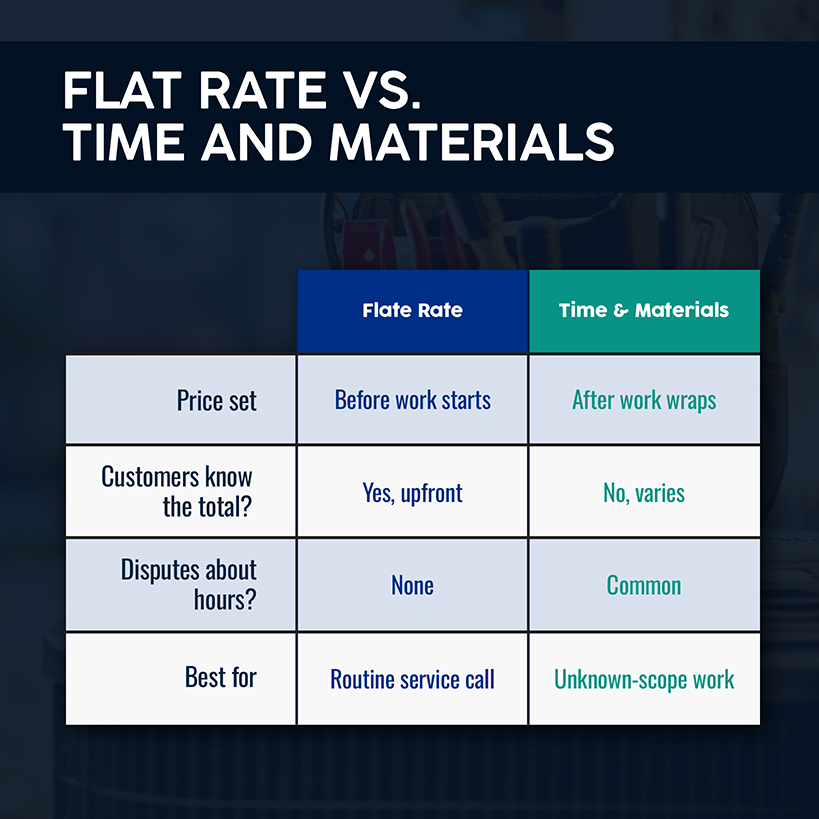
Flat rate means the customer receives one price up front, no matter how long the job takes. Time and materials (T&M) bills hourly rates plus actual parts, so the total isn’t finalized until the job wraps.
Most plumbing price books default to flat rate because it removes disputes about how long something took, eliminates the anxiety customers feel watching the clock, and forces accurate estimating. T&M is suited for exploratory work where the scope is genuinely unknown, but it shouldn't be the default for routine service calls.
The 3 Plumbing Pricing Models (and Which One to Build Your Book On)
Every flat-rate plumbing price book is built on one of three models, and most mature operations use at least two.
- Flat rate sets a fixed price per task, agreed before work starts.
- Time-and-materials bills labor hours plus actual parts, transparent but harder to predict.
- Service agreement pricing covers recurring visits under a maintenance contract at a discounted rate.
Flat rate scales best. It eliminates tech-to-tech variance, speeds up quoting, and makes upsells repeatable. Service agreements and flat rate coexist, as the agreement covers the recurring visit, while flat rate handles anything out of scope.
What to Include in a Plumbing Price Book
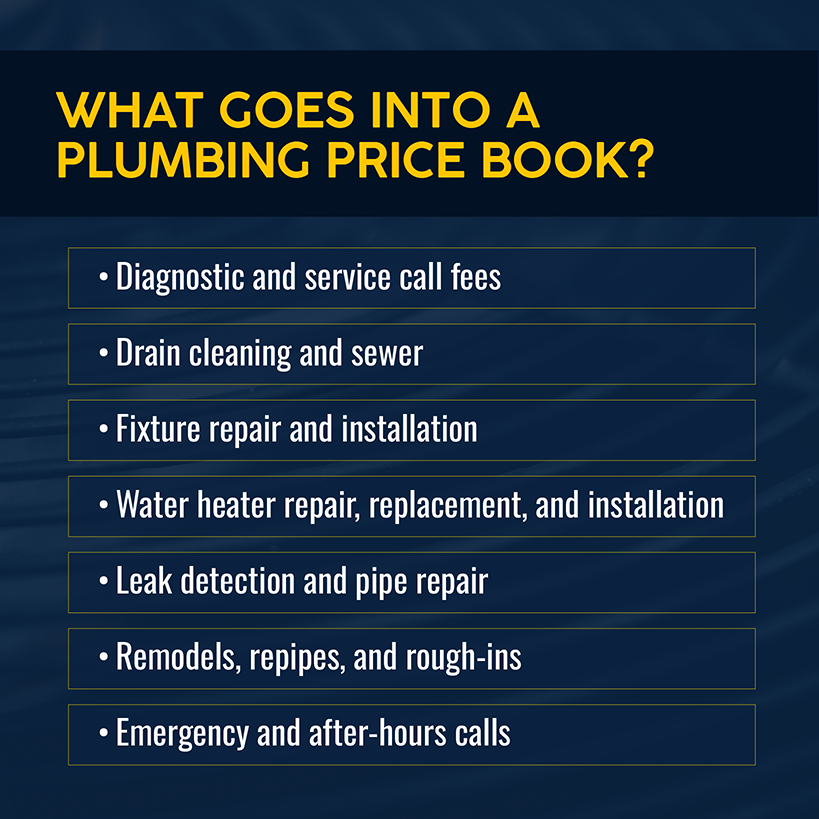
Structure the book around service categories first, then task level within each. These categories cover most residential and light-commercial plumbing services:
- Diagnostic and service call fees
- Drain cleaning and sewer
- Fixture repair and installation
- Water heater repair, replacement, and installation
- Leak detection and pipe repair
- Remodels, repipes, and rough-ins
- Emergency and after-hours calls
Each task entry needs six elements:
- Task name
- Description of what's included (and what isn't)
- Estimated labor hours
- Material allowance
- Flat-rate price
- Margin floor (the minimum price below which the job loses money).
The margin floor matters most when someone's under pressure to close a deal.
Build at the task level. Jobs are combinations of tasks, which makes bundling faster and cleaner. For example, a water heater replacement is three tasks: remove and haul the existing unit, install a new unit, and test and inspect. Each gets priced separately and combined on the quote.
Excavation is a notable exception. Soil conditions, depth, and access vary too much for a single-line price. Build a calculator or a rate-per-foot structure with a stated buffer, not a flat number that blows up on you.
Related: Learn how to price plumbing jobs in the US.
How to Calculate Flat-Rate Prices
The formula isn't complicated, but most shops skip at least one term:
Flat rate price = (labor hours × fully-loaded rate) + (material cost × markup) + overhead allocation
- Fully loaded labor rate: This is where most underpricing starts. The Bureau of Labor Statistics puts median plumber wages at roughly $30/hr, but fully loaded master plumber labor costs (wages, FICA, workers' compensation, benefits, and vehicle allocation) can run $100–$160/hr in most markets. Build from that number, not the base wage.
- Material markup: This deserves its own audit, as most plumbing shops leave margin on the table. Moving from 30% to 50% gross margin on specialty items — on a $5,000 fixture job — is $1,000 more in gross profit. Across 500 jobs a year, that's $500,000 extra.
- Overhead allocation: Figure out your overhead rate before building the price book by taking total annual overhead and dividing by total billable hours. Add that number to every flat-rate task. Anchor your service prices to your cost structure, not what competitors charge. Well-managed plumbing contractors target 20–25% overhead as a percentage of revenue.
How to Build a Plumbing Price Book Step by Step
The instinct is to price everything at once. Don't. A complete price book built on shaky math is worse than an incomplete one built on solid numbers.
Step 1: List Every Service You Offer
Start with your 20-30 most common jobs. Group by category: drain, fixtures, water heater, pipe, emergency, maintenance. Water heaters, toilet replacements, drain cleaning, faucet installs, and disposals belong in the first pass. These jobs are high-frequency, high-ticket, and clear enough to estimate accurately.
Leave edge cases for the second pass, such as slab leak detection, remodel rough-ins, and complex repipes.
Step 2: Set Your Labor Rate and Margin Floor
Pull your payroll data for the last 12 months. Calculate the fully loaded hourly rates for each technician tier (apprentice, journeyman, master). Add vehicle costs (fuel, insurance, maintenance, and replacement allocation), divided by annual hours worked.
Set a minimum gross margin floor before you price a single task. Top-performing plumbing shops using flat-rate price books consistently hit 60–62% gross margin on service and repair work. If your prices don't support that, the problem is your cost structure or market position — figure out which before pricing anything.
At a $2M revenue base, the difference between 10% and 20% net margin is $200,000 per year. Building the right rates into your price book is how you scale the bottom line without adding trucks.
Step 3: Price and Stress-Test Each Task
Build each task price using the formula above. Then run three tests before finalizing:
- Floor test: Does the price clear your margin floor with realistic material costs and actual labor hours?
- Market test: Is the price something your market will pay? Base it on what customers regularly accept, not what competitors charge.
- Tech test: Can a less experienced tech complete this task in the estimated hours? If not, widen the hours or create a separate rate tier.
Flag any task where the flat rate sits within 15% of your cost floor. Those jobs become unprofitable when discounts are applied.
Related: 9 tips for field service job order costing.
Step 4: Structure for the Field
Once tasks are priced, build good/better/best tiers where the job type supports it. Water heater replacement is the obvious one: standard tank, high-efficiency tank, tankless.
Trade businesses consistently report increases in average ticket size — not by charging more for the same job, but by giving customers a legitimate reason to spend more.
Format the field version for fast lookup. Sort by category, with short task descriptions the tech can read directly to the customer with confidence.
Related: 5 ways to improve your estimating skills.
Why Static Price Books and PDFs Fall Short
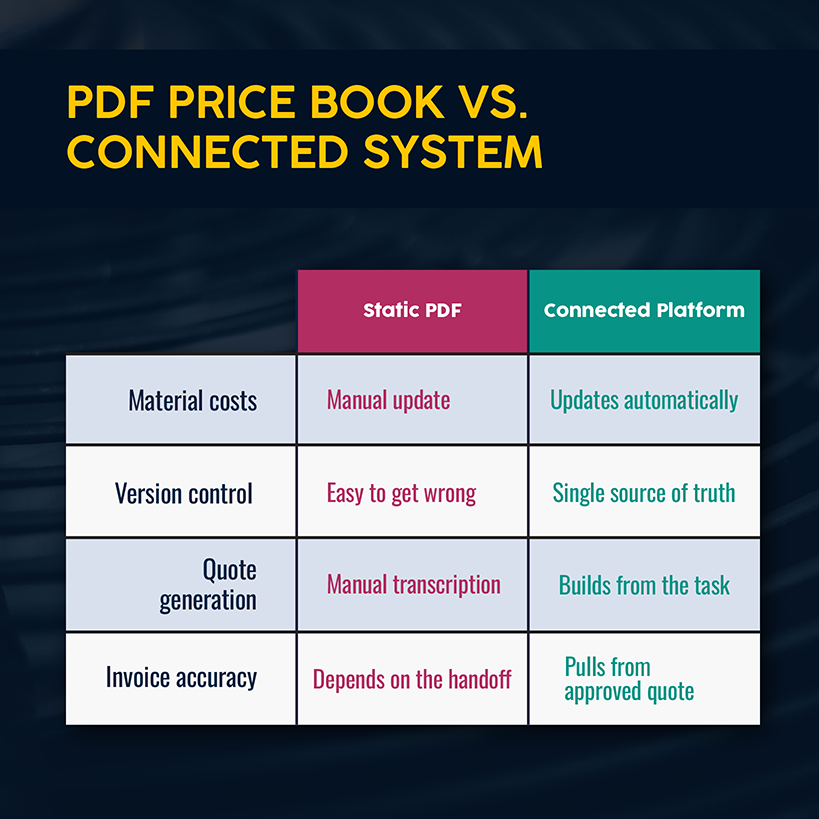
A plumbing flat-rate pricing PDF works fine on the day it's published. Three months later, it's a liability.
Material costs can shift 10-15% in a single quarter. Copper prices have soared because of electrification demand. PVC fittings and water heater wholesale costs move with supply chain conditions. A tech quoting from a stale PDF is either undercharging on materials or eating a margin hit on every call — and you won’t know about it until quarter-end.
The risk compounds with scale. On a one-truck operation, the owner knows when prices change. On a 10-truck operation, version control on a shared PDF is a real problem. Are all your techs working from the same file, much less an updated one?
Related: 5 cash traps every trade business should avoid.
How to Keep Your Plumbing Price Book Profitable as Costs Change
Quarterly reviews are the minimum cadence. Review monthly during volatile commodity periods, especially with the sharp price movements in copper.
What to monitor:
- Copper pipe and fittings: Most sensitive to electrification-driven demand cycles
- PVC and CPVC: Tracks resin markets and transportation costs
- Water heater wholesale pricing: Shifts with manufacturer costs and supply chains
- Your labor burden: Affected by wage increases, workers' comp adjustments, and benefits changes
Pull your top 50 most-quoted materials from the last 90 days. Compare old quotes against current supplier pricing. Any item that's moved more than 5% should trigger a price book update before the next quote goes out.
Related: Here are the 20 best apps for plumbers.
From Price Book to Paid: Connecting Your Pricing Catalog to Quotes and Invoices
A plumbing price book that lives in a spreadsheet or PDF is a manual process. Techs must locate the task and write down the price. Then the office creates a quote, and the quote becomes an invoice. Each handoff creates the risk of mistranscribed numbers or old prices slipping through.
Simpro® for plumbing is a connected field service management platform that supports flat-rate pricing from quote to invoice. When techs pull up a task on their phones, the quote is built automatically with real-time material costs, current markup, and up-to-date labor rates. The customer approves, the job generates. When the job closes, the invoice generates. No manual steps that lead to mistakes.
Simpro's catalogue works as a live price book — a structured repository of every part, material, and service with cost price, markup, and trade price attached. It connects supplier price updates, quote generation, purchase orders, and invoicing in a single system. Simpro also integrates with FlatRateNOW's 1,900+ pre-built tasks, which flow directly in without manual re-entry. Over 24,000 businesses benefit from having an end-to-end pricing workflow.
Schedule a demo to see how Simpro connects your price book to every quote, job, and invoice.


 Back to top