
Finding the best plumbing estimating apps isn't the hard part — there are dozens of them. What's harder is figuring out the best fit for your jobs, your team size, and where you want to be in two years. The last thing you want to do is commit to a 12-month contract, only to discover it wasn't built for your operation.
Estimating apps aren’t one-size-fits-all. A two-person residential crew and a commercial plumbing contractor bidding multi-million-dollar mechanical projects have almost nothing in common when it comes to estimating — different tools, different workflows, and different failure modes.
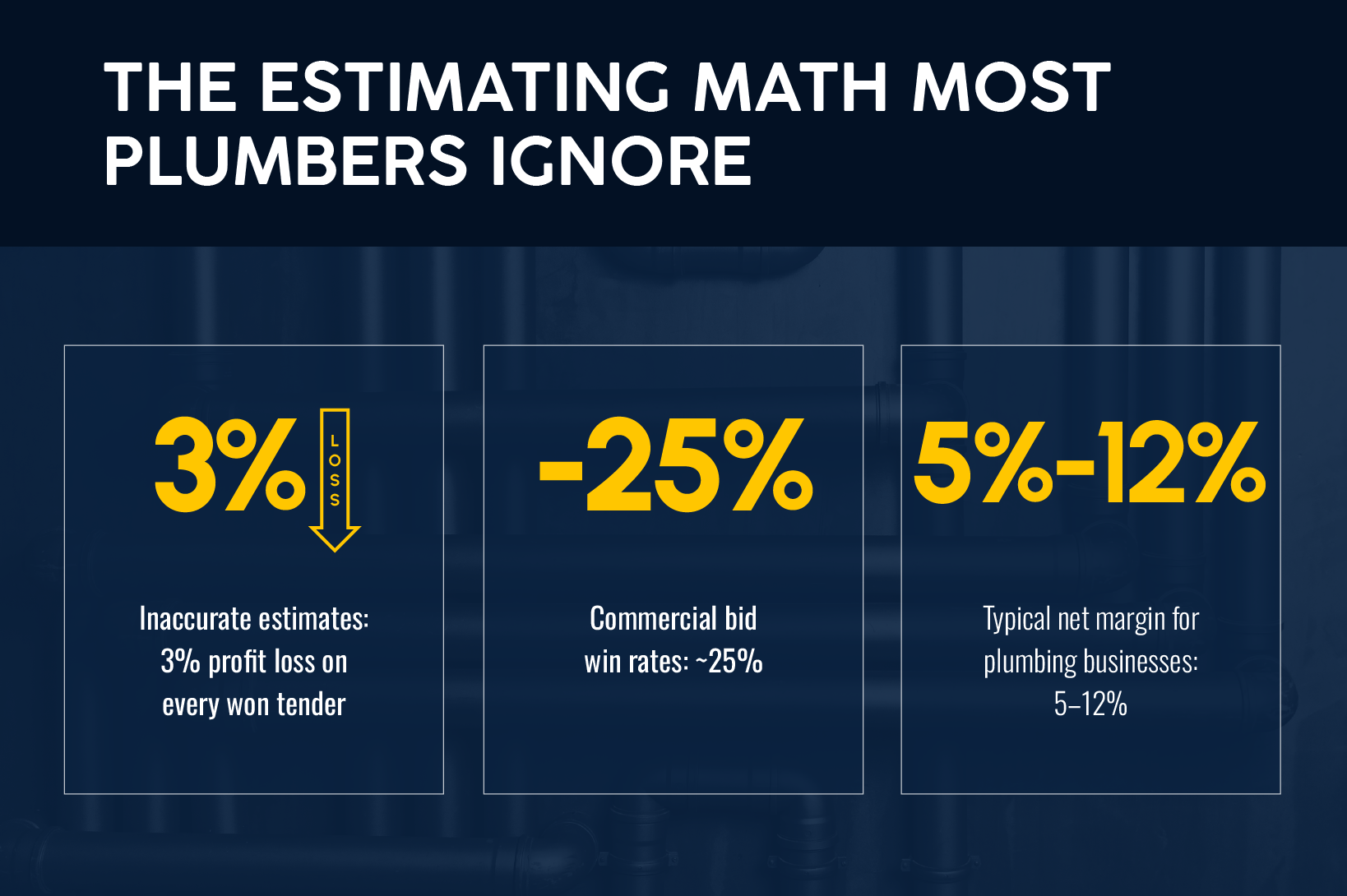
Inaccurate estimates cost plumbing businesses roughly 3% in profit on every job they win, which is damaging in an industry running 5–12% net margins. The average commercial bid win rate sits around 25%, meaning three out of four quotes don't close. The tools below address one or both of those problems at different price points and for different kinds of operations.
Best Plumbing Estimating Apps At A Glance
| App | Best For | Estimating Type | Starting Price |
|---|---|---|---|
| Simpro® | $1M+ service + project work | Quotes + project proposals + job costing | Price for your workflow |
| Housecall Pro | Small residential teams | Template-based quotes, good/better/best | From $59/mo |
| Jobber | Early-stage businesses | Basic estimate creation and tracking | From $29/mo |
| FieldPulse | Growing service teams | Tiered proposals, flat-rate pricebook | Depends on tier |
| FieldEdge | Residential service + maintenance | Multi-tier mobile proposals, pricebook | ~$100–$125/user/mo |
| STACK | Commercial estimators | Digital takeoff from blueprints | From $249/user/mo |
| Joist | Solo/small crews | Basic estimate and invoice creation | From $100/year |
The 7 Best Plumbing Estimating Apps
These aren't ranked by quality, they're matched by fit. A commercial estimator and a residential service tech are solving different problems, and platforms built for one will frustrate the other.
1. Simpro
Simpro is field service management (FSM) software built specifically for trade contractors — plumbing, HVAC, electrical, and other mechanical trades. It's the platform that covers the full business: estimating, scheduling, purchasing, job costing, invoicing, and reporting. For plumbing operations that handle service work and commercial projects, it's one of the few tools designed to handle both.
The estimating engine supports service quotes and full project proposals. You can build from catalog items, pre-built assemblies, or job templates — and send from the field or the office via Simpro Mobile. BGE Digital, a Simpro customer, reported being able to "put a quote out ten times quicker" than with spreadsheets — and when you can create accurate quotes that fast, the margin for error shrinks.
Related: See how Simpro's plumbing estimators integration connects your estimating workflow to live supplier data.
What separates Simpro from lighter-weight platforms is the downstream connection. A quote doesn't just become an invoice — it flows into purchasing, scheduling, and job costing, so you can see budgeted vs. actual costs at job close. That feedback loop helps plumbing businesses actually improve margins over time, not just guess better.
Simpro supports 250,000+ users across 24,000+ businesses worldwide, with integrations into QuickBooks, Xero, Sage, and MYOB. Simpro supports multi-company structures, which matters for holding companies or businesses with distinct service and project divisions.
Pros:
- End-to-end workflow: estimating from invoicing to job costing
- Pre-built assemblies and takeoff templates for faster quote turnaround
- Live supplier pricing sync for always-current material costs and labor costs
- Strong project management for commercial work — Gantt charts, variation orders, progress claims
- Deep reporting: P\&L summaries, work-in-progress reports, technician activity, BI dashboards
Cons:
- Steep learning curve, with weeks to months for full onboarding
- Custom quote required for pricing
- More complex than smaller operations need
- Higher total cost when add-on modules (takeoffs, GPS, SMS, digital forms) are factored in
Pricing: Tailored to your operation — contact Simpro for a quote. One-time setup and onboarding fees apply. Add-on modules priced separately.
Ideal fit: Plumbing businesses doing $1 million to $20+ million in revenue, running service, project, and maintenance work, actively scaling and with 10+ users who need standardized labor rates.
2. Housecall Pro
Housecall Pro targets residential plumbing businesses with 1–20 technicians. Onboarding typically takes one to two days, and it's the fastest path from spreadsheets to a real quoting workflow. Key features include pre-set templates, good/better/best package options, and automated follow-up on open estimates. The mobile apps let technicians create and send quotes from the field in English or Spanish.
The tradeoffs: Job costing is limited, reporting is basic, and per-user fees scale quickly for teams of 10+ technicians.
Pros:
- Fastest onboarding in the category
- Clean mobile experience for field estimates
- Good customer communication tools, including automated follow-up
- Estimate-to-job conversion without duplicate data entry
- Industry-specific templates pre-built for common plumbing tasks
Cons:
- Limited job costing
- Escalating per-user fees for growing businesses
- No advanced takeoff or commercial project functionality
- Weaker reporting for $1 million+ operations
Pricing:
- Basic: $59/month (1 user, annual)
- Essentials: $$149/month (up to 5 users)
- MAX: $$299/month (8 users) + $35/user/month for additional users.
- 14-day free trial.
Ideal fit: Residential plumbing businesses with 1–10 technicians and under $2 million in revenue that prioritize ease of use over feature depth.
3. Jobber
Jobber is built for small plumbing businesses in early-stage growth — the kind of operation doing $500,000 to $1 million that needs to get organized before stepping up to a heavier platform. It handles the basics well: estimate creation and tracking, automatic follow-ups, customer history, and scheduling. The mobile app is solid, and the QuickBooks integration is reliable.
The gaps are predictable: no pricebook, no assemblies, no takeoff capability, and reporting that won't help you diagnose a margin problem. If you're not sure what your quotes should include at this stage, this plumbing estimate template is a useful starting point before you commit to any platform.
Pros:
- Affordable, with transparent pricing tiers
- Low learning curve
- Solid mobile app
- Offers month-to-month options
- Good customer communication features
Cons:
- No pricebook with pre-built assemblies or live pricing sync
- No advanced job costing or profitability tracking
- No assemblies, takeoff, or commercial project tools
- Tier-based limits on users and features
Pricing (single-user plans):
- Core: $49/month
- Connect: $139/month
- Grow: $199/month
- 14-day free trial, no credit card required
Ideal fit: Small plumbing businesses under $1 million revenue, looking for an affordable entry point before stepping up to a more capable platform.
4. FieldPulse
FieldPulse sits between Jobber and the enterprise tools in both price and capability, as it’s built for growing service businesses with 5–25 technicians. The estimating workflow includes tiered proposal options, a built-in pricebook, and mobile quoting for on-site closes. It also handles scheduling, dispatching, invoicing, and basic CRM.
Job costing and reporting are lighter than enterprise platforms, but for a plumbing company running $1 million to $3 million in residential plumbing jobs, FieldPulse offers a capable fit that doesn't require a six-month implementation.
Pros:
- Strong mobile experience
- Built-in flat-rate pricing
- All-in-one: estimates, scheduling, invoicing, CRM
- Faster onboarding than enterprise platforms
- Tiered proposal options for upselling on-site
Cons:
- Doesn’t include job-level actual vs. estimated cost tracking
- Not designed for commercial project work or complex piping
- Fewer third-party integrations than larger platforms
Pricing: Not publicly listed, requires a demo. Essentials and Professional tiers, plus an Enterprise plan.
Ideal fit: Growing residential service businesses, 5–25 technicians, $1–$3 million revenue, looking for a capable all-in-one without enterprise-level implementation.
5. FieldEdge
FieldEdge is an all-in-one FSM platform for residential service businesses — plumbing, HVAC, and electrical. Its Proposal Pro feature lets technicians build and present multi-tier estimates from a mobile device without going back to the office. The built-in pricebook standardizes pricing across the team and suggests alternative products at different price points, which functions as a passive upsell tool for field techs. The QuickBooks integration is real-time and bidirectional.
It's built for service calls and maintenance agreements, not complex multi-stage commercial projects. Job costing is lighter than what you'd get in an enterprise platform, and the interface gets mixed reviews on its age. But for a residential-focused operation that runs on service agreement renewals and technician productivity, FieldEdge covers what matters.
Pros:
- Real-time, bidirectional QuickBooks sync — considered seamless by most users
- Pricebook with upsell suggestions for in-the-field revenue without requiring a sales-trained tech
- Strong for service agreement tracking, automation, and renewals
- Mobile estimates with multi-tier proposal options
- Performance dashboard with technician productivity and KPI tracking
Cons:
- Interface described as dated by some reviewers
- Lacks real-time actual vs. estimated cost tracking at the job level
- Escalating per-user fees for growing businesses
- Not suited for commercial project work or complex multi-stage plumbing jobs
Pricing: Three plans — Select, Premier, Elite — but the price isn’t publicly listed. Third-party sources report approximately $100/user/month for office users and $125/user/month for field technicians.
Ideal fit: Residential plumbing and HVAC service businesses with 3–25 technicians, focused on service calls, maintenance agreements, and upselling on-site.
6. STACK
STACK is a cloud-based takeoff and estimating platform built for commercial contractors. You upload digital blueprints, point-and-click to measure pipe runs, count fixtures, and calculate material quantities. This is especially useful for plumbing companies estimating work across multiple job sites. Pre-built assemblies carry over across similar project types, and estimates export to Excel.
It doesn't schedule jobs, dispatch technicians, or generate invoices — most commercial contractors pair it with a separate FSM platform for the full workflow.
Pros:
- Fast, accurate digital takeoffs directly from uploaded plans
- Cloud-based — accessible from any device with an internet connection
- Less setup time for recurring projects with pre-built assemblies
- More affordable than FSM platforms for estimating-only use cases
Cons:
- Estimating only — no scheduling, dispatching, invoicing, or job management
- Requires a separate platform for downstream operations
- No live material pricing sync from supplier catalogs
- Less suited to residential service calls or small repair work
Pricing: Plans start at $249/user/month (billed annually) for the Premium plan. Custom subscriptions are available.
Ideal fit: Commercial plumbing estimators who need fast, accurate takeoffs from blueprints and already have a separate platform managing operations.
7. Joist
Joist is the lightest tool on this list. The Basics tier gets you basic estimate and invoice creation; paid plans add line-item pricing, client portals, deposit collection, and QuickBooks sync.
Joist has no pricebook, assemblies, job costing, or field management. For a one- or two-person operation sending 10–20 quotes a month, that's enough. Past $500,000 in revenue, it isn't.
Pros:
- Fast to set up — no learning curve
- Professional quote and invoice templates
- Client portal for estimate approvals and deposits
Cons:
- No pricebook, assemblies, or job costing
- No scheduling or dispatching
- Caps out quickly as the business grows
- Limited reporting
Pricing: From $100–$320/year, or $10–$32/monthly.
Ideal fit: Solo operators or 1–2 person crews who need a step up from handwritten quotes or basic invoicing software.
Which Type of Plumbing Estimating App Is Right For You?
Most of the confusion in this category comes from treating "plumbing estimating app" as one thing. It isn't. Top plumbing estimating apps for a commercial contractor look nothing like the top picks for a residential service shop.
There are three meaningfully different categories, and the right one depends on your business model.
- Standalone estimating tools (STACK, FastPIPE, McCormick) are for commercial contractors doing plan-based takeoffs. They're fast, precise, and purpose-built for bidding complex piping work from blueprints. They don't schedule, dispatch, invoice, or track margins — and they're not designed to. Commercial estimators at mid-to-large contractors often use these alongside an FSM platform.
- All-in-one field service platforms (Simpro, FieldEdge, Housecall Pro, Jobber, FieldPulse) are for service- and repair-focused plumbing businesses. Estimating is one module in a broader operational suite that connects the estimate to everything downstream: scheduling, purchasing, job costing, and invoicing. For $1 million+ businesses that are serious about margin management, the ROI lives in the feedback loop between estimated and actual costs.
- Lightweight quoting tools (Joist) are for small or solo operations. They solve the "professional quotes without spreadsheets" problem without the cost or complexity of a full platform.
Ask yourself: Where is your business today? Where is it headed?
If you're under $500,000 and doing straightforward residential service work, Joist or Jobber gets you organized without overcomplicating things. Between $500,000 and $2 million with a residential service focus, Housecall Pro or FieldPulse makes more sense. For businesses above $1 million with a mix of service and commercial project work, Simpro handles both without requiring you to stitch systems together.
Related: Learn about plumbing apps that support the full field workflow — from scheduling to invoicing — not just the quote.
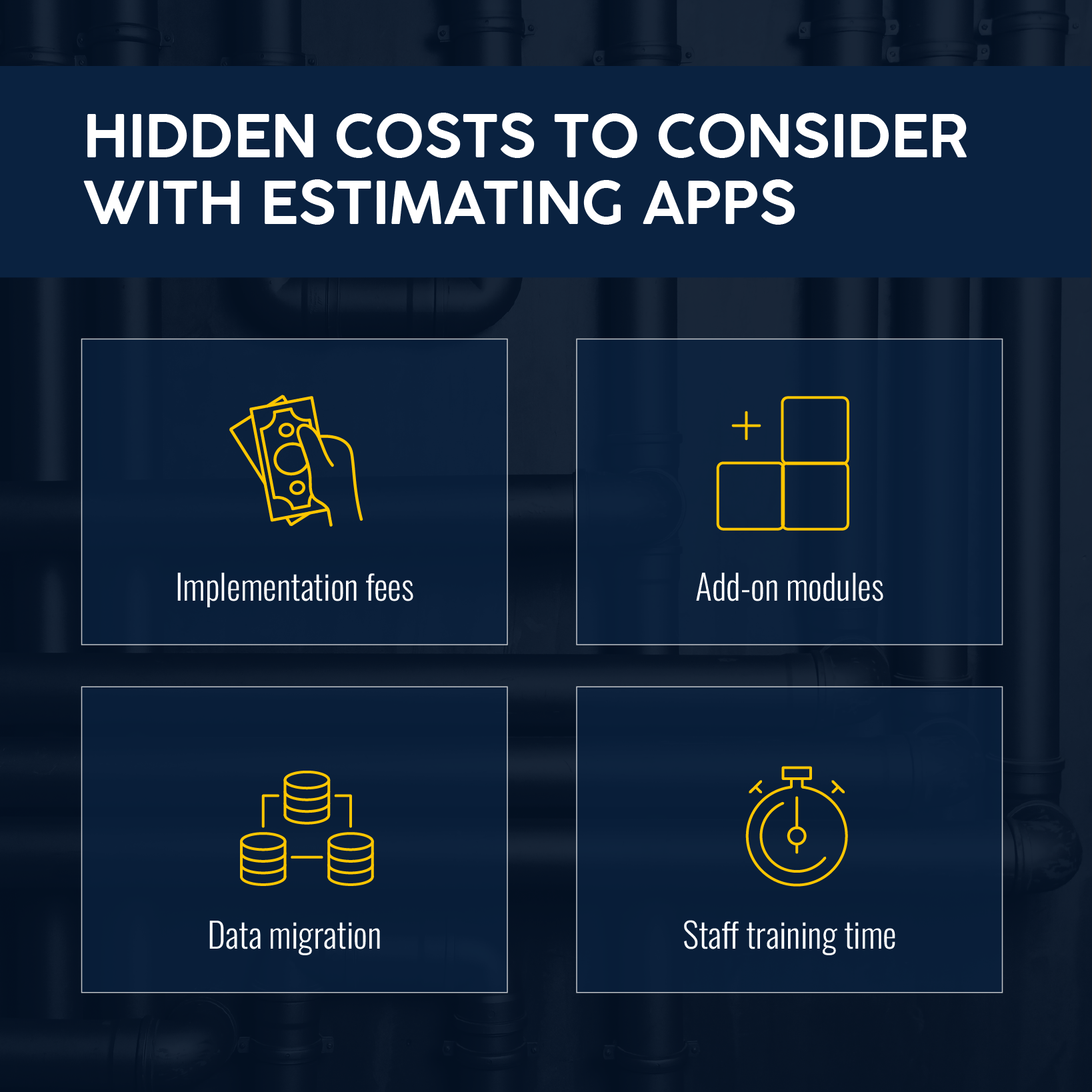
The gap between subscription cost and total cost of ownership is real. Implementation fees, add-on modules, data migration, and staff training time can push Year 1 costs well above what the pricing page suggests.
Software saves time and improves the bottom line when it's actually adopted. Remember: Simpro customers report 30% productivity increases because of full platform adoption, not just installing software.
Most plumbing businesses aren't losing money because they picked the wrong software — they're losing it because their estimating process has no feedback loop. Quotes go out, jobs get won, and nobody checks whether the numbers held.
Simpro connects estimating to job costing so you can see budgeted vs. actual on every job, tighten the process over time, and build a business that scales on margin, not just volume. If that's the problem you're trying to solve, schedule a demo to see how Simpro fits your operation.
Frequently Asked Questions About Best Plumbing Estimating Apps
What is the difference between plumbing estimating software and takeoff software?
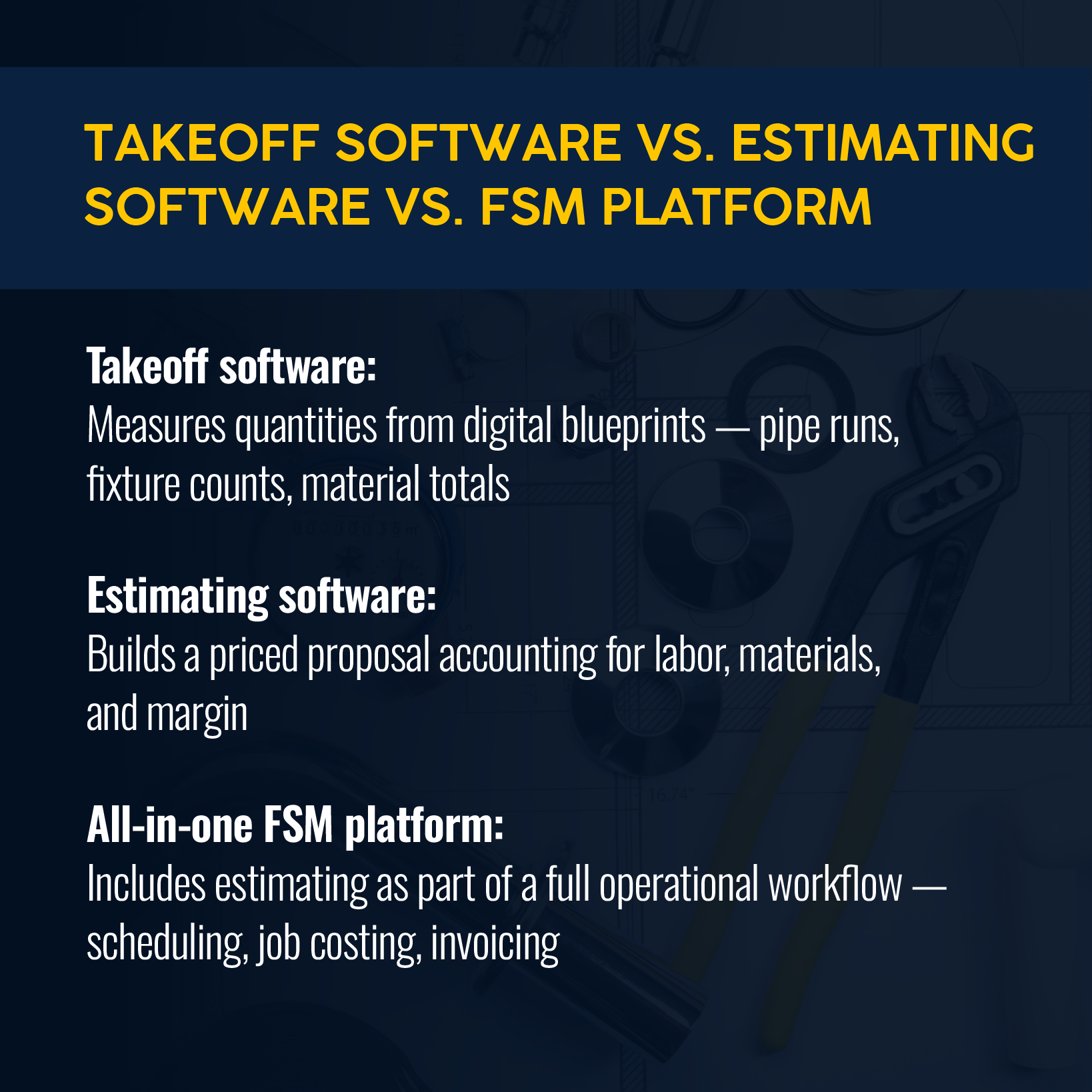
Takeoff software (STACK, PlanSwift, Trimble AutoBid) measures quantities from digital blueprints — pipe runs, fixture counts, material totals. Estimating software takes those quantities and builds a priced proposal accounting for labor, materials, and margin. All-in-one FSM platforms like Simpro include estimating as part of a full operational workflow. For commercial contractors doing complex piping work, it's common to use both: a takeoff tool for the plan work and an FSM platform for everything else.
Are plumbing estimating apps worth it for small plumbing businesses?
Yes, if your business sends more than 10–15 quotes a month. Inaccurate estimates cost roughly 3% in profit on won tenders — for a $600,000 plumbing business, that's $18,000 every year. A $49/month quoting tool that closes the gap will quickly pay for itself. The caveat: Small operations don't need enterprise software. The learning curve of a platform like Simpro makes more sense when you have the team and workflow complexity to justify it.
Do plumbing estimating apps work offline, or do you need internet access in the field?
Most cloud-based FSM tools require an active connection for full mobile functionality, including Housecall Pro, Jobber, and FieldPulse. Simpro Mobile performs best with reliable connectivity, though some functions work in low-signal conditions. Standalone desktop tools like FastPIPE are installed locally and don't require internet access, which matters for contractors working in basements or commercial sites with poor signal.


 Back to top