
A $2 million plumbing business running on informal estimates and loose bid documents is leaving roughly $500,000 on the table every year.
This isn’t theoretical. That $500,000 shows up in losing jobs to more professional-looking competitors or not getting shortlisted for commercial work because your proposal doesn’t look the part. It’s about burning margin because of missing line items that create problems after the contract gets signed.
The U.S. plumbing industry is expected to hit $191.4 billion in revenue in 2026, according to IBISWorld. Most of the high-value contracts go to plumbing contractors with a repeatable, professional bidding process.
This guide gives you that process, starting with a free plumbing bid template you can customize and put to work today.
Best Free Plumbing Bid Template (Download Here)
DOWNLOAD: Free Plumbing Bid Template
The template covers every section a commercial client or general contractor expects to see: cover page, scope of work, materials list, labor breakdown, payment schedule, and terms. Download it, add your branding, and customize the line items for your plumbing services.
Plumbing Bid Template vs. Plumbing Estimate Template — Which One Do You Need?
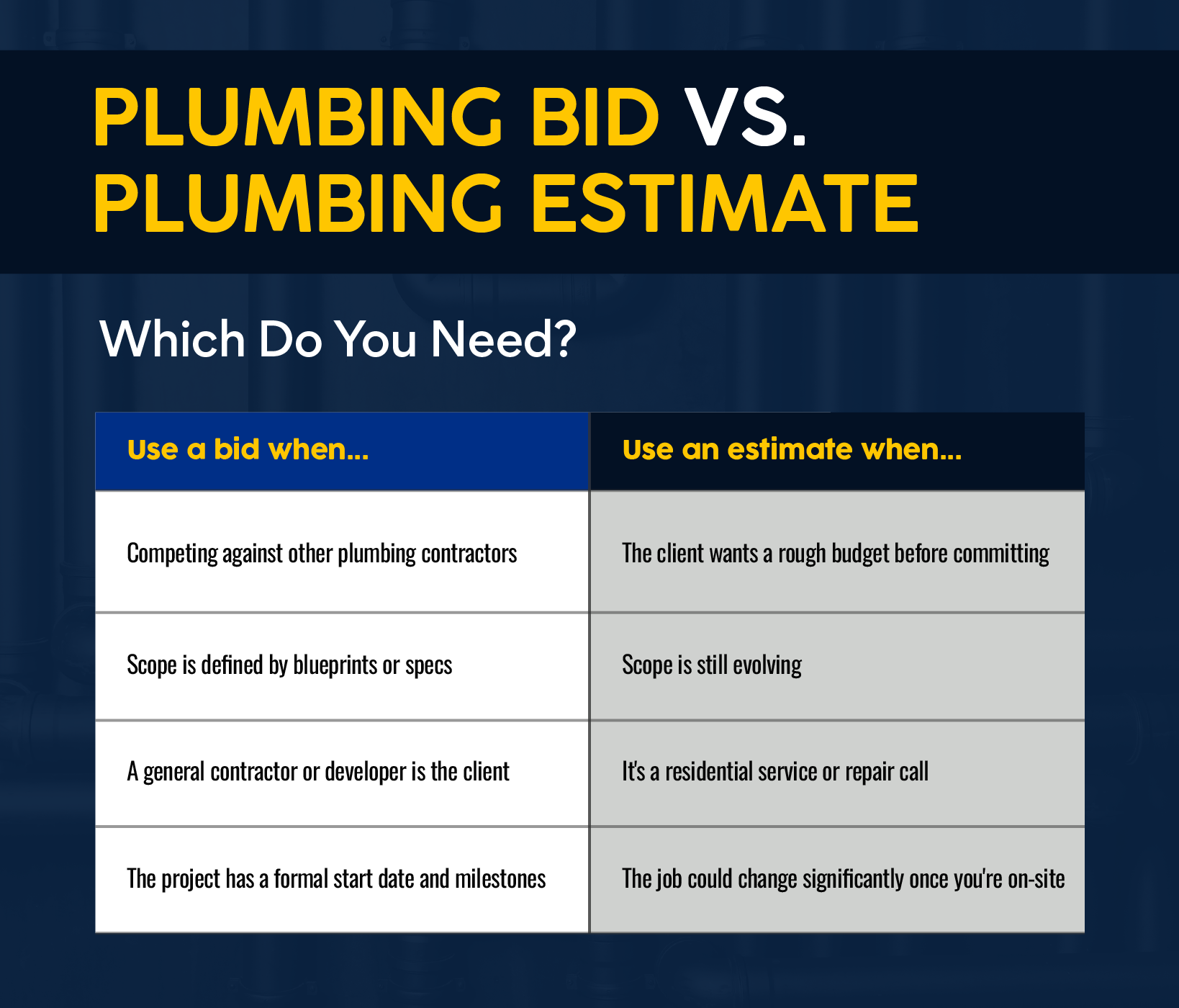
The confusion between these two documents is common, and using the wrong one can undermine your credibility — and likelihood of winning the job.
A plumbing estimate template works well for residential service calls, early-stage conversations, and situations where the scope is still being defined. The numbers can shift as the job develops.
A plumbing bid template is a formal, binding commitment. Once a client accepts a commercial plumbing bid, you're on the hook for everything in that document, and at the price stated. Missed line items come out of your margin, not the client's budget.
Use this as a quick decision guide:
| Use a bid when… | Use an estimate when… |
|---|---|
| Competing against other plumbing contractors | The client wants a rough budget before committing |
| Scope is defined by blueprints or specs | Scope is still evolving |
| A general contractor or developer is the client | It's a residential service or repair call |
| The project has a formal start date and milestones | The job could change significantly once you're on-site |
If you're responding to a request for proposal (RFP) or an invitation to bid (ITB), you need a bid document, not an estimate. By contrast, our plumbing estimate template is a better starting point for smaller residential work.
What to Include in a Plumbing Bid
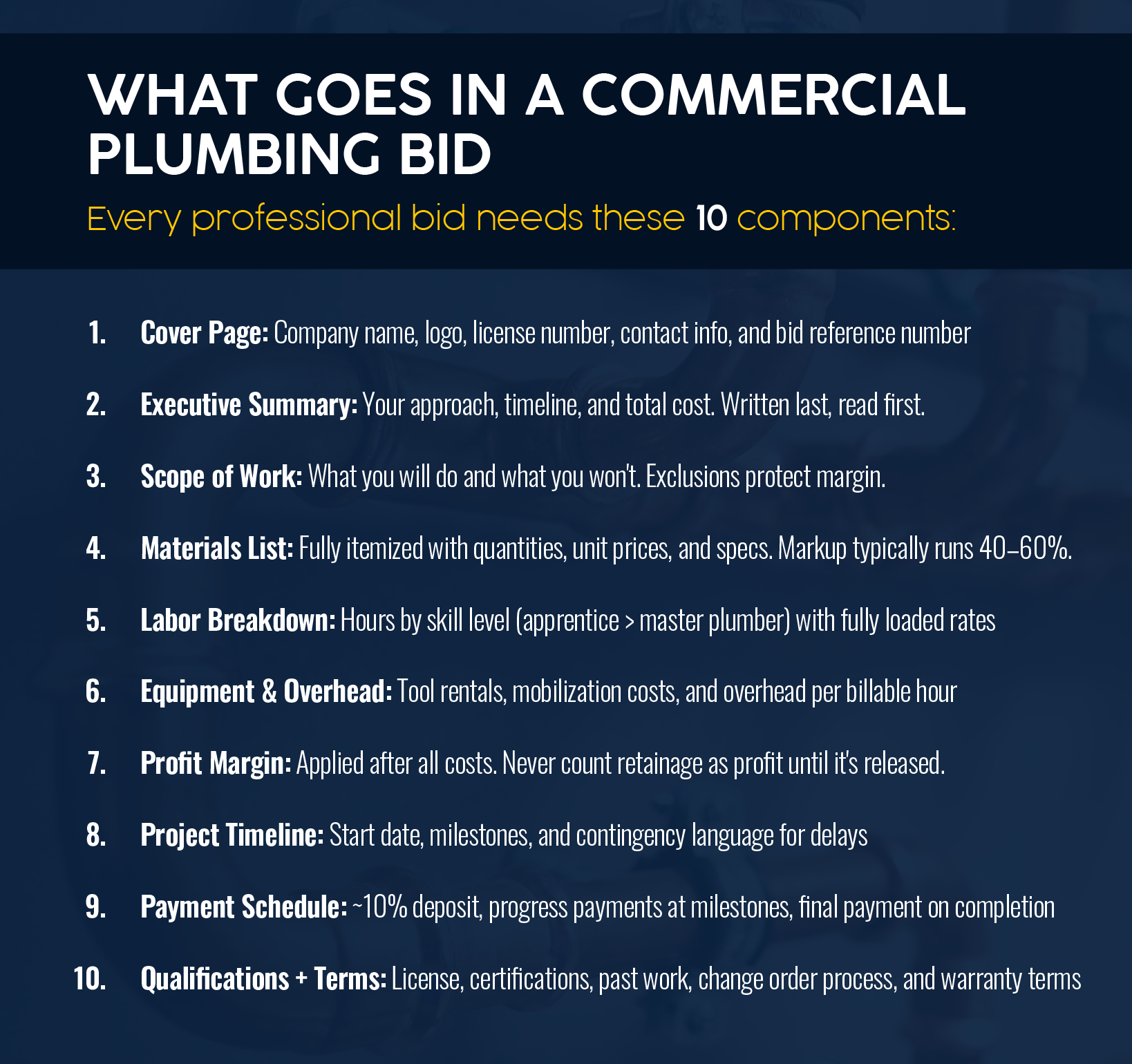
Winning a commercial plumbing bid starts by creating a comprehensive proposal document that demonstrates your understanding of the project and ability to deliver.
Here’s what you should edit within your commercial plumbing bid template:
- Cover page: Include your company name, logo, license number, contact information, bid reference number, the client’s name, and submission date. This page sets the tone. A generic header signals that the same document went to six other plumbing contractors this week.
- Executive summary: Write two to three paragraphs covering your approach, timeline, and total cost. Write this last, as it’s the first thing the client reads — and your sharpest differentiator in a competitive bidding process.
- Scope of work: Document what you will and won’t do. Exclusions like "excavation not included" protect your margin and prevent disputed change orders. For multiphase commercial plumbing projects, break out the scope by phase.
- Materials list: Include each item’s material description, specification or model number, unit of measure, quantity, unit price, and extended total. For the plumbing industry, aim for a material markup between 40% and 60%. If the client's spec sheet calls for a particular brand or fitting standard, reference it by name.
- Labor breakdown: Estimate hours by skill level (apprentice, journeyman, master plumber) across each phase of the plumbing project. Use fully loaded labor rates, not bare wages. If you're using a labor burden rate calculator for your bids, you're leaving money on the table or eating costs you didn't account for.
- Equipment and overhead: List specialty tool rentals, mobilization costs, and an overhead allocation applied per billable hour.
- Profit margin: Apply this after totaling all costs. Don’t net against retainage. If the contract includes a 10% retainage holdback, don't count that money toward profit until it's released.
- Project timeline: List start and completion dates, key milestones, and contingency language for weather or access delays.
- Payment schedule: Commercial contracts typically structure payments as a deposit (around 10%), progress payments tied to defined milestones, and a final payment upon completion. Defining payment triggers in the bid prevents collection disputes down the line.
- Qualifications: Include your master plumber license, certifications, relevant past plumbing work, and references. For competitive bids, this section helps you differentiate beyond price.
- Safety plan and terms: For most commercial and government plumbing contracting work, bidders are required to complete safety plans. Include your change-order process, warranty terms, and dispute-resolution language.
How to Create an Accurate Plumbing Bid
The bid document is only as good as the numbers behind it. When plumbing companies rush the cost side, they give away margin or, worse, take on jobs they can't deliver profitably.
Start with a thorough quantity takeoff from the project blueprints. Count every fitting, measure every pipe run, and account for all systems listed in the spec documents. Then get current supplier pricing. Don't rely on last quarter's quotes for a job that starts in four months.
From there, calculate labor hours by phase and apply your fully loaded rates. Before your next bid, make sure you know how to price plumbing jobs in a way that covers overhead and returns a real profit.
Add 10% to 15% contingency on labor for access complexity, coordination with other trades, and scope ambiguity you can’t predict until you're on-site. On a $180,000 commercial plumbing contract, a 12% labor overrun without contingency is a $21,600 problem that won't show up until the job is half-finished.
Have a second person review the full bid before it goes out, especially for scope of work, exclusions, and payment schedule. Build this internal review into your schedule, as most formal commercial procurement processes automatically disqualify late bids.
For more on the full commercial bidding workflow, from RFP receipt through follow-up, check out our guide on how to bid plumbing jobs.
Common Plumbing Jobs That Need a Bid Template
Not every plumbing job calls for a formal bid. But for certain jobs, showing up without a structured plumbing proposal template hurts your credibility before the conversation begins. Here are five times when a plumbing bid template is essential.
New Construction Plumbing
Ground-up residential or commercial builds require coordinating with multiple trades, defining milestone schedules, and aligning scope to engineering drawings. Whether you're working directly with an owner or as a subcontractor to a construction company, a plumbing construction bid template documents your commitment to those specs.
Commercial Tenant Build-Outs
Retail, office, and hospitality projects often involve general contractors managing multiple subcontractors. Your bid needs to fit a formal subcontract structure, with scope, schedule, and payment terms that align with the GC's project plan.
Repipe and Infrastructure Work
Large-scale repipes in multiunit residential or commercial buildings involve significant material quantities. There’s also the matter of phased access and building-wide disruptions to plumbing systems. A formal bid with a clear timeline and per-phase scope protects both sides.
Government and Public Works
Municipal contracts, school districts, and public agencies require bonded bids that meet prevailing wage requirements and specific documentation standards. If you're bidding for such work, confirm up front whether a performance bond is required. That cost needs to be in the bid.
Plumbing system upgrades
Commercial plumbing system replacements or upgrades in occupied buildings come with schedule constraints and phasing complexity. Estimates can’t capture all of that. Keep on file a plumbing bid template example from a previous comparable job — both to speed up the proposal process and to give your team a proven structure to work from.
Win More Jobs With Professional Plumbing Job Management Software
You've got a solid bid template. The harder problem is building accurate bids faster than your competitors without spending three days on a single proposal.
Simpro®'s plumbing software is built for plumbing contractors who handle commercial work. The estimating software generates tender-ready, itemized estimates from prebuilt assemblies for common plumbing systems. Populate your labor and materials from a library you've already verified, rather than rebuilding from scratch on every job. Quantities from blueprint takeoffs flow directly into cost calculations, and bid estimates feed into job costing, so you can track actual vs. estimated performance at every stage of the project.
Over 24,000 trade businesses use Simpro to manage work from the first bid to the final invoice. For plumbing contractors doing commercial work, your proposals go out faster, job-cost tracking is cleaner, and payment schedules match what you actually put in the contract.
If you're putting together competitive commercial bids and still reconciling costs across spreadsheets and disconnected tools, schedule a demo to see how Simpro handles it end to end.


 Back to top