
You're booked out three weeks. Two trucks are running. The phone hasn't stopped. And when the accountant sends over the year-end numbers, you're staring at 3% net profit. If you're lucky.
This is the reality for more plumbing businesses than anyone likes to admit. Revenue without margin discipline doesn't build a business. It builds a more expensive treadmill. Every new job, every new hire, every new truck adds cost faster than it adds profit, and the gap between gross revenue and what actually lands in your pocket keeps widening.
This plumbing business profit margin guide walks through how to diagnose where margin is leaking, how to fix it systematically, and how to track it as your business grows.
What Healthy Plumbing Business Profit Margins Look Like
A healthy plumbing company targets 60-62% gross profit margin and 20-35% net. A lot of plumbing contractors are scraping by on 2-8%.
If these terms don't mean much to you, here's a quick breakdown of the two numbers that define plumbing business profitability:
Gross profit margin is what you keep after direct job costs (labor and materials) before overhead touches it.
Net profit margin is what's left after deducting everything else you spent money on to get the job done: overhead expenses, insurance, vehicles, office staff, software, and your own salary.
Gross Margin Benchmarks by Service Type
The most successful plumbing business owners break their margins out by work type. A blended gross margin across the whole business hides where money is actually being made and where it's being destroyed.
Service and repair work should run 50–60%+ gross margin. It's single-tech, high-pricing-power work: a water heater replacement, a burst pipe, an emergency drain call. You control the price, labor costs are contained, and the material cost relative to the job price is manageable with the right markup. Each plumbing service call in this category is a genuine margin opportunity when it's priced correctly.
New construction typically yields 20–30% gross margin. The jobs are bigger, but so is the exposure: more labor hours, more materials, tighter bid prices, and longer cash cycles. Construction isn't inherently bad work, but it carries structurally different economics.
A shop running 50% construction revenue and 50% service revenue might report a 42% blended gross margin and think it's doing reasonably well. But it's actually running a high-margin division and a low-margin division simultaneously, and the construction side is dragging the whole business below the threshold where healthy net profit becomes possible. You can't hit 20% net from a 42% blended gross. The math doesn't work regardless of how tight you run overhead.
Pull your gross margin by job type for the last six months before you draw any conclusions from your blended number. If you're still building the financial systems to make that possible, our guide on how to start a plumbing business covers the reporting foundations worth setting up from day one.
Net Profit Margin: Where Overhead Leaks Show Up
One of the biggest profit leaks you'll face is in overhead expenses. The easiest way to spot that leak is looking for gaps between your gross profit margin and your net profit margin.
Your gross margin tells you how well you're pricing and executing jobs. It tells you how efficient you are (basically).
Net margin lets you know how well your business is running around those jobs.
If your jobs are looking profitable (gross margin) but your net margin is bad, overhead is often to blame.
For example, a shop running 55% gross margin and 4% net likely isn't pricing poorly.
It's carrying overhead costs that are quietly absorbing every dollar the field earns:
- Vehicles
- Insurance
- Office staff
- Software subscriptions
- Unbillable admin time
All those costs sit between gross and net. Almost everyone running a plumbing business knows these costs exist. Fewer know what they actually total per billable hour, which means they can't price to cover them accurately.
The net profit margin range you should aim for is 20–35%.
Getting there requires knowing your overhead rate, building it into your price book, and tracking your net profit margins monthly, not at year end when it's too late to act.
How to Build and Protect Your Plumbing Business Profit Margins
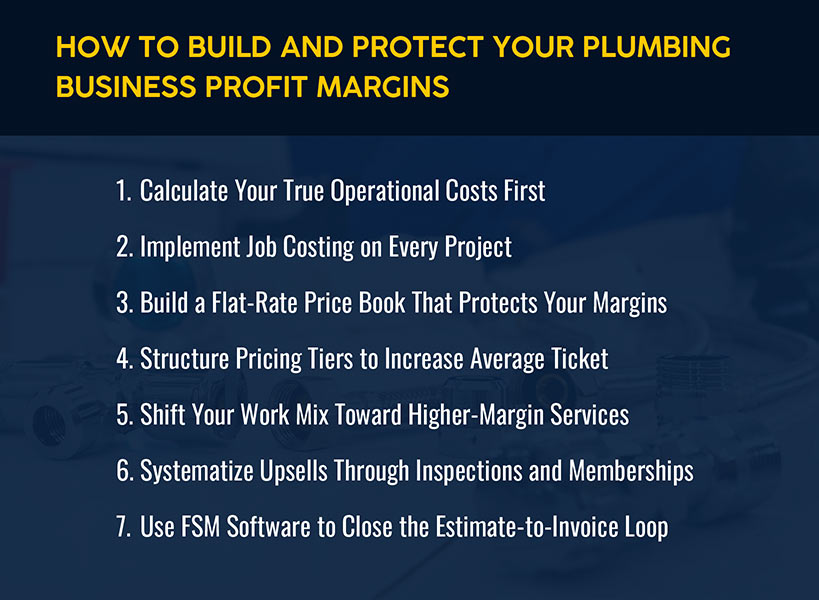
The sequence matters here. Most businesses try to fix margins by adjusting prices before they know their actual costs. That approach produces guesses, not sustainable margin improvement.
Calculate Your True Operational Costs First
Before anything else, you need your honest hourly rate: what it actually costs to put a technician and a truck on the road for one billable hour.
Start with total annual overhead expenses: office salaries, rent, utilities, insurance, vehicles, tools, software, and marketing. Add total direct labor costs: wages, payroll taxes, benefits, and paid time off. Then divide by your realistic billable hours per tech per year.
That last number is where most owners get it wrong. A technician doesn't produce 2,080 billable hours a year. Once you account for drive time, training, callbacks, non-billable admin, and downtime, the real number is closer to 1,200–1,400 hours. Run the math with the honest figure.
Most plumbing shops find their true break-even rate lands between $75 and $85 per hour, before any profit is added. If your current hourly rates are built on a cost assumption below that, you're not running thin margins because of bad luck. You're running thin margins because the price never covered the cost to begin with. Understanding how much you should charge for plumbing work starts with knowing this number cold.
Implement Job Costing on Every Project
Pricing correctly going in only protects your margin if execution matches the estimate. Job costing closes that loop. It's where you find out whether you actually made what you thought you would.
Compare estimated versus actual labor and materials on every job, not quarterly, not at year end. A straightforward drain replacement quoted at $1,200 with a 58% gross margin drops to under 45% if the tech runs 40 minutes over and uses $80 more in materials than estimated. This kind of thing happens when job costing isn't part of weekly operations.
The businesses that protect margin at scale are the ones that treat job costing as a standing review process, not a forensic exercise after something goes wrong. Clean plumbing invoicing processes and accurate job records make this systematic rather than reactive. When Zebra Plumbing started tracking estimated versus actual costs at the job level, they had clear visibility into which service types were consistently underperforming estimates, and were able to adjust both pricing and field processes before the gap compounded.
Build a Flat-Rate Price Book That Protects Your Margins
Hourly billing puts margin risk in the customer's hands. Every time a tech works slower than expected, the job costs more than estimated and your gross margin shrinks. Flat-rate pricing locks the margin into the price before work starts. The customer approves a total, and your cost structure determines what you keep.
The formula for defensible flat rate pricing is straightforward: labor time multiplied by your loaded labor rate, plus materials costs with markup, plus overhead allocation, plus your target profit. Materials should carry a 40–60% markup. Not because it's aggressive, but because materials handling, truck stock, purchasing time, and storage all carry real costs that go unrecovered when materials are passed through at cost.
Flat-rate systems consistently raise average ticket size 20–30% compared to hourly billing. Customers approve a job, not a clock. Simpro®'s Prebuilds feature lets you bundle standard labor and material combinations into reusable price structures, so your price book stays consistent across technicians and is easy to update when costs change. A solid plumbing estimate template built on flat rates is also one of the fastest ways to bring consistency to a team that's currently pricing jobs differently depending on who takes the call.
Structure Pricing Tiers to Increase Average Ticket
Good/Better/Best options on service calls change the structure of the conversation entirely. Instead of evaluating whether to hire you, the customer is choosing between options you've already pre-approved as profitable. A standard repair, a repair-plus-upgrade, and a full replacement give the customer agency and organically lift average ticket size without requiring a pitch.
This approach only works with a team that understands the options and can present them confidently on-site. That's a training and SOP challenge as much as a pricing challenge. The technology available to plumbers today makes it practical to arm technicians with tiered quote options directly from their phones, so the presentation happens in the field, not back at the office after the customer's already moved on.
McCarthy Plumbing Group implemented tiered service options as part of a broader operational overhaul and saw meaningful increases in average job value without any corresponding increase in customer acquisition costs. The revenue was already in the jobs they were running.
Shift Your Work Mix Toward Higher-Margin Services
Plumbing has structural margin advantages over comparable trades that most shops aren't capturing because they're filling capacity with low-margin construction work. Lower equipment cost per job, single-tech efficiency on service calls, and strong pricing power on emergency and repair work all point to service and repair as the engine of a profitable plumbing business.
The question isn't whether to do construction. It's whether your current construction revenue is strategic or just filling gaps in the schedule. If new construction is above 40% of your revenue and your net margin is thin, those two facts are almost certainly connected.
Triage incoming work by profit potential rather than calendar order. Prioritize emergency calls, service calls, and high-value repair work. Approach construction selectively, ideally work that feeds long-term service relationships rather than one-off builds. Heron Plumbing made a deliberate shift away from volume-based construction toward higher-margin service work and built a more stable, more profitable business with fewer trucks. The strategic framework for getting there is covered in detail in how to grow a plumbing business.
Systematize Upsells Through Inspections and Memberships
A plumbing inspection on every service call converts roughly 30% into additional profitable work. Not through pressure. Through process.
Technicians who follow a standardized inspection checklist find legitimate additional needs on a significant share of calls. The customer gets informed, the tech gets a natural opportunity to present options, and average job value increases without anyone having to "sell."
Maintenance memberships extend this further by creating recurring revenue at better margins than purely reactive work. Annual inspection plans, priority service guarantees, and bundled maintenance services smooth out seasonal cash flow and build customer retention at the same time, turning a transactional customer base into a predictable income stream.
Understanding how AI helps plumbers capture more value from existing jobs makes both inspections and membership programs significantly easier to systematize. Tropical Coast Plumbing built a membership offering that reduced their dependence on unpredictable call volume and created a stable margin floor.
The requirement is that it's built into the process, not left to the initiative of whichever tech happens to be on site that day. Track upsell conversion rate by technician weekly. The variance will tell you where training is needed.
Use FSM Software to Close the Estimate-to-Invoice Loop
Most margin loss doesn't happen at the pricing stage. It happens in execution: labor runs over, materials aren't tracked against the estimate, and nobody reconciles what was quoted against what was invoiced. A job estimated at 62% gross can arrive at invoice at 48% gross, and without real-time job costing, you won't know until it's too late to do anything about it.
This is where field service management software does its most important work. Simpro ties estimates, job execution, technician time, materials, and invoicing into a single connected workflow. Real-time job costing shows estimated versus actual while the job is still in progress, not after the fact. Businesses using Simpro report an average 25% revenue increase, with much of that driven by visibility they didn't have before: into jobs they thought were profitable that weren't.
If your team is currently rebuilding job costs from memory and receipts, that's the first process to fix. The case for moving beyond a basic plumbing CRM and into a full field service management platform comes down to exactly this: a CRM tracks customers, but it doesn't tell you whether you made money on the job. The right plumbing software does both.
5 KPIs for Healthy Plumbing Profit Margin
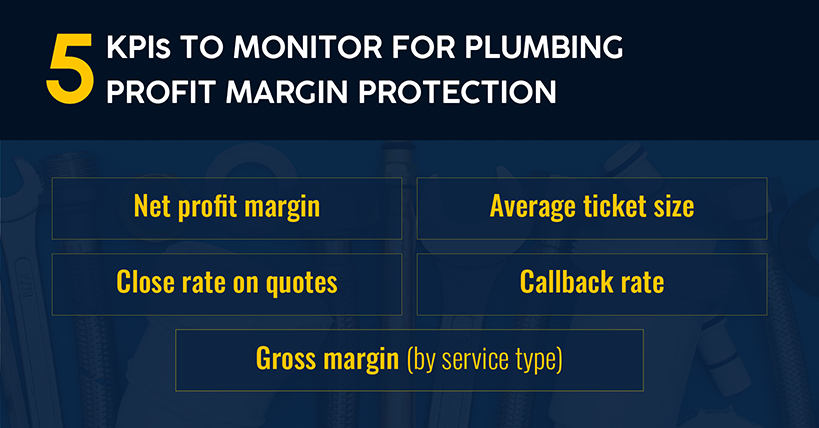
Margin management isn't a one-time adjustment. It's a set of numbers you review regularly and act on quickly when they drift. Five KPIs cover most of what matters:
Gross margin by service type: not blended. If service margin drops from 58% to 51%, you need to know that before it becomes a trend.
Net profit margin: monthly, not annually. Year-end surprises are a symptom of not watching this number in real time.
Average ticket size: should grow over time as flat-rate pricing, tiered options, and upsell processes mature. If it's flat or declining, something in the execution chain has broken down.
Close rate on quotes: one of the most underused diagnostics in a plumbing business. Most owners treat a full calendar as confirmation that pricing is working. It's often the opposite. If you're closing more than 85% of quotes, your prices are too low. The sweet spot is 70–80%. Closing everything means you're the cheapest option in your market.
Callback rate: every callback is an unrecovered labor cost. A tech spending three hours fixing work that was already invoiced is destroying margin silently. Track it by technician and treat it as a quality and training metric, not just a customer service one.
Using the labor burden rate calculator alongside these metrics keeps your cost baseline accurate as wages and overhead change, which means your flat rates and price book stay calibrated rather than gradually falling behind real costs.
Simpro's reporting connects all five of these metrics to actual job data, without manual spreadsheets. Owners can schedule automated reports, review margin by customer, job type, or service line, and catch drift early rather than reacting at year end. Knowing the numbers while you can still act on them is the practical difference between running a profitable business and running a busy one.
Common Challenges That Kill Plumbing Profit Margins
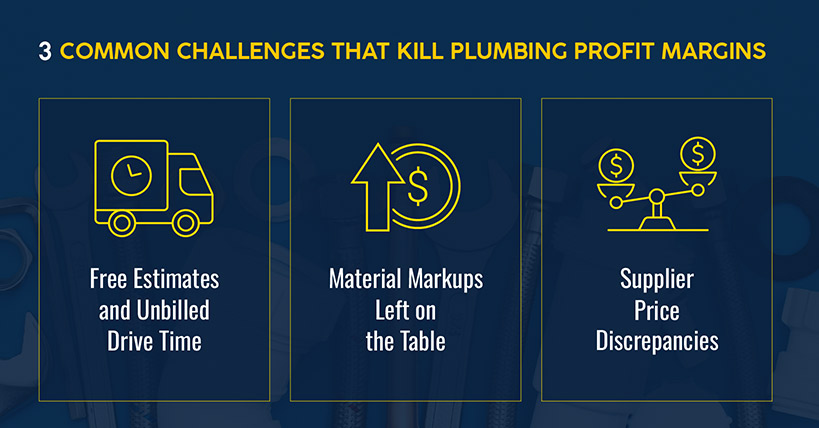
Even businesses doing most things right have a handful of specific patterns that erode margin quietly and consistently. These are the ones that show up most often.
Free Estimates and Unbilled Drive Time
Free estimates aren't free. They cost drive time, technician time, and overhead that goes unrecovered. A shop running eight free estimates a week at 45 minutes each is losing roughly six hours of billable capacity before a single paying job begins. At a $75–$85/hour break-even rate, that's $450–$510 a week in unrecovered cost, or $23,000–$26,500 annually before a single paying job begins.
The deeper problem is that most plumbing businesses have no way to see it. When quoting, scheduling, and dispatch live in separate tools or on paper, pre-job time is invisible. It never attaches to a job record, never shows up in a report, and never gets factored into pricing decisions. Owners who have connected their quoting and dispatch workflows in Simpro often discover, for the first time, exactly how much time and cost was sitting in that pre-job gap. Once it's visible, the path forward is clear: charge a diagnostic or dispatch fee credited back on awarded work, build pre-job time into flat-rate pricing, or both. You can't fix what you can't measure.
Material Markups Left on the Table
Most plumbing business owners know they should mark up materials. The industry standard is 40–60%, it's entirely defensible, and every trade coaching article says the same thing. The problem isn't knowledge. It's execution consistency.
When materials are priced from memory, added in the field, or sourced from a spreadsheet that hasn't been updated since last year, markup gets applied inconsistently. One tech applies 50%, another applies cost-plus-10%, and a third forgets entirely because they're focused on finishing the job. The result is a price book that looks healthy on paper and leaks margin on every third job. Simpro's catalog-based quoting builds markup into the material record itself. When a tech pulls a part into a quote, the markup is already there. It doesn't depend on who's building the quote or whether they remember the right percentage. That consistency compounds quickly across a team: 200 jobs a month at even a 5% improvement in materials margin is a meaningful net profit gain by year end.
Supplier Price Discrepancies You're Not Catching
Supplier invoices regularly arrive above the quoted price. It's common enough that most experienced plumbing business owners know it happens. What they often don't know is how frequently it's happening to them, or what it's costing.
Without a system that cross-references quoted material prices against actual supplier invoices, the only way to catch discrepancies is manually, job by job, invoice by invoice. Most shops don't have time for that, so the overcharges get absorbed and show up as unexplained margin erosion that's impossible to trace back to a source. A $12 variance on a common fitting across 40 jobs a month is $480 in margin that left through a gap nobody was watching. Simpro's price discrepancy reporting runs that comparison automatically, flagging variances between what was quoted and what was billed so your office can pursue adjustments from supply houses rather than absorbing the difference. That's margin recovered from a gap most shops didn't know they had.
Build a Plumbing Business That's Profitable, Not Just Busy
The gap between a 3% net margin and a 25% net margin in plumbing almost never comes down to working harder. It comes down to knowing your actual costs, pricing to cover them with margin built in, tracking execution against the estimate, and fixing the work mix when the numbers tell you something needs to change. Every one of those steps directly affects your bottom line, and the sequence matters.
If you're running on gut feel and year-end P\&Ls instead of weekly data, that's where to start. To increase your plumbing business profitability, you need financial visibility, job costing accuracy, and operational controls that work together, not in silos. Simpro gives plumbing business owners exactly that: a system where profit is a result of how the business runs, not a function of how many hours you put in.
Schedule a demo to see how Simpro can help you close the gap between the revenue you're generating and the profit you're actually keeping.


 Back to top