
A commercial HVAC maintenance contract doesn't necessarily go to the contractor with the best technicians. It goes to whoever bid as if they already read the buyer's spec, down to the response-time clause and the reporting format.
Facility managers, property managers, and contracting officers are held accountable if the rooftop units fail in August. Before signing an HVAC maintenance agreement, they'll compare scope documents, task frequencies, technician qualifications, and reporting deliverables side by side. That's a different sale than what most residential HVAC businesses adding on commercial work are used to.
Homeowners buy comfort and peace of mind. Commercial buyers who are accountable to a CFO look for risk reduction and a paper trail. Learning how to win commercial HVAC maintenance contracts starts with building proposals to spec rather than pulling from a template. Only then does recurring revenue follow.
Why Commercial HVAC Maintenance Contracts Can Strengthen Recurring Revenue
Let's start with where the money is. Space heating alone accounts for roughly 32% of end-use energy consumption across the 5.9 million commercial buildings tracked by the U.S. Energy Information Administration. Ventilation adds another 10%. In short, HVAC drives significant energy costs for commercial buildings, which is why the people who sign maintenance contracts scrutinize them closely.
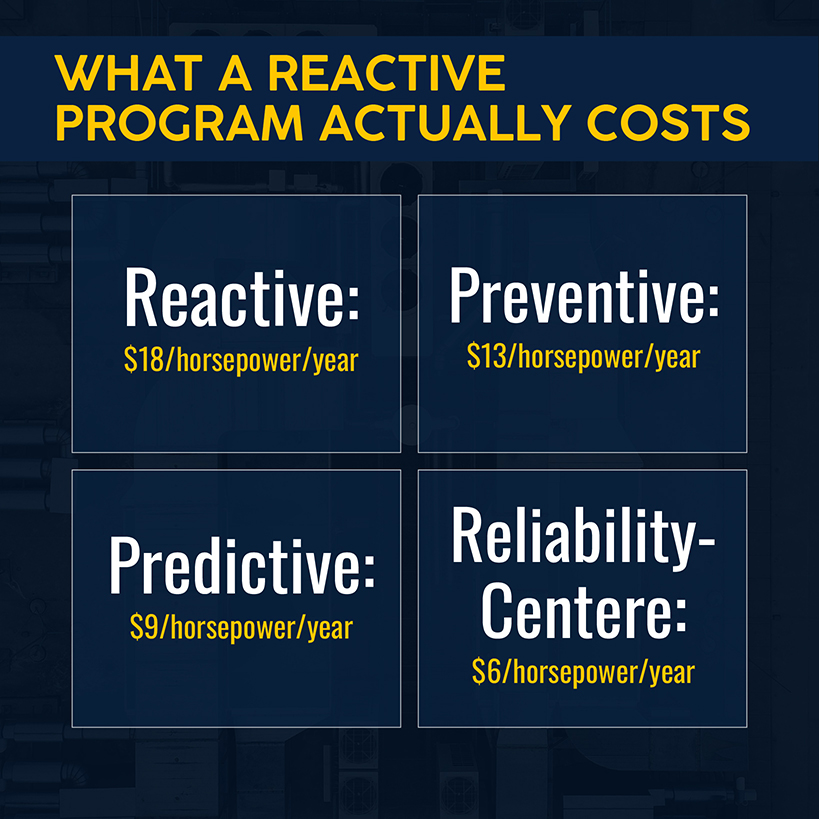
The math behind planned maintenance backs that scrutiny up. The U.S. Department of Energy Federal Energy Management Program (FEMP) puts average maintenance cost at $18 per horsepower per year for reactive work, $13 for preventive, and $9 for predictive. Facilities that shift from a reactive program to a disciplined preventive program save an estimated 12–18%, and predictive maintenance layered on top adds another 8–12%.
Most commercial buildings, however, are more reactive and prone to costly repairs. FEMP's benchmark shows that the average program features over 55% reactive work, with only 12% predictive. Top-performing facilities, by contrast, run under 10% reactive and 45–55% predictive.
The operational fix: Don't sell "maintenance." Sell the gap between today's maintenance program and what's possible with a disciplined preventive program. Quantify that potential in dollars per horsepower, energy efficiency, and downtime avoided. That's a conversation a facilities director can take upstairs.
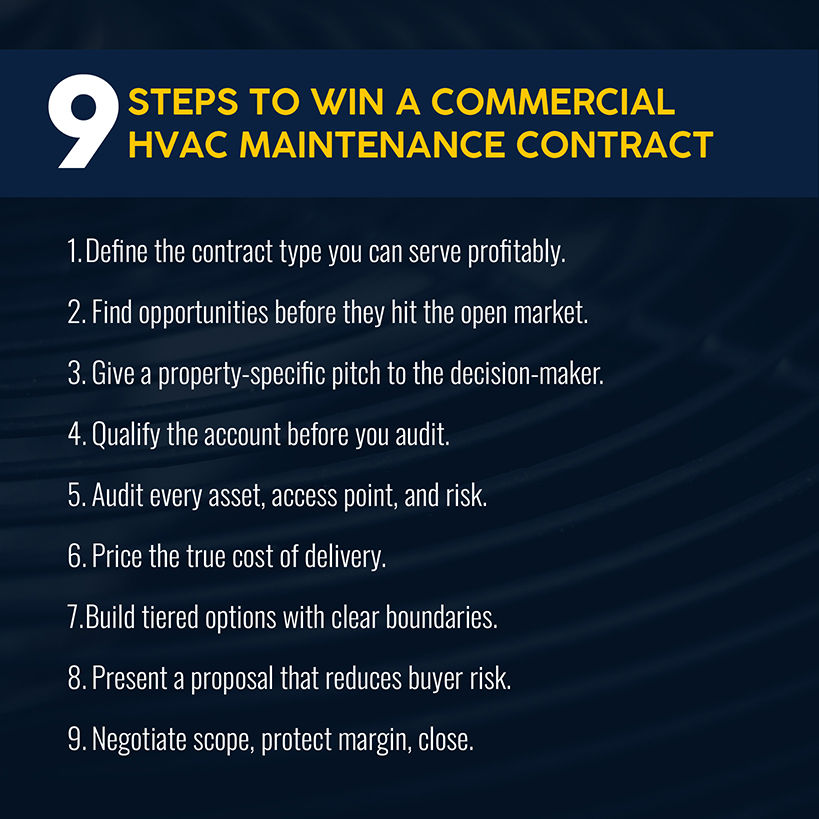
9 Steps to Win Profitable Commercial HVAC Maintenance Contracts
Winning this work requires a sequence of actions, not a single pitch. Each step builds on the one before it, from picking your lane through closing the signature.
1. Define the Type of Contract You Can Serve Profitably
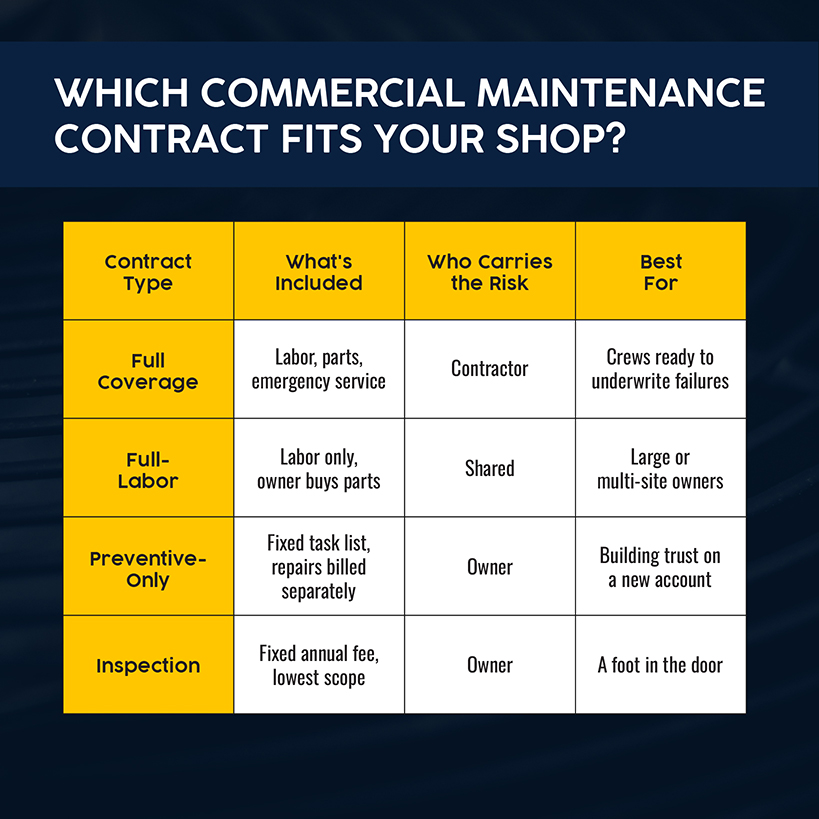
Before you start chasing accounts, decide what you're best-suited to bid on. The Department of Energy's FEMP describes four distinct commercial maintenance structures, each with different risk profiles for HVAC service agreements.
- Full-coverage agreements bundle labor, parts, and emergency service into one fee. They cost the owner more upfront, but they also offer every incentive for rigorous preventive work because premature failures come out of your margin.
- Full-labor agreements cover only labor, with the owner buying parts directly. This tends to favor large and/or multi-site owners buying materials in bulk.
- Preventive-maintenance-only agreements offer a fixed fee for a defined task list, with repairs billed separately as time and materials (T&M).
- Inspection contracts, sometimes called fly-by agreements, are the cheapest option but often the least effective. Their best use is to get your foot in the door.
For example, a three-technician commercial shop that has never carried a full-coverage account should think twice before underwriting a $150,000-a-year agreement on a 60-ton chiller plant. Know which structure matches your crew's depth and your risk appetite before writing the proposal.
Related: See how margins move across job types so you can properly structure a commercial HVAC maintenance contract.
2. Find Commercial HVAC Maintenance Opportunities Before They Reach the Open Market
Most contractors researching how to get HVAC maintenance contracts will monitor job boards for open RFPs. But those listings could draw bids from a dozen contractors, all bidding blind against a specification.
Better opportunities come from developing relationships with property management companies expanding their portfolio, general contractors who need a maintenance partner as they finish tenant improvement work, or facility managers whose current vendor isn't responding to emergency calls.
Watch for portfolio-level signals. A property management firm managing 12 strip malls is a far better target than an individual leasing office, as winning the relationship means getting the entire book of business.
Related: Here's how to grow an HVAC business beyond one-off jobs into recurring accounts.
3. Reach the Decision-Maker With a Property-Specific Value Proposition
Most of the pitches facility managers receive are interchangeable. What earns HVAC contractors the callback is a proposal that references their equipment, not a generic capabilities deck. If you know the property has a mix of packaged rooftop units and a central chiller plant, say so in the first email. If you know their lease structure passes maintenance costs on to tenants, frame your pricing around what that means when they reconcile common area maintenance charges.
In this step, even a survey you haven't formally run can still help you. A drive-by view of rooftop unit count and age, paired with public permit records or a quick search for the building's engineering staff, gives you enough to write a proposal that sounds built for that address instead of copy-pasted from a template.
4. Qualify the Account Before Investing in a Site Audit
A full equipment survey takes hours or even a full day, particularly for multi-building portfolios. Don't spend that time on every lead.
Qualify first. Ask questions like:
- Does the prospect control the maintenance budget, or are they gathering quotes for someone else's decision?
- Is the incumbent contract expiring, or is this a fishing exercise to get a lower number from their current vendor?
- Does the portfolio size match the risk tier you defined in step one?
The goal is to find out whether they have an approved maintenance budget for this cycle and who signs the final agreement. A prospect who can't answer both questions isn't ready to buy, no matter how promising the building looks.
5. Audit Every Asset, Access Condition, and Service Risk
Once a lead is qualified, the survey becomes the foundation for everything that follows: pricing, the task list, and the proposal.
Examine every piece of HVAC equipment with a standard form. Note the manufacturer, model, capacity, and location for each unit. Flag any signs of a poorly maintained system, such as missing access panels, dirty coils, worn belts, or a recent string of compressor replacements.
ANSI/ASHRAE/ACCA Standard 180, the industry's published definition of adequate commercial HVAC maintenance, requires a uniquely identified equipment inventory with manufacturer data, location, capacity, and a maintenance program identifier for each asset. It's that level of detail that makes facility directors believe they can defend a proposal to their boss. The asset register in Simpro® captures that data at the point of survey, meaning that the inventory you build in the field becomes the inventory a buyer can audit later.
Access conditions matter as much as the equipment itself. A rooftop unit that's only reachable by extension ladder costs more to service than one with roof hatch access. Incorporate the difference in your price.
6. Price the True Cost of Delivering the Agreement
Price from a task-based build-up, not a per-unit rule of thumb pulled from your last job. Cost every task by equipment type. Start with labor costs: hours multiplied by a fully loaded local rate. Add consumables, adjust for travel time and access difficulty, and then layer in an after-hours premium if the agreement includes emergency response. That fully loaded rate should reflect what an HVAC technician costs you in terms of wages, burden, vehicle time, and the gaps between calls.
A 40-ton rooftop package on a strip mall might run $1,800–$2,400 a year on a preventive maintenance-only agreement, depending on access and the number of air filters. Price it against the wrong wage assumption, and you'll forfeit the margin before the first no-heat call in January.
Site-specific factors belong in the price, too. A rooftop in a dusty industrial park might need coil cleaning two or three times each cooling season instead of once. Your survey should surface those details before you quote.
Related: The full build-up process, from labor hours to margin targets, is covered in how to price HVAC jobs.
7. Build Tiered Service Options With Clear Boundaries
Buyers will typically push back on the first number you propose. Give them a choice instead of a single yes-or-no decision. For example, a 200-unit apartment portfolio with 20 packaged rooftop units warrants three options:
- A full-coverage plan of roughly $52,000 a year that includes parts, priority service, and emergency response
- A preventive-only plan of roughly $31,000 with repairs billed separately
- A labor-only middle tier for an owner who already stocks common parts
Draw clear boundaries around what's covered under the maintenance fee versus what triggers a repair quote. For example, ANSI/ASHRAE/ACCA Standard 180 excludes repair and replacement from the maintenance scope, requiring separate approval and funding. Following that same line in your own agreement protects your margin without nickel-and-diming the client, and it often mirrors the structure a buyer's own spec already requires.
8. Present a Proposal That Reduces Operational and Financial Risk
The proposal document isn't a formality, so expect a thorough evaluation. Structure it like a public-sector solicitation, with scope and exclusions, a price schedule broken out by task, response-time commitments, reporting deliverables, and the period of performance.
Name the standard or guide behind each maintenance procedure, rather than handing over an unsourced checklist. That alone will separate your proposal from the pack.
Commit to numbers the buyer already reports upward, such as equipment availability above 95%, schedule compliance above 90%, PM completion above 90%, and emergency work under 10% of total hours worked. These are the same O&M benchmarks federal facility managers use internally. Codify them in your proposal so the facilities director can defend the proposal in their budget meeting.
Related: A structured proposal document does more of the selling than the meeting does. This bid template breaks down the sections a commercial buyer expects to see.
9. Negotiate the Scope, Protect the Margin, and Close the Contract
Most commercial maintenance agreement negotiations come down to scope: the frequency of each task, what counts as an emergency response, and whether after-hours calls are part of the base fee.
Hold your ground on the items that protect delivery quality, such as filter change frequency and the coil cleaning schedule, and compromise when possible on administrative terms, such as reporting format or invoice timing.
Know which concessions actually cost you money before you enter the negotiation. A facilities director asking for monthly instead of quarterly reporting is an ask with little downside. A request to drop your after-hours premium will cost you money every time the phone rings at 2 a.m.
Turn the Signed Agreement Into a Profitable, Renewable Account
Winning the contract is only half the battle. Before maintenance services begin, run a formal kickoff to confirm the equipment list against your survey, walk the site contact through the reporting format, and clarify how to escalate anything outside routine maintenance. Skipping this step can turn a well-priced agreement into a string of confused service calls.
ANSI/ASHRAE/ACCA Standard 180 builds a self-correcting mechanism into the maintenance program. Two straight unacceptable inspections trigger a review and a probable increase in task frequency, while three consecutive acceptable inspections trigger a review for a possible reduction. Adopt that same logic in your own agreements so you're neither locked into a fixed scope nor making the client pay for unjustified maintenance.
Each visit's condition findings are also your repair pipeline. A maintenance agreement that surfaces a failing capacitor or a coil past its useful life is doing what Standard 180 assumes will happen. Repair and replacement sit outside maintenance scope, and they require their own approval, so flagging the failure is part of the job. That approved-quote pipeline is where you make your agreement margin over the life of the account.
Related: Learn how to scale recurring maintenance out of a bunch of one-off contracts.
Manage Commercial HVAC Maintenance Contracts With Simpro
Somewhere between the fifth signed account and the 50th, tracking the maintenance schedule by spreadsheet stops working. Task frequencies drift. A technician skips a quarterly filter change because the reminder was in someone's inbox instead of a system. The facilities director who used to get a clean monthly report starts asking why it's three weeks late.
Simpro runs the recurring job series in one system. Every task stays on schedule, you have the completion record required by standards and public sector specs, and KPI reports help you win renewals instead of rebuilds.
Those are exactly the sorts of improvements seen by Buchanan & Hall, a 25-person commercial refrigeration and HVAC business in Ontario, after switching to Simpro. With past-job data and prebuilds available in one place, quoting sped up, and the team stayed on top of preventive maintenance tasks even during busy stretches.
Over 250,000 users run their field service operations on Simpro, which is purpose-built for trade businesses rather than adapted from a generic SMB tool. Its estimating and asset management tools are built for the task-based, standards-anchored pricing required for successful HVAC commercial maintenance plans.
Schedule a demo to see how Simpro handles asset registers, recurring maintenance planning, and the reporting a commercial buyer expects before they sign.
Frequently Asked Questions About Commercial HVAC Maintenance Contracts
How do I get commercial HVAC maintenance contracts?
Build relationships with property management companies, general contractors, and facility managers, so you hear about contract opportunities before they hit the open market. Win them with a proposal built around a documented site survey and a task list tied to a recognized standard like ANSI/ASHRAE/ACCA 180, rather than a generic capabilities pitch.
How should I price a commercial HVAC maintenance contract?
Build the price from a task-based estimate instead of a flat per-unit rate. Cost labor hours against a fully loaded local wage rate, add consumables and access constraints, and price site-specific drivers separately, such as coil-cleaning frequency or after-hours response.
How long should a commercial HVAC maintenance contract last?
Most commercial maintenance agreements run one to three years with an annual renewal or escalation clause. Longer terms suit full-coverage structures where you're underwriting more risk, while shorter terms are good for inspection- or preventive-only agreements that help you build trust with a new account.
Should contractors offer multiple maintenance agreement tiers?
Yes. A single HVAC maintenance agreement presented as three priced tiers, typically full-coverage, labor-only, and preventive-only, turns a yes-or-no decision into a scope conversation. Budget-constrained buyers can say yes at a lower tier instead of walking away.


 Back to top