
A dispatcher who's run a 30-technician crew for a few years can list, from memory, which rooftop units are due this month. But "from memory" doesn't work when you're managing recurring commercial HVAC maintenance at scale and giving that same dispatcher 300 assets across 60 buildings. Visits are missed, technicians show up without the service history, and maintenance agreements start costing more than they earn.
ANSI/ASHRAE/ACCA Standard 180-2018 defines the minimum requirements of a maintenance program, including an asset inventory, a documented plan, defined work authorization, and a process for revision as your portfolio changes.
We're sharing eight operational steps for scaling up your commercial HVAC maintenance program, including centralizing your assets and agreements, generating visits automatically, forecasting demand before it swamps your calendar, and turning service history into stronger contract renewals.
Build an HVAC Maintenance Schedule You Can Scale
One-size-fits-all maintenance schedules break down once your portfolio includes a mix of rooftop units, water-cooled chillers, boilers, cooling towers, and variable air volume (VAV) boxes across dozens of buildings. The same goes for relying on a generic checklist, whether on a monthly, quarterly, or annual cadence.
Even within a single equipment type, tasks should be split by risk and wear rate. ANSI/ASHRAE/ACCA Standard 180-2018 lays out 25 separate equipment tables covering such areas as air handlers, absorption, air-cooled, and water-cooled chillers, cooling towers, economizers, rooftop units, VAV boxes, and water-source heat pumps — each with its own inspection tasks, maintenance tasks, and minimum frequencies.
For air handlers alone:
| Air Handler Task | Standard 180 Minimum Frequency |
|---|---|
| Filter changes and drain-pan checks | Quarterly |
| Belt, VFD, and control checks | Semiannual |
To scale your schedule, start with a task library that's keyed to equipment type. Each asset should pull the applicable tasks and frequency. Even simple recurring work — like replacing air filters, lubricating moving parts, and checking belts and drain pans — needs a frequency attached to the asset it belongs to. Two customers on the same service tier might need different task lists depending on their equipment mix, which is why the library should key off the asset, not the contract.
Related: Our HVAC preventative maintenance checklist shares how to standardize your program.
8 Steps to Managing Recurring Commercial HVAC Maintenance at Scale
Standard 180's discipline — inventory, plan, documentation, and review cycle — becomes operational once you break it down into steps your team can run every week.
The eight steps below build on each other: Centralizing your data feeds the schedule, which feeds dispatch, which feeds the service record that closes the loop.
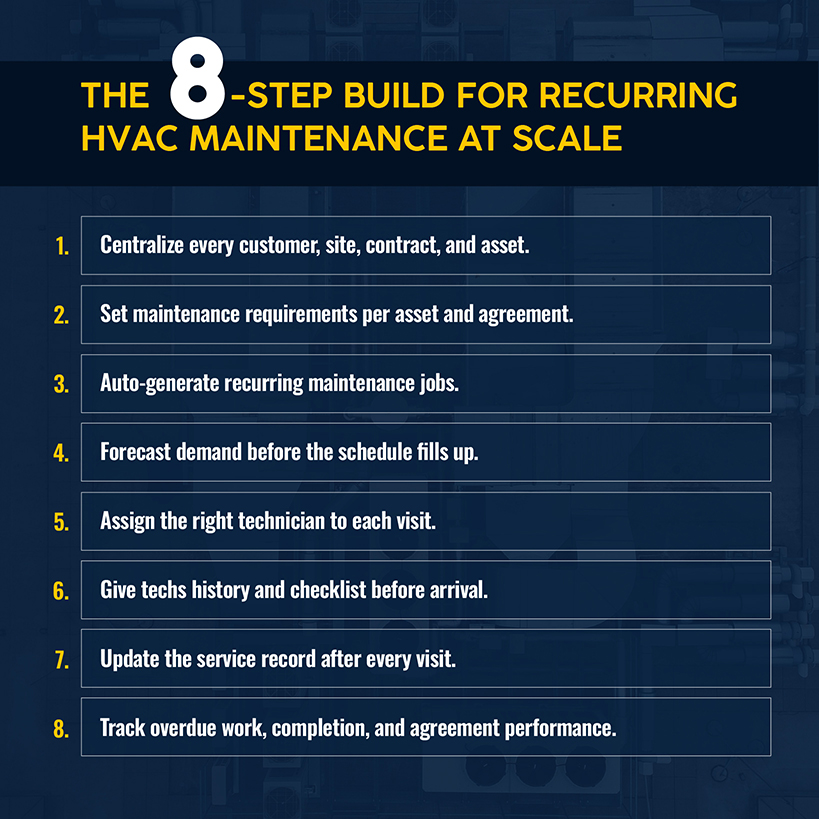
1. Centralize Every Customer, Site, Contract, and HVAC Asset
Success begins with having a clean asset register that's structured in alignment with Standard 180 and federal maintenance contracts with the General Services Administration (GSA). Start with the site, then move to each building, system, and asset. Include parent and child relationships so, for example, a chiller plant's pumps and cooling towers roll up under the chiller they serve.
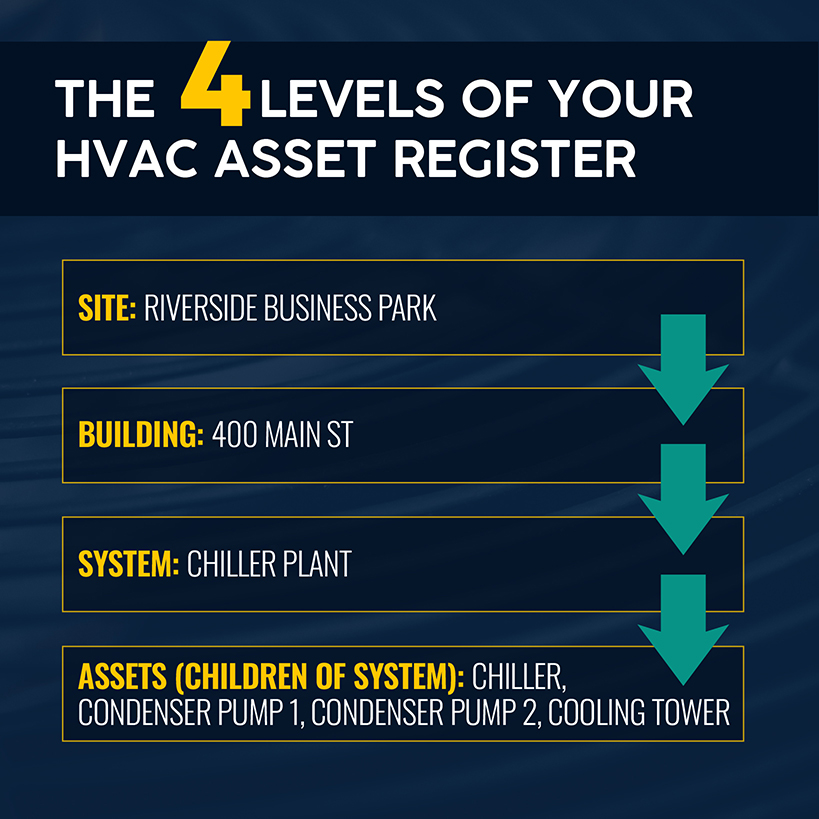
The same hierarchy applies whether the asset is a packaged air conditioning system on the roof or a single outdoor unit tucked behind the building. Give each asset a unique ID, and document the manufacturer, model, and serial number. Attach the nameplate data (horsepower, voltage, amperage, tonnage, CFM, GPM) directly to the record, rather than burying it in PDFs that technicians struggle to find once on-site.
Let's say you've acquired another contractor with a 400-unit portfolio and 20-technician crew. Creating a clean asset register can take 2–3 weeks of data entry, but it's worth it: Each downstream step (task assignment, forecasting, dispatch, reporting) references this register.
Related: The right HVAC CRM software keeps every customer, site, and contract in one searchable record instead of scattered across spreadsheets and emails.
2. Set Maintenance Requirements for Each Asset and Agreement
Within each contract, different maintenance items can have different frequencies. For example, a restaurant's kitchen makeup-air unit might need quarterly filter service because of grease load, but a cooling system serving the office 40 feet away only needs attention every six months.
Also pay attention to Standard 180's required feedback loop: if an asset fails two inspections in a row, you should review the plan for more frequent attention. But if it passes three straight, you can consider a lesser frequency. When you set this rule at the portfolio level instead of leaving it up to individual technicians, you can more easily track frequency and labor cost against actual equipment condition and system efficiency.
3. Automatically Generate Recurring Maintenance Jobs
Managing HVAC maintenance agreements at scale isn't feasible without automatic scheduling. Manually rescheduling 600 assets every quarter for a book of business worth $40,000–$250,000 per customer annually turns your planner into a full-time data-entry clerk, with the error rate climbing with each additional asset.
Automated recurring jobs should pull straight from the asset record and the maintenance plan. The system creates the next work order, attaches the checklist, and puts it on the calendar as the current visit closes out, whether the trigger is a calendar date or a usage threshold like operating hours.
Related: The right maintenance planning software turns a recurring maintenance backlog into a system that runs itself.
4. Forecast Maintenance Demand Before the Schedule Fills Up
Spring and autumn create a logjam for commercial HVAC contractors. Not only do cooling season startups and shutdown visits spike, but so does reactive call volume. Meanwhile, neglected units work harder to keep up and fail faster under load, turning what should have been a routine visit into an emergency repair.
One way to reduce this crunch is by staggering each agreement's anniversary date across the year rather than defaulting to the sale date. For example, you might pin quarterly inspections to the first month of each quarter. Load-disruptive annual work, meanwhile, gets pushed into low-demand months (and sometimes weekends) to free up your calendar for peak season.
The operational fix: Stagger contract anniversary dates at signing. Hold a fixed percentage of technician capacity open through peak seasons so you can respond to reactive work.
5. Assign the Right Technician to Each Maintenance Visit
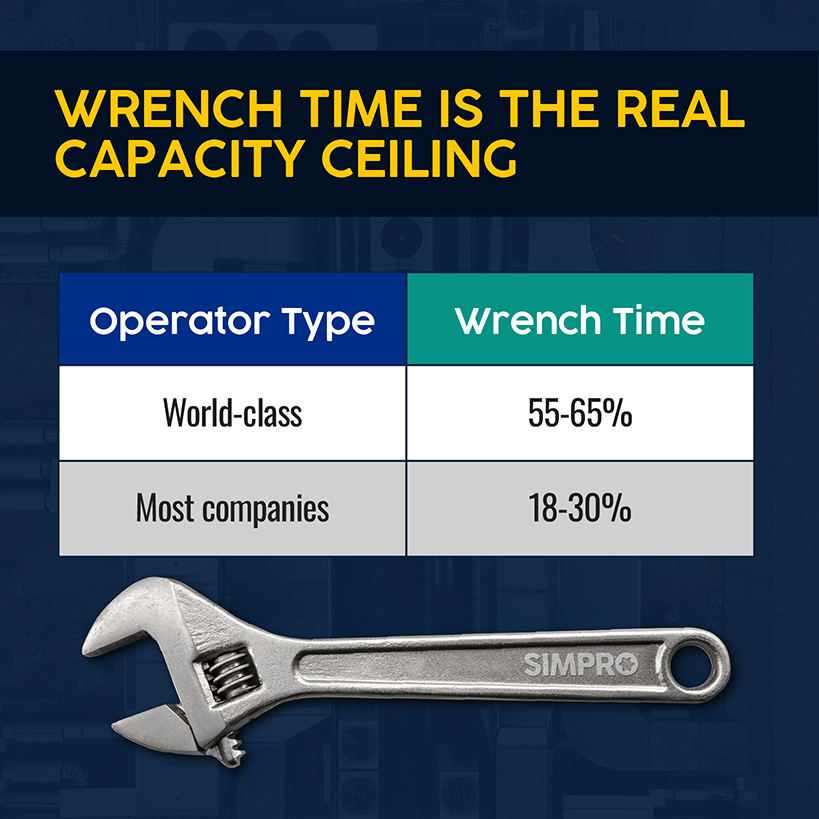
One of the biggest ceilings on your maintenance capacity is wrench time, or the share of a paid day spent using tools. The authors of a maintenance and reliability guide put world-class wrench time at 55– 65% but note that most companies are less than half of that (18–30%).
Improvements here add up quickly: Getting a 10-person crew from 30% to 40% wrench time is the equivalent of an additional mechanic without adding headcount.
The operational fix: Revisit your assignment logic. Match HVAC technicians to visits by certification and proximity, batch assets in one building into a single dispatch instead of three separate trips, and cluster nearby sites into one route.
Related: Learn what goes into excellent HVAC dispatching, including assignment and routing logic.
6. Give Technicians the Asset History and Checklist Before They Arrive
A technician who shows up without service history will repeat diagnostic work every time, with no guarantee of detecting the same problems. The fix is having software that delivers everything you need to the technician's phone before arrival — the asset's maintenance history, prior findings, and equipment-specific checklists. Then, the visit becomes about execution instead of discovery.
On multi-asset sites, your history should flag which units have failed inspections or shown declining system performance, which illustrates what's due for a frequency review. For a crew covering 15 to 20 stops a day, that prep work is the difference between a 5-minute look and a 45-minute investigation that makes them late for every other visit that day.
7. Update the Service Record After Every Maintenance Visit
Standard 180 requires documentation for each completed task. Federal maintenance contracts go further: Asset records must be updated within three business days of completing a work order, and at least 10% of completed preventive maintenance work orders — plus 10% of all other completed work orders — get quality-checked.
When visits aren't logged into the asset's record on the same day, that's valuable information you don't have at the ready, whether it's the next technician to visit or your next renewal negotiation.
The operational fix: Your standard process for closing out jobs should include same-day record updates, rather than leaving it for someone else to do later.
8. Track Overdue Maintenance, Completion Rates, and Agreement Performance
GSA's maintenance specification requires preventive maintenance work to be completed in the month it was scheduled. Further, contractors must track backlog as a performance measure and report on work-order status.
The Society for Maintenance & Reliability Professionals publishes more than 70 standardized metrics, such as planned maintenance percentage, schedule compliance, and craft utilization. Each has formulas to help you compare branches or acquired companies on the same basis instead of each reporting a homegrown version of "on schedule."
The operational fix: Set a target HVAC planned maintenance percentage for your portfolio, and review it monthly against actuals by branch or crew. If a branch is drifting toward reactive work, view that as a renewal risk, not just a problem with how you're scheduling maintenance.
Use Maintenance History to Improve Future Service and Contract Decisions
Having 12 months of service records on a single rooftop unit is useful. But what's even better is three years of records across a customer's portfolio and cross-referenced with what failed and when. That sort of detail improves operations, prevents unexpected costly repairs, and helps you price the next contract instead of guessing.
When negotiating multi-year agreements, make sure to include an escalation mechanism, or else you'll bleed margin because of inflation, rising labor costs, and other factors. The producer price index for maintenance and repair of nonresidential buildings rose 5.1% over the 12 months ending July 2026. Meanwhile, labor pressures aren't going away: The median HVACR technician pay is $29.33 an hour, with about 40,600 openings expected each year through 2035.
Anchor your renewal pricing to a named public index rather than a flat percentage. Use documented scope changes (such as added, removed, or retrofitted equipment) as the built-in trigger for a price adjustment.
Condition history does the same work on the sales side. A chiller with three consecutive clean inspections and no failed components leads to a very different replacement conversation than a chiller with two years of climbing repair costs. When you have that history in your hands, you can argue for either outcome with the customer's own equipment record.
Related: Our asset maintenance strategy guide covers how to connect service history directly to renewal pricing and replacement quoting.
Manage Recurring Commercial HVAC Maintenance in One System With Simpro®
More than 250,000 users worldwide run their field service operations on Simpro, many using the Maintenance Planner add-on that's built specifically for HVAC service programs as we've discussed above.
Service levels and testing frequencies attach to each asset. Alerts fire automatically when a unit is due or has failed testing. And jobs generate automatically from the plan instead of a spreadsheet that requires a planner's intervention each month.
When two services on one asset land on the same date, the Maintenance Planner consolidates them into a single job instead of sending a technician out twice. You can also tie preferred technicians to a customer, a site, or an asset type, ensuring that the right certification is automatically assigned instead of creating manual work for dispatchers. Simpro can also forecast how much labor is required for a given testing cycle before it hits the calendar.
In the field, technicians scan an asset's barcode or QR code to pull test history and recommendations, log results, and close the loop while still on-site. The combination of all these features allows systems to operate on a documented schedule instead of whatever a technician remembers from the last visit.
With Simpro, you can turn these eight steps into a working program. Chillmech Services is a case in point: a 45-plus employee commercial and industrial HVAC and refrigeration contractor that needed to better manage workflows and reporting across the business.
"One of the first things that we found, and that continues to surprise us with Simpro, is the range of features that are available to monitor and manage different business areas," said ICT Manager Carl Murray, with the reporting tools, in particular, continuing to be a growth area.
Turn Recurring Maintenance Into a Predictable Service Operation
You already know whether your maintenance program is running on solid infrastructure or over-relying on your dispatchers' memory. You probably also know which upcoming renewals are based on fault pricing that doesn't reflect the cost of servicing them.
The eight steps above align with what Standard 180 already requires. What changes at scale is creating a system that automatically runs that structure versus someone rebuilding it by hand every month.
Simpro connects asset records, maintenance planning, scheduling, and reporting in one platform built for trade and field service businesses. Recurring maintenance turns into steadier revenue and stronger renewals instead of overhead your office has to carry by hand.
Schedule a demo to see how it fits your operation.
FAQs About Commercial HVAC Maintenance Scheduling
How often should commercial HVAC preventive maintenance be scheduled?
It depends on the equipment and how hard it works. Standard 180 sets minimum frequencies by equipment type, ranging from quarterly filter and drain-pan checks on air handlers to annual duct-liner and biological-growth inspections. Boilers, chillers, and heat exchangers each carry their own separate frequency tables.
On top of that baseline, the standard requires you to revise frequency based on actual performance. For example, two failed inspections in a row trigger a review for more frequent service, while three clean inspections in a row prompt consideration of less frequent service. Other frequency conversation triggers include the climate and how a facility is being used.
What should an HVAC preventive maintenance program include?
Standard 180 requires six elements:
- Complete inventory of the equipment being maintained
- Documented maintenance plan describing each task and its frequency
- Minimum documentation standards
- Defined process for authorizing and executing work
- Process for revising the plan over time
- Periodic program review — at a minimum, two formal meetings per performance period to set and evaluate objectives
How do you manage HVAC maintenance across multiple commercial sites?
Start with a single asset register that's structured at the site level, then building, system, and asset. The goal is having technicians and reports each pulling from a shared source. From there, automate job generation, so visits don't depend on someone remembering to schedule them. Assign technicians by certification and route density, so multi-site work gets batched instead of scattered. Centralize reporting so every branch or acquired company gets measured the same way.


 Back to top