
Selling HVAC service agreements can feel harder than it needs to be, usually because you miss the moment when the customer is ready to say yes.
A technician wraps up a $600 repair, hands over the invoice, and never mentions the plan that would have covered half of it. A customer service representative (CSR) books the appointment and moves on to the next call without asking about it, either. By the time someone follows up, the urgency is gone.
This guide covers how to sell HVAC maintenance agreements when customers are ready to buy: right after a repair, on the phone with a CSR, and in the weeks before a plan lapses. Some contractors call it a contract instead of an agreement, but either way, the same tactics apply.
Why HVAC Maintenance Agreements Are Valuable for Growing Contractors
A maintenance agreement changes what kind of business you're running. Instead of a fee for one visit, your customer commits to keeping their HVAC systems tuned every spring and fall, plus making you their first call if something breaks in between. According to one industry forecaster, recurring service agreements already account for 55% of total heating, ventilation, air conditioning, and refrigeration (HVACR) industry revenue.
The retention math backs it up. Acquiring a new customer costs 5–25 times more than keeping an existing one, and a mere 5% increase in retention can boost profits up to 95%, according to long-standing research cited by Harvard Business Review.
Maintenance agreements also change what the business is worth. Auctus Capital Partners, an M&A advisory firm that works HVAC deals, reports that businesses with strong recurring revenue from maintenance agreements typically sell for 4–6 times seller's discretionary earnings, versus 2x–4x for installation-dependent businesses. That gap can be worth hundreds of thousands of dollars on a midsize shop. It's also the math a lender might use to judge a contractor's long-term revenue stability.
Selling HVAC service agreements at scale requires a universal process, not letting everyone develop their own pitch. Simpro® customers report revenue increases of up to 25% after moving from ad-hoc maintenance scheduling to a structured, automated process. The 10 tactics below are where that starts.
Related: This article focuses on selling and renewing maintenance plans. For the bigger picture, see how recurring maintenance agreements fit into growing your HVAC business.
10 Ways to Sell More HVAC Maintenance Agreements
Part of knowing how to sell HVAC maintenance contracts is about the pitch. But don't forget about pricing, training, and the back-office habits that make an agreement stick after it's sold.
Work through these tips in order, as a great script sold at the wrong moment or incorrectly priced still loses money.
1. Build a Maintenance Plan Customers Can Easily Understand
Customers won't pay for plans they don't understand, no matter how good the pitch is. If they can't repeat back what they're buying in one sentence, you need a simpler plan, not a longer explanation.
Write the coverage in plain terms:
- How many visits
- What's included
- Whether priority service is part of the deal
- What's discounted
- What happens if something breaks between visits
Save the fine print for customers who ask for it.
The top-converting plans answer three questions: What do I get? What does it cost? What happens if something isn't covered?
If your current agreement takes more than a minute to explain out loud, that's the first thing to fix.
2. Price Every Agreement From Its True Delivery Cost
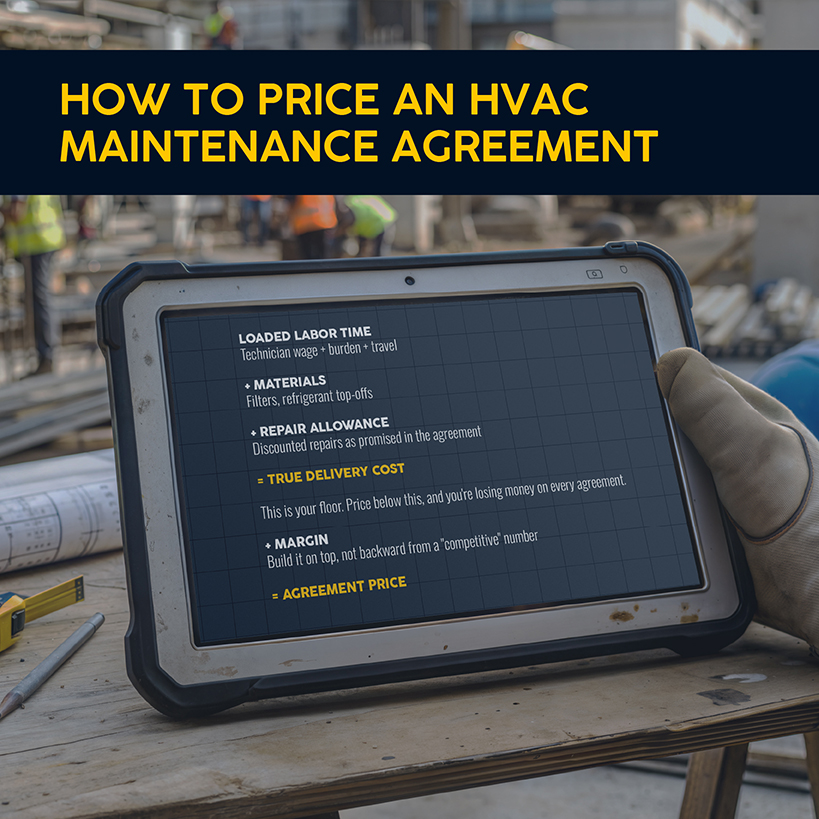
If you're still working out how to price HVAC maintenance plans, start with what a visit costs you to deliver, not what a competitor charges. Include loaded labor time (technician wage, burden, and travel), typical materials like filters and refrigerant top-offs, and a reasonable allowance for the discounted repairs promised in the agreement. That number is your floor. Price below it, and every agreement you sign becomes a liability you're contractually obligated to honor.
Use that number to build margin instead of guessing at what sounds competitive. A plan priced to protect margin might look less aggressive than a bargain-bin offer, but you'll still be profitable after the second callback. Track the cost to serve by plan tier, just as you'd track job costing on an install, because an agreement is delivered over 12 months instead of one afternoon.
Related: Pricing your maintenance agreement goes smoother when your HVAC price book reflects current labor and material costs.
3. Offer Tiered Plans Without Overcomplicating the Choice
A single flat-rate plan forces every customer into the same decision: Yes or no. But offering three tiers — basic, standard, and premium — gives the customer a choice instead of a verdict, and that makes the conversation feel more comfortable.
Structure the difference in real terms customers can understand, like visit frequency, repair discount rate, priority scheduling, and parts coverage. Leave out cosmetic features that don't change what the plan does.
Price the middle tier as the one most customers should choose, then let the other two do their job: a low-commitment entry point on one end, and a premium option that makes the middle tier the obvious choice on the other end.
Resist the urge to offer more than three options. Otherwise, you're moving from a five-minute conversation to a spreadsheet, with many customers selecting nothing rather than getting it wrong.
4. Sell the Outcome Rather Than the Maintenance Checklist
Nobody wakes up wanting a coil cleaning. They call you because they want air conditioning in August, not a surprising failure that requires an emergency repair visit.
A pitch built around the checklist tells the customer what you're going to do: preventive maintenance like filter changes and refrigerant checks. A pitch built around the outcome tells them what they get: fewer breakdowns, lower repair costs, service priority, and peace of mind heading into the next heat wave.
The checklist still matters, as it justifies the price and gets read by customers. But leading with it turns the conversation into a features comparison instead of a reason to buy.
5. Present the Agreement at the Right Moments
The strongest moment to offer a maintenance agreement is right after a technician finishes a repair, install, or maintenance visit. If the customer is holding the invoice, preventing the next breakdown feels concrete instead of hypothetical. Waiting a week and calling from the office is less effective because the urgency has passed.
Inbound calls to CSRs also have their moment. When you book the appointment, mention the plan in the same breath. It costs nothing, and it will prompt customers to think about an upgrade they wouldn't have asked about otherwise.
6. Give Technicians a Simple, Natural Sales Script
Technicians didn't get into HVAC to sell memberships, and a script that sounds like a sales pitch will make many too uncomfortable. What works is a short line anchored to the job in front of them. Have them state today's diagnostic and repair cost, explain what the plan would have saved on that visit, and let the math do the convincing.
Keep the ask to one sentence and one follow-up question: "Should I go ahead and set you up on the plan so this is covered next time?" does more work than a five-minute explanation, as it puts the decision in front of the customer. If a tech has to memorize a paragraph, the script is too long.
7. Train the Entire Team to Explain the Same Value
Telling customers about the maintenance plan is good, but if they hear a different explanation from the CSR, the technician, and a sign in your lobby, they'll be confused and less likely to buy. Everyone who talks to customers should state the same core values in the same words.
That doesn't mean scripting every interaction. It means agreeing on the two or three sentences that describe what the plan does and why it's worth it. Run an actual training session so the team can practice, as well as ask what happens when a customer pushes back.
Related: Consistent messaging is just one component of successful HVAC sales strategies.
8. Address Common Objections Without Pressuring the Customer
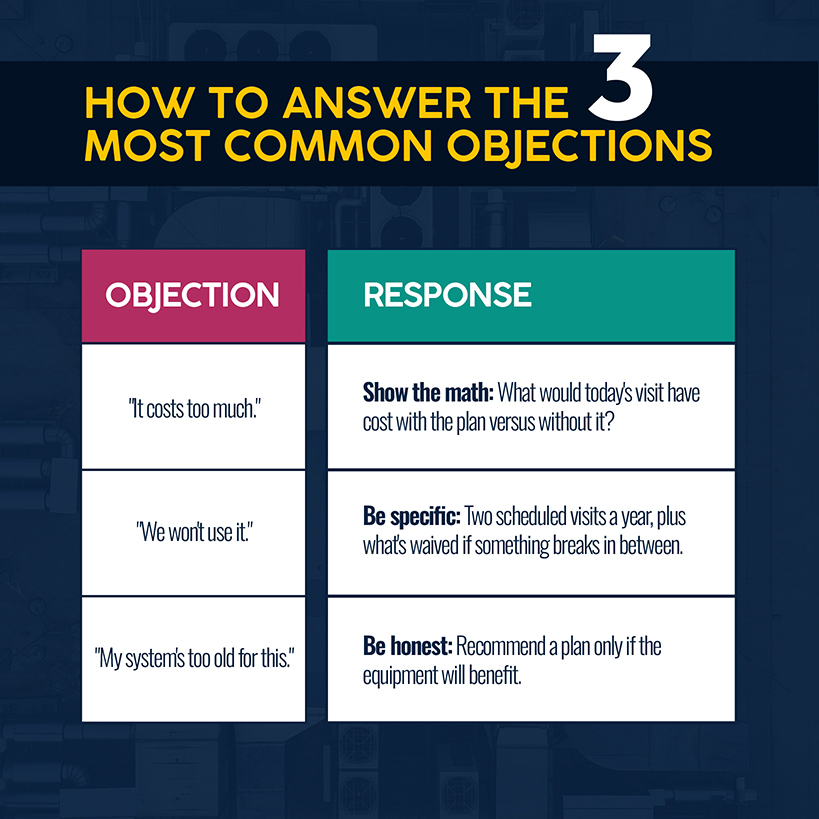
Most objections come down to three things: price, a feeling the plan won't get used, or a system old enough that a plan feels like a waste.
- Price objections: Lean on the math by explaining what today's visit would have cost with the plan versus without it.
- Usage skepticism: Give specifics, like two scheduled visits a year plus what's waived on emergency service if something breaks.
- Aging system: Be transparent, recommending a plan only if the equipment will benefit. If not, say that, too.
A technician who mentions a maintenance plan but tells a customer their 15-year-old furnace isn't a strong candidate will build more trust than a tech who pushes the plan anyway. That trust eventually pays off when there's something meaningful to sell.
9. Make Enrollment and Payment Frictionless
An agreement that takes 10 minutes to sign will lose some would-be customers. Enrollment should happen on-site, on a phone or tablet, in the time it takes to finish the invoice. If the customer has to wait for a follow-up email or a call from the office, they're less likely to follow through.
Annual plans can be daunting, especially with an upfront payment. Monthly billing with a card or bank account on file removes that friction. Customers will say yes more easily to a smaller monthly charge; with auto-pay, renewal happens without anyone needing to think about it. Make continuing enrollment the default — opt-out, rather than opt-in.
10. Manage Delivery, Renewals, and Performance as Carefully as Sales
Selling the agreement is half the job. A member who misses their promised fall tune-up because nobody scheduled it is a near-certain cancellation at renewal, and no script fixes a broken promise.
This is a potential failure point for most HVAC maintenance plans. The sales team hits its numbers, but no one books the visits, schedules the renewal reminder, or notices when the agreement lapses.
Simpro's Maintenance Planner schedules recurring visits automatically across your customer base, flags upcoming maintenance-due work, and assigns the closest available technician to keep the two-visits-a-year promise. Contract management tracks service levels and testing frequency by asset, while recurring invoicing handles monthly or annual billing without someone chasing payments by hand.
A good pitch still matters. But the right software fulfills the agreement you do sell and leads to more renewals.
Related: Automated maintenance renewals are among the ways top HVAC firms are protecting revenue and margins with AI in 2026.
Residential vs. Commercial HVAC Maintenance Agreements
Residential and commercial maintenance agreements share the same basic structure, but they're sold and priced differently. Treating a commercial account like a bigger residential plan is a common way to underprice complex work or to lose a deal by overcomplicating things.
| Residential | Commercial | |
|---|---|---|
| Decision maker | Homeowner, usually one person | Facilities manager, property owner, or a committee |
| Typical contract term | One year, auto-renewing | One to three years, often negotiated |
| Pricing basis | Flat annual or monthly fee per system | Per unit, per square foot, or per building, scaled to equipment count and complexity |
| Visit frequency | Two visits a year (spring and fall) | Quarterly or monthly, depending on equipment criticality |
| Sales cycle | Same-visit or same-call close | Multiple conversations, often a formal proposal |
| What closes the deal | Trust in the technician and clear pricing | Documented reliability, response-time commitments, and references |
Selling commercial work means selling to someone who won't personally feel the air conditioning go out. They're comparing your proposal to whatever the facility budgeted last year. That's a longer sales cycle but a more durable one. A commercial account with three buildings on a maintenance agreement holds more stable revenue than the same dollar amount spread across a dozen residential customers who can cancel any time.
Common Mistakes That Make HVAC Maintenance Plans Harder to Sell
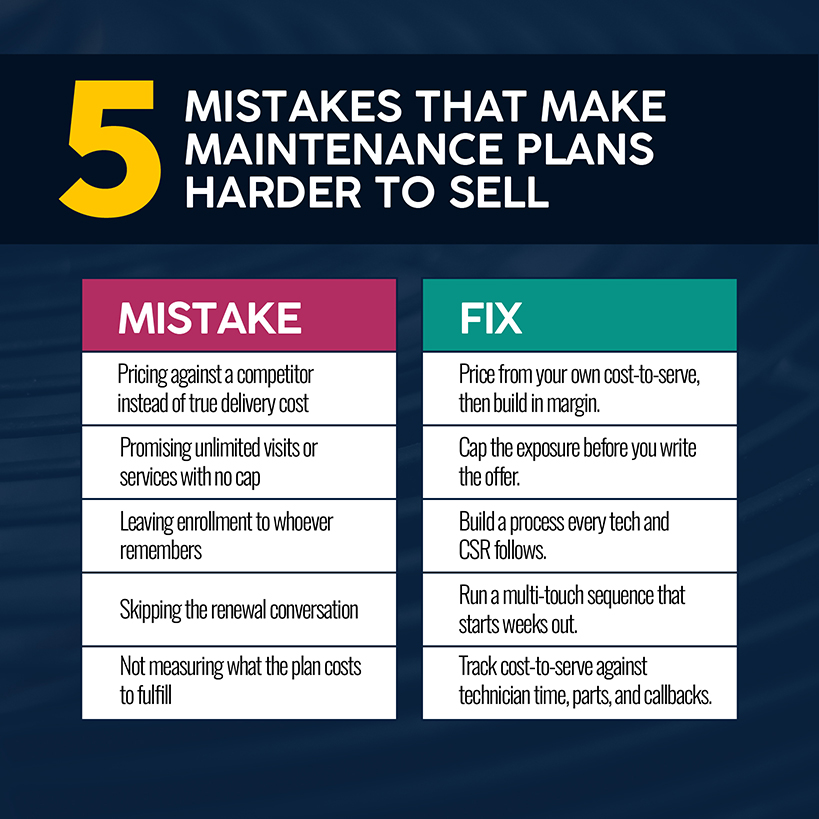
Most plans that struggle to sell were doomed before the pitch ever happened. The problem is a pricing or process decision made weeks earlier.
- Pricing against a competitor instead of true delivery cost. When you price your plan to beat another HVAC contractor's rate, you risk profitability because you aren't considering what a visit costs you to deliver.
- Promising unlimited service calls or work without capping exposure. "Unlimited" sounds generous and easy until too many customers call your bluff, eroding your margin.
- Leaving enrollment to whoever remembers. If selling the agreement depends on one motivated technician instead of a process every tech and CSR follows, the attach rate will remain inconsistent.
- Skipping the renewal conversation. Most cancellations trace back to a lack of contact before the agreement expires. Likewise, a single renewal notice converts fewer customers than a sequence that starts weeks out.
- Not measuring what the plan costs to fulfill. A maintenance program that isn't tracked against technician time, parts, and callback rate can look profitable on paper while losing money in practice.
Fix the pricing, the process, and the tracking, and all you need to do is have the sales conversation.
Related: Apply HVAC performance metrics to maintenance agreements so this revenue stream becomes a measured part of the business.
Turn Maintenance Agreements Into a Reliable Growth Channel
Right now, there are one-time invoices that could become maintenance agreements, if only someone knew to pitch them. Meanwhile, some of the maintenance contracts you've already sold are a missed renewal call away from lapsing. Neither problem gets solved by a better script alone.
The tactics we shared deliver in two ways: a sales process that converts, and the discipline to deliver what was promised and catch renewals before they lapse. HVAC companies that run all 10 consistently add revenue that shows up every month, regardless of weather. That's the kind of revenue that changes what the business is worth.
Simpro's Maintenance Planner, contract management, and recurring invoicing tools handle the operational side, so your team can focus on the sales conversation rather than the follow-up spreadsheet. Schedule a demo to see how it fits your business.
FAQs
How much commission should HVAC technicians earn for selling maintenance agreements?
Most shops use one of two structures: a flat spiff per agreement sold, paid on top of base pay, or a small share of the contract value. Tie commissions to a required step on the closeout ticket, such as confirming the plan was offered, so the incentive reinforces the process. Structure the payment carefully, as spiffs paid to hourly technicians can affect how overtime is calculated.
Should HVAC maintenance agreements renew automatically?
Yes, set auto-renewals with the customer's card or bank account on file, giving clear notice before each charge. Auto-renewal removes the risk of no one following up before the expiration date. Give customers an easy way to cancel or change tiers, because a renewal model that feels like a trap will do more damage than you'll gain in convenience.
Can an HVAC business sell a maintenance agreement after installing a new system?
Yes, and the moment right after installation is one of the strongest selling opportunities. The customer has just made a major investment and is thinking about protecting it. That makes a first-year plan (potentially bundled into the install price) an easy addition rather than a separate sale.
How often should HVAC maintenance agreement prices be reviewed?
Review prices at least once a year, alongside labor rates and material costs. Pricing from even a couple years ago can become unprofitable, especially if wages and parts costs rise. Review pricing by tier rather than as a single blended number, as a change in one tier's cost-to-serve doesn't necessarily apply to the others.


 Back to top