
Not having a capacitor on a 95-degree afternoon doesn't just cost you a return trip. It can cost you the job, the review, and sometimes the customer. The problem is less often about human error and more about the barriers facing your HVAC technicians, who can’t tell what parts are available or where they’re located. Meanwhile, your office is ordering too little of some products and too much of others.
The problem isn't a parts shortage. It's poor visibility.
The best HVAC inventory management software solves this by connecting your stock to the jobs that consume it. These platforms and apps track what's in your warehouse and what's installed at your customer sites.
As your business scales, you need visibility into parts, jobs, and equipment history in one place. When a tech pulls a part in the field, your inventory updates. When a job is scheduled, the software checks parts availability before dispatch. When stock dips below the threshold, a purchase order goes out automatically.
This guide covers the best HVAC asset management software in 2026, including top features, pricing, and which types of HVAC businesses will benefit most.
Best HVAC Inventory & Asset Management Software at a Glance
Here's a quick overview of HVAC industry options before diving into the full reviews.
| Tool | Best for | Starting Price |
|---|---|---|
| Simpro® | Commercial + residential HVAC, $1M+ revenue, mixed workflows | Priced for your workflow |
| BuildOps | Commercial HVAC and mechanical contractors | Custom quote |
| Sortly | Small businesses needing simple visual parts tracking | Free limited plan; paid from $24/mo |
| FieldEdge | Residential and light commercial HVAC | Tier-based pricing |
| Housecall Pro | Small to midsize residential HVAC | From $59/mo |
| inFlow Inventory | Multi-location inventory control, no FSM needed | From $129/mo |
| Acctivate | Distribution-heavy businesses using QuickBooks | Custom quote |
7 Best HVAC Inventory & Asset Management Software
Each of these HVAC service software options can help contractors better track inventory, manage assets, or both. We’re featuring full-fledged platforms that handle everything, as well as the best HVAC asset management apps and tools for specialized uses.
Related: Here are the best HVAC apps for technicians.
1. Simpro
Best for: Commercial and residential HVAC businesses running mixed workflows -- service, maintenance contracts, and project work -- particularly those doing $1 million+ in revenue.
Simpro is a cloud-based field service management (FSM) platform designed specifically for trade contractors. Its inventory capabilities are fully native, not bolt-on modules. Stock levels update in real time across every location: warehouse, vans, and active job sites. Field technicians access and update inventory from the field via Simpro Mobile, so everyone views the latest data in real time.
The clearest differentiator is the connection between inventory and job costing. When a quote is built inside Simpro, material costs pull directly from live supplier catalog data. As jobs progress, actual material consumption is tracked against the quoted bill of materials, so your job costing reflects what happened in the field rather than a weeks-old estimate.
For a contractor running $3 million in annual revenue across residential service calls, quarterly maintenance contracts, and multiphase commercial projects, that accuracy ensures you know what your margin is — and where it’s at risk.
Simpro serves numerous trades, including HVAC, with personalized, in-house training as part of implementation.
Key Features
- Real-time stock visibility across locations from any device
- Inventory, quoting, and job costing together for tracking material consumption versus estimates
- Supplier catalog sync to compare supplier pricing, auto-populate quotes with live pricing
- Barcoding Portal with barcode scanner support for accurate, audit-ready stocktakes
- Purchase order management, with automatic stock updates on receipt
- Stock transfer between locations (warehouse to van, van to job site)
- Materials tracking from the field via Simpro Mobile
- Preventative maintenance automation, with scheduled job triggering for predictable parts demand
- Inventory forecasting with usage trend reporting
- Minimum stock level alerts and automated reorder triggers
- Integration with Xero, QuickBooks, and MYOB
Pricing
Custom pricing based on team size and requirements. Designed for teams of 5 or more. Contact Simpro for a quote tailored to you.
2. BuildOps
Best for: Commercial HVAC contractors, multisite operations, and construction or mechanical contractors.
BuildOps is built specifically for commercial service businesses, particularly those that need to track serialized equipment for warranty management, such as compressors, control boards, and heat exchangers. Its inventory module covers real-time tracking across trucks, warehouses, and job sites, with serial number tracking for. Vendor management and automated purchase order generation are included.
The platform is built for commercial workflows and is less suited for residential service volume.
Key Features
- Real-time stock tracking across trucks, warehouses, and job sites
- Serialized inventory tracking for warranty management
- Vendor management and automated purchase order generation
- Barcode and QR code scanning for real-time stock updates
- Job-level material cost tracking with work order management
Pricing
Custom pricing. Contact BuildOps for a quote.
3. Sortly
Best for: Small HVAC businesses or warehouse teams needing a simple, standalone parts-tracking tool.
Sortly is a standalone inventory tracking tool, not an FSM platform. It doesn't manage jobs, dispatch, work orders, or purchasing workflows.
What it does best is visual tracking: You can photograph parts for easy identification, scan barcodes via a mobile app, set low-stock alerts, and share access across a small team. Sortly is accessible and affordable, especially for a solo operator or small team that needs to track truck inventory and when to restock. To manage job costing or purchasing against active jobs, you'll need a separate FSM platform.
Key Features
- Photo-based inventory tracking for easy part identification
- Barcode and QR code scanning via mobile app
- Multiuser access, with controlled permissions
- Low-stock alerts and customizable notifications
- Cloud-based access from any device
Pricing
Free tier available. Paid plans start at $24/mo for two users.
4. FieldEdge
Best for: Residential and light commercial HVAC contractors wanting job-linked inventory with strong accounting software integration.
FieldEdge is built for HVAC and home service trades. Its inventory module ties parts directly to work orders, and its QuickBooks integration is a defining feature. When technicians complete a job, the record of materials consumed flows directly into billing and your accounting system, all without manual re-entry.
For contractors already running QuickBooks whose operations center on residential service calls, FieldEdge reduces the data entry burden between field and office. Advanced features for commercial project workflows are limited.
Key Features
- Job-linked parts tracking
- Reorder signals to prevent stockouts
- Real-time integration with QuickBooks
- Multi-location inventory tracking
- Mobile access for field technicians
Pricing
Custom quote based on tiers.
5. Housecall Pro
Best for: Small and midsize residential HVAC businesses focused on scheduling, dispatch, and customer communication.
Housecall Pro is built for ease of use in residential home service businesses. Its user-friendly interface makes it popular with smaller teams and owner-operators. Inventory functionality lets technicians request and track parts during service calls, but native inventory depth is limited. Housecall Pro customers are encouraged to add an integration with Ply to get more robust inventory management capabilities.
For businesses unburdened by inventory complexity and prioritizing scheduling automation and customer satisfaction tools, Housecall Pro works well as an entry-level option.
Key Features
- Parts requests and basic inventory tracking during service calls
- Material usage reporting across jobs and employees
- Equipment and asset tracking by property, including service history and replacement recommendations
- Ply integration available for barcode scanning, truck stock management, and multi-location tracking
- QuickBooks integration for basic accounting sync
Pricing
Tiered plans starting at $59/mo. Some features are only available on higher tiers.
6. inFlow Inventory
Best for: HVAC businesses needing multi-location inventory control and purchasing workflows without a full FSM platform.
inFlow Inventory is a standalone inventory management system, not an FSM platform. It provides warehouse management, purchasing, barcode scanning, and reporting for businesses managing parts across multiple storage locations.
If your challenge is warehouse organization and purchase order management, inFlow can handle it. If you need inventory that connects to HVAC field operations, you'll need a separate FSM platform and an integration layer between the two.
Key Features
- Inventory tracking across warehouses and storage sites
- Purchase order and vendor management
- Barcode scanning support
- Sales order and basic invoicing workflows
- Mobile access for warehouse staff
Pricing
From $129/mo for two users.
7. Acctivate
Best for: Distribution-heavy businesses and HVAC suppliers already running QuickBooks who need advanced inventory and order management.
Acctivate is an inventory and order management system built to extend QuickBooks for product-based businesses with distribution needs. In the HVAC industry, it fits businesses that operate more like a distributor or parts supplier — managing large parts catalogs, purchase orders, and multi-location stock.
This platform doesn’t offer native work-order management, job costing, or technician dispatching. HVAC service contractors will want a separate FSM tool to cover field operations.
Key Features
- Deep QuickBooks integration for accounting sync
- Multi-warehouse and multi-location tracking
- Lot and serial number traceability for parts and equipment
- Barcode scanning and label printing
- Purchasing and vendor management workflows
Pricing
Custom quote based on tiers.
Key Features to Look for in HVAC Inventory Management Software
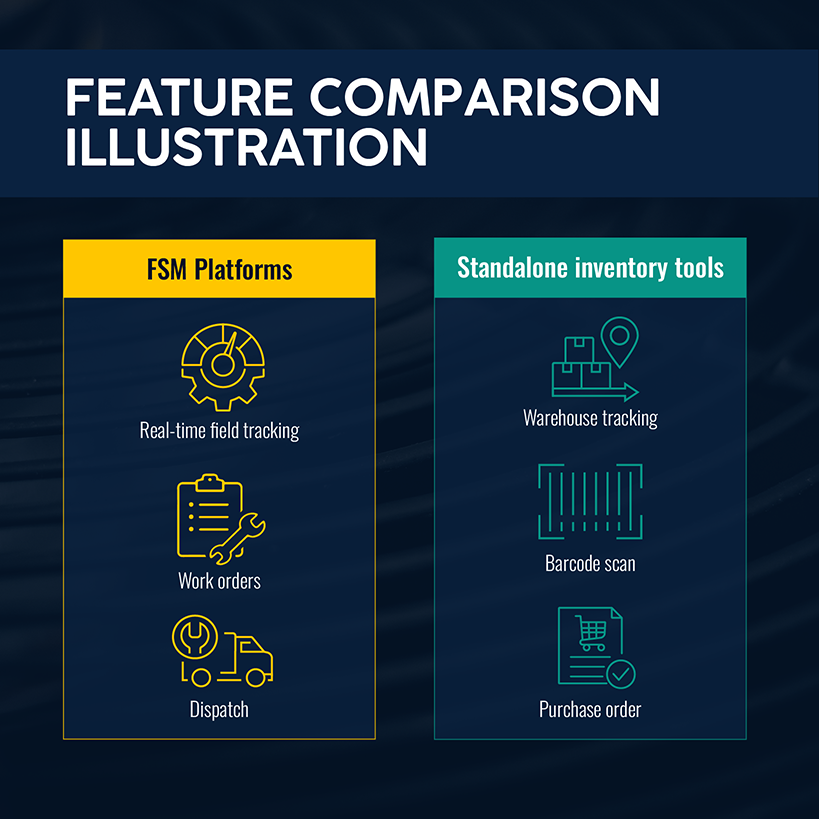
Not every feature matters equally for every HVAC operation. These are six capabilities that drive real competitive advantage.
Related: What HVAC KPIs are you measuring?
Real-Time Stock Visibility Across All Locations
If your system shows yesterday's inventory, your technicians are working with outdated information. You need real-time tracking across warehouses, vans, and job sites to ensure that listed inventory actually exists and is in the right location. When inventory is connected to a mobile app, field technicians can update stock at the point of consumption, ensuring real-time updates for all employees.
Integration with Job Costing and Work-Order Management
Untracked inventory consumption is a direct hit to job margin. When a technician pulls a $180 motor without logging it, that cost disappears from the job. Across multiple crews and several jobs per day, these omissions add up to significant margin leaks each month.
Software connects each material pull to a specific work order and automatically creates consumption records, ensuring your job costing reflects reality. This is one of the clearest dividing lines between a full FSM platform and a standalone inventory tool.
Automated Reorder Points and Purchase-Order Management
Emergency spot procurement for HVAC parts can cost multiples of planned procurement. But when your software system includes automated reorder triggers and purchase-order generation, you can prevent most emergency buys without overstocking. Pair that with preventative maintenance schedule automation, and you can project parts demand weeks ahead instead of reacting to an empty shelf.
Serialized Equipment Tracking for Warranty and Replacement Management
Serialized equipment tracking ties individual units (compressors, air handlers, heat pumps, etc.) to their purchase records, warranty status, and full service history. For HVAC businesses with maintenance agreements, this capability creates a natural trigger for replacement conversations — and flags an expiring warranty or aging system before the customer calls with a problem.
Supplier Catalog Sync and Pricing Integration
HVAC equipment prices have risen by about 40% since 2020. If your quoting uses last quarter’s price lists, much less last year's, you're undercharging on materials before you even close the deal. Look for software that pulls live supplier catalog pricing into your quoting workflow, ensuring estimates reflect the latest price for parts. You’ll give customers an accurate view of the cost while avoiding margin hits down the line.
Related: See how to estimate HVAC jobs accurately in a volatile pricing environment.
Asset Tracking and Service History
Knowing which equipment is installed at each customer site is a real operational advantage, especially for HVAC businesses with recurring contracts. Asset tracking lets you log installed equipment details, record service history against individual units, and flag warranty status. Your technicians arrive prepared to tackle the work, while expiring equipment is a conversation rather than a surprise.
HVAC Inventory vs. Asset Management: What's the Difference?
HVAC inventory and asset management are terms that get used interchangeably, but they describe different problems. Knowing which one applies to your situation will stop you from buying a tool that solves the wrong thing.
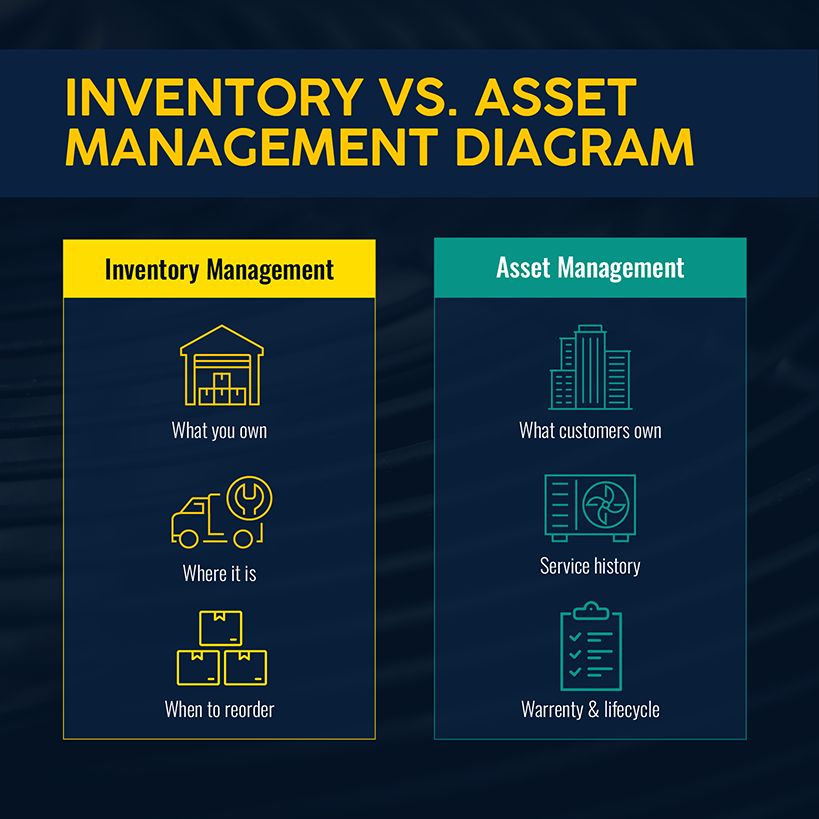
Inventory Management: What You Own and Where It Is
Inventory management tracks the parts, materials, and consumables your business owns and moves through operations. This includes warehouse stock, van stock, materials purchased for specific jobs, and supplies consumed during service calls. This answers these types of questions:
- How many units do we have?
- Where are they?
- When do we reorder?
- What did we use on this job?
Most inventory problems in HVAC are management problems: offseason stockouts, untracked parts consumption, unaudited van stock, and preventable emergency procurement expenditures
Asset Management: What Your Customers Own and Its Service History
Asset management tracks the physical equipment installed at customer sites. In HVAC, that means furnaces, condensers, air handlers, thermostats, VRF systems and more at each service address. This answers questions such as:
- What equipment does this customer have?
- When was it last serviced?
- What's the warranty status?
- Is the equipment approaching end of life?
Asset management becomes essential once you're running preventative maintenance contracts. Knowing each unit’s service history lets you proactively schedule maintenance, catch problems before they turn into emergencies, and have an informed conversation about equipment life cycles.
Which Problem Do You Actually Have?
The best HVAC inventory management apps cover a range of needs, from standalone tools that close gaps to a full-service platform that helps growing HVAC businesses go to the next level.
Asset management and Inventory management are both important, but inventory is often the more urgent challenge. If your technicians are showing up to jobs without the right parts, your job costing is inaccurate, or you're regularly making emergency supply runs, that's an inventory management problem. If your maintenance contracts are growing but your service history lives on paper or inside your technicians’ heads, that's an asset management problem.
Purpose-built FSM platforms like Simpro handle both within a single management system, connecting van stock to job records and job records to customer equipment histories. Standalone tools like Sortly, inFlow, and Acctivate address inventory, but they don’t cover asset tracking or connect to field operations without additional integration.
Choose Software That Connects Inventory to Jobs and Assets
At some point, every growing HVAC business hits the same wall. More trucks, more maintenance contracts, and more commercial jobs are great, but they reveal the pitfalls of managing inventory with spreadsheets or basic tracking apps. Parts go missing, job costs drift from reality, and the office team spends more time chasing data than using it.
The best HVAC inventory management software gives a unified, real-time view of what's in your warehouse, helping techs focus on field work and making accounting easier. But this software goes further — not just telling you what you have, but also what you need, when to order it, and the per-job cost of materials.
For HVAC businesses over $1 million in revenue running a mix of service calls, maintenance contracts, and commercial project work, Simpro is built for this complexity. Over 24,000 businesses use it to run faster estimates, manage field technicians more efficiently, and get the inventory visibility that makes growth manageable. Customers report an average 25% revenue increase and 30% improvement in field technician productivity after implementation.
Want to see what that looks like for your operation? Schedule a demo to see how Simpro handles the full workflow, from purchase order to paid invoice.


 Back to top