
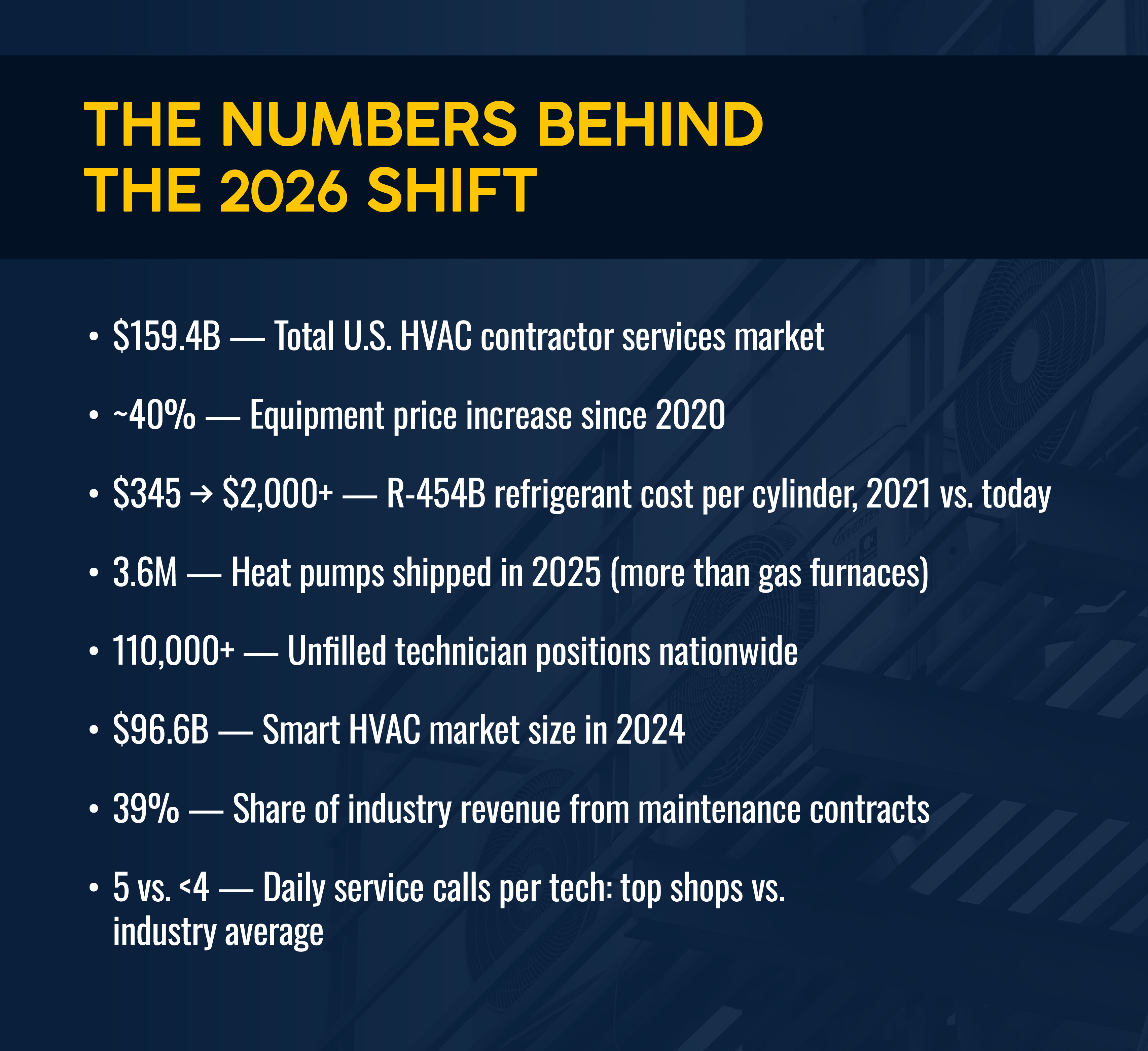
Quick Answer: The nine HVAC trends shaping contractor operations in 2026 are: A2L refrigerant transitions under the AIM Act, heat pump adoption (manufacturers shipped 3.6 million heat pumps vs. 3.2 million gas furnaces in 2025), smart HVAC systems, AI-assisted diagnostics, indoor air quality upgrades, SEER2 efficiency standards, workforce shortages (110,000 open positions nationwide), field service software integration, and data-driven asset management. Together, these shifts are changing how contractors quote jobs, dispatch technicians, manage inventory, and retain customers across a $159.4 billion market.
The trends in HVAC are playing out in a $159.4 billion contractor services market. Yet turning a consistent profit is still harder than it should be.
Equipment costs have significantly risen in the last few years. The technician shortage is 110,000 open positions nationwide. New refrigerant regulations took effect in 2025. These HVAC industry trends of 2026 are already reshaping how contractors quote jobs, dispatch teams, manage inventory, and retain customers.
This article covers the nine shifts with the most direct impact on how you run the business, what each trend means at the job and technician level, and what you should do next.
9 HVAC Trends Shaping the Industry in 2026
Each of these shifts has operational implications. Here's what they mean at the job and technician level.
1. Low-GWP Refrigerants and the A2L Transition
Federal regulations under the AIM Act took effect on January 1, 2025, meaning that all new air conditioner and heat pump equipment manufactured after that date must use A2L refrigerants with a GWP of 700 or below. Low-GWP refrigerants, such as R-454B and R-32, are now standard on new installs. The price for R-454B cylinders has jumped from $345 in 2021 to over $2,000 today due to supply constraints.
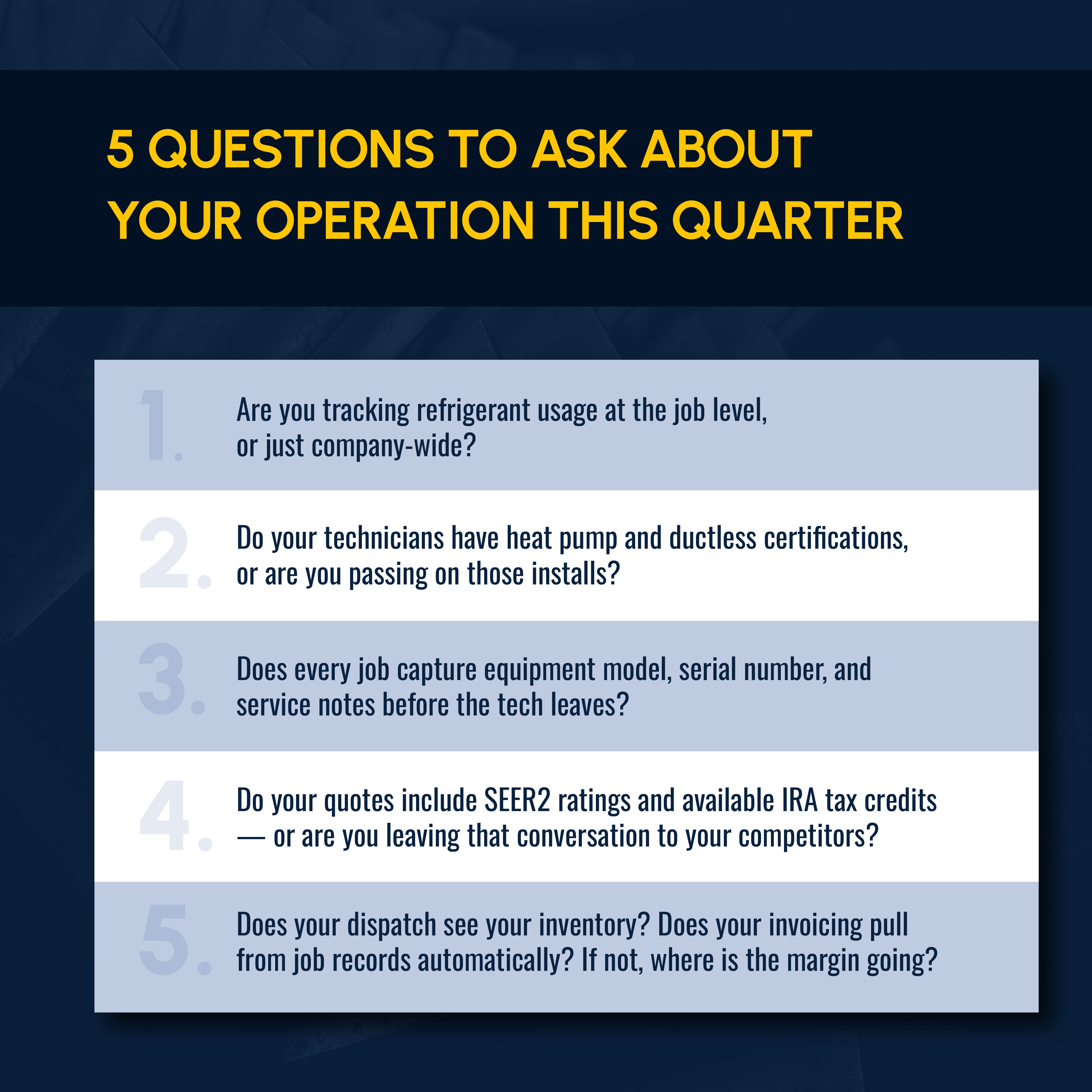
Contractors running jobs on legacy and new equipment face two inventory problems. You need R-410A stock to service existing air conditioning systems, as well as A2L refrigerant for new installs. Without job-level tracking, cost visibility disappears fast, and that hits margin before you even invoice.
The EPA also requires installation documentation per A2L rules: refrigerant type, quantity installed, and company identification on installed equipment. That's not something you can manage informally across a fleet of technicians.
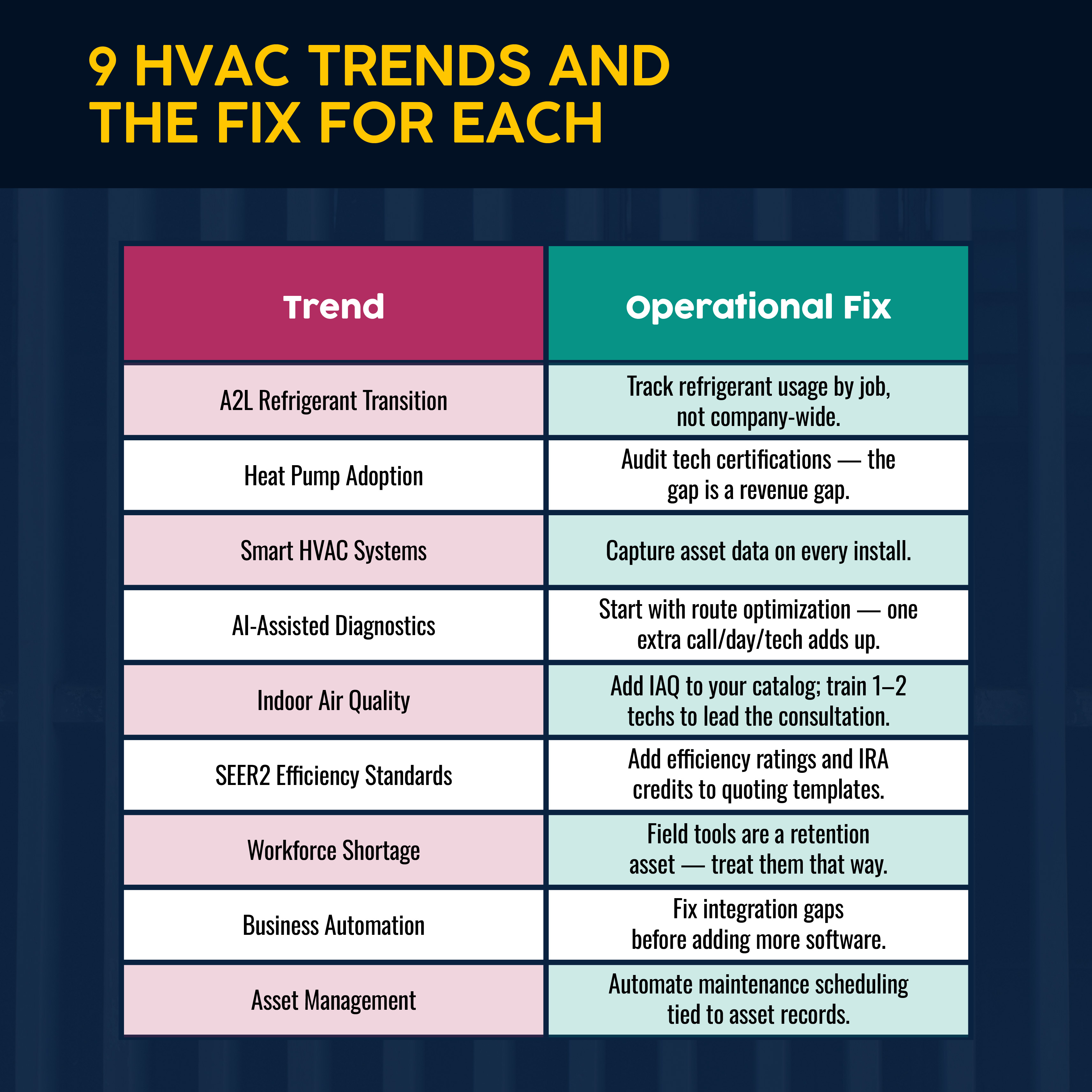
The operational fix: Track refrigerant stock and usage at the job level, not just company-wide. Every new install should capture which refrigerant was used and in what quantity. Tie that to job cost so you know the materials cost of each job before you close it.
2. Heat Pump Adoption and Electrification
Manufacturers shipped more heat pumps than gas furnaces in 2025: 3.6 million units versus 3.2 million. Efficient heating through heat pumps has been gaining ground for two decades, with annual sales up 70% and gas furnace sales down 7%.
Contractors who can confidently install, service, and explain heat pump systems have a direct pricing and market advantage. Also important: Heat pump certification and proficiency with ductless mini-split system installations. Contractors who can't do these things are increasingly dependent on a shrinking install category.
The operational fix: Audit your technician certifications and service catalog. If your team doesn't have heat pump qualifications, that's a revenue gap with a direct cost to your install business.
3. Smart HVAC Systems and New HVAC Technology
The smart HVAC market was valued at $96.6 billion in 2024 and is projected to reach $178.3 billion by 2033. Smart thermostats are already installed in many homes because of incentives from utility companies. More of your customers' equipment is generating data, and more of them will expect you to know what it's saying.
Connected smart technology opens new service models: remote diagnostics, predictive troubleshooting, faster resolution. But when technicians arrive at a call without an asset history or equipment data, they're flying blind despite homes having more information available than ever before.
The operational fix: Build asset data collection into every job. Every install should capture equipment type, model, serial number, and service notes. Technicians who pull that data early will complete jobs faster and fix issues right the first time.
4. AI-Assisted Diagnostics and Predictive Maintenance
According to the Simpro® 2025 Trades Outlook Report, 69% of trade business owners say AI's biggest ROI comes from workflow optimization: routing, scheduling, and reducing technician idle time. Beyond dispatch, AI is changing how contractors approach diagnostics. Platforms that ingest asset data and surface patterns before equipment fails are shifting maintenance services from reactive to predictive.
For contractors with maintenance agreements, this changes the value proposition. Proactive maintenance alerts, beyond the standard scheduled tune-up, become part of the standard agreement and support premium pricing.
The operational fix: Start with AI where it pays immediately. Route optimization alone reduces drive time, which can result in additional service calls per technician per day. Every additional repair ticket means more revenue per tech without adding headcount.
Related: Protect revenue and margins with AI.
5. Indoor Air Quality Upgrades
Indoor air quality (IAQ) has moved from specialty niche to standard customer conversation, as the pandemic raised awareness and expectations. Contractors that can assess, install, and maintain filtration systems, UV purification, humidity control, and ventilation monitoring are accessing job values and upsell opportunities that didn't exist several years ago.
In commercial work, building management requirements and tenant demands are accelerating IAQ adoption even faster than in residential.
The operational fix: Add IAQ services to your catalog and train at least one or two technicians to lead those consultations. The margin on UV systems and filtration upgrades is typically higher than routine service, and the conversation starts from an existing customer relationship. Hard to find a cheaper sales call than that.
6. Higher Efficiency Expectations and SEER2 Standards
SEER2 standards changed minimum efficiency requirements for efficiency HVAC systems in 2023. Equipment designed to reduce energy consumption now meets a higher performance floor. The downstream effects of this change are still working through distributor inventories and customer expectations. Meanwhile, customers facing rising energy costs are increasingly asking about tax credits and Energy Star certification before they approve a quote.
Millennials and Gen Z buyers are 30% more likely to choose contractors who can explain energy efficiency and green refrigerant credentials. For HVAC marketing, that translates directly into which calls you win and whether estimates convert.
The operational fix: Update your quoting templates to include efficiency ratings and relevant incentive information, including under the Inflation Reduction Act. When contractors walk a customer through available tax credits at the estimate stage, they close faster, create differentiation, and do so without creating costs.
7. Workforce Shortages and Technician Upskilling
The industry is already facing a labor shortage, and more than 40,000 jobs open up each year. HVAC technician turnover can be 20% or more for some organizations, leaving HVAC service companies scrambling to cover calls.
One underused retention lever is providing better tools. Only 23% of young people believe the trades involve advanced technology, but 89% of trades professionals report working with it daily. Technicians who show up with a tablet, real-time job info, digital forms, and the ability to invoice from the field finish jobs with less friction, fewer calls back to the office, and more time for the next call.
The operational fix: Your field tools are a retention asset that can reduce turnover rates and replacement costs. Technicians with less friction in their workday have lower turnover rates, and lower replacement costs show up in your P&L. Tracking HVAC KPIs by technician will show you exactly where the friction is.
8. HVAC Business Automation and Field Service Software
Most contractors use some form of field service management (FSM) software, but fewer have fully integrated systems connecting dispatch, inventory, invoicing, and customer relationship management (CRM).
The average trade business manages at least five platforms, with larger operations running eight or more. When dispatch, quoting, inventory, and accounting are siloed, decisions get made on incomplete information. Billing delays slow cash flow. Blind spots in scheduling create idle time between jobs. None of this appears as a line item, but it accumulates in eroded margin.
Companies with fully integrated digital platforms, by contrast, report higher productivity and faster invoice-to-payment cycles. For a contractor doing $3 million annually with a 42-day average wait on commercial receivables, compressing that payment window by even a week directly affects working capital.
The right service software for your HVAC business connects the entire workflow, from the first quote to the final payment, so nothing gets lost or siloed.
The operational fix: Before adding another point solution, audit your tech stack. If your dispatch can't access your inventory or your invoicing doesn't pull automatically from job records, solve the integration problem before adding anything else. More tools on a broken stack just add noise.
9. Data-Driven Maintenance, Reporting, and Asset Management
Repair revenue has grown in the last decade, with annual repair volume per organization rising even faster. Average repair ticket value is up nearly 50%, meaning higher call volume at a higher per-call value.
That shift creates more calls to manage and a larger base of customer assets to track. Maintenance agreement programs that depend on manual tracking (spreadsheets, CRM notes, calendar reminders) can't scale with that volume. The stakes are high: Maintenance contracts account for 39% of industry revenue, and these customers renew at a higher rate than one-time HVAC service customers. That retention spread compounds over time.
Top-performing HVAC businesses complete about five service calls per technician per day versus the industry average of less than four. That gap can represent hundreds of thousands of dollars in annual revenue per technician at current ticket values. The increased productivity comes from tighter scheduling, better asset data, and less time wasted between jobs.
The operational fix: If your maintenance agreements rely on someone remembering to schedule them, they're already at risk. Move to automated scheduling tied to asset records, so your maintenance book doesn't depend on individual memory or manual follow-up.
Why HVAC Industry Trends Matter More at Scale
Not every trend hits all HVAC contractors equally. A single-tech operation can absorb scheduling gaps and paperwork delays that cost a six-tech shop thousands of dollars in a week. Keeping up with HVAC trends is especially critical for contractors generating over $1 million in revenue, where complexity compounds and every bottleneck carries a dollar amount.
Several forces are converging at once:
- Demand is high, and so is operational complexity.
- Refrigerant transitions require job-level documentation.
- Labor shortages make every technician expensive to lose.
- Smart equipment requires technicians who understand it.
- Customer expectations around same-day service, online reviews, and digital communication are setting the floor — and your competitors are already trying to clear it.
Whether you're looking to start an HVAC business or scale one past $2 million in revenue, the operational infrastructure decisions you make this year will determine your margin three years from now.
How HVAC Businesses Can Prepare for These HVAC Trends
The right HVAC solutions for each of these challenges run on operational decisions, not capital expenditure:
- Refrigerant transition: Train all technicians on A2L handling. Pre-position inventory with multiple suppliers. Capture refrigerant usage at the job level in your management platform.
- Heat pumps and efficiency: Certify technicians for heat pump and ductless mini-split installation and service. Update service catalog and quoting templates to include efficiency data and tax-incentive information.
- Smart systems and IAQ: Build asset data collection into every job. Train technicians to use that data before they arrive on-site.
- Workforce: Equip technicians with tools that reduce administrative friction. Track performance by technician to identify where productivity gaps actually originate.
- Software and automation: Audit your stack for integration gaps. Connected systems that share data across dispatch, inventory, and invoicing solve the invisible margin leak before it becomes a quarterly problem.
- Maintenance programs: Move from manual to automated scheduling. Tie it to asset records.
The future of HVAC business growth depends both on your technicians and an operational structure that lets them work at full capacity.
Related: 10 tips to help you run a successful HVAC business.
Manage HVAC Industry Change with Simpro
Running an HVAC company with eight technicians and watching margin stay flat even as revenue climbs? That gap usually appears between what's happening in the field and what shows up in the financials.
Simpro connects quoting, scheduling, dispatch, inventory, job costing, invoicing, and reporting in a single platform built specifically for the trades. More than 24,000 businesses use it to close that operational gap. Prairie HVAC/R now manages project timelines, tracks labor and material costs, and delivers exceptional customer service because it's using one centralized system.
If your business wants to capitalize on the biggest trends in HVAC, the next step is assessing your specific operation with Simpro. Schedule a demo today.


 Back to top