
A submittal for a grease interceptor sits in someone's inbox for three weeks. Nobody flags it as overdue because nobody tracks submittal due dates against the pour schedule. By the time the general contractor (GC) asks about it, the slab is two weeks from pouring, but the fixture still hasn't cleared review.
That's commercial plumbing project management in a nutshell. You miss one deadline, and your margin vanishes before the rough-in. This commercial plumbing project management guide breaks down why commercial jobs are harder to run than residential service calls. Plus, we share nine steps for managing large plumbing construction projects successfully, from signed contract to final payment.
You'll learn about the coordination habits and financial controls that keep project schedules intact, along with commercial plumbing project management tips for catching problems before they turn into change orders.
Key Takeaways
- Commercial plumbing projects fail on process, not workmanship.
- A missed submittal or undocumented change order drains margin faster than labor issues, while lack of financial visibility hides the damage until it's too late.
- A phase-based approach — tracking underground, rough-in, and trim as separate budget lines — catches problems early instead of at closeout.
- Every change order needs a paper trail before work proceeds, and the same goes for requests for information (RFIs) and inspection sign-offs.
- When plumbing contractors are juggling several commercial jobs at once, they need real-time job costing and inventory visibility, not spreadsheets and people's memory about jobsite conditions.
What Makes Commercial Plumbing Projects Complex?
Residential plumbing work runs on a simple loop. You schedule the technician, dispatch to the call, and invoice the homeowner. Commercial construction is more challenging. You don't control the schedule or manage the other trades involved. And the work sits inside a contract that assigns blame even before delays happen.
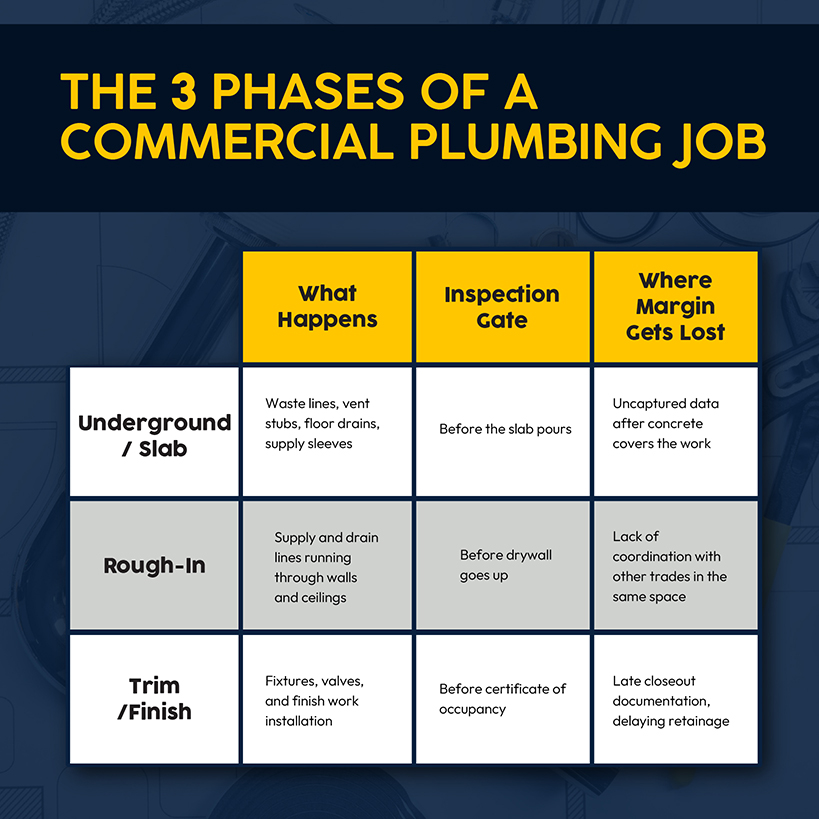
The difference between residential and commercial starts with underground rough-in. Waste lines, vent stubs, floor drains, and supply sleeves go in before the slab pours. You have one shot to get it right before the concrete covers them. A GC's pour schedule doesn't wait for a late fitting delivery or an inspector who can't make it out until Thursday.
Below-slab work becomes invisible the moment it's finished, which means as-built documentation, pipe locations, invert elevations, and cleanout positions have to be captured before backfill, not reconstructed from memory at the end of the week.
Layer onto all this the number of parties involved. A residential job has you and the homeowner. A commercial construction site has you, your team members, the GC, and mechanical and structural trades, all in the same footprint. Then there's the architect fielding RFIs and an owner's rep tracking the schedule against the certificate-of-occupancy date. Every one of those relationships generates paperwork, including submittals, change orders, progress billing, and retainage. None of it is optional, and mismanaging any of it brings scheduling and financial consequences.
The U.S. plumbing industry is on pace to top $208 billion in revenue in 2026, spread across roughly 129,000 businesses, according to IBISWorld's industry analysis. No single company holds more than a sliver of that market. But that fragmentation is also an opportunity for plumbing contractors with the operational discipline to run bigger jobs cleanly.
There's also risk: Managing large plumbing construction projects without a phase-based structure is how strong bids fail to capture profit.
The operational fix: Separate underground, rough-in, and trim into distinct budget and schedule lines. This way, a slip in one phase doesn't cannibalize the margin of the other two.
9 Steps for Managing Large Commercial Plumbing Projects From Bid to Closeout
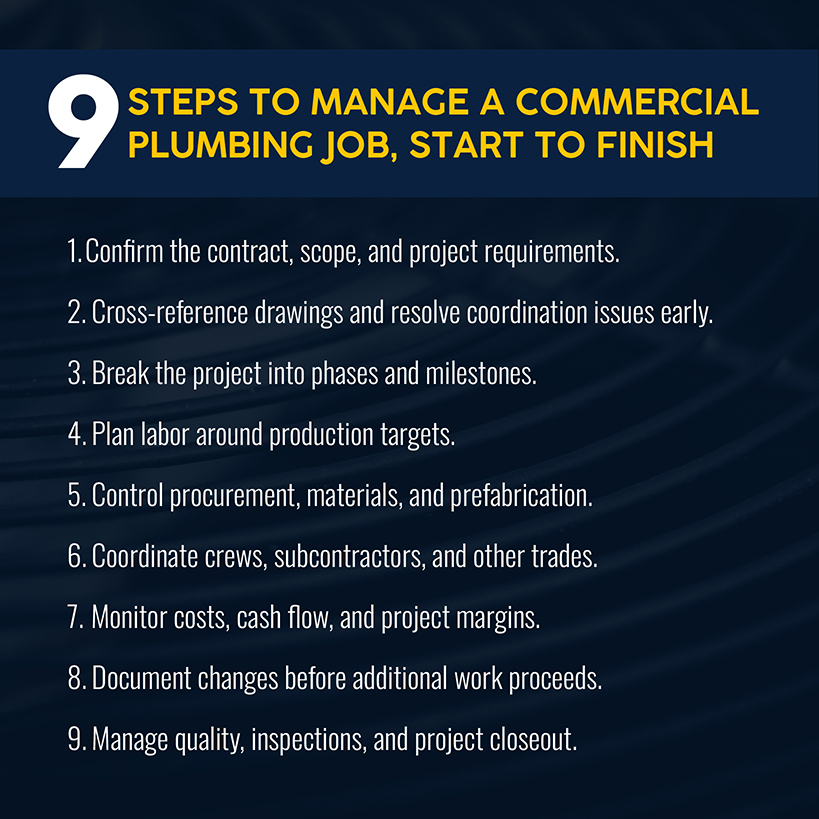
Here's how to manage commercial plumbing projects successfully, phase by phase, from the moment you're awarded the work to the day you collect final retainage.
Related: Read these plumbing management tips for the day-to-day habits that support these steps.
1. Confirm the Contract, Scope, and Project Requirements
Before sending out crews, read what the contract says about scope, exclusions, and concealed-condition clauses, as the terms could differ from what the estimator assumed. Failing to do so means preventable estimating errors, which are the largest driver of construction cost overruns.
Confirm local plumbing codes, backflow-prevention rules, and accessibility requirements against the drawings before breaking ground. Flag anything the bid didn't account for; doing so now allows for correction rather than a post-job dispute.
The operational fix: Build a one-page scope summary from the contract language and have your construction manager sign off before mobilization. That provides a baseline you can document scope creep against.
2. Review Drawings and Resolve Coordination Issues Early
Cross-reference the architectural, mechanical, and plumbing drawings against each other, not in isolation, to catch pipe-material conflicts and fixture-placement issues. On larger jobs, overlaying mechanical, electrical, and plumbing (MEP) drawings will catch conflicts between plumbing, ductwork, and structural elements — before crews collide on the construction site.
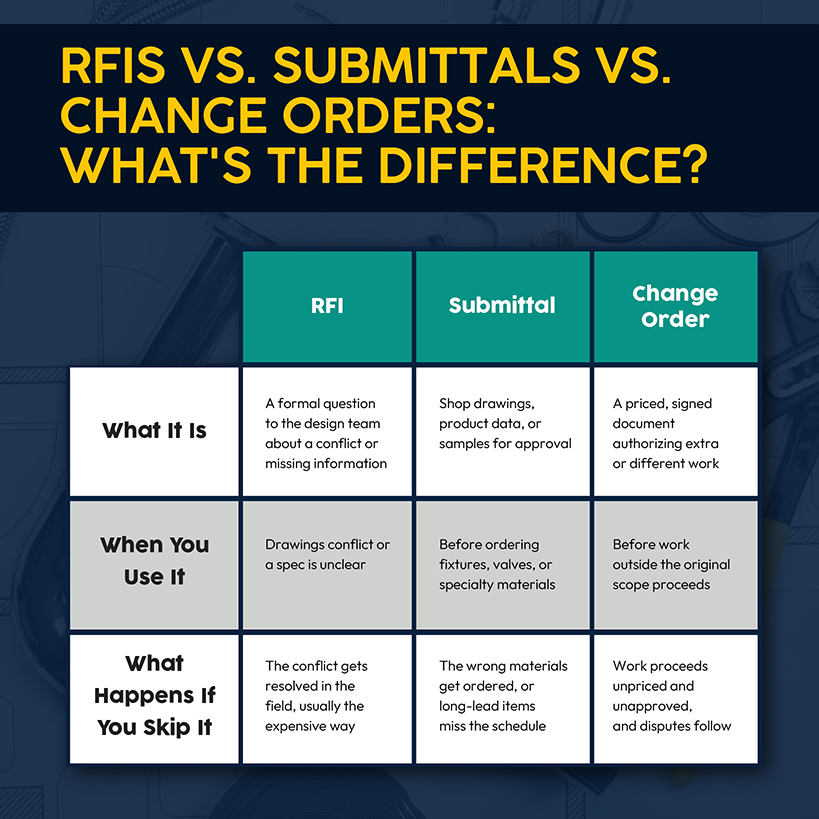
Log open questions as a formal RFI rather than hallway conversations, and track each one's cycle time against the schedule. An RFI that goes unanswered for two weeks creates risk the moment it's filed.
The operational fix: Start an RFI log at project kickoff, rather than after a conflict emerges. Give every open item an owner and a due date.
3. Break the Project Into Manageable Phases and Milestones
Commercial plumbing scopes split cleanly into underground/slab, rough-in, top-out, and trim. Each phase carries a different risk profile and inspection gate. Tracking the job zone by zone, rather than as one undifferentiated timeline, helps you see which phases are bleeding time or budget while the work is ongoing, not after closeout.
Tie milestones to inspections, not just dates. A milestone that says "underground complete" is vague, but one that says "underground rough-in passes inspection by the 14th" gives details and a deadline for a construction manager to work against.
The operational fix: Build your project plans around inspection gates first, then fill in labor and material schedules around them, not the other way around.
4. Plan Labor Around Production Targets
Commercial jobs require a rolling, look-ahead schedule of 3–6 weeks that accounts for crew availability, material lead times, and shutdown windows. This should be updated weekly. Track hours by cost code and compare earned versus planned quantities, so slippage shows up while there's time to correct it.
Labor planning matters more now than it did five years ago. The U.S. Bureau of Labor Statistics projects roughly 44,000 annual openings for plumbers, pipefitters, and steamfitters over the coming decade, but the available talent pool is likely smaller. Every wasted labor-hour on a jobsite costs more to replace than it did a decade ago.
The operational fix: Run a weekly coordination meeting to review the look-ahead schedule, RFI status, and labor needs. Leave with assigned owners and dates, not just a list of concerns.
5. Control Procurement, Materials, and Prefabrication
Long-lead items need to be identified and submitted first, with due dates tracked and escalated before they threaten the schedule. These include specialty valves, backflow devices, grease interceptors, and commercial-grade water heaters. For example, off-site prefabrication of pipe racks and assemblies saves time on-site. You only realize these savings if material delivery is scheduled to arrive in sequence rather than all at once or after the crew is already staged and idle.
If a fitting is missing on a Tuesday, that can push the rough-in inspection to the following week, which then delays the drywall crew and eventually affects the GC's schedule. Materials and equipment delays rarely stay contained to the trade that caused them. On a midsize medical office build, a single backflow preventer stuck in submittal review for six weeks can hold up a $40,000 mechanical room package and idle a six-person crew. The device itself costs a few thousand dollars. A crew idle for three or four days costs more than the device.
The operational fix: Keep a submittal register, not an inbox, and give long-lead plumbing items a submission date in week one.
Related: We're sharing plumbing inventory management best practices for keeping material availability ahead of the schedule instead of behind it.
6. Coordinate Crews, Subcontractors, and Other Trades
Your crew doesn't work alone on a commercial construction site. Plumbing, mechanical, and electrical trades need to coordinate their workflows, or they'll constantly encounter scheduling conflicts and rework. A coordination meeting that only covers your scope misses the point.
Weekly meetings should cover safety and access constraints, RFI status, submittal approvals, the current look-ahead by area, and upcoming shutdowns or inspections. Every meeting that produces minutes needs to name a decision owner. Disconnected workflows in field service create the exact blind spots that turn a two-day delay into a two-week wait. Documented construction processes keep those blind spots from repeating.
Here's a straightforward example: A 14,000-square-foot retail buildout has a nine-person plumbing crew split across two zones. Without a shared look-ahead schedule, the team framing zone two didn't know plumbing rough-in was running two days behind in zone one, so they showed up to close in walls that still needed inspection. The rework to open, reinspect, and reclose cost roughly 1.5 days of labor across two trades. With a shared calendar, this is avoidable.
The operational fix: Assign one point of contact to cross-trade coordination. Questions from other trades get a single, fast answer instead of getting lost among multiple foremen.
7. Monitor Costs, Cash Flow, and Project Margins
Net margins in plumbing and HVAC trades are thin to begin with, and commercial subcontractors face additional downward pressure from competitive bidding. A blended margin across active jobs can look healthy, but it's hiding big losses on a specific project. That's why it's important to track project costs at the job level, not just the portfolio level.
A weekly work-in-progress view will compare costs-to-date against estimated cost at completion, as well as flag overbilling and underbilling positions before your accountant catches them at month-end. Overbilled jobs are a liability you owe in future work. Underbilled jobs are a cash-flow problem you're financing out of pocket.
McCarthy Plumbing Group is a useful reference point here. The commercial and residential plumbing business grew from a husband-and-wife team into an 18-person operation. After real-time job costing replaced guesswork, the company added $1.5 million AUD in annual revenue over six years without having to add administrative staff. Instead of wondering where profit was leaking, McCarthy could pinpoint and fix the problem.
The operational fix: Pull job costs weekly instead of monthly. Review any job trending more than 5% over budget before the next progress bill goes out.
Related: Review the plumbing KPIs that protect margin for the numbers worth tracking every week.
8. Document Changes Before Additional Work Proceeds
Change orders should follow the same sequence every time: Identify, document with photos and measurements, notify, price, review, approve, and execute. Skipping to "we'll sort out the paperwork later" is how unforeseen underground conditions and fixture substitutions turn into disputes instead of approved, paid change orders.
Price every change order to start with direct cost, then overhead, then profit. From there, match the pricing structure to the situation. Time-and-materials works for exploratory work you can't scope in advance, for example, while unit-priced or lump sum works for defined additions.
Make sure you review your contract's change-order clause during pre-construction. That review is the most effective prevention step in this entire process.
The operational fix: No additional work proceeds without a signed change order in hand, even when the GC's superintendent says it's fine and they'll "get to it."
9. Manage Quality, Inspections, and Project Closeout
Quality control checkpoints belong at every inspection gate, not just the final walkthrough. Underground inspections occur before the slab pours, rough-in inspections occur before drywall goes up, and finals take place before issuing the certificate of occupancy. Missing any one of these gates doesn't just delay your scope. It delays every trade scheduled behind you.
Closeout runs smoother when your pay application already matches your contract requirements. You should have as-built drawings, O&M manuals, and warranty documentation ready to produce, not hastily assembled after the GC's superintendent asks.
The operational fix: Build your closeout checklist during pre-construction so if anything is missing, you can fix it without risking retainage.
Commercial Plumbing Project Management Tips That Prevent Delays
The only way to stay organized across a dozen open submittals, RFIs, and change orders at once is a system that surfaces what's overdue instead of relying on someone remembering to check.
Here are the habits you'll see across well-run commercial jobs, regardless of project size:
- Separate RFIs from submittals. Submittals are shop drawings and product data. RFIs are formal questions to the design team about conflicts or missing information. Treating them the same is a common source of avoidable delay.
- Track retainage as its own line item. That 5–10% that's typically withheld until substantial completion affects your available cash, so track it separately as both a receivable and a future payable.
- Capture as-built conditions before backfill. Below-slab work becomes invisible the moment it's covered. Document it in real time to avoid trying to remember the details later.
- Use real-time updates from the field instead of end-of-day recaps. When your field team relays job-status updates as they happen, your office can address problems while they're still cheap to fix. Tracking progress phase by phase helps you put the look-ahead schedule into practice.
- Keep a long-term view of job profitability. A job can look fine on cash flow but still be losing money if costs are outpacing the schedule of values.
The construction industry isn't forgiving of loose tracking, and plumbing subcontractors absorb that risk as much as the GC. If you're running into issues, it's probably not about effort. You need a cost-effective system that keeps project schedules, project costs, and documentation in one place instead of scattered across texts, spreadsheets, and memory.
Related: See how the right platform handles this end-to-end in our guide to plumbing job management software.
Manage Larger Plumbing Projects With Greater Visibility
If you've made it this far, you're probably managing several commercial jobs and overseeing a construction manager, a handful of foremen, and a growing set of clients who expect the same visibility a GC gets from their project management software.
If that sounds like you, this is where informal tracking processes stop scaling. As Tropical Coast Plumbing grew from two people to five locations, they hit this wall: no real-time visibility into job margins and no way to track data beyond labor hours. They closed that gap with real-time cost tracking against budget — the same discipline involved in the nine steps listed above.
Simpro® builds this visibility directly into your day-to-day management of construction projects. Budgets are tracked at every stage of a job, including real-time spend against that budget. Inventory visibility flags material shortfalls before it delays a rough-in. Invoicing keeps pace with progress billing instead of lagging. And AI-assisted quoting and data capture reduce the manual data entry that causes estimating errors and leads to cost overruns.
The right software doesn't substitute for a plumbing contractor with strong coordination and documentation habits. But it does help you run consistently across five jobs instead of one — and without adding headcount to your office. Simpro supports more than 250,000 users managing this kind of operational complexity.
If you're outgrowing spreadsheets and a reliance on job-site memory, you need a system built to handle all the moving parts. Schedule a demo to see how Simpro makes it possible.


 Back to top