
Managing recurring commercial electrical maintenance at scale has changed considerably in just the past few years. In 2023, NFPA 70B moved from a recommended practice to an active standard, raising expectations for every contractor and turning once-optional practices into minimum acceptable performance.
With NFPA 70B as a standard, maintenance visits are less about courtesy calls and more about documented, auditable work tracked across every site, asset, and contract.
Facility managers and operations teams count on that maintenance program. Missing a cycle can contribute to equipment failures and create safety hazards at sites your business is contractually responsible for. But when your program maintains proper scheduling, asset tracking, and paperwork, you can reduce downtime and be confident every contract is defensible in the face of a customer request or inspector audit.
Scaling your electrical preventive maintenance program doesn't have to be risky, but it requires a new approach. At 10 contracts, you can probably run the operation on good habits and memory. But as you keep adding contracts, the gap between the paperwork and the real world grows — and that's when you need a new approach.
Why Recurring Electrical Maintenance Gets Harder as Your Contract Base Grows
The math is deceptively simple. At 10 maintenance contracts with a mix of quarterly and annual intervals, your company is responsible for up to 40 scheduled visits a year. At 100 contracts, that's up to 400 scheduled visits. Both involve a range of site locations, each with distinct testing frequencies, electrical components, equipment ages, and customer notification preferences.
Nothing about the underlying work changes, but the complexity of coordinating all those contracts and site visits compounds. Every new contract brings new equipment surveys, asset inventories, and testing intervals that must be folded into the plan.
That plan, built asset by asset rather than contract by contract, is what separates electrical planned preventive maintenance from reactive, ad hoc service calls.
Relying on spreadsheets to manage all of this might work OK at 10–15 contracts. But at 150, spreadsheets are too unwieldy, require too much manual upkeep, and don't provide the alerts you need — like the breaker that's six months overdue for thermography.
The operational fix: Treat maintenance contracts, sites, and assets as a connected dataset, not three lists that get reconciled by hand only after a customer calls about a missed test.
How to Manage Recurring Commercial Electrical Maintenance at Scale in 9 Steps
Scaling a maintenance operation isn't just about adding staff. It's about giving your existing team a disciplined, connected system they can easily use, whether in the office or in the field. Here's the sequence of steps in the order they need to occur.
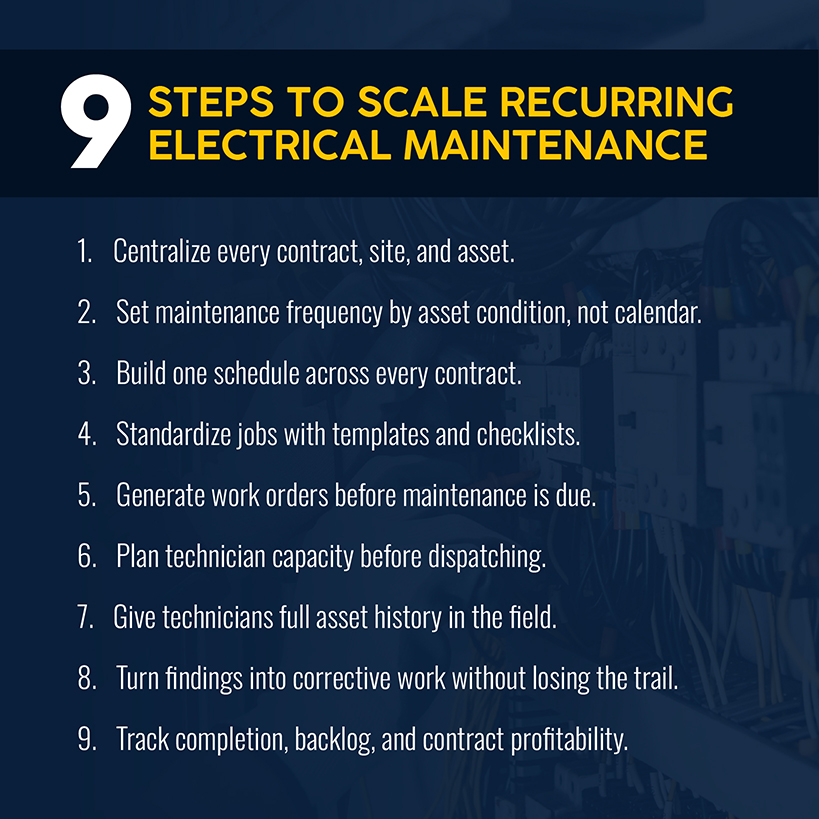
1. Centralize Every Maintenance Contract, Customer Site, and Electrical Asset
Start with a single register of assets, organized in this hierarchy:
- Survey and analyze electrical equipment and power systems.
- Base maintenance requirements on that inventory.
- Build the hierarchy implied by the standard: Site, building, switchgear/panel, individual device.
- Attach nameplate data — manufacturer, voltage and current ratings — along with the install date and the contract it falls under.
Record the contract terms each asset falls under — testing frequencies, response-time commitments, customer notification preferences. That allows scheduling steps to be generated from the register rather than reconstructed customer by customer.
This register is the foundation for the subsequent eight steps. Skip it, and site details, contract terms, and asset lists are scattered in three places, if documented properly at all. Any gaps at this step flow downstream: Technicians ask the office for information they should already have. Install dates and breakers aren't logged. Someone guesses at a condition assessment instead of reading one from the record.
2. Set the Maintenance Requirements and Frequency for Each Asset
After centralizing assets, electrical contractors should set each asset's interval based on its actual condition, not the calendar.
NFPA 70B Chapter 9 details how to use a condition assessment to set intervals. Build the assessment on three inputs: physical condition, criticality, and operating environment. The standard takes the worst of the three. For example, a like-new breaker in a dirty or mission-critical environment gets a shorter interval because the environment supersedes the equipment's age.
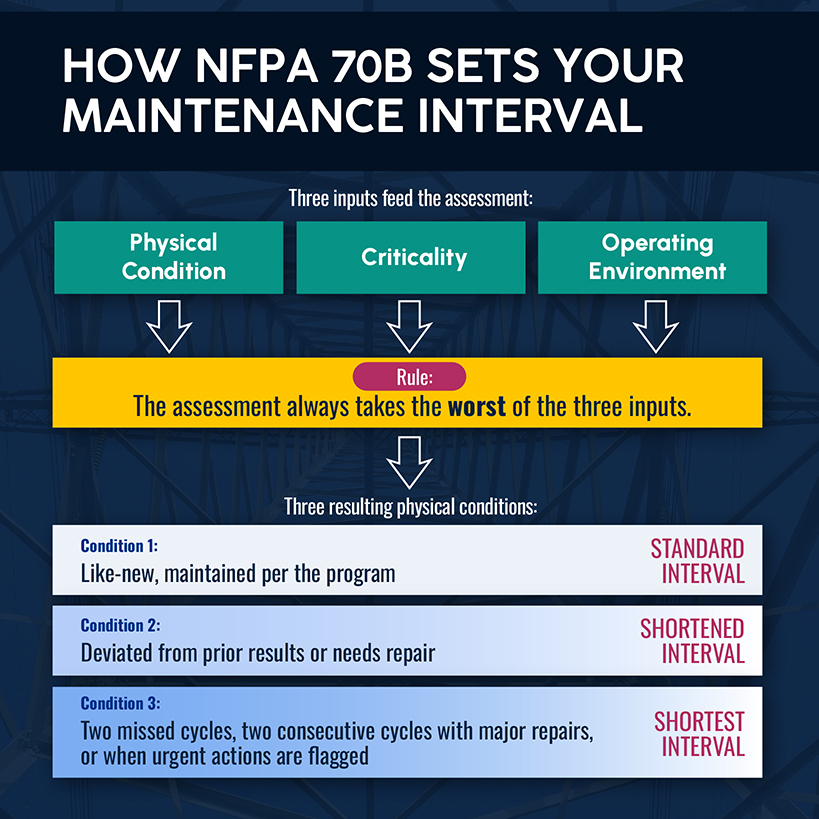
This logic sorts the physical condition of each asset into one of three levels:
- Condition 1 is like-new equipment, maintained per the program.
- Condition 2 covers equipment that's deviated from prior results or needs repair.
- Condition 3 applies when there are consecutive missed maintenance cycles, two cycles with major findings, or predictive techniques that flag "urgent actions." It carries the shortest interval.
Additionally, you'll want to assess the condition of maintenance, which also falls into three categories:
- Serviceable means that the equipment is in sound working order.
- Limited service means that there are deficiencies, but they don't prevent the asset's safe operation.
- Non-serviceable means that the equipment no longer operates safely within the required parameters.
Keep in mind that manufacturer's instructions take priority when applicable. The standard's tables apply when manufacturer guidance is unavailable and a failure creates unacceptable risk to people or the surrounding environment. Either way, the interval gets recorded against the asset, not against a generic preventive maintenance plan template.
Without discipline, small problems can compound, degrading power quality long before an outage occurs.
3. Build One Electrical Maintenance Schedule for All Contracted Work
After setting intervals per asset, roll everything into an overall schedule, rather than one schedule per customer. A unified schedule gives you visibility into overlap, like three different customers on the books for thermography in the same week and located near each other. When you can see every customer's needs, route planning becomes easier and smarter.
Core fields the schedule needs to track:
| Field | Why It Matters |
|---|---|
| Asset ID and location | Ties every task to a specific device at a specific site, not a general contract line item |
| Maintenance task and scope | Distinguishes visual inspections from thermography and from full electrical testing |
| Assigned interval | Relies on the condition assessment, not a default calendar cycle |
| Last completed date | Anchors future due dates |
| Next due date | Drives the dispatch board before a visit becomes overdue |
| Serviceability designation | Records whether the asset was serviceable, limited service, or non-serviceable, based on the last visit |
| Compliance documentation status | Tracks whether test records, photos, and reports are attached and current |
Filling out these fields saves time, as no one needs to flip through contract paperwork or ask a technician what happened last time. As your maintenance business scales, the cost of manual rework grows too.
Regularly scheduled maintenance also extends equipment lifespan, giving customers another benefit even though it's not a line item on the invoice.
4. Standardize Recurring Jobs With Service Templates and Checklists
A Denver-based technician inspecting switchgear should capture the same fields as a tech based in Tampa, Fla. Both are working from ANSI/NETA MTS-2023, the standard for determining whether equipment is operational, within applicable standards and manufacturer tolerances, and suitable for continued service. Build your service templates and checklists around that structure so your tech can generate accurate, auditable paperwork while still on-site.
One place to begin is infrared thermography, which NFPA 70B applies to all equipment. Pick a six- or 12-month interval, depending on the condition assessment. Infrared thermography applies to every job, catching loose connections and hot spots long before they fail. Make sure your templates break it out as its own recurring task.
Related: Simpro®'s electrical inspection checklist breaks down what a compliant checklist needs to capture.
5. Generate Recurring Work Orders Before Maintenance Becomes Due
Are you generating work orders before the due date? If not, you're back in reactive mode, only responding when a customer calls.
Maintaining a calendar of regular inspections isn't just good customer service. NFPA 70B calls for an asset's condition to be downgraded after two missed cycles. Late or missing work orders create delays and could trigger downgrades and shorter intervals.
After an asset is downgraded, NFPA 70B lets you restore the original interval after two consecutive maintenance cycles that don't require extra service, but that's harder when work orders are generated by hand on a random schedule.
6. Plan Technician Capacity Before Filling the Dispatch Board
As you scale, finding enough qualified labor becomes more challenging. The Bureau of Labor Statistics projects 72,700 openings per year through 2035, many of them due to workers retiring or leaving the industry. Finding qualified testers takes time and is capped by a fixed, slow-growing pool of candidates.
Plan around the labor constraint, not around the calendar. Cluster maintenance visits geographically. Batch tasks with the same interval into a single site visit, whether that's thermography on switchgear or testing on individual circuit breakers. When scheduling shutdown-dependent work, do so early, not the week of.
Remember to reserve capacity for any corrective work generated by maintenance visits. A program that plans only for inspections will quickly fall behind.
Related: Field service scheduling tools built for multi-site routing make this kind of clustering possible without a dispatcher doing it by hand.
7. Give Technicians the Complete Asset and Service History in the Field
Any technician can run a test and assign a maintenance condition designation. But when they're also equipped with an electrical panel's service history, they can understand whether the latest test is an outlier or a trend.
With detailed testing records, you can see how equipment condition has changed over time, which informs corrective or replacement decisions. It also enables trending, as long as methodologies stay consistent and instruments stay calibrated. All of this only happens when the technician can instantly access work history, rather than search files back at the office.
Related: Simpro's guide to asset maintenance management explains what goes into a field-facing asset record.
8. Turn Maintenance Findings Into Corrective Work Without Losing the Trail
Every maintenance program generates corrective work. What matters is how you respond. Waiting too long on a flagged deficiency can cause a breaker to trip, turning a scheduled fix into an emergency call.
Scaling your electrical maintenance programs depends on your ability to automatically convert a deficiency into a quoted job — without anyone re-entering the findings. A technician who flags a failing insulation-resistance test on Tuesday shouldn't need a separate phone call and quote request. And the resulting work order should link back to the maintenance visit that uncovered the problem.
That link also preserves the audit trail if a customer asks or an inspector comes calling.
Related: Work order software for commercial contractors can ensure that corrective jobs sync back to their originating maintenance visit.
9. Track Completion, Backlog, and Maintenance Contract Profitability
Completed visits are easy to count, but not particularly useful as a standalone metric. SMRP's Best Practices standardizes definitions for over 70 metrics, including share of work that's planned, schedule compliance, and preventive maintenance compliance.
Preventive maintenance can be 12–18% cheaper than reactive, according to the U.S. Department of Energy, with predictive maintenance adding another 8–12% in cost savings. Develop and track your own ratio of planned to reactive labor hours, defining the categories so each hour lands in a specific bucket."
Backlog needs the same visibility. A maintenance contract can look profitable based on completed visits but lose money once you add unscheduled corrective work. Look at metrics including completion rate, planned-versus-reactive labor hours, and deficiency close-out rate per site.
Related: Review the electrical KPIs that protect margin in your business.
When Spreadsheets Aren't Enough for Recurring Electrical Maintenance
The steps above can run through spreadsheets and shared folders when you're small, and plenty of electrical contractors do just that. But as you grow, this gets harder. There's no exact number of contracts that's the tipping point. Instead, look for when your staff spends more time reconciling data between systems than actually using it for real work.
Simpro is built around the structure that works with NFPA 70B: a connected asset register, condition-based scheduling, technician-ready service history, and corrective work that remains linked to the maintenance visit. Simpro customers running their service and maintenance operations through a connected platform have reported a 25% average increase in revenue.
Build a Maintenance Operation That Can Grow With Your Contract Base
If you're reading this because your maintenance division has scaled beyond what spreadsheets alone can handle, the fix isn't more of the same. It's about adopting a purpose-built system that automatically connects your schedule and documentation — with capacity planning built on top of both. Your next 50 maintenance contracts should flow seamlessly through your software, from office to field, rather than be something you need to add people to track manually.
That's the operational difference between a maintenance program that scales and one that becomes harder to run with every new contract.
Schedule a demo to see how Simpro handles asset registers, scheduling, and compliance records at the contract volume you're running today and what you hope to grow to next year.


 Back to top