
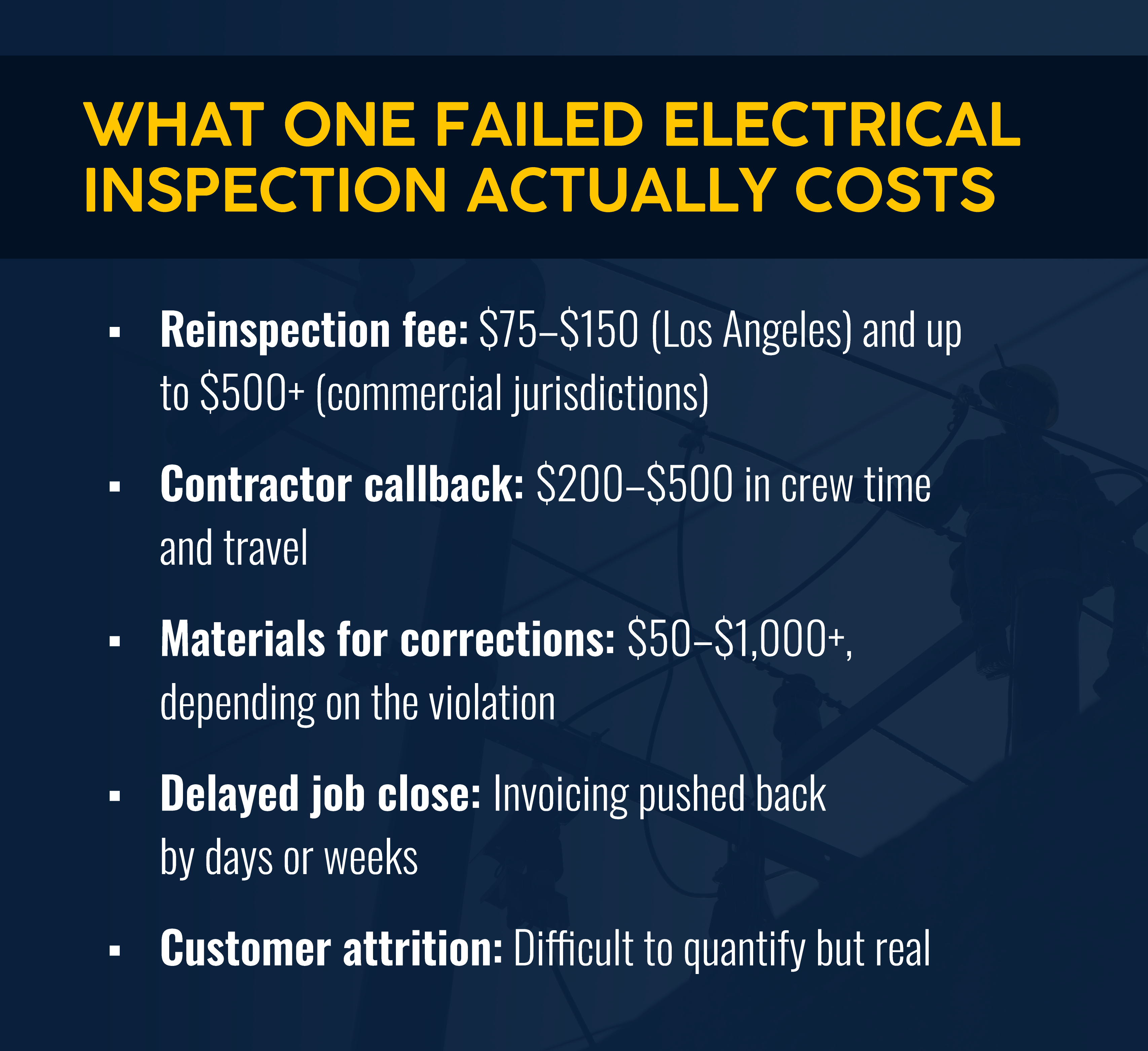
Every electrical inspection checklist failure has a direct cost: re-inspection fees, contractor callbacks, schedule delays that ripple into the next job, and customers who move on.
In Los Angeles, a failed inspection can run $75–$150 in fees plus $200–$500 in contractor callback costs, all before you've fixed a single wire. In New York City, permit remediation for major commercial rework can hit $20,000. The potential cost isn’t just financial. Electrical distribution systems are the third-leading cause of home structure fires in the U.S., blamed for $1.3 billion in property damage annually.
We’re sharing a working electrical inspection checklist that covers 10 areas that determine whether your crew gets approval. It's written for electrical contractors doing service and commercial work. Use it to prep your team before inspectors arrive, prevent electrical failures from becoming re-inspection callbacks, and eliminate rework that eats into margin.
When Should Electrical Inspections and Maintenance Checks Be Completed?
Inspection timing is set by permit requirements, jurisdiction rules, and the type of work. It's not negotiable.
For permitted new construction and major renovation projects, most jurisdictions require at least two inspections: a rough-in before walls close, and a final before occupancy. Some states require additional checks at intermediate stages. Work can’t be concealed or occupied until it's been inspected and approved.
For existing electrical systems, NFPA 70B was elevated to a mandatory standard in 2023, requiring that all electrical equipment be inspected at least once every 12 months. Equipment rated at Physical Condition 3 requires thermographic inspection every six months. If you're servicing commercial or industrial clients, that's a compliance obligation, not just a best practice.
Other inspection triggers include: whenever panels are modified, load calculations change, equipment is replaced, or a facility changes use classification.
Related: Win more jobs with a solid electrical estimate template.
Before You Start: What Technicians Should Prepare
The documentation you bring to a job determines how smoothly an inspection goes. Not just what the inspector finds.
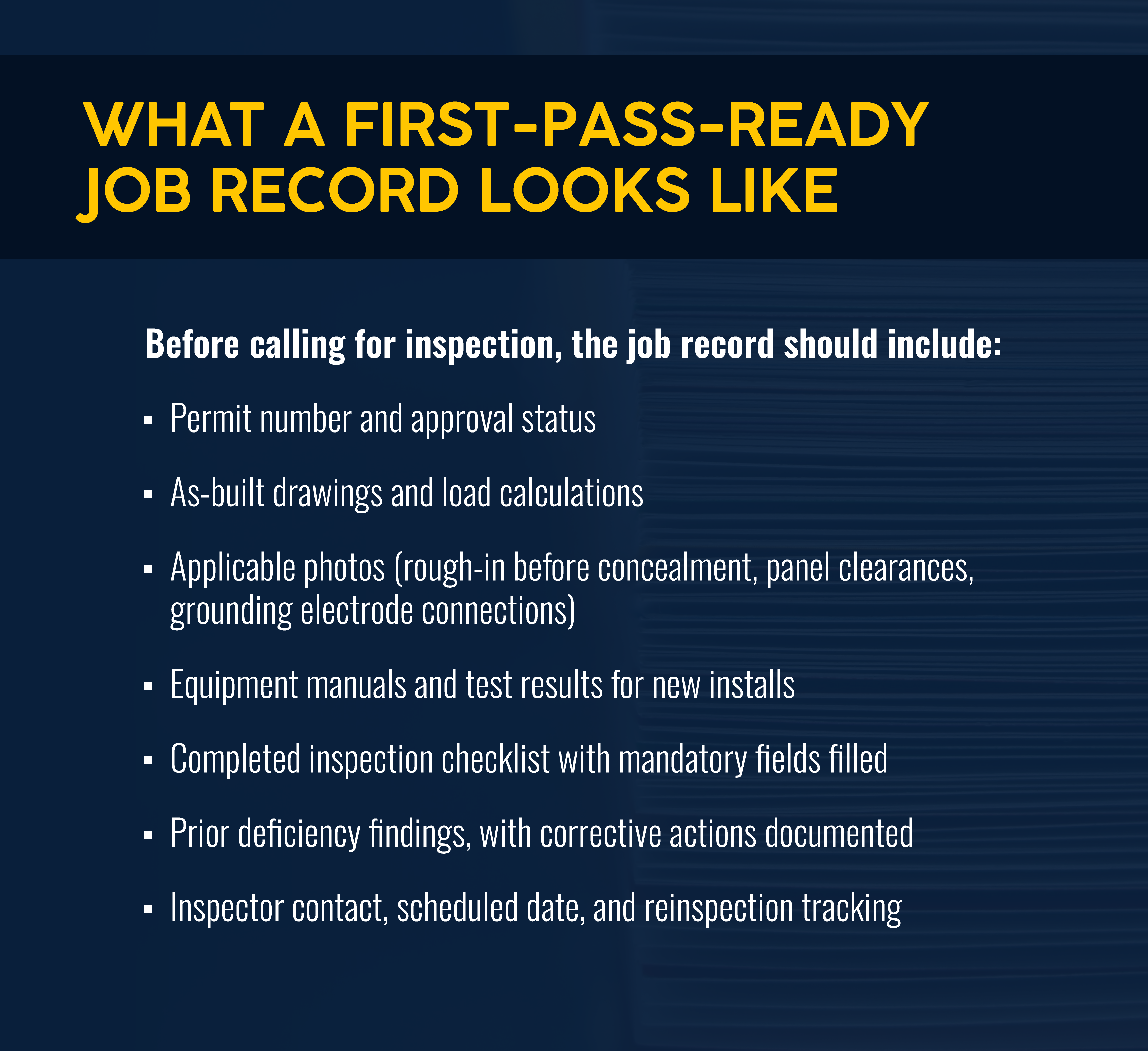
Before calling for an official inspection, make sure your crew has:
- Permit numbers on-site. Unpermitted work is one of the most commonly cited violations in commercial buildings. Liability follows the contractor, not the job.
- As-built drawings and load calculations. Inspectors want documentation that matches what was installed.
- Installation photos from before concealment. Conduit routing, grounding electrode connections, panel clearances: Photograph all of it before closing up walls. Those images are your primary defense against inspection disputes.
- Equipment manuals and test results. This covers new panels, switchgear, or protection devices.
Running a mock inspection against this checklist is among the highest-leverage habits your service team can build. It takes an hour and catches most of the common failure points. It also protects your license. The alternative? Repeatedly failing inspections can escalate to licensing board scrutiny, and no reinspection fee fixes that problem.
Electrical Inspection Checklist
Below is the working checklist. Each section maps to a common failure area. Use it to prepare for rough-in and final inspections, all while adapting it to your jurisdiction's National Electrical Code (NEC) edition and local amendments.
Each item should be verified and documented by technicians before calling for an inspection.
1. Site Safety and Access
Inspectors check access before they look at anything else. If a panel isn't reachable, nothing else matters. This section also covers the electrical hazards and site conditions that need to be addressed before work begins.
The Occupational Health and Safety Administration (OSHA) can issue fines of up to $16,550 per serious violation and $165,514 per willful or repeated violation.
- Clear working space exists in front of all electrical panels — a minimum of 36 inches, per OSHA 1910.303.
- All personal protective equipment, as appropriate for the arc flash hazard zone, is on-site and in use.
- Lockout/tagout (LOTO) procedures are posted, documented, and followed where de-energization is required. LOTO violations consistently rank among OSHA's most-cited standards.
- All hazardous areas are marked. No work in progress on energized circuits without proper authorization.
2. Electrical Panels and Distribution Boards
Common failure points include access clearance, labeling, and overcurrent protection sizing. All three are visible and fast to check, which means there's no excuse for getting cited by inspectors.
- The panel is accessible. Not blocked by equipment, stored materials, or partitions.
- Panel directory is accurate, legible, and current. Inaccurate or missing panel schedules are a common commercial violation.
- All unused knockout openings are filled with proper blanks, not tape.
- Circuit breakers and fuses are properly sized for each circuit. No double-tapping unless the breaker is rated for it.
- No arcing, overheating, moisture intrusion, or corrosion is present at busbars, lugs, or breaker connections.
- Main breaker operation has been tested.
3. Wiring, Cables, and Connections
Wiring violations are a common cause for inspection failures, whether at rough-in or final stages. Examples include loose connections, improper splices, insufficient support, and the wrong gauge. All wiring and connections should be verified before closing walls or completing ceilings.
- Wire type and gauge match circuit amperage and location, per NEC.
- Aluminum wiring isn’t used in pre-code applications without properly listed connectors.
- Inspect all accessible wiring for frayed, damaged, or deteriorated insulation.
- Inspect electrical connections at all terminations: no loose connections, corrosion, or signs of overheating.
- No open splices exist outside of listed junction boxes. All junction boxes are covered and accessible.
- Conduit is intact and securely supported, per NEC Article 300, and properly grounded.
- Check for proper box fill compliance, per NEC Article 314: adequate volume for all conductors, devices, and clamps.
- No temporary wiring is permanently left in place.
4. Outlets, Switches, and Receptacles
Missing covers and reverse polarity are preventable inspection failures, as long as you conduct a thorough pre-inspection pass.
- All outlets are tested for functionality, proper grounding, and correct polarity.
- No reverse polarity or open neutral conditions exist.
- All outlet and switch covers are installed. Missing or broken faceplates are a guaranteed failure.
- No buzzing, flickering, or overheating at any device or fixture.
- Light fixtures are installed with the correct wattage; no wiring is exposed.
5. Grounding and Bonding
Improper grounding is another commonly cited NEC violation. Shock risk, fire risk, equipment damage: They all trace back to grounding and bonding. Grounding systems need to be complete and properly bonded before calling for inspection.
- Grounding electrode system is complete and properly bonded, with conductors sized according to NEC Article 250.
- Ground/neutral separation is confirmed in all sub-panels.
- Service panels, metallic piping, and structural steel are bonded correctly.
- Grounding electrode conductor connections are photographed before burial or concealment.
6. Lighting, Emergency Lighting, and Exit Signs
Life-safety systems get their own section. On commercial work, inspection failures are safety issues.
- Exit signs are illuminated and functioning.
- Emergency lighting activates correctly during simulated power loss.
- Backup battery condition is verified.
- Per NFPA 110, backup generators are load-tested annually. Full-load test documentation is available on-site.
7. Circuit Breakers, Fuses, and Safety Devices
Arc fault circuit interrupters (AFCI) and ground fault circuit interrupters (GFCI) are common trouble spots for inspections on residential and commercial jobs. They're also among the easiest to catch before the inspector arrives.
- All GFCIs are tested in required locations, including kitchens, bathrooms, garages, unfinished basements, crawl spaces, and outdoor areas. Verify each outlet is functioning correctly by testing the test and reset buttons.
- AFCI protection is verified in all rooms required by the applicable NEC edition.
- Interrupting ratings on all overcurrent devices are verified against available fault current. Undersized interrupting ratings are a frequently missed commercial code violation.
- All protection devices are properly rated for the circuits they protect.
8. Electrical Equipment and Assets
Equipment condition and documentation are standalone inspection items on commercial and industrial work. As NFPA 70B is now mandatory, your technicians’ records carry real compliance weight. Technicians should inspect electrical components and equipment for condition issues during every scheduled maintenance visit.
- All equipment is properly grounded and bonded.
- No excessive heat, unusual noise, or visible deterioration during operation.
- Equipment condition is assessed and documented per NFPA 70B 2023, including the Equipment Condition Assessment (ECA) decal where required.
- Thermographic survey of all switchgear is documented per NFPA 70B 2023 annual schedule.
- Arc flash hazard assessment is completed and posted per NFPA 70E.
9. Load, Performance, and Thermal Checks
These checks are the difference between a documentation pass and a system verification. They matter most on commercial work and during preventive maintenance inspections.
- Voltage at all panels is measured and within an acceptable range. Verify stable power supply to all circuits.
- Load calculations are reviewed against actual circuit loading. No circuits operate consistently at or above 80% of rated capacity.
- Surge protectors and transient voltage surge suppression devices are inspected for condition and replacement indicators.
- Thermal imaging is completed on panels and switchgear where required or flagged by prior inspection findings.
- Any components showing elevated temperature are documented with photos and flagged for corrective action.
10. Documentation, Photos, and Follow-Up Actions
Inspection readiness isn't just about what's installed. It's about providing documentation when asked.
- All permits and inspection records are available on-site.
- Installation photos are attached to the job record. This includes rough-in before concealment, panel working clearances, grounding electrode connections, and any equipment with prior condition findings.
- Timestamps record the Inspector name, date, findings, and corrective actions.
- Deficiencies are documented with GPS-stamped photos and an assigned corrective action.
- Re-inspection dates are tracked in the job management system, not on paper.
Electrical Maintenance Checklist vs. Electrical Inspection Checklist: What's the Difference?
These terms get used interchangeably. They're not the same thing, and the difference matters for how you document and schedule work.
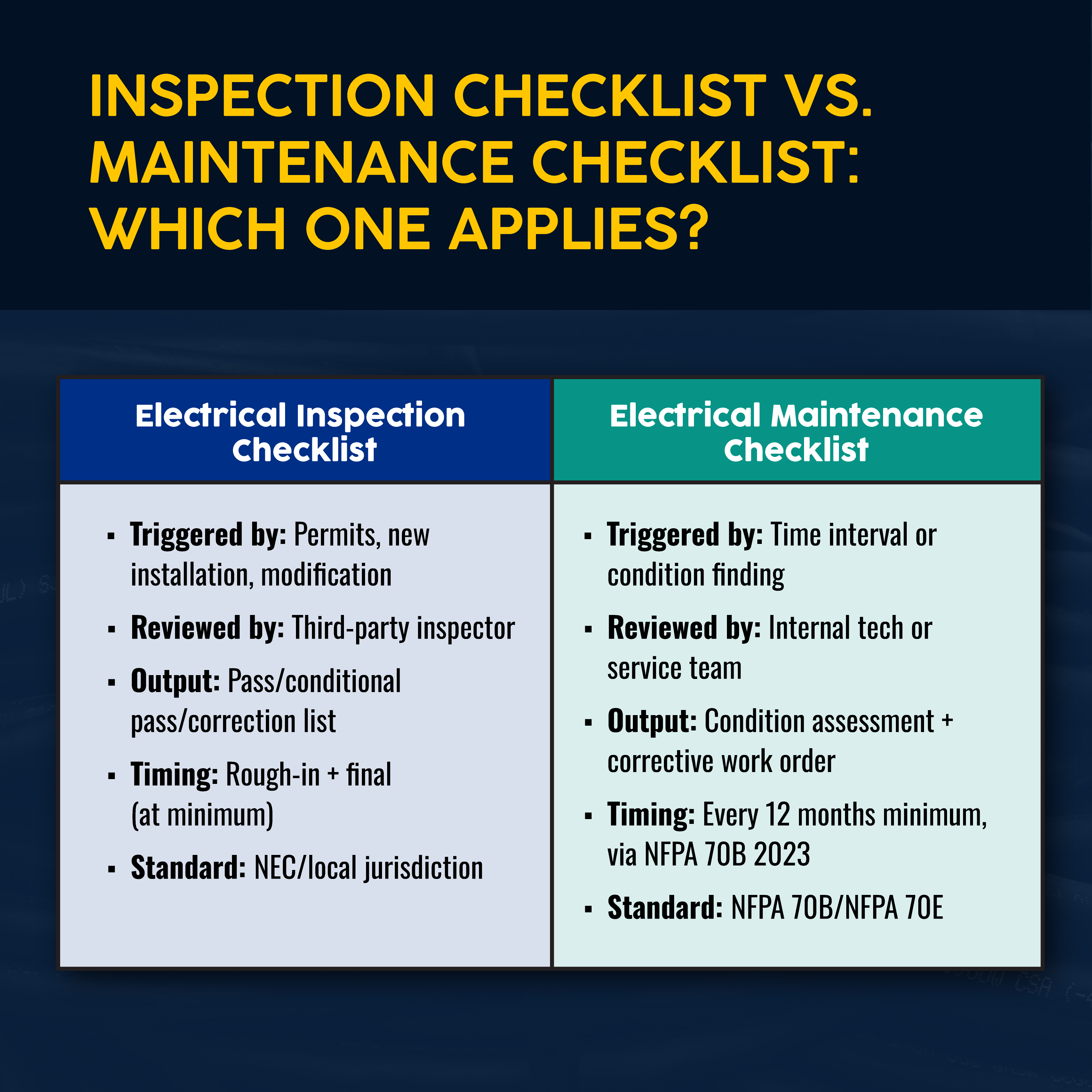
An electrical inspection checklist verifies that an installation meets electrical codes and requirements at a specific point in time. It's tied to a permit, triggered by new installation or modification, and reviewed by a third-party inspector. The output is a pass, a conditional pass, or a correction list before reinspection.
An electrical maintenance checklist runs on existing systems on a recurring schedule. The purpose is to catch deterioration, performance degradation, or emerging faults before they become failures or violations. Regular maintenance tasks (thermographic surveys, connection checks, equipment condition assessments) are the mechanism. The 2023 NFPA 70B standard, now mandatory rather than recommended, requires those maintenance tasks to be documented at least annually, with more frequent checks for equipment in poor condition.
In practice, these terms have significant overlap. But the framing is different. Inspection checklists are reactive and verify what was installed. Maintenance checklists are proactive; they catch what's degrading.
For contractors running commercial service agreements, both apply. An installation that passes inspection becomes an asset under a maintenance program. Ensuring compliance with NFPA 70B now requires programs to be documented, scheduled, and tied to corrective work orders.
How Electrical Contractors Can Manage Inspection Checklists Digitally
Paper checklists don't cause inspection failures, but they increase the risk of missing photos, lost forms, and technicians who can't tell from the truck what was documented last visit.
By contrast, contractors that implement digital documentation workflows can improve their inspection pass rate through better tracking, flagging, and reporting. Digital forms in a connected system ensure mandatory fields are filled out. They attach photos directly to the job record and timestamp everything automatically. The completed checklist is retrievable in seconds when an inspector asks a question.
Simpro®, an electrical contractor software platform, connects these workflows at the job level. Digital forms with conditional logic and photo capture attach directly to job records in Simpro Premium. Technicians complete checklists in the field, including government-compliant forms, and the data syncs to the office immediately. The Simpro + SafetyCulture integration pre-fills inspection forms from Simpro job data and auto-attaches completed PDFs to the correct job record. Simpro reporting and analytics track inspection completion by job, by technician, and across the business, so office managers can spot documentation gaps before they reach the inspector.
For NFPA 70B compliance, Simpro's asset management module lets technicians capture test readings, record equipment condition, and pull test history from the field. Recurring maintenance scheduling keeps inspections from lapsing on commercial accounts — preventing code violations and mandatory correction timelines.
When every job in your system has inspection documentation attached (photos, test readings, permit numbers, compliance certificates), you're not scrambling when an inspector asks a question or a customer disputes a finding. Pair that with accurate electrical estimates, and the job record covers everything from quote to signoff.
The operational fix: Require technicians to complete the inspection checklist in the field management system before marking jobs as complete. This simple policy makes inspection readiness the default state of every job. For a service team writing 20–30 jobs a week, the documentation trail builds itself.
Related: Find out how electrical contractors protect revenue and margins with AI.
Make Every Inspection Easier to Complete and Easier to Prove
Most electrical inspection failures are preventable. The work is usually right. The problem is locating the documentation for an inspector or making sure everyone works from the same checklist.
Step one: Standardize your electrical inspection checklist. Step two: Add the checklist to a field management system that attaches the output to the job record — not emailed as a PDF or printed out and filed away.
If your current workflow makes inspection readiness harder than it should be, schedule a demo to see how Simpro handles it.


 Back to top