
Your foreman says the rough-in is on track. Your purchasing agent says the wire order alone ate the rest of the budget. Neither one is wrong.
Real-time job-cost tracking on commercial electrical projects lets both claims be correct. A phase can run on schedule but also forecast to go over budget. The value of electrical job cost tracking is seeing both in real time instead of being surprised weeks later. Catch the problem early, and it's a line item you can adjust. Miss it, and it's either a loss you have to explain or a change order you have to fight for.
Electrical contractors that focus on service calls can close them out in a day and settle their own accounts. Your multi-phase commercial build doesn't offer that luxury. Labor costs can move daily, material pricing on core commodities like copper wire can increase by double digits within a quarter, and long-lead gear gets committed on a purchase order (PO) months before it gets invoiced.
If you're only reporting on what's been paid, you won't see any of that. Every week you miss it, you fail to make a manageable correction and risk your profit margin. This guide shows you how to successfully implement electrical project cost tracking.
7 Controls for Tracking Commercial Electrical Project Costs in Real Time
These controls mirror how costs move through your job, from the initial budget to the weekly review that decides whether a variance gets fixed or absorbed. Together, these steps upgrade you from a spreadsheet you update once a month to genuinely real-time electrical job cost tracking.
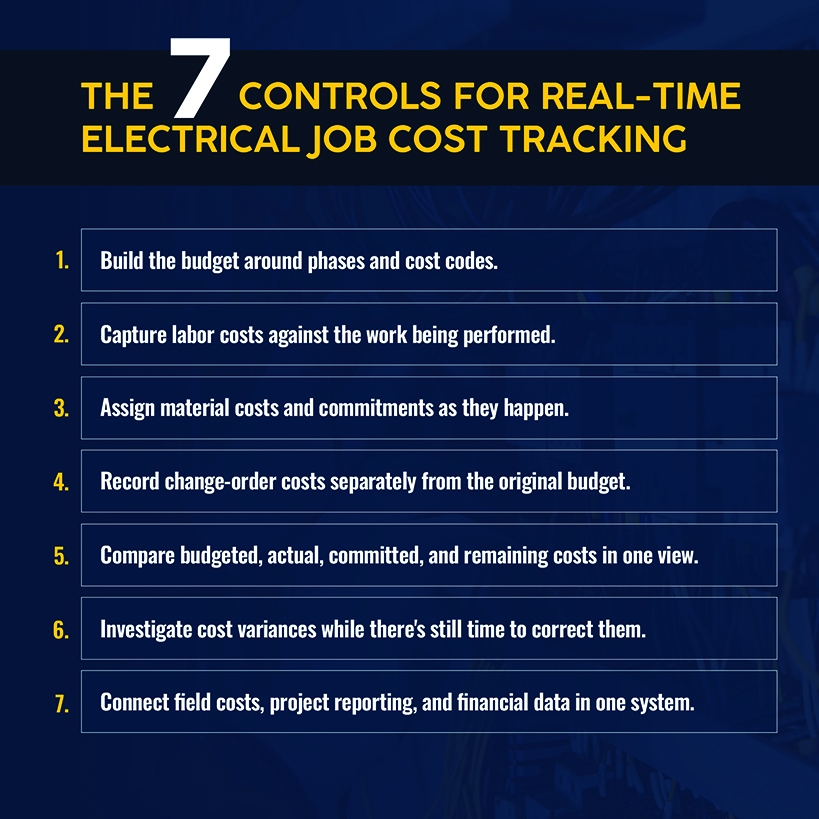
1. Build the Project Budget Around Phases and Cost Codes
Your estimate should break down into phases and cost codes before the job starts. CSI MasterFormat organizes electrical power and lighting in Division 26, communications and low-voltage in Division 27, and fire alarm and life-safety in Division 28. Mapping your cost codes to that structure requires that your estimate, schedule of values, POs, and cost report speak the same language.
Codes should be specific enough to isolate a real problem, such as separating feeders, branch conduit, gear setting, and fire alarm and low-voltage scope. But they shouldn't be so granular that your foreman must sort through hundreds of line items on a Friday afternoon. A code structure your crew can't use under time pressure won't hold up in the cost report.
Getting to that starting number is its own job, and Simpro® already covers it end to end.
Related: Our guide to the electrical estimating process covers labor, materials, and overhead pricing, helping you accurately estimate before the budget gets built.
2. Capture Labor Costs Against the Work Being Performed
Labor costs move quickly on electrical jobs, and tracking them comes down to labor capture. The first thing to know is that you're not just tracking wages; you're also accounting for indirect costs like payroll taxes, insurance, benefits, small tools, and truck costs.
If your crew of eight is running 10% over its labor units, tracking hours alone won't tell you that. A timesheet with eight hours against a cost code tells you burn rate, not how your crew is tracking against the estimate. Pair hours with what actually got installed (devices hung, feet of conduit run, terminations made) to produce a unit rate that's directly comparable to what your estimate assumed.
The operational fix: Make sure the field data has the same level of detail as the estimate. Capture should occur daily and be mapped against cost code, rather than reconstructed from memory at week's end.
Related: Mobile apps for electrical contractors help crews easily log data while surfacing insights that traditional management software can't produce.
3. Assign Material Costs and Commitments to the Project as They Happen
Material and gear carry different risk profiles than labor. Commodity material is priced live, and it moves. The Bureau of Labor Statistics' producer price index for copper wire and cable increased by 13.5% from January to August 2026 alone. If you're sitting on an unpriced wire package for a nine-month fit-out, you're carrying a live commodity position.
Meanwhile, switchboards, switchgear, panelboards, and transformers get priced and locked at release, but lead times run long. The cost is committed on the PO months before it ever shows up on an invoice.
What are committed costs in electrical job costing? A committed cost is what your project owes after the PO is released or a subcontract is signed, independently of whether the invoice arrived. It includes open PO value, received-but-not-yet-invoiced material, and subcontract commitments. If you're building cost reports from paid invoices alone, you'll miss committed costs for months — absorbing the entire gear and wire package at once, near the end of the job, with little time to adjust.
The operational fix: Track committed costs as they're released to keep your budget honest and give you an accurate cost picture throughout the project, instead of just at the beginning and end.
Related: Our electrical inventory management software guide illustrates why material tracking gets easier when receiving and usage are tied to a specific job as it happens.
4. Record Change-Order Costs Separately From the Original Project Budget
Approved change orders need to have their costs recorded somewhere, ideally with their own cost codes and separate from the original scope. Blending change-order labor and material into the same codes as the base bid creates numbers that distort your original budget and hide the change order's profitability.
Unbilled change-order work is also an early signal that a job is drifting. When approved change-order costs accrue faster than you're billing them to general contractors, that widens your underbilling position well before the monthly close flags it.
Related: Our electrical bid template is a useful starting point if you're building that paperwork yourself.
5. Compare Budgeted, Actual, Committed, and Remaining Costs in One View
Electrical project cost tracking is more than just tracking labor and materials. You need to track four things:
- What you budgeted
- What you've invoiced
- What's committed but not invoiced
- What's left to spend in the phase
Here's what that looks like on a rough-in phase with a $220,000 budget:
| Cost Category | Budgeted | Invoiced to Date | Committed (Open POs) | Remaining to Complete |
|---|---|---|---|---|
| Labor | $95,000 | $52,000 | $0 | $48,000 |
| Material and Gear | $105,000 | $58,000 | $47,000 | $6,000 |
| Equipment and Rental | $20,000 | $8,000 | $7,000 | $8,000 |
| Total | $220,000 | $118,000 | $54,000 | $62,000 |
Based on actual costs alone, this phase of the construction project looks healthy because 54% of the budget is spent, and the phase is 55% complete. But add the $54,000 in open POs and the $62,000 needed to finish the remaining rough-in work, and you see your real exposure is $234,000 against a $220,000 budget.
What you just calculated is an estimate at completion (EAC), which is: Actual Cost to Date + Committed Cost + Remaining Cost to Complete. If you're running actuals-only reports, you won't see that $14,000 overrun until the wire package gets billed weeks from now.
The operational fix: Your forecast is only as good as your percent complete. Measure progress by units installed, not dollars spent or days on the schedule. A phase that's burned 60% of its labor budget isn't necessarily 60% finished, and if the crew is behind on installed quantities, that $62,000 cost to complete is already too low.
6. Investigate Cost Variances While There's Time to Correct Them
The goal is to identify variances while there's still labor left to recover. That requires following up and asking why a code is running hot.
For example, it's well known in the construction industry that elevated and occupied-space work has quantifiable productivity loss. Track that loss as cost. Electrical Contractor Magazine's coverage of NECA's labor unit guidance quantifies the cost:
- Mounting elevations above 10 feet typically add 5% to standard labor units.
- Elevations of 16–20 feet add 10%.
- Working in occupied spaces can add 50–100%.
Overtime fatigue, trade stacking, and out-of-sequence rework consume hours in the same way, even when the labor unit didn't anticipate that.
The operational fix: Code these hours to a specific impact code on the day they're worked. If your cost report shows three weeks of hours coded to an occupied-space impact code, that's far better documentation for a change order or a claim than relying on the foreman's memory at closeout.
Run a weekly cost review with your project manager, foreman, and accounting. Work from a unified cost report with a written cost-to-complete for every open code. Doing so enables you to act on variances quickly and decisively.
Related: Once a variance is coded and visible, our guide to electrical KPIs covers which margin-protecting metrics are worth monitoring.
7. Connect Field Costs, Project Reporting, and Financial Data in One System
Everything up to this point depends on the same underlying requirement: A unified software system that connects labor, material, committed cost, and productivity data. If your team has to manually reconcile field spreadsheets and accounting packages every month, you're wasting time, increasing error risk, and missing opportunities to improve performance and catch job cost problems early.
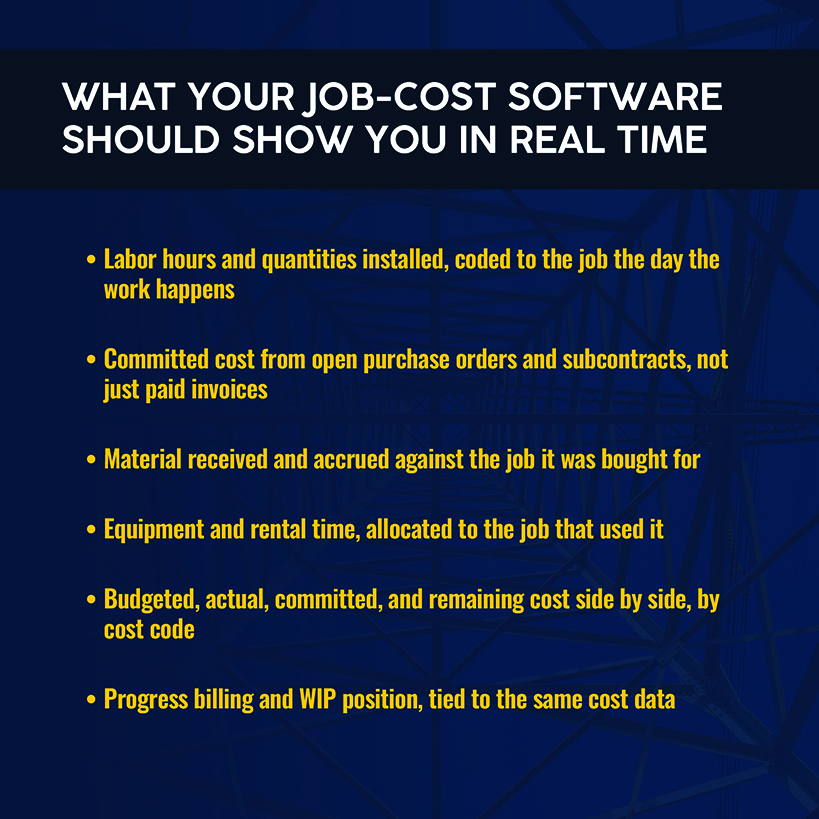
One of the most frequently asked questions from contractors evaluating a new system is this: What should electrical job-cost tracking software show in real time? Here are a few features to look for:
- Labor hours and quantities installed, coded to the job and cost code the day the work happens
- Committed cost from open purchase orders and subcontracts, not just paid invoices
- Material received and accrued against the relevant job
- Equipment and rental time, allocated to the job that used it
- Budgeted, actual, committed, and remaining cost, side by side at the cost-code level
- Progress billing and work-in-progress (WIP) position, tied to the same cost data
Progress billing turns job costing into a financial governance tool, not just a field report. A WIP schedule tracks contract value, cost to date, estimated cost to complete, earned revenue, and billed to date — allowing you to surface and act on overbilling and underbilling.
Overbilled work is borrowed cash you have to earn back later. Underbilled work is usually the result of an unbilled change-order cost or an eroding cost-to-complete estimate. Underbilling drains cash flow first, and it's often the earliest sign of a job going bad.
Job-level WIP tracking feeds into company-level financial health, too. The Construction Financial Management Association's Construction Financial Benchmarker compares liquidity, profitability, leverage, and efficiency ratios to industry peers. Electrical contractors with chronic underbilling across their job base show up there via weakening liquidity and cash-flow ratios.
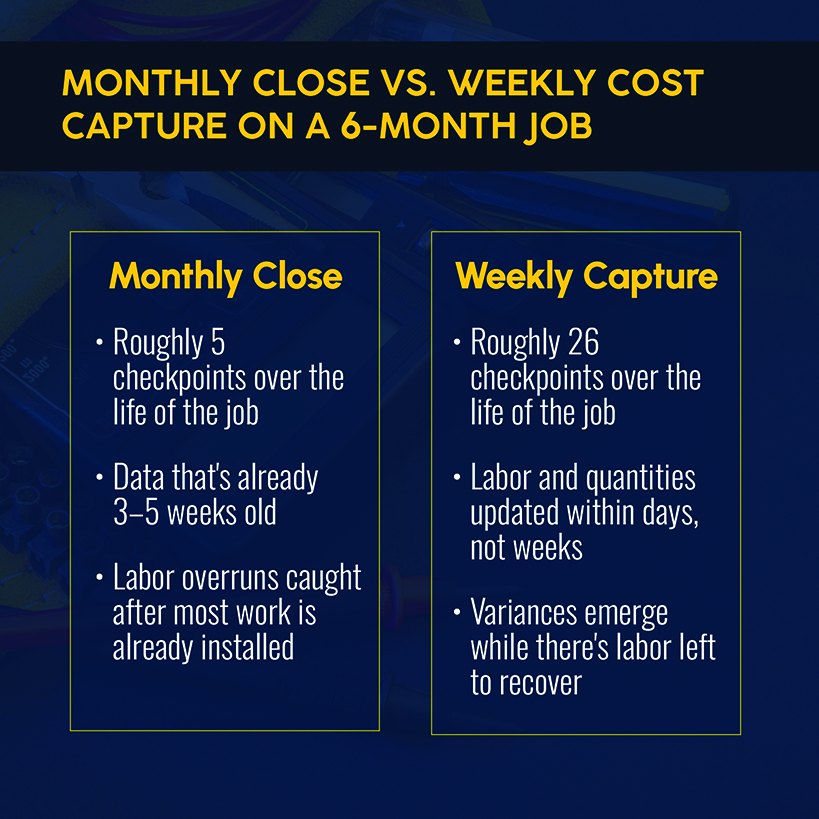
This type of tracking can't afford to wait. Choose weekly reviews over monthly. A monthly close on a six-month project gives you roughly five checkpoints to catch a problem, but each is built on data that's already three to five weeks old. The practical middle ground: Weekly labor and quantity capture, with a formal WIP reconciliation each month. That cadence is quick enough to catch a labor variance while it's still small and structured enough to satisfy your accounting team.
Simpro ties everything together so your team isn't struggling to find and connect important data across separate systems. Field timesheets are coded to a job and cost center on the day the work happens. That data feeds into project job costing. From there, committed costs from POs, material receipts, and subcontracts sit next to actual and budgeted costs at the cost-center level. Progress billing and WIP reporting draw from that same live position, and profitability reporting rolls it up by job or by cost center for your weekly review.
More than 24,000 field service businesses have moved to Simpro. For commercial electrical contractors, that means a single live cost picture instead of a patchwork of spreadsheets, paper files, and disconnected systems.
Know Where the Project Is Heading Before It Gets There
On every open job, how do you answer the question "How are we doing on budget?" If it takes you 10 minutes to pull the data, or you have to chase the foreman and purchasing agent for information, then you're ready for a system that's suited to real-time job costing for electrical contractors.
Closing the gap isn't just about visibility. When you can see labor, committed cost, and cost-to-complete together every week, you can spot a phase running hot while there's still time to fix it. A connected system helps you protect the margin promised by your estimate instead of explaining underperformance after the fact. That's the difference between a business that survives a bad phase and one that's still profitable at closeout.
Simpro brings timesheets, cost centers, committed costs, and WIP reporting into one live system built around how electrical contractors actually run jobs, from bid to closeout. Schedule a demo to see what it looks like on a job like yours.


 Back to top