
Figuring out how to spot an unprofitable commercial electrical job before closeout is all about timing.
Let’s say you have a $340,000 gear and rough-in package on a mid-rise office renovation. It looks fine at the 50% billing mark: the general contractor is paying on schedule, your crew is hitting milestones, and your project manager’s monthly report lists margin at 14%. Six weeks later, closeout shows a 3% margin. The monthly report was wrong because nobody was watching the numbers that would have caught the drain.
That gap between the monthly report and the job’s actual cost lands squarely on your bottom line. Commercial, industrial, and institutional work makes up 54.8% of electrical contractor revenue, and 68.5% of revenue at firms with 10 or more employees, according to the 2024 Profile of the Electrical Contractor. That electrical work gets bid on your estimated labor units, executed by crews whose productivity shifts with site conditions, and billed on a percent-complete schedule that can hide losses for an entire reporting cycle.
The warning signs show up in the field and on the books weeks before they land on the P&L, but only if you know where to look.
What Makes a Commercial Electrical Job Unprofitable?
Specialty trade contractors are playing a game of thin, fast-moving margins. CFMA's 2025 Construction Financial Benchmarker measured the industry as a whole at 22.4% gross profit margin and 7.7% net profit margin before taxes for fiscal year 2024. "Best in class" contractors do notably better with a 14.2% net margin before taxes.
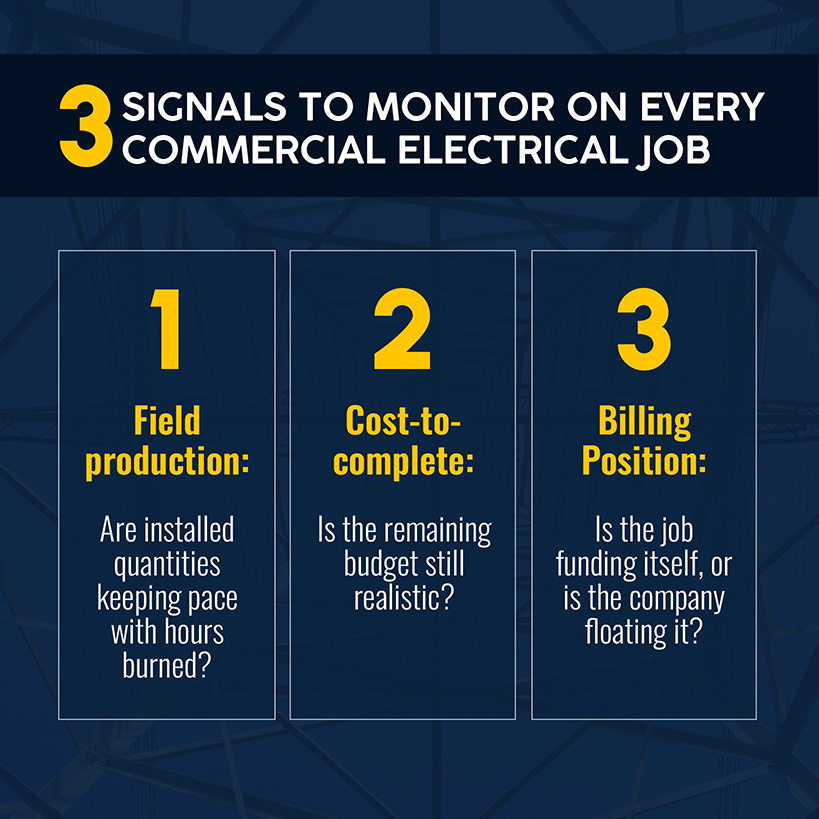
The gap depends in part on whether you’re tracking these signals on every job:
- Field production: shows whether installed quantities match the hours your crew has burned.
- Cost-to-complete: shows whether your remaining budget is realistic or carried forward out of habit.
- Billing position: shows whether the job funds itself or whether your company is floating it.
When you’re working with electricity, you need to spot the warning signs early, because waiting until closeout means it’s too late.
7 Warning Signs Your Commercial Electrical Job Is Becoming Unprofitable
The seven signals below will show up on unprofitable electrical jobs weeks or even months before other data confirm them. Track these by cost code, and you'll still have time to act.
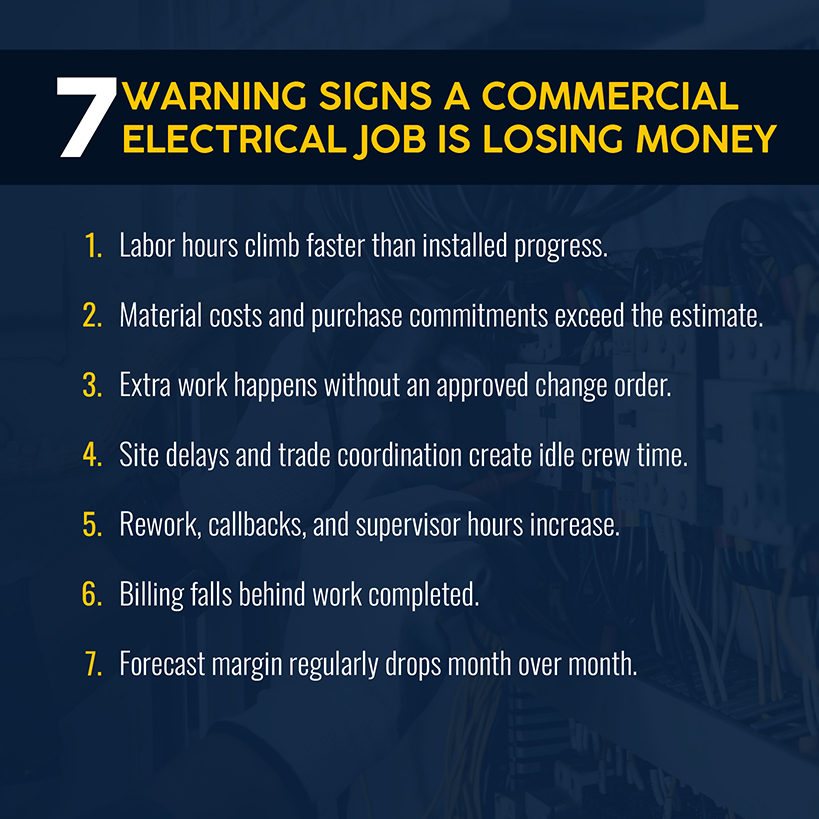
1. Labor Hours Increase Faster Than Project Progress
A NECA standard labor unit assumes roughly 65% of the hour goes to installation, with the other 35% split between tasks such as material handling, layout, and supervision, according to an EC&M and ABB explainer.
Beware that these figures assume a crew of journeyman electricians, rather than master electricians overseeing apprentices. And if field conditions change, the hours can pile up even though your crew is working just as hard.
Occupied-building work adds 50–100% to labor units versus an empty shell, and mounting height over 10 feet adds 5%, rising to 10% for installations between 16–20 feet, per Electrical Contractor Magazine. Ladder work adds 3% at 12 feet up to 25% at 20 feet, fixed scaffold adds 40%, and existing-building remodel work can run up to 200% over new construction, per EC&M's guide to adjusting labor units. Those adjustments should live in your labor cost code, not your master schedule.
Say you're running a four-person crew on a 30,000-square-foot medical office buildout, doing rough-in on a floor that's occupied by three other trades. You might hit every target date but still burn hours that aren't accounted for in the original estimate.
The operational fix: Each week, track installed quantity per cost code against the units you bid, not against the calendar. If 40% of your conduit is in and 55% of your labor hours are spent, the job is already 15 points behind, no matter what the schedule says.
2. Material Costs and Purchase Commitments Exceed the Estimate
Material pricing can erode your gross margin before a single hour gets billed. Producer prices for nonferrous wire and cable rose nearly 29% from January 2025 to July 2026, according to the Bureau of Labor Statistics. Producer prices for copper and brass mill shapes rose 21.6% over the same period, while copper base scrap prices rose 46.7%.
Gear commitments carry a second risk: lead time. Generator packages and switchgear lineups that once shipped in roughly 15 weeks have been reported at more than 92 weeks in recent years, with low-voltage power circuit breakers taking more than one year from purchase order. When purchase orders get released late, you’re adding scheduling, pricing, and lead time risk simultaneously.
For example, if you hold a bid open for a quarter on a 15,000-linear-foot feeder run for a distribution center, you could lose most of your material margin before the purchase order gets cut.
The operational fix: Recheck material buyout against the current index before releasing a purchase order. Treat gear release-for-manufacture dates as a schedule milestone that’s tracked alongside labor, not a submittal task buried in a log.
A bid built on stale unit pricing or outdated lead-time assumptions creates exposure before the job is awarded. Errors here affect subsequent stages and their margin, too.
Related: Our electrical estimating tips article covers how to build a bid that survives a long lead time and a moving material index.
3. Extra Work Gets Completed Without Approved Change Orders
Change orders do more than add scope. They can cause delays, add management time, interrupt job flow, and force overtime. Worse still, you have to track the productivity losses yourself, as there’s no clean formula.
Another problem emerges if your crew keeps working through the change before it's priced or approved. CFMA's guidance on work-in-progress (WIP) management is to chase outstanding change order requests each month, and with the same discipline you’d apply to a billed receivable.
The operational fix: Log and price every change as it's identified, even if it's not yet approved. An unpriced change order sitting idle is unbilled labor you're financing for free.
4. Site Delays and Trade Coordination Problems Create Idle Time
Repetition is where your crew makes its labor units. A run of 10 identical fixture installs goes faster per unit than the same fixture installed as one-off instances scattered across three floors. When the general contractor doesn’t coordinate well among different trades, electrical productivity suffers, producing negative financial effects.
The repetition benefit you built in only becomes reality when your crew can focus on runs of 6–15 repeats. If they’re constantly getting interrupted, fighting for hoist access, and completing the same task in isolated instances, that benefit listed in the estimate is long gone.
The operational fix: Document the disruption as it happens, including the date, which floors, and what your crew was blocked from doing. Contemporaneous notes are the best basis for a productivity claim later that relies on real evidence. As-it-happens documentation can also catch quality problems before they eat into your margin.
5. Rework, Callbacks, and Supervisor Hours Are Increasing
Field rework before project completion averaged 0.38% of contract value across a wide range of projects, according to research, rising to 0.76% once post-completion corrections were included. The biggest concern isn’t the raw percentage, but rather that rework costs were underreported by roughly 300%.
Previous research involving the same researcher calculated a mean rework cost of 0.39% of contract value across 346 projects, reducing average yearly profit by 28%. Outliers are partly to blame: A mere 0.45% of rework events accounted for 34% of total rework cost.
The operational fix: Give rework its own cost codes instead of letting corrected work hide inside base labor hours. A National Electrical Code violation caught at final inspection, for example, needs its own visibility, not a fold-in to "the crew was slow." If you can't isolate rework in your job cost report, you can't tell whether a labor overrun is a productivity or quality problem. Rework concentration allows for a targeted fix that prioritizes recurring defect types.
Related: Our job costing guide breaks down how to structure cost codes so problems like this can’t hide.
6. Billing Falls Behind Work Completed
CFMA's WIP guidance treats underbilling as a margin indicator. It's also a cash flow problem because work you've finished but haven't billed for still has to be financed. Disciplined WIP review is associated with lower days sales outstanding and less underbilling overall.
On your job, that usually means one of three things:
- Unapproved work you've already performed
- Costs outpacing your schedule of values
- A schedule of values that's front-loaded and out of room
Don’t assume an invoice is already reflected in costs-to-date just because material arrived on-site before the cost cutoff. Without a purchase order system, a six-figure switchgear delivery can sit uncaptured for a full reporting cycle. That’s enough to flip your projected gain into a loss.
The operational fix: Each month, review underbilling and open commitments together with a named owner. Financial teams and project managers should meet on a schedule, not just when someone notices a problem.
Related: Our electrical KPIs guide shares every metric worth watching on an active job.
7. The Forecast Margin Shrinks as the Job Progresses
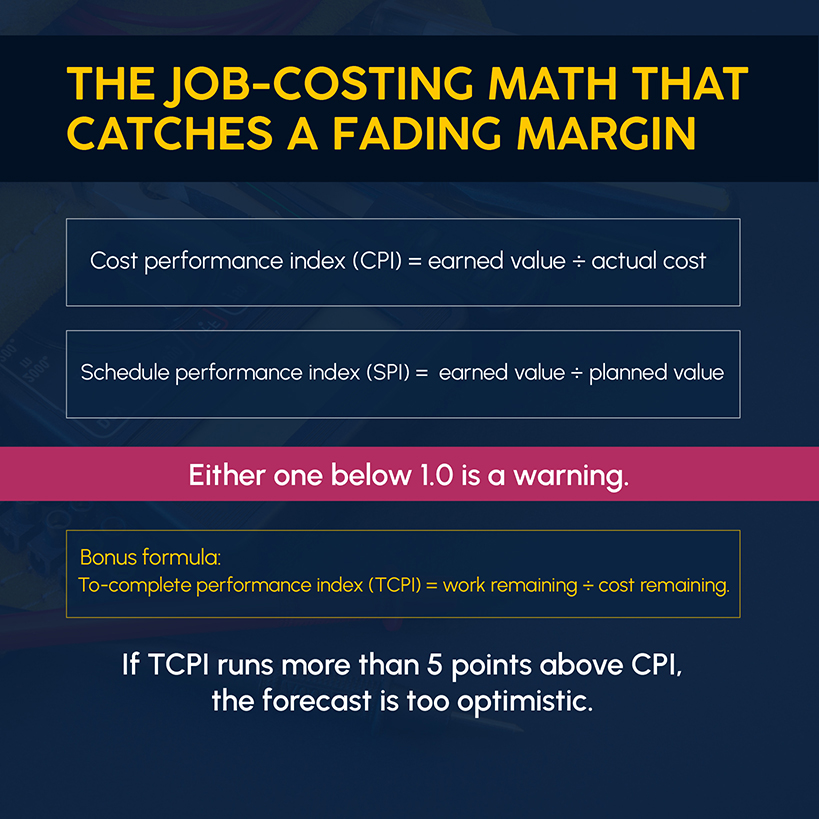
Electrical contractor profit margins will erode over time when forecasts aren’t checked. The most reliable early warning is arithmetic, not intuition:
- Cost performance index (CPI) = earned value ÷ actual cost
- Schedule performance index (SPI) = earned value ÷ planned value
Either metric sitting below 1.0 means the job cost more or accomplished less than planned. The Government Accountability Office notes that these indexes can flag problems before results turn bad.
If the forecast looks too good, use this formula:
- To-complete performance index (TCPI) = work remaining ÷ cost remaining.
This is the productivity your crew would need to deliver for the remainder of the job to hit the current cost-to-complete number.
Finally, a forecast that never shifts from month to month is also a red flag, as costs keep changing either way. Catching it early still beats explaining it at closeout.
The operational fix: Run CPI and SPI on your biggest cost codes every month, not just at milestone billing. If TCPI is more than 5 points above CPI, the forecast is likely assuming a productivity jump your crew probably can’t hit. Ask your PM to explain, with data, why productivity is about to improve.
Related: Review our electrical business profit margins guide to better understand where margins come from.
What to Do When an Electrical Job Starts Losing Margin
When you detect any of these warning signs, don’t scramble. Instead, apply a process to your project management response. For example, you might have finance teams meet each month with managers to adjust the WIP before any financial presentations to a bank, bonding company, or shareholders. Project managers are held to their own monthly projections.
That monthly review assesses:
- Whether the revised estimated cost to complete is realistic
- Whether each identified change order has been submitted
- Whether billing to date matches what the PM reports in the field
- Cost transfers and misclassifications that could mask an overrun
- Which labor cost codes have overrun their budget, and by how much
- Whether the projected profit fade from those overruns has been captured in full
CFMA's advice on a projection that looks too good to be true is to remain skeptical until the gain is proven real. An unexplained pickup is oftentimes a misclassification.
Related: Find out how AI-assisted estimating and job tracking is protecting electrical margins.
Use Real-Time Job Data to Protect Electrical Job Profitability with Simpro®
Simpro provides one system to track every signal across your commercial project work instead of having to piece them together from spreadsheets and disparate tools. More than 250,000 users across 24,000+ businesses use the Simpro platform to manage their field service and project operations.
Job costing in Simpro compares your estimates and actuals by cost code. A labor overrun on electrical systems work surfaces as a number early in the job, not at closeout. Field timesheets are tied to those same cost codes and capture hours as they're worked, building the job-cost history needed to set your own labor-unit factors.
Cost-to-complete reporting keeps the forecast honest instead of carried forward from last month. Progress invoicing and retention tracking create real-time visibility of your billing position. Change order and variation workflows turn unapproved extra work into a tracked, priced, and dated queue. Purchase orders and committed-cost visibility close the delivered-but-not-invoiced gap and track long-lead gear as a milestone.
Finally, consolidated margin-by-job reporting means the same number appears everywhere, without waiting for reconciliation at closeout.
Protect Your Margin Before the Job Reaches Closeout
Once you know how to spot unprofitable electrical jobs, the fix becomes an operational exercise. You need data with the right level of detail, regularly scheduled check-ins, and someone assigned to question the numbers that look too good.
Most electrical companies running several job types already collect this information, perhaps in timesheets, purchase orders, change order logs, or billing schedules. The challenge is consolidating this data into one system so you can act on it early.
With Simpro, you’ll detect a crew running behind on a rough-in within the same week it occurs instead of at the quarterly financial review. A stable, profitable electrical business stays that way by catching a 15-point gap in week 6 instead of week 20, not from a better closeout report. Over the long term, that's the difference between a company that grows versus one that merely survives.
Schedule a demo to see how Simpro connects job costing, labor tracking, and billing on your commercial electrical jobs.


 Back to top