
Winning electrical jobs isn't just about submitting the lowest number. You also need accurate estimates that cover your actual costs, protect your margin, and persuade the customer to choose you over the next contractor on their list.
Most electrical businesses that struggle with profitability aren't losing because they're bad at the work. They're losing because their electrical estimating process is loose.
Labor burden gets underestimated. Overhead isn’t included in the price. Material costs get locked in, but then prices rise. By the time the job wraps, their anticipated margin is gone.
This step-by-step guide breaks down how to estimate electrical jobs with the precision needed to stay profitable — from the first document review to your bid submission. Learn where you might be leaving money on the table and how better project management fixes that.
How to Estimate Electrical Jobs Accurately
Accurate electrical estimating starts with your initial data and inputs. You need an estimating and job-costing process that’s disciplined at each step.
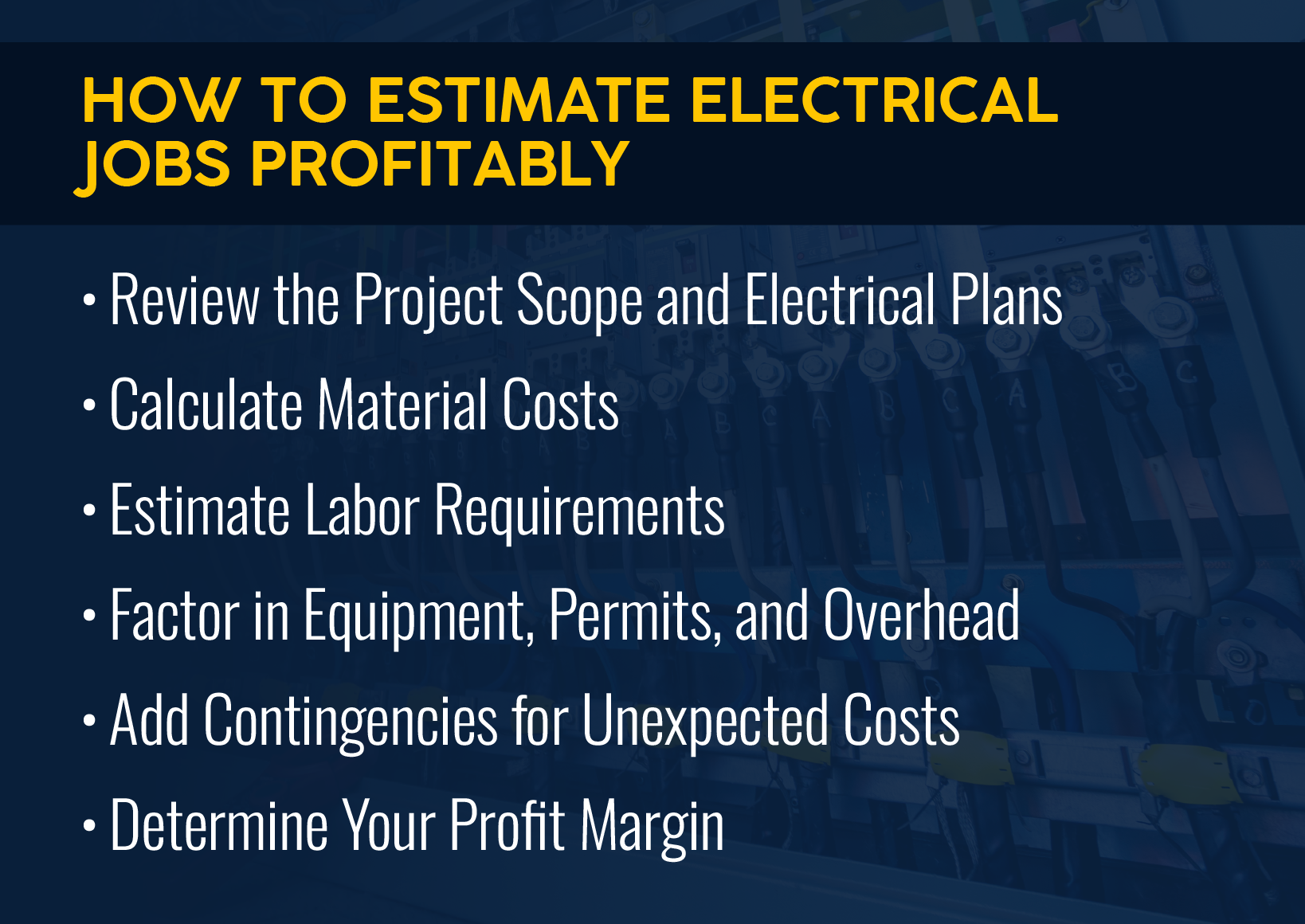
Review the Project Scope and Electrical Plans
Begin each commercial bid process with a thorough review. This includes the request for proposal, electrical specifications, NEC code requirements, coordination obligations with other trades, and any special installation requirements.
Poor document review is a common — and costly — cause of electrical bidding errors. Missing a requirement on a $200,000 job isn’t a minor line item. It shows up as a change-order dispute or a cost you absorb.
The operational fix: Before moving into numbers, make sure you understand what the job actually requires. Flag anything ambiguous in writing before the bid is submitted.
Calculate Material Costs
Materials often represent the single-largest cost driver on electrical work. Start with solid quantity takeoff work, laying the foundation for a reliable bill of materials (BOM).
Key categories include:
- Conduit and fittings
- Wire and cable
- Panels and switchgear
- Outlets and devices
- Light fixtures
On larger commercial jobs, digital takeoff tools or electrical estimating software let you count plan symbols and auto-populate your BOM directly, which eliminates manual transcription errors and significantly speeds up the process.
Make sure you’re regularly reviewing copper and wire pricing, which can fluctuate. Electrical contractors who default to pricing materials off stale supplier sheets will eventually realize they’re eroding margin on jobs they thought were profitable.
The operational fix: Tie your BOM to live supplier pricing. Review material costs at least once per quarter. Factor in 5% to 10% overage for waste. Don't forget delivery and storage costs.
Estimate Labor Requirements
Electrical contracting businesses can easily make estimating mistakes when calculating labor costs — an error that also tends to cause the most margin damage.
The NECA Manual of Labor Units is the standard industry reference for labor unit estimating on commercial work. Each task is assigned a unit value (typically calibrated to journeyman hours), and total unit count gets multiplied by your labor rate.
What gets missed most often? Labor burden.
Taxes, benefits, workers' comp, and insurance can add 20%, 30%, or more to base hourly wages. A journeyman at $35 per hour costs roughly $44 to $46 per hour once burden is factored in. If you're pricing labor hours at the base rate, you're underbidding every job.
Other burden components include nonbillable time (travel, setup, cleanup, admin), supervision costs, and productivity adjustments for difficult working conditions.
The operational fix: Build a loaded labor rate that includes all burden components. Revisit whenever benefits or insurance costs change. Use historical job data to calibrate your productivity assumptions. Don't apply a standard unit value to jobs with significant constraints to access or site conditions.
Factor in Equipment, Permits, and Overhead Costs
Overhead for electrical contractors typically runs from 13% to 20% of total sales. When you omit that cost from a bid, it eats into your margin. Every billable hour needs to recover a proportional share of your overhead.
Here’s a simple formula: If your annual overhead is $60,000, and you run 1,500 billable hours per year, every hour needs to recover $40 before you've earned a dollar of profit.
The operational fix: Your estimate should account for permits, equipment rental, specialty tools, and subcontractor costs — not as afterthoughts, but as line items calculated from the scope.
Add Contingencies for Unexpected Costs
Scope creep and on-site surprises are a reality on electrical projects. A contingency line that’s sized to the job’s risk profile can be a critical buffer against the unexpected.
The more clearly defined the scope, the smaller the reasonable contingency. For jobs with incomplete plans, unclear coordination requirements, or significant unknowns, a larger contingency is appropriate.
The operational fix: Make sure contingencies are accounted for before bidding. Otherwise, you could find yourself fighting a change-order battle on a job with no breathing room in the original bid.
Determine Your Profit Margin
One of the most consistent mistakes in electrical estimating (and pricing strategy, in general) is confusing markup with margin. If your target is 25% gross margin, don't add 25% to your costs. Doing so only gives you a 20% margin.
The correct formula is Price = Cost ÷ (1 − Target Margin %)
If your total cost is $1,000 and your target margin is 25%, your price is $1,000 ÷ 0.75 \= $1,333. On service work, target gross margins typically fall between 65–67%; net margins in the 10–20% range.
The operational fix: Check out our guide to pricing electrical jobs across service and project work, including how to set flat rates and time-and-materials (T\&M) structures.
How to Bid Electrical Work and Stay Competitive
Getting your numbers right is half the equation. The other 50% is how you present and position the bid.

Understand the Client's Requirements and Timeline
Your bid won’t stand out unless it directly addresses the client’s needs — timeline, specific materials, coordination, and complexity.
Generic bids lose when the price is close. Competitive bids show that you've read the documents, understood the scope, and built a specific answer for their specific job.
Price the Job Based on Value, Not Just Cost
Flat-rate pricing can succeed when applied to jobs with a well-defined and repeatable scope. This method lets experienced technicians earn more per job and gives customers a predictable number. Effective flat-rate pricing can yield 30% to 50% profit margins on service tickets.
For more complex or open-scope commercial work, T\&M protects you from scope risk. For clearly defined commercial projects with complete plans, fixed-price bidding keeps you competitive. A tiered good/better/best structure on service work will increase average ticket value while giving the customer a choice.
Avoid Common Electrical Bidding Mistakes
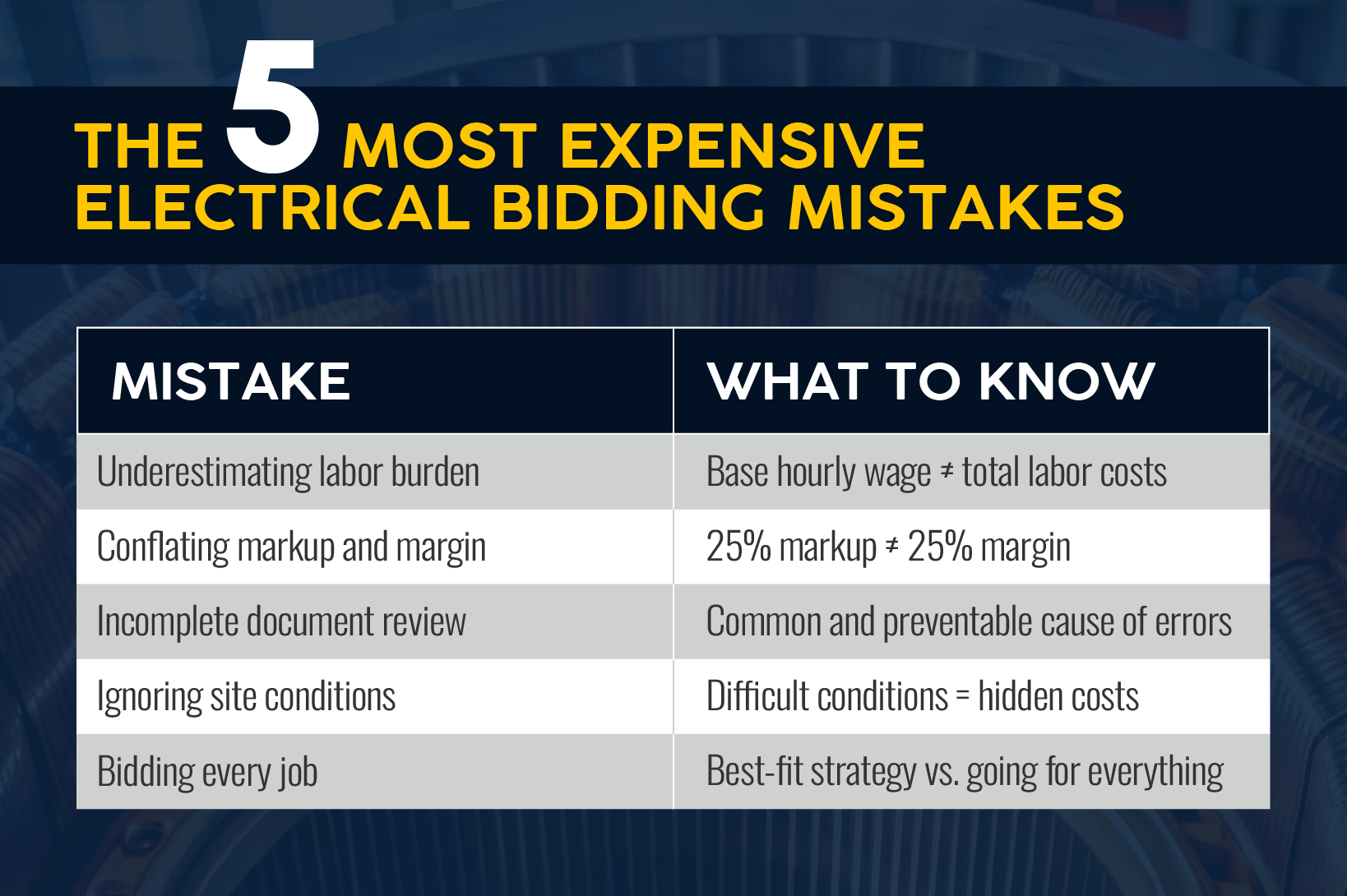
The most expensive bidding mistakes are process failures:
- Underestimating labor burden. Base hourly wage is not your actual labor cost.
- Conflating markup and margin. A 25% markup is not a 25% margin.
- Incomplete document review. This preventable mistake frequently causes bidding errors.
- Ignoring site conditions. "Difficult" vs. "easy" conditions have a significant labor impact.
- Bidding every job. Low-margin jobs or projects outside your expertise can hurt your win rate and profitability.
The industry average win rate for electrical estimators is roughly 18% to 25%. If you're consistently winning over 40% of bids, you're likely underpricing. A strong pipeline of electrical leads makes it easier to walk away from bad-fit jobs without feeling like the calendar is empty.
Submit Clear and Professional Proposals
Winning bids are those that build confidence. Your proposal should include a detailed scope of work, material specifications with brand and model numbers, breakdown of labor, timeline, payment terms, warranty information, and a clear list of exclusions and assumptions.
Ambiguous proposals create disputes. Creating upfront scope clarity protects your margin throughout the job.
Electrical Estimating Methods Used by Successful Contractors
The right method for estimating project costs depends on the job type, scope clarity, and your operational systems.
Unit Cost Estimating and Digital Takeoffs
To reduce manual error and speed up the process, start with the NECA labor unit method. Then, pair it with digital takeoff tools — counting plan symbols, marking up drawings, and auto-populating your BOM. The right electrician apps can support field quoting so your team can create and send estimates from job sites.
Simpro's electrical software includes a takeoffs add-on built for exactly this workflow, with live supplier pricing and a rules-based markup that frees your estimates from stale spreadsheets and manual recalculation.
Using Past Job Data to Improve Future Estimates
Every job you complete is a data point. By comparing estimated vs. actual hours and materials, you calibrate your productivity assumptions over time. For example, if labor unit assumptions are consistently off in one direction on a certain job type, historical data can flag this so you can correct it before the next bid.
AI in electrical businesses is increasingly part of how leading contractors decide which jobs to bid in the first place, helping teams prioritize the work most likely to be profitable before beginning the estimate process.
Building a Profitable Electrical Bidding Process
If you're reviewing past jobs and consistently find below-target margin, the problem often lies with the estimate. You need a repeatable process, supported by the right tools, to make bids more accurate and margin-protected.
Simpro® is purpose-built for electrical contractors as they estimate and quote. From digital takeoffs and live supplier pricing to good/better/best quote structures and change-order management, Simpro connects how electrical businesses estimate electrical jobs to how they actually run them.
If your current process relies on spreadsheets, manual pricing lookups, or gut-check markup, it's worth understanding what a purpose-built system built for the trades looks like. More than 24,000 businesses have made the switch.
Schedule a demo to see how Simpro can help you build a more profitable electrical bidding process.


 Back to top