
Running a busy electrical business and running a profitable one are two different things — and the gap is wider than most owners realize.
The average electrical business profit margin typically sits between 2% and 6% net. That's well below the 10% to 20% that indicates a healthy operation. If your electrical contracting business is booked out for months but you're still closely watching cash flow, that’s a warning sign and ignoring it means leaving money on the table.
This guide breaks down what electrical contractor profit margins actually look like, what's pulling them down, and what you can do to close the gap.
2026 Average Electrical Business Profit Margins
Before you can improve your margins, you need to know how profitable electrical businesses should be. This table gives you a working benchmark by margin type, and more importantly, a diagnostic frame for what each number means for your business.
| Margin Type | Industry Average | Healthy Target | Top Performer |
|---|---|---|---|
| Gross Profit Margin | Varies by type | 65–67% (service) | 70%+ |
| Net Profit Margin | 2–6% | 10–20% | 20%+ |
| Overhead as % | 20–30% | Below 20% | 15% or less |
Gross profit vs. net profit. Gross profit is what's left after direct costs, including labor, materials, subcontractors, and equipment. Net profit margin is what remains after subtracting operating expenses, including insurance, vehicles, admin, office space, and tools.
Many electrical companies track gross margin reasonably well. But they can struggle to calculate net margin because they treat overhead as a fixed cost instead of a managed one. For most electrical businesses, that blind spot is where the bottom line erodes.
Residential vs. commercial margins. The target of 65% to 67% gross profit margin applies primarily to residential electrical service work, where flat-rate pricing and faster job cycles support stronger margins. Commercial project work typically shows average profit margins in the 30% to 50% range because of labor-heavy scopes, longer billing cycles, and more competitive bidding.
Both models have a net profit margin target of 10% to 20% (and 20%+ net profit for top performers). Beware of blending residential and commercial revenue into a single metric, as you could be masking which side of the business is actually performing.
Key Factors That Affect Electrical Business Profit Margins
Your profit margin for electrical work on a given job depends on the accuracy of your estimate, your crew’s efficiency, and how tightly you manage costs. Your business model determines which levers matter most.
Labor efficiency. Direct labor typically runs 35–45% of revenue. When a job takes two hours longer than estimated because materials weren't staged or the crew had to troubleshoot a wiring issue that wasn't scoped, you're losing margin before the invoice is even sent. And that's assuming your labor cost is accurate to begin with, which it often isn't. Most contractors underestimate the true cost of their workforce because they're not accounting for payroll taxes, benefits, workers' comp, and other overhead that goes beyond the base hourly wage. Using a labor burden rate calculator gives you the full loaded cost per employee, so your estimates reflect what labor actually costs. Your technicians' effective hourly rate depends on how many of their hours are billable.
Material costs. Copper and wire prices fluctuate. Review material costs quarterly, and adjust your rates accordingly. Otherwise, you absorb price increases without passing them through. Standard practice on labor materials runs at a 2x–6x markup depending on item value. Low-cost items carry higher percentages, while expensive components such as panels and switchgear carry lower percentages.
Estimating accuracy. A 10% to 15% variance between estimated job cost and actual job cost is common, but a variance of 25% to 30% is a pricing problem. Inaccurate pricing of electrical jobs drives down margins on every job that runs over, and those losses compound over a full schedule.
Overhead creep. As electrical businesses grow, operating expenses tend to climb — more vehicles, more admin staff, expanded office space — but pricing rarely adjusts to absorb that increase. Aim to keep overhead below 20% of revenue. Above that, you’re working that much harder just to cover fixed costs.
Win rate. If you're winning more than 40% of the bids you put out, your prices are likely too low. Aim for a win rate of 30% to 40% on electrical service work — enough volume to keep crews productive, but not so high that you're leaving money on the table on every job.
Common Profit Margin Mistakes Electrical Companies Make

Here are five common causes of margin problems in electrical businesses.
Confusing markup with margin. A 25% markup produces a 20% margin, not a 25% margin. If you're setting prices based on markup percentage and quoting those numbers as margin targets, then your actual profit margin for electrical work is lower than you think on every job.
No real-time job cost tracking. Reviewing job costs at close — or worse, at month-end — means you're always looking backward. By the time you know a job ran 20% over on labor and materials, that crew is already on the next job, likely making the same mistakes.
Ignoring overhead allocation. When you quote a job at cost-plus, you still have to deal with operating expenses. Build overhead recovery into every estimate, or else you're effectively subsidizing operating costs out of leftover margin at month-end. That will crush your bottom line in the long term.
Underpricing service calls. Residential service calls are often underpriced relative to their value. A two-hour troubleshoot and repair on an electrical panel requires expertise and carries risk. Pricing it like a commodity job erodes margin, while flat-rate pricing protects it. Electrical service generates the fastest cash flow; don't give it away.
Slow invoicing. When working capital is tied up in uncollected receivables, you have a cash-flow problem that compounds into a margin problem. The longer it takes to invoice and collect, the more you're financing customers' operations with your own money.
How to Maximize Profits in Your Electrical Contracting Business
Electrical contractors have several ways to improve their profit margin. Here are some common steps.
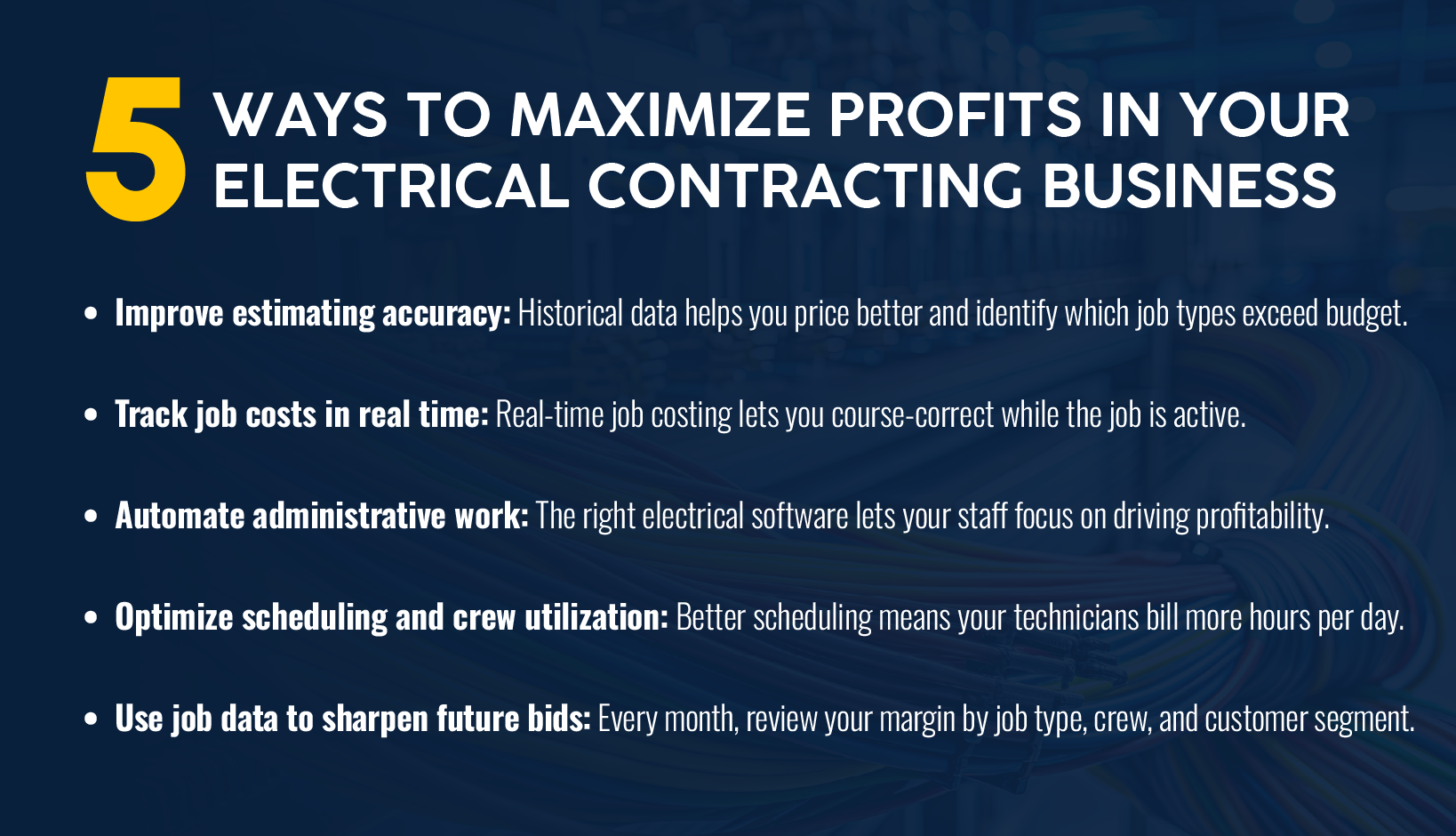
Improve estimating accuracy. Margin management starts with knowing what the job costs before it begins. Tracking estimated vs. actual hours and labor and materials on every job builds the historical data you need to price accurately — and identify which job types consistently run over budget.
Track job costs in real time. Don’t wait until the job closes to review costs. Real-time job costing lets you course-correct while the job is active. You can reassign labor, substitute materials, or adjust scope before a small variance becomes a big loss.
Automate administrative work. Manual invoicing, scheduling coordination, and back-office paperwork are overhead that doesn't generate revenue. Reduce that burden with electrical software, freeing up your office staff to focus on work that actually drives profitability.
Optimize scheduling and crew utilization. Nonbillable drive time, idle time between jobs, and poor crew-to-job matching — these situations drag down your workforce’s effective hourly rate. Better scheduling means more billable hours per technician per day, and that flows directly into margin.
Use job data to sharpen future bids. Every completed job is a dataset. Every month, review your margin by job type, crew, and customer segment. Doing so shows you which work is well-priced and which consistently runs over — giving you the data needed to maximize profits over the long term, not just react to last month's numbers.
Want to go deeper? Our article on electrical KPIs walks through the metrics that matter most for protecting margin across the full job lifecycle.
Building a More Profitable Electrical Business
If your electrical business profit margin sits in the 2% to 6% range, you’re likely dealing with several ongoing challenges. Small pricing gaps, untracked job costs, overhead creep, and slow invoicing cycles aren’t crises in isolation. But when you compound them across hundreds of jobs a year, you get an electrical contracting business that's busy, but barely profitable.
Electrical companies operating at 15% to 20% net profit margin aren't doing anything fancy. They know their numbers by job type and department, rather than just blended totals that hide the sources of average profit margin. They price based on actual cost data, not rules of thumb. They invoice fast, track labor materials in real time, and treat cash flow as a managed metric, not an afterthought.
You can achieve this operational discipline, too. Start by getting your numbers off of spreadsheets and into a system that connects your estimates, job costs, and financials in one place. Use tools built specifically for electrical businesses — not generic small-business software — to get the margin visibility you need to see what's working, and fix what isn't.
Generating more electrical leads or improving marketing for electricians can build revenue, but margin improvement starts with knowing exactly what each job costs to deliver.
Ready to see what that looks like for your business? Schedule a demo with Simpro® and find out how electrical contractors use real-time job costing and profitability reporting to hit — and hold — their margin targets.


 Back to top