
You've taken the 2 a.m. call for a breaker trip in a data closet. But emergency response doesn't teach you how to win commercial electrical maintenance contracts that pay every month even when nothing breaks. Before signing, modern facility managers expect proof that you can handle the compliance paperwork long term, not just show up for the panel swap when something fails.
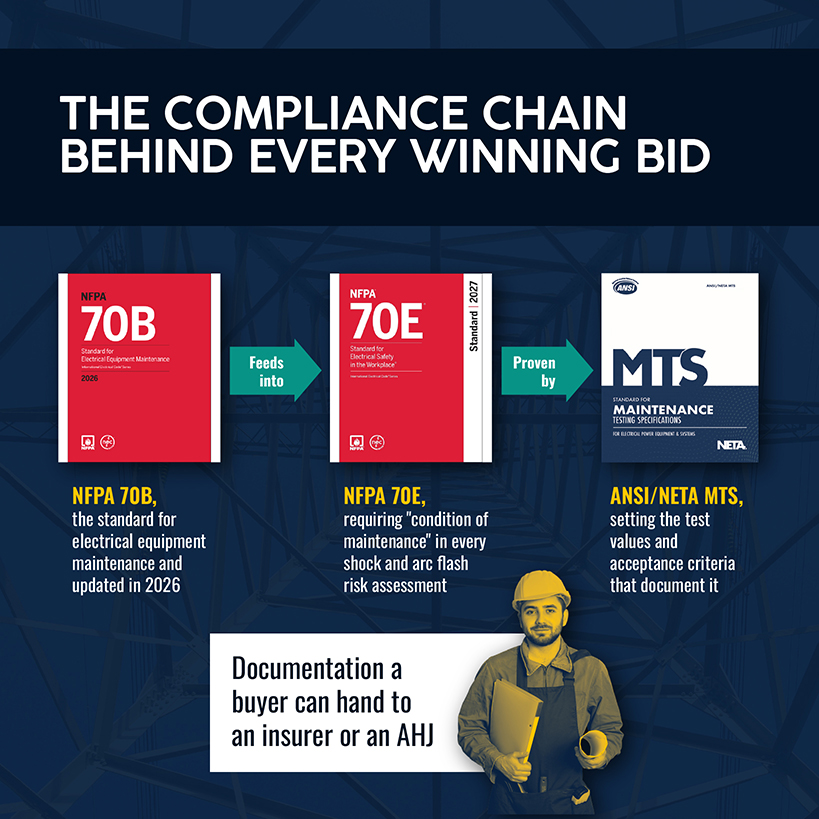
NFPA 70B graduated from a recommended practice to a standard in January 2023, with further updates in 2026. That turned electrical preventive maintenance from a discretionary line item into a paper trail building owners have to produce. The compliance chain runs through NFPA 70E's condition-of-maintenance requirement and ANSI/NETA maintenance testing specifications (MTS) test values. The contractor who understands how those compliance steps connect will be the one who wins the multi-year agreement.
The seven steps below cover qualifying, pricing, and proposing for an electrical maintenance contract that holds up under a procurement team's scrutiny. We're also sharing the metrics that show whether your maintenance agreement is actually profitable.
7 Steps to Win Commercial Electrical Maintenance Contracts That Fit Your Business
Not every building maintenance contract is worth chasing, and your first step is figuring out which fits the recurring-revenue model you want.
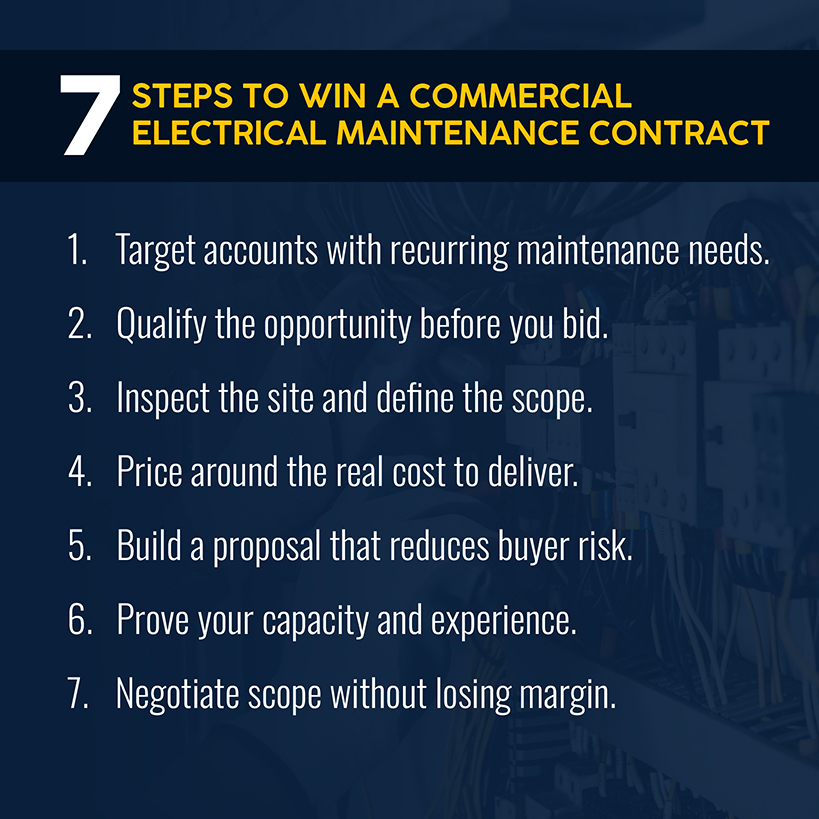
1. Target Commercial Accounts With Recurring Maintenance Needs
Most advice for how to get electrical contracts focuses on cold outreach and bid boards, which are good for one-off electrical work but not for building maintenance revenue. Winning the latter begins by picking the right buildings.
Most maintenance dollars still go to reactive service calls. Historically, the majority of commercial and industrial buildings operate with reactive maintenance, with roughly a third using preventive maintenance and the rest predictive, according to the Department of Energy's Federal Energy Management Program.
You want to target the buildings still relying on reactive maintenance, as they can't produce the "condition of maintenance" documentation NFPA 70E now requires for every shock and arc flash risk assessment. Arc flash studies add a second recurring hook, as they must be reviewed at least once every five years — meaning that a one-time engineering job can become a standing relationship.
Good targets share a few traits:
- Switchgear, transformers, and panelboards old enough to need documented testing
- A facilities team too thin to run its own preventive maintenance program
- An insurer or risk officer asking questions the building can't answer
For example, a 120,000-square-foot office building with an aging main switchboard is a better target than a new build under a commissioning warranty. Hospitals, data centers, and multi-tenant industrial parks tend to have the asset density and compliance exposure to justify ongoing electrical service contracts instead of a one-off inspection.
Once you have a shortlist that fits the profile, the next filter is whether the opportunity is worth chasing.
Related: Building this pipeline from scratch takes more than a target list. Review our guide to how to grow your electrical business.
2. Qualify the Opportunity Before You Commit to the Bid
Not every request for proposal in commercial electrical bidding is worth the estimating hours it takes you to answer. Before committing your estimator's time and attention, find out who holds the account and why the work is going out to bid. Check the building's compliance history, making sure the timeline and budget are realistic for the scope described.
A facility manager who can't produce an asset list, arc flash study, or existing maintenance plans is telling you that the incumbent (if there is one) never delivered the required documentation. Read that either as a red flag for the building or an opening to win on capability instead of price.
How sophisticated are procurement and facilities management? Institutional buyers, such as federal agencies, publish specifications with required certifications, response-time tiers, and reporting formats down to the work order. Look for commercial buildings that ask similarly specific questions about tour frequency, quality control rates, and documentation format. If a building asks only for a flat annual price with no scope detail, they're a risk. Either it's an easy win on the relationship or a low-bid fight where the cheapest number wins. Adjust your proposal preparation accordingly.
Inspection comes next. You can't price or propose what you haven't seen.
3. Inspect the Site and Define What the Contract Covers
The biggest differentiator for contractors that win institutional-grade maintenance contracts is the asset register for the building's commercial electrical systems. Federal facility specifications require the contractor to validate and continuously update equipment inventory. For each asset, that means recording such fields as tag, type, manufacturer, model, serial number, location, and nameplate data, including voltage and amperage. Many commercial buildings don't have this documentation, at least not in a usable form.
Walk the site yourself and build that register, even as a paid or bundled first phase. Doing so gives you a defensible basis for pricing, plus you give the customer a reason they can't easily walk away at renewal, as you're holding the data.
Use your walkthrough to define thermography testing scope in specifics rather than leaving it as a line item. Define which assemblies get scanned, under what minimum load, at what frequency, and what delta-T threshold triggers a corrective action.
Reference ANSI/NETA MTS section numbers in your proposal for testing procedures and acceptance values instead of writing something like, "we'll test the equipment." MTS helps establish whether equipment is operational, within manufacturer tolerances, and suitable for continued service.
Throughout, don't leave testing scope undefined, as that will eat into margin once the customer starts expecting work that wasn't priced.
The operational fix: Build the asset register and a defined scope of work into your proposal as a named and priced deliverable. With the asset list and scope defined, you can price the work against what it truly costs, rather than what feels competitive against the last job you bid.
Related: A structured walkthrough process matters. Our electrical inspection checklist shows what to capture by asset so nothing gets missed on a first-phase site survey.
4. Price the Contract Around the Real Cost of Delivering It
Start your labor build-up from a real wage number. Median electrician pay was $63,190 a year, or $30.38 an hour, as of May 2025, according to the Bureau of Labor Statistics. The federal agency projects 9% employment growth through 2035, with 72,700 openings each year, on average. Expect a tight labor market with a wage floor that rises over a multi-year contract.
Make sure to charge a premium for certified technicians, especially if the account requires ANSI/NETA ETT or NICET Level 3 qualifications. Account, too, for test-equipment amortization, engineering hours for the arc flash study, and a documented annual price escalator for multi-year terms.
Additionally, create a separate line item for after-hours testing and utility shutdowns, even when the buyer doesn't ask upfront. Some institutional specifications push those costs onto the contractor at no additional charge, potentially erasing your margin if left unpriced in a private-sector proposal. Consider a weekend switchgear shutdown at a distribution center where a two-person test crew responds. That's a very different cost than a solo Tuesday-morning panel inspection. Make it clear by pricing it in the proposal.
A defensible price only wins when it's wrapped in a proposal the buyer can evaluate against their own risk.
Related: For the full build-up methodology from labor rate to markup, see how to protect your electrical business's profit margin.
5. Build a Proposal That Reduces Risk for the Buyer
A winning proposal helps a facilities director reduce risk when they defend the decision to their boss or insurer. Mirror the structure already used by institutional buyers: a preventive maintenance plan that names each system, its maintenance standard, procedure, and frequency. Specify to ANSI/NETA MTS and put the acceptance criteria in the document itself so the buyer can see test-value thresholds instead of "we'll inspect your equipment."
Submit the plan with the proposal, not afterward. Include a sample outage and shutdown plan so the customer sees how downtime gets coordinated before signing.
Additionally, commit to a reporting cadence and response-time tiers in writing, even when the buyer hasn't asked. This might cover:
- Immediate response for emergency work orders and call-backs
- A defined response window for urgent but non-emergency calls
- Preventive maintenance completed in the month it's scheduled
- A monthly progress report covering work-order status, deferred work, and testing results
These commitments cost you almost nothing but separate your proposal from bidders who didn't address response time.
Related: If starting from scratch, the electrical bid template provides a base structure you can adapt for a maintenance scope.
6. Prove You Have the Capacity and Experience to Deliver
On paper, capability comes down to certifications, quality control, and documentation discipline. List your technician certifications against what the account requires, including ANSI/NETA ETT or NICET Level 3.
Federal specifications require review of at least 10% of completed preventive maintenance work orders and 10% of non-preventive ones. Matching or beating that rate in a proposal shows a higher level of rigor.
Every preventive maintenance visit should produce a deficiency report with photo evidence, test values against the stated acceptance criteria, a risk ranking, and a quoted corrective action. At the proposal meeting, provide a sample report to illustrate for the buyer what your approach looks like. After winning the contract, build a habit of prompt, detailed reports, which will convince existing clients to give you corrective project work when needed.
Once a buyer is convinced the work can be delivered, the last step before signing is protecting the priced number and your margin.
7. Negotiate the Scope Without Giving Away Your Margin
The contract negotiation will see buyers ask for added scope, extended response times, or separately priced costs to be absorbed instead. While these are usually framed as small asks, each request has a dollar figure, especially if the price came from a real build-up. Answer with the number, not a flat yes or no. If a buyer wants after-hours testing folded into the base price, say what that costs rather than absorbing it just to close faster.
The asset register, testing scope, and reporting cadence are your contract's operational backbone. Treat them as fixed points. What you can adjust is contract length, payment terms, or the timing of the initial asset-capture phase. Those affect cash flow more than they do your ability to deliver the work.
Track Whether the Contract Is Actually Profitable
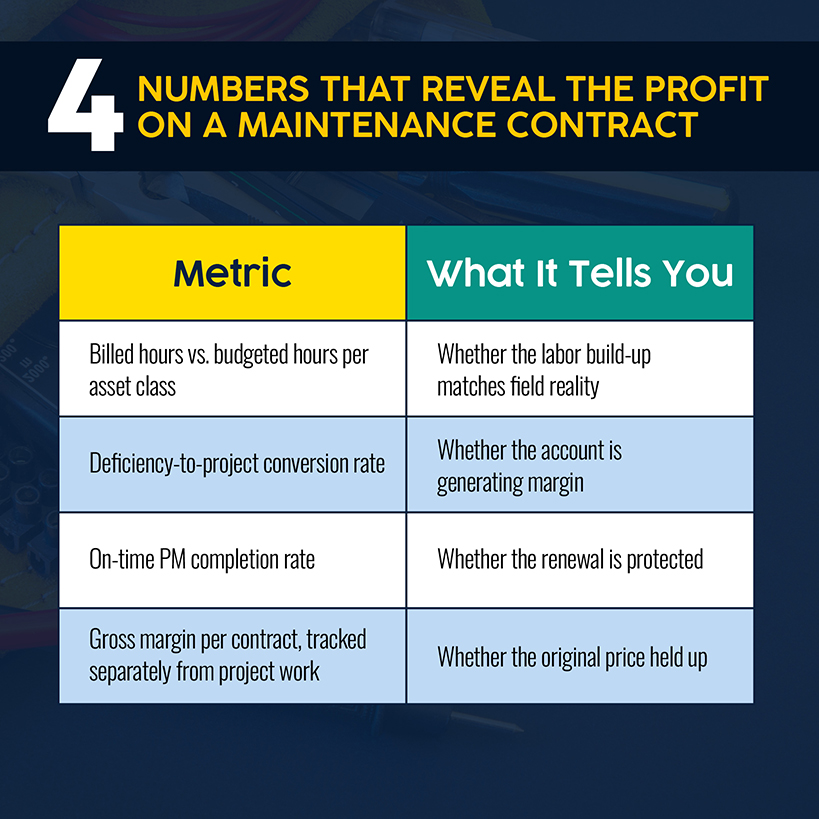
A signed maintenance agreement isn't automatically profitable. Here are some of the metrics, tracked account by account, that show whether it's holding up:
- Billed hours vs. budgeted hours per asset class. For example, switchgear and transformer testing often run longer than a flat per-visit rate assumes.
- Deficiency-to-project conversion rate. The share of flagged deficiencies that turn into approved corrective work can be the difference between breakeven and real margin.
- On-time project manager completion rate. Missed preventive maintenance windows are the fastest way to lose a renewal, regardless of how good the test data looks.
- Gross margin per contract, tracked separately from project work. This number shows you whether the labor build-up held up against reality.
The Department of Energy estimates that preventive maintenance is 12–18% cheaper than reactive maintenance over time. That's a portfolio-level average, so you'll want to track each contract against its own numbers.
Related: For a fuller list of the numbers worth watching account by account, see the electrical KPIs that protect your margin.
Use Contract Performance to Win Renewals and Future Work
When you're bidding a maintenance agreement for the first time, you lean on estimates. At renewal, however, you have actual data: Labor hours per asset, deficiency rates, testing outcomes measured against MTS acceptance values. Every claim in the proposal is backed by completed work, not an industry average.
Feed that operational history back into the next estimate. For example, fix the labor formula if switchgear testing runs 20% long; flag on the next bid when deficiency reports turn up loose connections on electrical panels from one manufacturer.
But none of this happens if your operational data lives in scattered technology or on paper instead of a central system that everyone pulls from.
Manage Recurring Electrical Maintenance Work With Simpro®
Simpro is field service management software built for trade and field service businesses like yours that run recurring, compliance-heavy work.
Quoting and estimating tools turn the labor formula from step four into a reusable template — per equipment class, switchgear assembly, transformer, and generator — instead of being rebuilt each time. Recurring maintenance planning turns calendar obligations into a schedule that generates jobs automatically and surfaces backlog before it becomes a missed project management window.
Asset management holds the asset register, including the make, model, serial number, location, nameplate data, and full service history against every piece of equipment. Job and asset documentation updates deficiency reports, test values, and technician certifications against the asset record in real time. That's how the audit trail proving condition of maintenance under NFPA 70E gets produced on demand.
More than 250,000 users run field service operations like this one on Simpro.
Build a Maintenance Contract Pipeline You Can Deliver Profitably
There are probably two or three buildings on your books that fit the profile from step one but don't have a real maintenance agreement. That's the fastest place to start. Walk through one, build the asset register, price it against real labor data, and use that proposal as the template for the next five.
The key takeaway from these seven steps is this: The compliance environment is only getting more complicated, while buyers expect more documentation as a baseline. The winners will be electrical contractors who can prove their work instead of describing it. A stable, profitable maintenance business wins accounts that renew because the paperwork holds up, not just because the price was right. Simpro gives you the asset records, recurring scheduling, and documentation trail to make that proof easy to produce, contract after contract.
Schedule a demo to see how it fits your operation.


 Back to top