
Your schedule of values is the difference between getting paid on the 20th of the month and explaining to your controller why payroll is short again.
On a commercial electrical job, that one document determines how quickly your pay application clears with the general contractor and how much retainage sits against your cash for the next six months. Get it wrong, and an architect kicks the whole package back for revisions.
This guide will walk you through eight comprehensive steps for handling a schedule of values and progress billing for commercial electrical jobs. By the end, you’ll know what a line-item breakdown looks like, how to calculate progress billing, and how to verify percent complete without guessing.
What Is an Electrical Schedule of Values?
An electrical schedule of values breaks down your total contract amount into itemized portions of work, each carrying its own dollar value. It's the document your progress billing runs against for the life of the job. Under AIA A201 general conditions, the SOV has to go to the architect before your first application for payment, in whatever form the contract requires.
AIA G702 is the certified summary sheet, while underneath, G703 carries the line items, such as: Scheduled value, work completed to date, materials stored, percentage complete, balance to finish, retainage.
Beware of relying on a generic schedule of values for electrical contractors. Copy-pasting from a standard industry checklist means you’ll miss the specifics of electrical work. Without this structure, you end up not being able to bill for expensive equipment that’s sitting in a warehouse, even though you've already paid for it.
The Construction Specifications Institute's guidance for the schedule of values (SOV) varies by project, but prices are typically apportioned in this order: by area, specification section, type of work within that section, material and equipment costs, delivery to site, and installation labor.
It's this level of detail that applies cleanly to lump-sum and cost-plus work. By contrast, unit-price scopes generally don't need an SOV, as the unit becomes payable the moment it's installed to spec.
How a Schedule of Values Supports Electrical Progress Billing
Every payment application you submit is measured against the SOV, so its accuracy determines whether it clears or is sent back for revisions. The Construction Specifications Institute frames the SOV as a risk-allocation tool: You want to bill early to keep cash flowing and protect your days revenue outstanding (DSO), while project owners and their stakeholders want to know you’re not being paid ahead of the work completed.
That tension plays out on any commercial electrical construction project, whether it's a $1.8 million school renovation or a $12 million data center buildout.
Specialty trade construction companies carried 22 days of cash on hand in fiscal 2024, up from 19 days the year before. Three weeks of cash isn’t much runway to float a rejected pay application. It's even less secure on federally funded work. Under FAR 52.232-27, progress payments are due 14 days after the billing office receives a proper request, and primes then have seven days to pay subcontractors after that. If you don’t submit the SOV in the format expected by the billing office, that clock doesn't start.
Related: See how backlog and billing fit in a cash flow forecasting model you can actually plan around.
8 Steps to Creating an Electrical Schedule of Values and Using It for Progress Billing
Building the SOV happens in the first two weeks of the job, before you send the first application for payment. Get these eight steps right, and every billing cycle thereafter runs off a proven document.
1. Review the Contract Scope and Billing Requirements
Start by reading the construction contract and seeing how the owner and architect want billing handled. Some general contractors require the AIA G702/G703 pairing. Others run their own billing software with a specific line-item structure that your SOV needs to match. Either way, the contract tells you the retainage percentage, payment schedule, milestone stepdowns, and required lien waiver form.
California, for example, requires a conditional waiver under Civil Code §8132, effective only once the bank confirms the check has cleared. Sign the unconditional version against a check that hasn't cleared, and you've voided your lien rights on that payment.
At this step, also confirm who's responsible upstream for payment terms. On private commercial work, that's whatever Article 9 of an AIA-based prime contract says. On federal or federally funded jobs, FAR 52.232-27 sets the clock.
The operational fix: Pull the billing article and the retainage clause before you break down scope. Note the required waiver form, the architect’s certification deadline, and whether a state statutory retainage cap applies.
2. Break the Electrical Scope Into Measurable Work Packages
Break your scope into work packages that map to how the job gets built and billed, rather than just section numbers from the Construction Specifications Institute.
A defensible commercial electrical schedule of values usually carries separate lines for:
- Mobilization and submittals/shop drawings, gear submittals especially, since approval cycles gate everything else
- Temporary power
- Underground and slab rough-in
- Branch rough-in by floor or area
- Feeders and buses
- Gear and panel set
- Electrified devices and trim
- Fixtures
- Fire alarm and low-voltage systems
- Testing and commissioning
- Operation & maintenance (O&M) manuals and as-builts
- Punch list and closeout
Consider a $4 million hospital electrical package spanning 14 months with a 12-person crew split across rough-in and gear set. How you structure electrical scope can make the difference between billing gear the day it's set and waiting until the entire floor is finished.
Compare that to a $1.8 million school renovation with a 5-person crew and a compressed summer schedule. The packages are smaller, but the principle holds: Group fixtures and devices as 'finishes' instead of breaking them out, and you can't bill fixtures on delivery if devices won't be trimmed for three more weeks.
3. Assign a Contract Value to Every Line Item
Every line item needs a dollar value that ties back to your estimate. Cross-reference each line against your job cost budget. You want gross profit front-loaded into early activities rather than punch list and closeout, where it's hardest to collect. If your feeder and gear line items are underloaded relative to month-two labor and material, you're financing the back half of the job with the front half's margin.
The operational fix: Front-load billing weight toward the fastest-cash-converting items: submittals, gear delivery, rough-in. Price closeout at what it's actually worth.
Related: Review our guide to electrical business profit margin so the margin you load into the SOV holds up against labor and materials.
4. Align the Schedule With Cost Codes and Project Tracking
Your SOV line items should map to the cost codes your team uses to track labor and materials. When percent-complete is pulled from job cost data instead of rebuilt in spreadsheets every month, you'll bill the right number and be able to defend it on a site walk.
Aligning the SOV with cost codes also makes work-in-progress reporting possible. If your SOV and job costing don't talk to each other, you're manually reconciling two systems every billing cycle, on every active job, right when your controller is trying to close the month.
Related: Refresh your memory on how to bid and estimate electrical jobs so you get the contract value right up front.
5. Account for Stored Materials, Retainage and Closeout Work
AIA A201-2017 §9.3.2 lets you bill for materials and equipment delivered and stored on-site, as well as for material stored off-site when the owner has approved the location in advance. To collect on this, you need:
- A clear title
- The ability to transfer that title free of liens
- Proof from your suppliers, available on request
- Documentation of how the material is stored
- Insurance
Off-site material should get its own line item instead of being folded into the associated work. Per the Bureau of Labor Statistics, producer prices for nonferrous wire and cable rose 12.2% from July 2025 to July 2026, and 18.4% for copper and brass mill shapes.

If you lock in pricing by buying feeder wire and switchgear early, you're carrying a fast-appreciating, cash-hungry asset for months before it goes into the wall. Bill it as stored material, however, and that cash comes back sooner.
Retainage terms vary by state and by public or private work. New York caps private retainage at 5% on contracts over $150,000, requires release within 30 days of final approval, and charges 1% monthly interest if the owner sits on it past that. Wisconsin's public works schedule stops adding retainage once a project hits 50% complete. Check your state's statute at bid time, not at closeout.
The operational fix: Track retainage as its own receivable with its own aging. It's the last money in and the easiest to lose. On 12–18 month jobs, you might not catch a problem until an audit.
Lien waivers belong in this conversation, too. A201-2017 §9.3.1 lets the owner or architect require releases and waivers of lien from your subcontractors and suppliers as substantiating data.
Related: These electrical inventory management best practices enable the recordkeeping that makes a stored-material claim collectible.
6. Submit the Schedule of Values for Approval
Submit the SOV to the architect before your first payment application, with any substantiating data the contract requires. Treat that first application as a template so values stay consistent and the architect doesn't relearn your billing format each cycle.

It also helps to know why applications get held up. Under AIA A201-2017 §9.5.1, an architect can withhold certification for seven reasons:
- Defective work that hasn't been remedied
- Third-party claims or reasonable evidence one is coming
- Failure to pay your own subcontractors or suppliers
- Evidence the remaining balance won't cover completing the work
- Damage to the owner or another contractor
- Evidence the work won't finish on schedule with what's left in the contract
- Failure to follow the contract documents
Three of those seven are documentation failures. An electrical sub whose fire alarm or low-voltage sub hasn't been paid can get its application held over someone else's invoice.
The operational fix: Before you submit, walk the SOV with your project manager and, where the relationship allows it, informally with the architect or owner's rep. A five-minute conversation can save you the delays and costs of a rejected application.
7. Calculate Progress and Prepare Each Payment Application
For each billing cycle, calculate the percent complete for each line item, and apply it against the scheduled value to calculate what's been earned.
The cleanest billing is for repetitive scopes: devices trimmed, fixtures hung, feeders terminated, panels set. A unit either happened or didn't. Continuous scopes without a natural unit, like temp power maintenance or general conditions, require judgment calls and can lead to disputes.
Share the billing percentages with your foreperson a few days before the application goes out. They know what got done and can flag anything inaccurate.
8. Add Change Orders and Reconcile the Remaining Balance
Change orders get their own line items on the SOV as they're approved. Approved change orders that sit unbilled raise the risk of the full job becoming underbilled.
Separate line items are cleaner for audits and disputes. As the job nears substantial completion, reconcile the remaining balance against actual cost to complete, not just contract value, so overruns surface before they eat your margin.
Under AIA A201-2017 § 9.10.1, final payment and remaining retainage aren't due until you certify that all debts and claims are satisfied and provide final lien releases. Start that paperwork as soon as scope is substantially complete.
The operational fix: Shift money away from final closeout. Start punch lists, O&M manuals, and as-builts as soon as submittals are approved. No SOV fixes a punch list that's been growing for six months and eating your margin.
Commercial Electrical Schedule of Values Example
Here's that structure applied to a $1.1 million electrical package. The figures are illustrative, but follow the AIA G703 column structure and the work-package breakdown from Step 2.
| Line Item | Scheduled Value | Billed to Date | This Period | Materials Stored | % Complete | Retainage (5%) |
|---|---|---|---|---|---|---|
| Mobilization & Submittals | $45,000 | $45,000 | $0 | $0 | 100% | $2,250 |
| Underground & Slab Rough-In | $180,000 | $126,000 | $36,000 | $0 | 90% | $8,100 |
| Feeders & Gear | $310,000 | $93,000 | $62,000 | $85,000 | 50% | $12,000 |
| Branch Rough-In (Floors 1-4) | $220,000 | $110,000 | $55,000 | $0 | 75% | $8,250 |
| Devices & Trim | $95,000 | $0 | $19,000 | $0 | 20% | $950 |
| Fixtures | $140,000 | $0 | $0 | $42,000 | 0% | $2,100 |
| Fire Alarm & Low-Voltage | $85,000 | $17,000 | $8,500 | $0 | 30% | $1,275 |
| Testing, O&M & Closeout | $25,000 | $0 | $0 | $0 | 0% | $0 |
| Total | $1,100,000 | $391,000 | $180,500 | $127,000 | 52% | $34,925 |
Notice that the Feeders & Gear line carries $85,000 in stored material value despite a field percent complete of only 50%. That's the §9.3.2 clause in action, and where an SOV leaves money on the table if you’re not tracking closely.
How to Calculate Electrical Progress Billing
The math behind electrical progress billing is:
- Work completed to date ÷ scheduled value = percent complete
- (Percent complete × scheduled value) + materials presently stored = total earned to date
- Total earned to date − retainage = net earned to date
- Net earned to date − billed to date = what to bill this period
Percent-complete errors carry forward, since each step references cumulative totals. Pull it from job cost data, not a project manager's estimate.
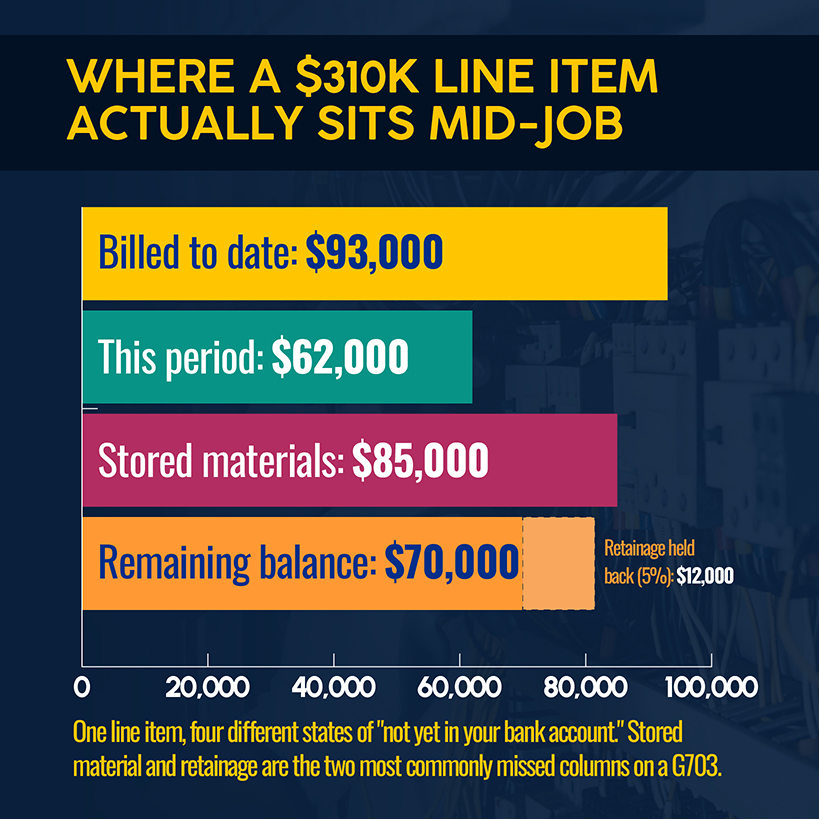
Take the Feeders & Gear line from the example above, with a scheduled value of $310,000 and prior billing of $93,000. This period's completed work is $62,000, and stored materials total $85,000.
The total earned to date is $155,000 in completed work plus $85,000 in stored materials, or $240,000. The 5% retainage holdback comes off that full total — $12,000 — leaving $228,000 net earned to date. Subtract the $93,000 already billed, and this period's application on that line is $135,000.
Now imagine there’s an error here, and multiply it by 12 line items and a monthly billing cycle. This is why rebuilding SOVs in spreadsheets every month creates risk, not just extra hours for your employees.
How to Verify Percentage Complete on an Electrical Project
The reliable version of percent complete is costs incurred divided by total estimated cost for that scope. Compare that number against the completion percentages billed to date.
If billed is running ahead of cost-to-cost, you're overbilled, which is fine as long as it's intentional. If cost-to-cost is running ahead of billed, you're underbilling, which means you’re indirectly financing the owner's project with your cash.
The operational fix: Track overbilling and underbilling separately across your job list. One job running ahead doesn't offset another job falling behind, but a blended metric hides which is which.
Related: Find out about the electrical KPIs that protect margin.
Build a Reliable Electrical Billing Process With Simpro®
If you're still rebuilding your SOV in a spreadsheet every month and cross-referencing job cost reports that live in a separate system, you already know where errors creep in.
Simpro® ties progress claims to the same cost structure your job was estimated and costed in. That means the percentage you bill comes from actual job cost data that’s updated in real time, not a re-created estimate. That's a meaningful shift from billing software that lives apart from your job costing, where percent complete is really just a project manager's best guess written into a spreadsheet.
With Simpro for Electrical Contractors, job costing, billing, and inventory work together in one system. Retention is tracked as its own line, with the aging and release clock visible rather than buried in general accounts receivable. Inventory and purchase order records document exactly what you bought, where it's stored, and when title passed. This gives you a stored-material claim you can collect instead of struggling to substantiate G703 columns.
Contractors who move commercial electrical billing, job costing, and inventory into one system report a 30% increase in productivity once they're no longer reconciling three tools to bill one job.
Your schedule of values only protects your cash flow if the numbers behind it hold up under review. Get your billing tied to the numbers you costed jobs at so you can submit every payment application with confidence. Schedule a demo.


 Back to top