
A rooftop unit at a medical office has two histories in most commercial HVAC shops. Shops that sort their work into project vs. service jobs close the install paperwork with the project and open a separate set of tickets for the techs who service the unit afterward. When the compressor fails on a hot Tuesday, the tech has half the record and the closeout binder has the other half.
The two tools exist because the work runs as two businesses. A shop with a much bigger service share than projects leans harder on dispatch and utilization than on project margin. The trouble starts when a service finding turns into a replacement quote, because the customer, the site and the unit belong to both businesses. The handoff has no owner.
Fixing that takes one record that both teams write to, and a clear line between a service job and a project.
Project vs. Service Jobs: What's the Difference?
A service job and a project job differ in how long the work runs and how they get billed. A service job repairs or maintains installed equipment in hours or a day, and you price it per visit, at a flat rate or under an agreement. A project job installs or replaces systems over weeks, and you build it from an estimate, track it against a budget and bill it in progress stages.
Each row marks a point where managing projects and dispatching service calls pull a shop in different directions.
| Category | Service job | Project job |
|---|---|---|
| Trigger | Service call or maintenance schedule | Bid or award |
| Duration | Hours to a day | Weeks to months |
| Pricing | Flat rate, T&M or agreement | Fixed price or guaranteed maximum price |
| Costing | Per ticket | Budget by cost code |
| Billing | On completion | Progress claims and retainage |
| Metrics tracked | Utilization, first-time fix, average ticket | Job margin, work in progress (WIP), margin fade |
| Records | Asset service history | Submittals, as-builts, warranties |
Related: Service work and projects price differently, so settle T&M vs fixed price before the estimate goes out.
The line between the two blurs at replacement. The U.S. Census Bureau puts a major replacement, such as a new heating system, in the same category as additions and alterations. It reserves maintenance and repair for "incidental construction work that keeps a property in ordinary working condition." Replacing a rooftop unit is therefore project work even when a service tech found the problem, so the tech's finding crosses from one job type to the other at the quote.
Where Running Two Separate Systems Breaks
Picture a 45-person commercial shop with eight service techs and two install crews. Dispatch runs in one tool, and project tracking happens in spreadsheets.
A tech replaces a $1,800 condenser fan motor on a 12-year-old rooftop unit and notes that the unit is near the end of its life. The crew that installed it left the model and serial number in a closeout binder. Nothing in the dispatch tool points to either. The $38,000 replacement quote waits until someone remembers to build it.
The same gap shows up in five places:
- A customer and site entered twice, so a gate code or a facilities contact updated in one tool never reaches the other.
- A service tech can’t see the equipment the install crew set up. ASHRAE/ACCA Standard 180 requires an equipment inventory in which each unit is uniquely identified, and that inventory is hard to produce when install records and service history live in two places.
- A service call that turns into a quote and gets re-keyed into the project tool. The quote goes out late, and the photos, readings and access notes that justified it get thinner on the way.
- Margins that can’t be compared across work types, because a $1,800 ticket and a $38,000 job get costed on different cost types in different tools.
- Resource allocation can’t see both sides. Install crews and service techs work from different boards, so the lead tech gets sent to a no-cooling call on the morning a crew needs a startup sign-off, and neither dispatcher spots the conflict.
The operational fix: Pick one record for each customer, site and piece of equipment, and make service and project staff both write to it. Every later step builds on that record.
Related: Before you buy, compare how work orders for commercial contractors software handles call notes and photos.
How to Run Service and Project Work in One System
Each step removes one place where information gets retyped, and each builds on the step before it. Service and project management software in one platform only pays off when the customer, site and equipment data underneath is shared, which is why the order matters.
Start With One Customer, Site and Asset Record
Give each customer one record, hang its sites off that record and hang each unit off its site. The unit your install crew commissions is then the unit your service tech opens a year later, with model, serial number and capacity already attached instead of copied from a binder. Add custom fields for gate codes and roof access. Classify each job as service, maintenance or project when it's created, so reports can split the work later.
Related: If you want that inventory to drive recurring work, read more about asset maintenance planning.
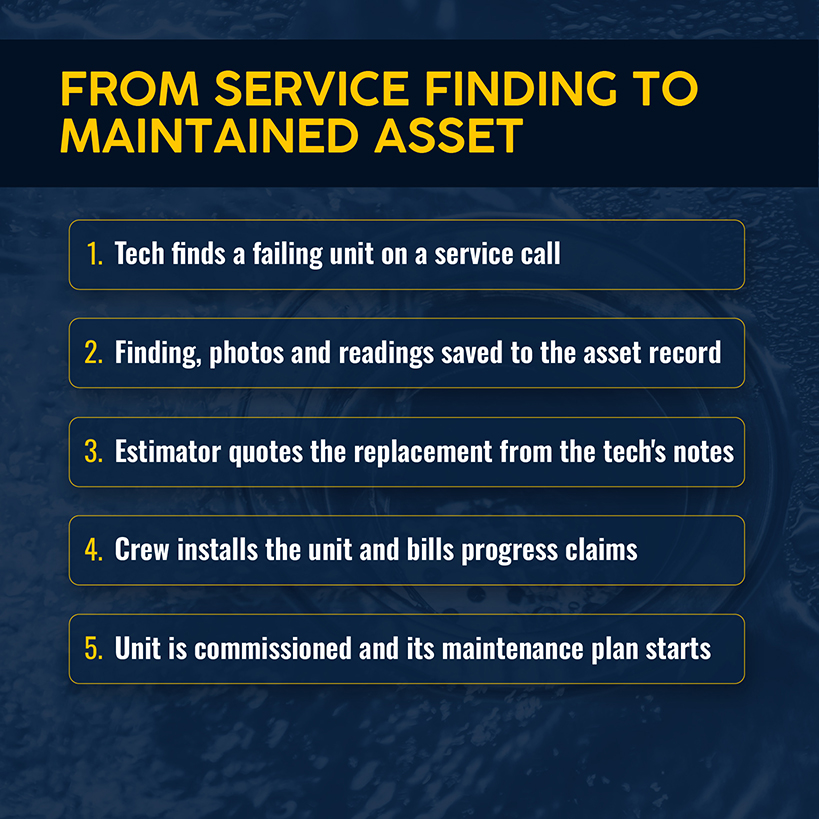
Turn Service Findings Into Quoted Projects Without Re-Keying
A tech who flags a failing compressor on a 14-year-old unit at a medical office has already done the survey. The finding, photos and readings should convert into a quote on the same asset and site, so the estimator starts from the tech's notes instead of a phone call. Assign tasks for the handoff to a named owner, usually the service manager or the estimator, because a finding nobody owns sits in the ticket until the unit fails. Kanban boards with columns for found, quoted, approved and scheduled show which findings are still waiting on a price.
Buchanan & Hall, a 25-person commercial refrigeration and HVAC shop, links its quotes to jobs in Simpro® and builds quote templates from past job data.
Related: When you shortlist tools, compare how quoting and invoicing software carries a tech's finding through to the invoice.
Hand Finished Projects to the Service Team as Maintained Assets
A finished install should become a maintained asset at closeout, so project planning has to include the maintenance plan and its first due dates before commissioning wraps. The Department of Energy's Federal Energy Management Program says preventive maintenance can save as much as 12% to 18% on average over a reactive program. Use that number with the owner while the crew is still on site.
That plan needs a home before the install crew leaves the roof. In Simpro’s Maintenance Planner, you set up the new unit’s recurring visits at closeout: quarterly filter changes and annual coil cleanings on the calendar, a service tech assigned to the site and a flat rate pre-build for each visit. The first PM call lands on the service board already tied to the asset your crew commissioned, so nobody has to remember the unit exists.
Schedule Service Techs and Project Crews on One Board
Techs and crews pulled from one labor pool belong on one calendar, which is where resource management for a mixed shop starts. A visual project schedule of the install crew’s next three weeks, beside today’s dispatch, keeps a startup from getting booked on top of a service rush.
Related: For installs and service on one schedule, read the broader view in commercial HVAC job management.
Cost Every Job One Way, Bill Each Type Its Own Way
Use the same labor, material and subcontract cost types on every job so margins compare across work types. Run time tracking the same way on service tickets as on projects and tasks, so an hour of labor costs the same in both reports. Simpro's project management features handle deposits, progress claims, final claims and retention claims, and they show estimated costs against actual costs as the job moves.
Related: When project costs drift from the estimate, a closer look at job cost variance shows where.
Report Margin by Work Type
Blended margin hides which line is working. Say your shop reports an 18% blended gross margin. That number can sit on 30% maintenance agreements and 11% projects, and nobody sees the gap. Set your management tools to report reactive service, maintenance agreements and projects separately every month. If the project’s based on a fixed-price model, look for underpriced bids. If service trails, check whether your flat rate book is outdated.
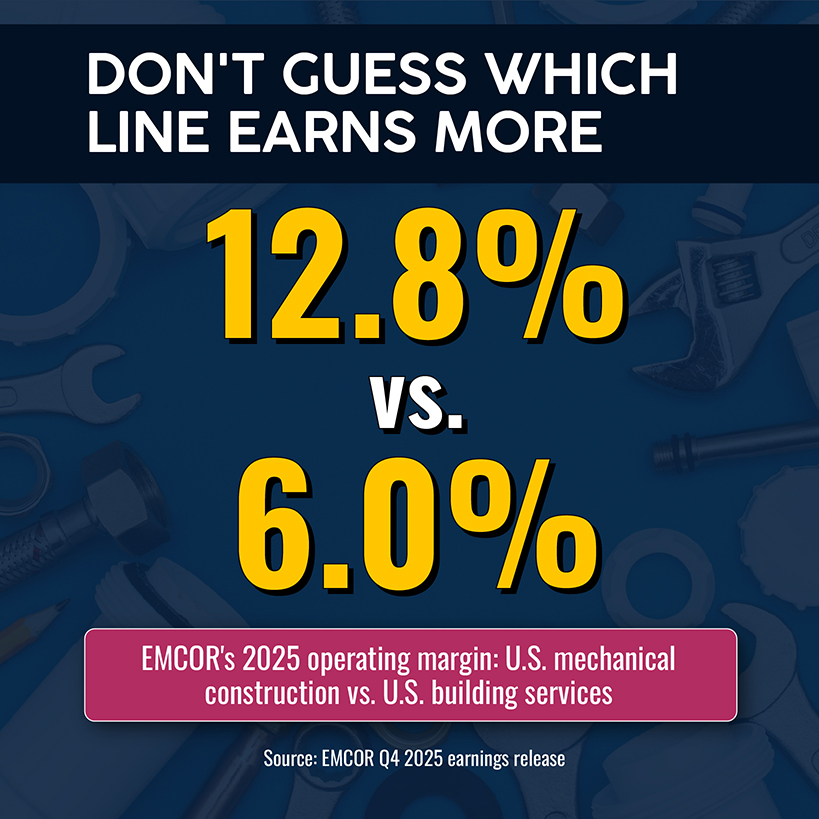
A common rule of thumb says service pays better than projects. EMCOR's 2025 results run the other way. They put its U.S. mechanical construction segment at a 12.8% operating margin and its U.S. building services segment at 6.0%. Those are different segments of a multibillion-dollar contractor and a poor benchmark for your shop, but they're a reason to measure your own split instead of assuming one.
Related: Flat rate pricing starts with a price book, and an HVAC price book built on your real costs keeps service margins honest.
Test a Platform Against Your Real Job Mix
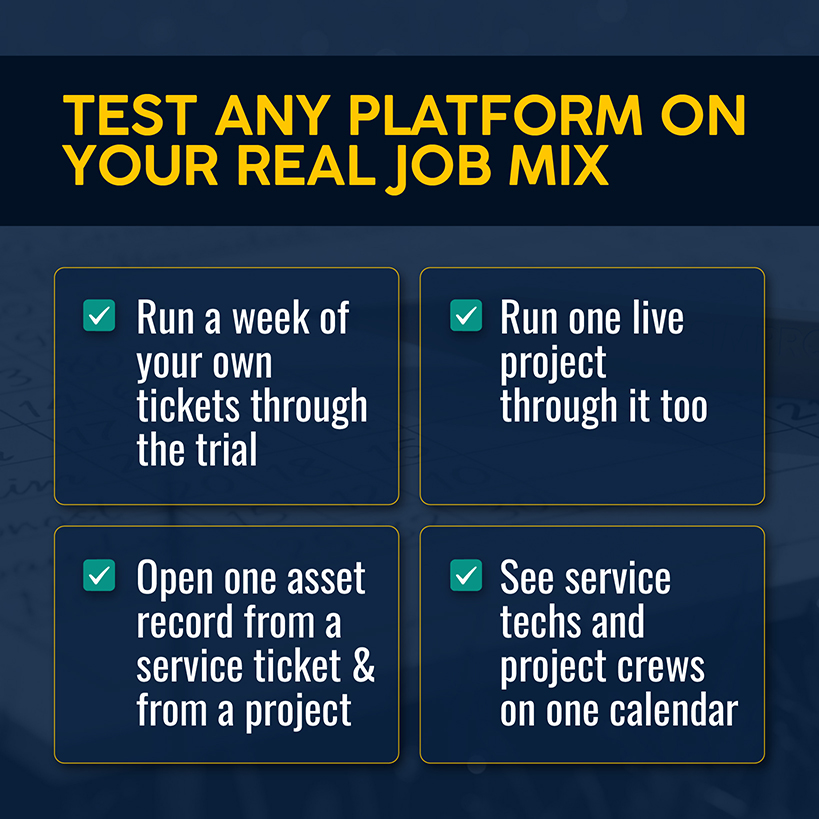
Run a week of actual tickets and one live project through any trial before signing. Two checks settle most decisions. Ask to see one asset record opened from both a service ticket and a project, and ask to see service techs and project crews on one calendar. A platform that still needs a separate project management tool for budgets and billing puts you back in two systems.
More than 250,000 users run on Simpro, built for the trades, so service, maintenance, and project work share one platform instead of borrowing from tools designed for IT teams or general contractors. Its project tools include Gantt charts and WIP reports, so a trial can show a timeline view of a live job.
Related: Quote-to-project conversion, variations and progress claims all sit under project management in Simpro Premium.
One Record From First Service Call to the Next Maintenance Visit
Trace the last replacement your shop closed back to the tech's first note, and count how many times the same details were typed. Each retyped entry was a chance for the model number to drift.
Related: HVAC contractors who want the product side of this can start with Simpro for HVAC.
The target is one entry per detail, read by the estimator, the install crew and the next maintenance visit.
If your count came back higher than one, each extra entry sat between the tech's finding and the customer's quote. More than 24,000 businesses run on Simpro. Bring your real job mix and see how Simpro handles service and project work side by side. Schedule a demo to learn how.
FAQs
What Is the Difference Between a Project Job and a Service Job?
A service job repairs or maintains installed equipment on a short cycle and bills when the visit ends. A project job installs or replaces systems against a budget and bills in progress stages.
Can One System Handle Both Service Calls and Projects?
Yes, if it keeps one customer, site and asset record under both and lets one team manage tasks across service calls and projects on the same schedule. It also has to support each job type's own costing and billing.
What's the Difference Between Project Management Software and Field Service Management Software?
Project management software plans long jobs through task management and bills them in stages. Field service management software dispatches technicians and tracks the assets they service. A commercial HVAC contractor needs both capabilities, either in two tools that share data or in one platform.


 Back to top
