
TL;DR
- Retainage is the share of each progress payment the payer holds until the work is accepted. Federal contracts allow up to 10% and only when progress is unsatisfactory, and seven of the eight states in the table below cap it at 5%.
- The release clock starts at project completion, final approval or your own completion, depending on the statute.
- The claim is a closeout package, a separate retainage pay application and conditional lien waivers, followed up on a schedule.
- Late retainage can carry 1% monthly interest, and federal bond claims have 90-day and one-year deadlines.
- On a $620,000 electrical subcontract, a 10% to 5% step-down at the halfway mark keeps $15,500 more in your account than a flat 10% hold.
Retainage in construction is the portion of your pay you earn on day one but can't collect until the job is accepted. The general contractor holds back a slice of every payment, often 5% or 10%, and that money stays put until someone files the paperwork to release it. On a $620,000 subcontract held at 10%, that's $62,000 in someone else's account after your punch list is signed.
Most contracts define retainage in one line, such as 10% of each payment until final completion. That line leaves out what decides when you see the money. Getting that $62,000 back means working through three questions in order about retainage: the cap, the release date and the claim.
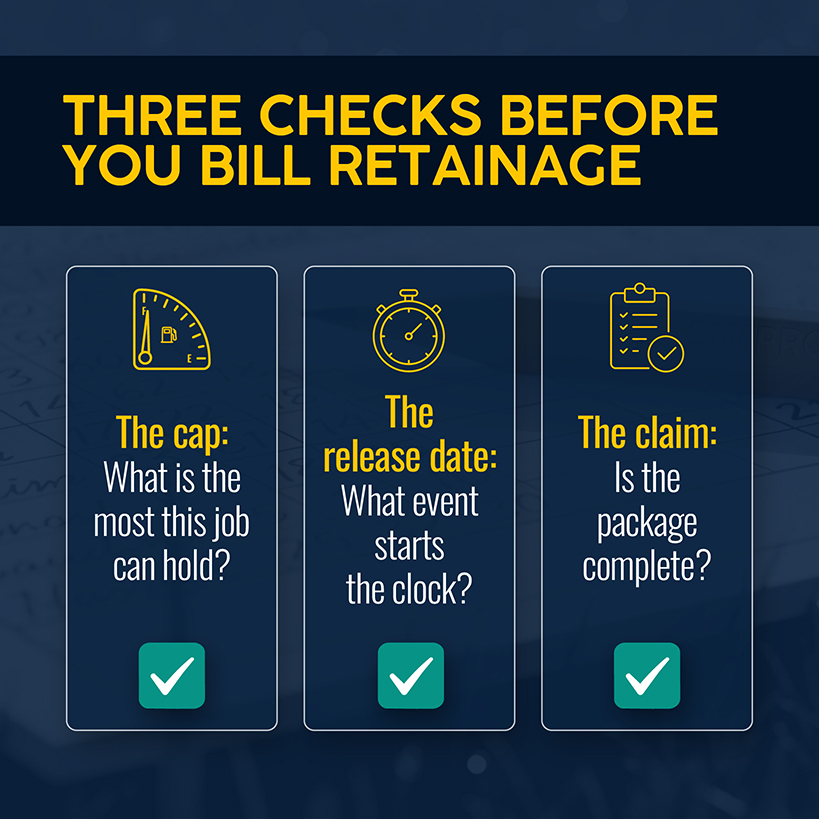
Federal rules, state laws and private contracts answer each of those questions differently, so there are links to many of the statutes or regulations that apply.
What Is Retainage in Construction?
Retainage is the share of each progress payment that stays with the owner, or with the general contractor on its way down to you, until the construction project passes acceptance. It's the payer's way to get the contractor to complete the punch list items and to keep subcontractors and suppliers down the chain paid. The contract sets the rate and the terms, and many states add a cap, a release deadline or interest on late payment.
Related: Contract terms are set up front and work-in-progress reporting tracks the balance. This guide to commercial electrical project management covers both.
What is retainage in construction once a job has several tiers? Every tier of a commercial job can withhold retainage from the tier below it: the owner from the general contractor, the general contractor from you, and you from your own subcontractors and suppliers. Each contractor or subcontractor waits on the tier above it, so a closed job can still show a balance months later. How big that balance gets comes down to one multiplication.
How Is Retainage Calculated?
Multiply each progress payment by the retainage rate in the contract: the product stays with the payer, and you receive the rest.
Take a hypothetical $620,000 electrical subcontract billed in eight equal pay applications of $77,500, with 10% retainage that drops to 5% once the job reaches 50% complete. Each of the first four applications holds $7,750 and pays $69,750, so the fourth application holds $31,000. From the fifth on, each application holds $3,875, and the total held at completion is $46,500, or 7.5% of the contract. A flat 10% would have held $62,000, so the reduction milestone keeps $15,500 more in your account.

Related: Multi-phase electrical jobs create a retainage balance with every claim, and the post on progress claims and retainage on complex jobs covers the claim methods and retainage settings that apply.
Money held through completion has a carrying cost: $46,500 carried for six months at an assumed 8% cost of capital runs about $1,860, so swap in your own rate. If that cost never shows up in the bid, it comes out of your profit margins, and statutes in many states cap the rate.
Retainage Rules: The Cap, the Release Date and the Claim
Retainage rules shift with project type and state, so the same $620,000 contract can face a different ceiling and a different release clock. This is general information and isn't legal advice.
How Much Retainage Can Be Held
Statutory caps focus on public works, while private contracts mostly follow their own terms, except in states that have legislated, such as California for new contracts from 2026 and New York. On federal construction contracts, FAR 32.103 allows retainage only when a contractor hasn't achieved satisfactory progress and caps the hold at 10% of the approved estimated amount.
| Jurisdiction | Maximum retainage | Statute |
|---|---|---|
| Federal construction | 10%, only when progress is unsatisfactory | FAR 32.103 |
| California public works, contracts from 2012 | 5% of each payment and of the total contract, with limited exceptions | Public Contract Code 7201 |
| California private works, contracts from 2026 | 5% of each payment and of the total contract, except non-mixed-use residential of four stories or fewer | Civil Code 8811 |
| New York private construction | 5%, never more than the owner holds back | General Business Law 756-c |
| Florida public construction | 5% of each progress payment | Florida Statutes 255.078 |
| Georgia public works, contracts from 2022 | 5% of each progress payment | O.C.G.A. 13-10-80 |
| Oregon construction and home improvement | 5% of the contract price of the work completed | ORS 701.420 |
| Texas public works | 10% under $5 million, 5% at $5 million and above, with some exemptions | Texas Comptroller |
| Virginia public construction | 5%, including subcontracts | Virginia Code 2.2-4333 |
| Washington public improvements | 5%, held in trust, with a bond allowed in its place | RCW 60.28.011 |
Under Civil Code 8811, a 10% hold on a California private commercial contract signed after January 1, 2026 runs past the cap unless the bid request gave written notice of a required bond, and the prevailing party in a suit to enforce the cap recovers reasonable attorney's fees. A state missing from the table can still have a cap.
The operational fix: Match the retainage clause in every open contract to the cap for its project type and state. Flag any clause above it before your next pay application goes out.
When Retainage Must Be Released
A cap tells you how much you can hold, and the release date tells you when it ends. Some statutes start the clock at substantial completion and others wait for final approval, so the same job can carry release dates months apart.
- New York: Under General Business Law 756-c, the owner releases within 30 days after final approval of the work.
- Georgia public works: Under O.C.G.A. 13-10-80, the owner pays within 30 days after the invoice is received once the work is substantially complete.
- DOT-assisted projects: Under 49 CFR 26.29, the prime pays retainage within 30 days after the subcontractor's work is satisfactorily completed.
A release date can also slip on a dispute. California lets a direct contractor delay retention only for a good-faith dispute between the contractor and subcontractor about that specific payment, as the state Supreme Court held in United Riggers v. Coast Iron, and Civil Code 8814 limits the amount withheld to 150% of the estimated disputed value and requires payment to the subcontractor within 10 days after the direct contractor receives retention.
The operational fix: Record the release trigger and the statutory deadline next to each open job in your tracking sheet, so every job shows a calendar date for release.
Early and Line-Item Release for Subcontractors
Trades that finish early wait longest when release is tied to the whole project's closeout. Take a hypothetical $180,000 low-voltage package accepted in month six of an 18-month build. At 10%, the $18,000 held stays with the general contractor until the other trades complete the project 12 months later, unless the subcontract ties release to your scope. Two rules tie the clock to your own work instead. On DOT-assisted projects, the 30 days run from your satisfactory completion, and on federal contracts FAR 52.232-5 calls for payment without retention on completion and acceptance of each separately priced division of work.
Both give you language to request in a private subcontract: release on acceptance of your scope, with the clock starting on your completion. You'll want the request in writing, with the closeout package attached, the day your scope is accepted.
Related: Trade businesses that bill commercial work can see how Simpro® handles progress billing and retainage claims for commercial contractors.
Private subcontracts add one more wait, because your payment can depend on someone else's.
How Pay-When-Paid Clauses Move the Release Date
A pay-when-paid clause links your payment to the moment the general contractor gets paid. Retainage then inherits two waits: the owner releases to the general contractor once the owner considers the project completely finished, and the general contractor releases to you after that. Some states limit pay-if-paid clauses, which make your payment conditional on the owner paying the general contractor, so check your state's rule before you sign one. A flow-down clause passes the prime contract's retainage terms to you, so read the prime's rate and release language first. Ask for three terms in negotiation:
- A retainage rate no higher than the rate the owner holds from the general contractor, which California and New York already require.
- Release keyed to acceptance of your scope instead of the whole project.
- A fixed number of days after the general contractor receives your retainage from the owner.
The operational fix: Mark every pay-when-paid or pay-if-paid clause in your subcontract template and add the three terms above to the redline before the first pay application.
How to Claim Your Retainage Back
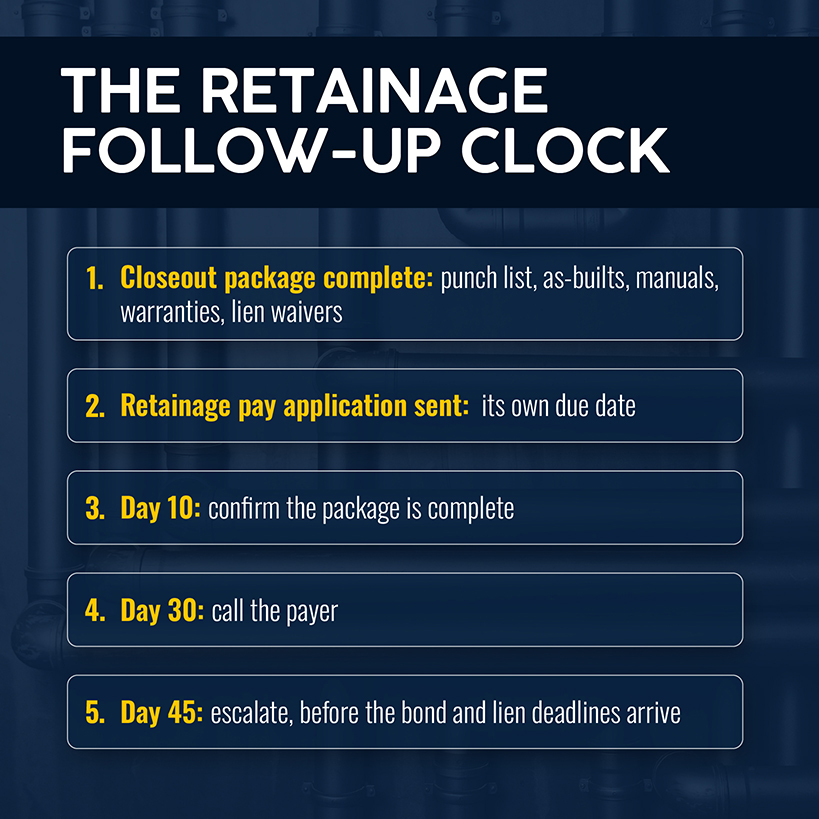
A release date only helps when the payer has a complete request in hand, so the claim starts with the closeout package: the signed punch list, as-built drawings, operation and maintenance manuals, warranties and lien waivers. If any one of them is missing, you've handed the payer a reason to wait.
Don't include retainage in your last progress billing. Bill it on its own pay application with its own due date, and run your follow-up against that date. On a 30-day clock, check on day 10 that the package is complete, call on day 30 and escalate on day 45, which leaves a record before the bond and lien deadlines arrive.
California's Contractors State License Board publishes statutory waiver forms for progress payments and final payment, each in conditional and unconditional versions. A conditional waiver takes effect only once payment arrives, and an unconditional waiver certifies that you've already received it, so send conditionals until the funds clear. Other states may prescribe their own forms, so check yours first.
Related: The Simpro page on construction invoicing covers invoicing against milestones and completion percentages.
What to Do When Retainage Is Paid Late
Late retainage payments cost the payer interest in some states, and missed deadlines can cost you the claim. New York adds 1% per month on retainage not released when due, which is $465 a month on $46,500. Oregon charges 1% per month on the unpaid balance starting 30 days after the contractor completes the work and the owner accepts it, under ORS 701.420.
Start with a written demand that names the statute and the amount due, and on DOT-assisted work cite the 30-day prompt-payment rule in 49 CFR 26.29. If that fails, the bond and lien deadlines decide what remedies remain. They run short. On City of Seattle work, the period for filing a lien on retainage ends 45 days after the City accepts the project. On federal jobs covered by the Miller Act, a person without a direct contract with the prime must give written notice within 90 days after the last labor or material. That person may sue on the payment bond once 90 days pass without full payment and must file suit within one year after the last labor, under 40 U.S.C. 3133.
Related: Teams that chase overdue invoices with calendar reminders can automate that follow-up with Simpro's FastCash.
How to Reduce the Cash Flow Hit From Retainage
The cheapest retainage is the amount you never have to chase, and three levers head off cash flow issues before the job starts. The first is the rate and its reduction milestone, which the $620,000 example showed is worth $15,500. The second is the bid itself. Price the $1,860 carrying cost from the earlier example, along with the release timeline your contract allows, before the proposal goes out.
The third is substitute security. Washington lets a contractor submit a bond for all or any portion of retainage on public improvements. The public body must release the bonded portion within 30 days after accepting the bond under RCW 60.28.011. Ask whether your state offers the same option, then compare the bond premium against your cost of carrying the cash.
Related: Pricing retainage into a bid starts at the quote, and the guide to software for quoting and invoicing covers how an accepted quote carries through to billing.
Make Retainage Part of Your Project Closeout Process
Which of your open jobs has a retainage release date on the calendar today? If you can't answer that at a glance, the retainage is aging because the balance, the dates and the paperwork live in three different places and matching them is rarely anyone's assigned job.
Related: Simpro's project management tools can generate deposits, progress claims, retainage claims and final claims.
If closed jobs on your receivables report still show retained funds, your closeout process isn't carrying the claim from the job to the payer.
Margin sitting in a general contractor's account can't cover payroll or materials. Simpro supports more than 250,000 users worldwide, and its commercial contractor software generates progress invoices and retainage claims. Schedule a demo today to learn more.
FAQs
Is Retainage the Same as Retention?
Yes. The retainage definition is the same under either name: a percentage held back from each progress payment until the work is accepted. California statutes say retention in Civil Code 8811, while FAR 32.103 and many other states say retainage.
What Is a Typical Retainage Percentage?
The statutory ceilings in the table above run from 5% to 10%. On the $620,000 example, 10% is $62,000 and 5% is $31,000.
How Long Can Retainage Be Held?
The release trigger in your contract and the statute for your project set the limit. New York requires release within 30 days after final approval, while Florida Statutes 255.078 sets no retainage deadline and instead applies the payment-request time limits.


 Back to top
