
"Just get it running" and "Give me a price on a tune-up." These are two different requests, but both force a decision on time and materials vs. fixed price for service work before dispatch can send a truck. A flat rate doesn’t make sense for the first situation, as the tech needs to open the unit before establishing scope. And because a tune-up is a 40-point checklist, hourly billing makes the customer pay for a slow-moving technician.
The Federal Acquisition Regulation (FAR), which governs how the U.S. government buys work, simplifies when to use time and materials pricing: Only use time and materials (also known as T&M) when you can’t estimate the job’s extent, duration, or cost “with any reasonable degree of confidence.” Fixed price applies whenever the tech can scope in advance.
Choosing T&M vs. a fixed-price contract determines who pays when it runs long, which in turn determines whether your margin comes from beating the estimate or charging the right hourly rate.
At a Glance: Time and Materials vs. Fixed Price for Service Work
| Time and Materials | Fixed Price | |
|---|---|---|
| You bill | Actual labor hours at an agreed rate, plus materials | One price agreed up front against a written scope of work |
| Who absorbs an overrun | The customer, up to any agreed cap | You |
| Where your margin comes from | The burdened hourly rate and materials markup | Finishing under the estimate |
| Fits best | Unknown scope, troubleshooting, discovery work | Repeatable tasks with historical hours |
| Main exposure | Disputed hours and slow invoicing | Scope creep and stale material prices |
Worth noting: Three of those rows turn on who eats an overrun.
The Real Difference Is Who Carries the Cost Risk
Each model shifts financial risk differently. A fixed-price contract, often called a flat rate or lump sum contract, makes the contractor answerable for each dollar of cost, profit, and loss. Your margin comes from beating the estimate. T&M passes the overrun to the customer, giving you no built-in reason to work faster. The rate caps your margin and must cover the true cost of putting a tech on the job.
These two project examples illustrate the time-and-materials contract vs. fixed-price debate.
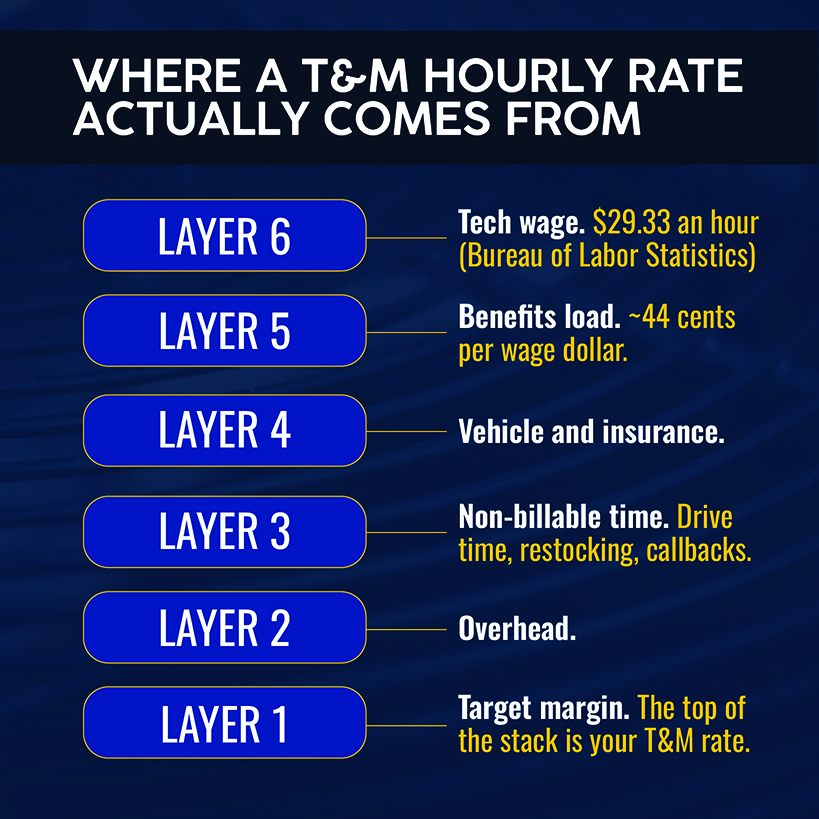
T&M: The average construction employer paid $51.97 per hour worked in June 2026, according to the Bureau of Labor Statistics (BLS). Of that, $36.13 went to wages and $15.84 to benefits, or 44 cents of benefits for every wage dollar.
The median HVAC mechanic and installer makes $29.33 per hour, according to the most recent BLS data. Apply the same benefits-to-wage ratio, and you’re looking at $42 per hour before vehicles, certain insurance, non-billable time, or overhead.
How does this apply to a T&M rate? If you build it as wages plus a 30% markup, you end up at $38.13, and every billed hour still falls short of labor costs alone.
Fixed price: The CFMA 2025 Construction Financial Benchmarker found that specialty trade contractors made a 22.4% gross profit and a 7.7% net income before taxes on FY2024 revenue, with direct costs at 74.2% of revenue.
On a job priced at those averages, a 10% overrun on direct costs takes 7.4% of revenue — nearly the entire net margin. Under T&M, that overrun shows up on the customer's invoice. Under a fixed price contract, it comes out of your margin.
Choosing T&M or Fixed Price for Different Types of Service Work
When comparing time and materials vs. fixed price for service work, match the model to the job. Scope is often a better indicator than ticket size or the trade involved.
Emergency Repairs and Troubleshooting Work
A rooftop unit trips its breaker at 4:45 p.m. on a Friday in July. You don’t know whether the issue is a $150 part or a failed compressor until a tech puts a meter on it. This work is tailor-made for T&M because you can't estimate accurately until the tech investigates.
Quoting a fixed price before diagnosis means pricing blind, and the wrong number costs you either the job or the margin. However, you can still apply a fixed price structure with these steps:
- Charge a flat diagnostic or call-out fee, using your after-hours rate.
- Quote a fixed price for the repair after diagnosis.
To win customers over, consider crediting the diagnostic fee toward the repair. If the customer wants the tech to keep working while you source parts, bill labor on T&M, with a not-to-exceed cap that requires written approval to exceed.

Routine Service and Preventive Maintenance
You've run hundreds of 40-point tune-ups, so you know the hours. Price it flat. But make sure you’re pricing to real-life conditions, because missing by 10 minutes per tune-up adds up over time. Pull the last 50 tune-ups, look at the average and the spread in on-site time, and price to the hours your crews actually log.
A maintenance contract offers the same idea in bulk. Visits are bundled into a recurring fixed price, creating predictable tech schedules and cash flow. The exception is a unit that fails inspection. Anything found beyond the checklist gets its own quote instead of a hidden discount inside the agreement.
Standard Repairs, Replacements, and Installations
Fixed pricing is the right choice for repeatable jobs with a known parts list and job history. You can estimate accurately, and your margin comes from finishing at or under the quoted number.
Picture a two-tech crew swapping a 3-ton condenser. The quote assumed 4 hours, but your last dozen swaps averaged 5.5. At roughly $42 an hour per tech, that’s $126 of unrecovered labor cost before overhead. This is where job costing data pays off: Quote against the 5.5-hour average, and update it as new jobs come in.
Complex Jobs With an Uncertain Scope
A panel upgrade for a house built in 1974. A boiler swap with unknown pipe conditions. A tenant buildout on a construction project with drawings that are two revisions behind. These jobs are where T&M vs. fixed-price contract isn’t the right debate, because you need both.
A fixed quote on these jobs needs a contingency, but the customer won't like it. But relying on T&M for the whole job means the customer can’t see the total cost. Split it instead: Price the defined scope at a fixed number, and bill discovered conditions on T&M against a cap.
How to Decide Before You Send the Quote
These four questions help you decide when to use time and materials pricing and when to set a fixed price:
- Can you name the scope today? If a tech has seen it or a checklist covers it, quote fixed. If the answer's behind a wall, start with a diagnostic fee.
- Do you have actual hours for this job type? A fixed price is only as accurate as the hours behind it. Without history, you're guessing.
- What could change before the last invoice? Material prices can change while quotes sit open, so add a shelf life or an escalation clause.
- Can techs record time and materials on-site? T&M revenue depends on the ticket; having to log hours at the end of the week leaks revenue.
If you get a mix of answers, you might need both contract types.
Related: Learn how to price service jobs profitably, including labor burden, margin targets, and when to choose flat rate or T&M.
Protecting Your Margin on T&M Work
Once you’ve chosen, you need to defend your margin. Start with the rate. A T&M hourly rate typically includes wages, overhead, general and administrative expenses, and profit. Don’t settle for just wage plus a markup. Build the rate from fully burdened cost (wages, payroll taxes, benefits, workers' comp, vehicle, non-billable time, overhead), then add your target margin. Set material markups the same way.
After the rate, protect the ticket:
- Log time and materials daily, on the job.
- Get the customer's sign-off on every ticket. An unsigned ticket is an invoice you'll negotiate.
- Set a not-to-exceed cap and require written approval before crossing it. For example, federal T&M contracts require a ceiling price that you exceed at your own risk.
- Invoice when the work ends. Every week of lag leaves you financing payroll and parts.
The operational fix: Pick one job this week, bill it on T&M, and compare the hours on the signed ticket with your tech’s logged hours. A gap reveals where revenue's leaking.
Related: Find out how location-aware data supports accurate labor tracking.
Protecting Your Margin on Fixed Price Work
For fixed-price contracts, start by writing down the project scope, listing exclusions, and treating anything else as a priced change order before the work starts. A customer would rather hear, "That costs extra" at the quote stage than mid-job after a long day.
Materials need a shelf life. BLS producer price data show nonferrous metals up 33.0% over the 12 months to August 2026 (preliminary), albeit with month-to-month fluctuation up and down. Put a validity date on quotes, or add an escalation clause to the terms.
Next, check the estimate against reality. Pull actual hours by job type, per quarter, and compare them with what you quoted. A 10% overrun on direct costs can erase nearly all of a job's net margin. If the job type runs that far over twice in a row, you need to reprice.
The operational fix: Choose the job type you sell most, pull the last 20 invoices, and compare quoted hours against clocked hours. If the average miss is over 10%, the price is wrong.
Related: Learn about protecting service margins as material and labor costs climb.
Can You Use T&M and Fixed Pricing on the Same Job?
For jobs with an uncertain scope and complexity, combining fixed price and time and materials is often the best structure.
Consider a panel upgrade on a house built before 1974. You can quote the panel, meter base, permit, and inspection at a fixed price. Anything found behind the panel — such as deteriorated wiring or a missing ground — should be billed on T&M at your burdened rate, with a cap that requires written approval to cross. The customer benefits by knowing the final price’s floor and ceiling before the tech opens the wall.
These two habits help you with a hybrid approach:
- At the quote stage, the fixed-price agreement should state what triggers T&M so undiscovered work isn't a surprise.
- Apply basic project management: Track each scope against its own budget. Blended tracking can hide where margin is leaking because the overall number looks fine.
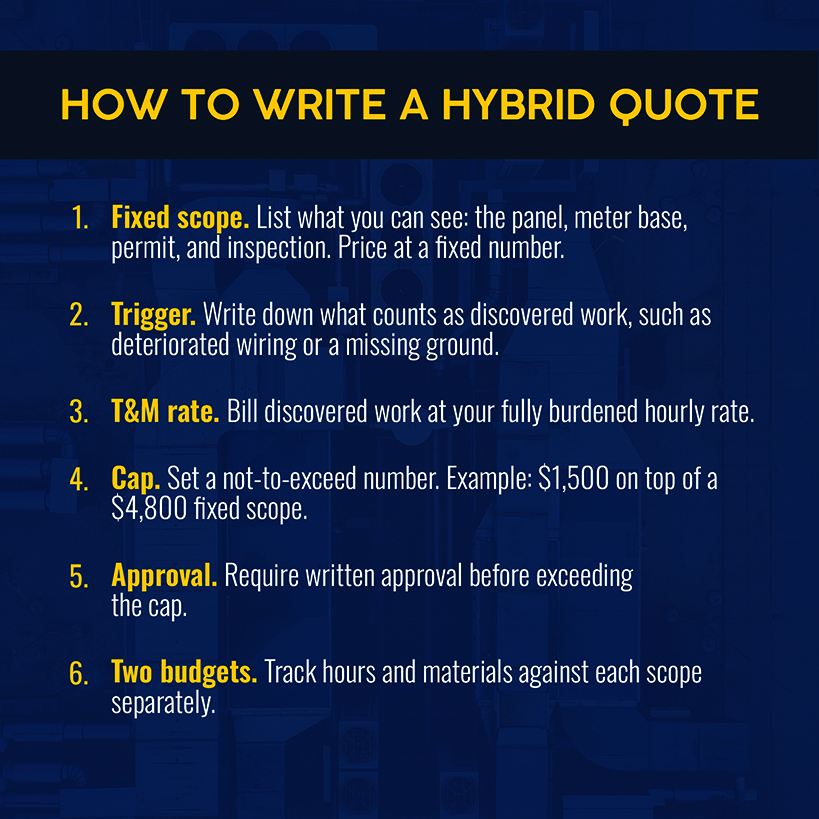
A hybrid job produces two sets of numbers, and both need to show up somewhere besides the invoice.
Track the Numbers That Tell You Whether Your Pricing Is Working
Company-wide margin doesn’t tell you which pricing models are performing. For example, you might have a 22% blended margin while running 30% on T&M and 14% on fixed price. Instead, measure gross margin by pricing model. CFMA’s gross profit benchmark of 22.4% offers a reference point.
When one model lags, three job-level numbers explain why:
- Fixed price: Compare actual hours with estimated hours by job type. Any type that misses twice in a row gets repriced.
- T&M: Track days from job completion to invoice. A gap of weeks means your payroll is carrying the customer.
- Hybrid: Track how often discovery work exceeds its not-to-exceed cap. If most jobs exceed it, the cap is set too low.
Each of these numbers depends on data captured while the job runs.
Related: Missing job details and corrected time entries are common sources of field service margin leaks.
Manage T&M and Fixed Price Work With Better Job Cost Visibility
Simpro® is field service management software built for the trades, with 24,000+ businesses running jobs from quote to invoice. With Simpro, quotes calculate labor, material, travel, and overhead costs for a job. Technicians clock in and out on Simpro Mobile, record travel time, and allocate the materials they used on-site. Job costing tracks billable and non-billable parts, labor, contractors, and equipment against the job.
The Breakdown Table on a job's Summary tab sets estimated costs beside actual costs before you invoice. On project jobs, the Financial View adds actual and projected margin.
Enhanced Electrical shows how increased visibility improves T&M work. A week on-site used to generate pages of hand-calculated write-ups, with invoices taking 4–6 weeks to go out. After moving to Simpro, invoices went out within a few days, and the company gets paid within 30 days instead of 60–90. Enhanced Electrical can also compare estimated hours against actual hours in real time and break jobs into cost centers, which is the kind of structure a hybrid job needs to track each scope individually.
You probably know which of your jobs belong on which model. The harder question is whether last month's jobs behaved that way. Simpro shows estimated and actual project costs side by side while the job is still open, which gives you room to raise a change order or reprice the next quote before margin disappears.
Schedule a demo to learn how you can improve your quoting, estimating, pricing, and job costing.


 Back to top