
Most HVAC business owners don't have a demand problem. They have a capacity problem. The U.S. HVAC market is expected to reach $65 billion in 2025 and grow to over $82 billion by 2030. The customers are there. What holds operators back is what happens between the service call and the invoice — the missed callbacks, the underpriced estimates, the shoulder season cash gaps, and the office buried in manual work it shouldn't be doing.
Growing an HVAC business means more than adding trucks or hiring techs. It means tightening the systems that turn jobs into profit, building revenue streams that don't depend entirely on new customers, and creating a marketing engine that fills the calendar before the season turns. For most HVAC contractors, the path to growing your HVAC company isn't about working more hours — it's about building an operation that works without you being the critical path for every decision.
3 Reasons HVAC Businesses Fail to Grow
Running an HVAC business gets harder before it gets easier. The patterns that hold back HVAC business growth aren't random — they're structural. Whether you're trying to scale an HVAC business past your first few trucks or figure out how to run a successful HVAC business long-term, the same three blockers keep coming up.
The Operation Isn't Built to Sustain It
At three trucks, a busy owner can hold most of the business in their head. Quoting, scheduling, job updates, invoicing — it all flows through one or two people who know where everything is. It works, until suddenly it doesn't.
At six or eight trucks, that same system becomes the ceiling. Office staff spend hours manually updating spreadsheets, chasing job status from the field, and rebuilding purchase orders from memory. HVAC technicians wait on parts that should have been pre-assigned. Customers call about invoices that haven't gone out yet. The owner is still the critical path for decisions that should be handled without them.
That's operational drag — the primary reason HVAC businesses stall out not from lack of work, but from an office that can't keep pace with it. Over 65% of HVAC businesses in the U.S. never surpass $1 million in annual revenue — not because of competition, but because of fixable operational bottlenecks.
There's No Predictable Sales and Marketing Engine
Most HVAC companies grow on word of mouth and reputation. Word gets around that you do good work, the phone rings, and the schedule fills up. That model builds real businesses — and it hits a real ceiling.
Word of mouth is inconsistent by nature. You can't forecast it, can't accelerate it in March when the shoulder season hits, and can't depend on it to support a second location or a new service line. When the pipeline dries up, there's no lever to pull.
The HVAC business owners who grow past that ceiling have built something different: a repeatable system for generating leads, converting estimates, and turning potential customers into long-term accounts. They know which marketing channels produce bookable jobs, what their close rate is by service type, and what a maintenance customer is worth over five years versus a first-time caller. If you can't pull those numbers today, that's the gap to close first — you can't optimize a marketing channel you're not measuring.
They're Undercapitalized When It Matters Most
Hiring a new technician, buying another truck, or bridging a slow shoulder season all require cash before they generate it. Most small HVAC operations don't carry enough runway to make those moves confidently — so growth stalls at the exact moment it should accelerate.
Cash flow problems are behind the majority of small business failures across every industry, and the HVAC industry is no exception. A healthy net margin for an HVAC business runs 10–20%, with top operators reaching 20–30% through tight operations. Most operators are nowhere near that — the average sits below 5% — which leaves very little buffer when growth creates new costs before new revenue catches up.
Undercapitalization becomes a much smaller problem once the first two are solved. An operation that runs efficiently and a revenue pipeline that's predictable create the financial foundation — better margins, steadier cash flow, more leverage with lenders — that makes growth fundable. Fix the machine first. Then fuel it.
Stop Running Your Business on Manual
The operations changes that matter for a successful HVAC business aren't about working harder or adding headcount. They're about removing the friction that costs your team time every single day — the manual steps, the status updates, the follow-up tasks that no one tracks but everyone feels.
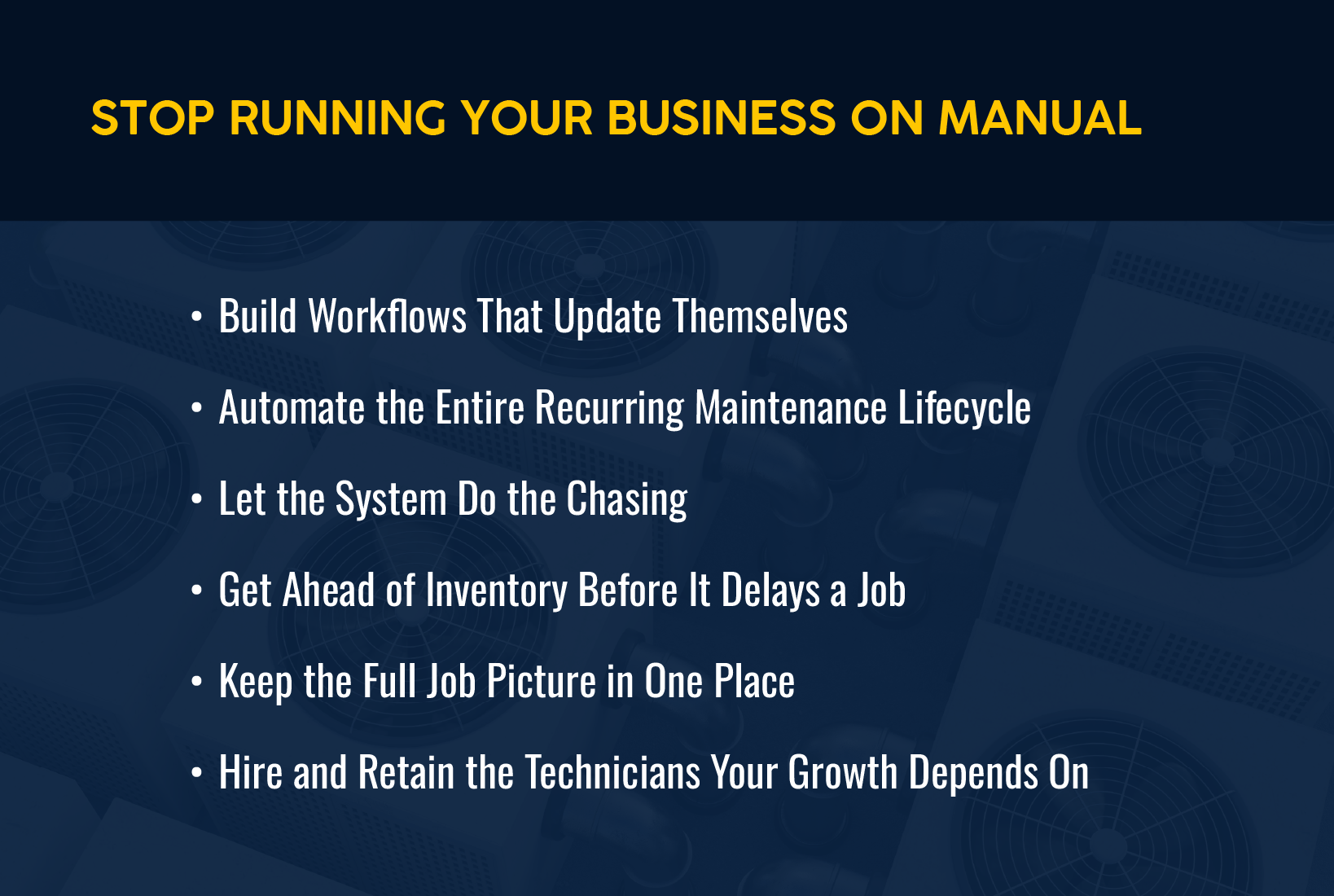
Build Workflows That Update Themselves
Every time a tech completes a job and someone in the office has to manually update a spreadsheet, change a job status, or move a card on a board — that's friction. Multiply it across 20 jobs a day and you're looking at a part-time admin role that's invisible on the P\&L but very visible to your team.
The fix is baking status progression into the workflow itself. When an action happens — a quote gets emailed, a job gets scheduled, a tech checks out from site — the system updates automatically. No manual step, no lag, no follow-up required.
Simpro's Status Codes and Automatic Triggers handle this at the workflow level. When a user performs a natural workflow action, the system updates the project's status code, changes its color on the schedule, and can move the job to the next stage without anyone touching it. For a business running 40+ jobs a week, that's the difference between a dispatch board that's current and one that's three hours behind. Pairing this with the right HVAC apps for field teams removes the last manual gap between site and office.
Automate the Entire Recurring Maintenance Lifecycle
Maintenance agreements are one of the strongest levers in the HVAC business — and one of the more tedious to run manually. Every recurring visit needs to be scheduled, confirmed, and invoiced. At scale, that work is relentless, and the answer isn't to hire another office person.
Simpro's Maintenance Planner, combined with Automated Scheduling, Automated Invoicing, and Automatic Payments via Square or Stripe, handles the full loop: job generates → tech gets dispatched → job completes → invoice goes out → card gets charged. No one has to touch it.
For a business with 200 active maintenance agreements, that eliminates potentially 400+ manual tasks per year. You can read more about structuring maintenance workflows in the asset maintenance management guide.
Let the System Do the Chasing
Hours get lost every week on follow-up that shouldn't need a human at all: quotes waiting on approval, HVAC professionals needing compliance reminders, invoices sitting unpaid. Each task feels minor — together they're a significant drag on office capacity.
System-level automation handles this without staff intervention. You can configure rules to automatically text a contractor confirming job details, alert a salesperson days before a quote expires, or send a courtesy reminder to a customer before an invoice is due. The communications go out based on events, not manual effort — which means they actually go out, every time. That consistency is part of what defines the customer experience at scale.
Get Ahead of Inventory Before It Delays a Job
Manually counting stock and building purchase orders from scratch is one of the most underestimated time sinks in an HVAC operation. It delays jobs when parts aren't on hand, introduces errors when quantities get estimated rather than counted, and creates a recurring fire drill at busy periods.
Simpro's inventory tools — Minimum/Restock Levels, Auto Assign Stock, and Automatic Catalogue Syncing — cut through most of that. The system monitors stock levels continuously and generates a purchase order automatically when items fall below a predefined minimum, populated with the exact quantities needed to restock. Auto Assign Stock allocates materials directly from storage to the job. Catalogue syncing keeps material costs current from supplier feeds without manual updates.
For an HVAC company running mixed residential service and commercial installs, material cost accuracy matters — especially as equipment prices fluctuate. Protecting job margins starts with knowing what your parts actually cost at the time of the quote. If your technicians are calling the office to check stock before heading to a job, that's the first workflow worth automating.
Keep the Full Job Picture in One Place
When a customer calls back three weeks after a job, how quickly can someone pull up the full picture — what was quoted, what was installed, what the tech noted on site, what was emailed, and when? For most HVAC businesses, that means checking two or three different places and hoping nothing fell through the cracks.
Simpro's Activity Timeline builds a chronological, timestamped record of everything that happens on a job: system events, mobile updates from the field, forms submitted, emails sent. The Data Feed integration can automatically capture incoming and outgoing emails and append them to the job timeline as notes, removing the need for anyone to manually log correspondence.
That history pays off in ways that aren't obvious until you need it — handling disputes cleanly, prepping for a site revisit, or getting a new tech up to speed on a customer's equipment without a phone call to whoever worked it last.
Hire and Retain the Technicians Your Growth Depends On
The HVAC industry is short roughly 110,000 technicians nationally, with about 25,000 leaving the field every year through retirement, burnout, and career changes. Nearly 30% of current technicians are over 55. You can build the best operational systems in your market and still hit a hard ceiling if you can't staff the trucks to run them.
Recruiting has to be active, not passive. That means partnerships with trade schools and apprenticeship programs, not just job board postings. It means being specific about what you offer — not just wages, but career path, tools, technology, and culture. HVAC professionals fielding multiple offers are paying attention to whether they'll be handed a clipboard and a paper route sheet or a mobile app with full job history and real-time dispatch. That distinction matters more than most owners realize.
Retention is where the real cost lives. Replacing a trained technician runs $15,000–$30,000 once you account for recruiting, onboarding, and the ramp to full productivity. The HVAC businesses that hold onto their best people combine competitive compensation with genuine visibility into performance — technicians who can see their own numbers, understand what good looks like, and have a path from field tech to lead to supervisor tend to stay. Simpro's reporting gives managers the data to have those conversations concretely, and gives technicians the mobile tools that make field work less frustrating and more professional day to day. Businesses using Simpro report a 30% improvement in field productivity — which is also the kind of metric that justifies performance bonuses and builds the culture that keeps people around.
Create a Revenue Model That Holds in the Off-Season
Break-fix revenue is real revenue — but it's unpredictable by nature. The HVAC businesses that grow steadily, even through slow seasons, have diversified beyond it. They've built revenue that's contracted, recurring, and compounding.
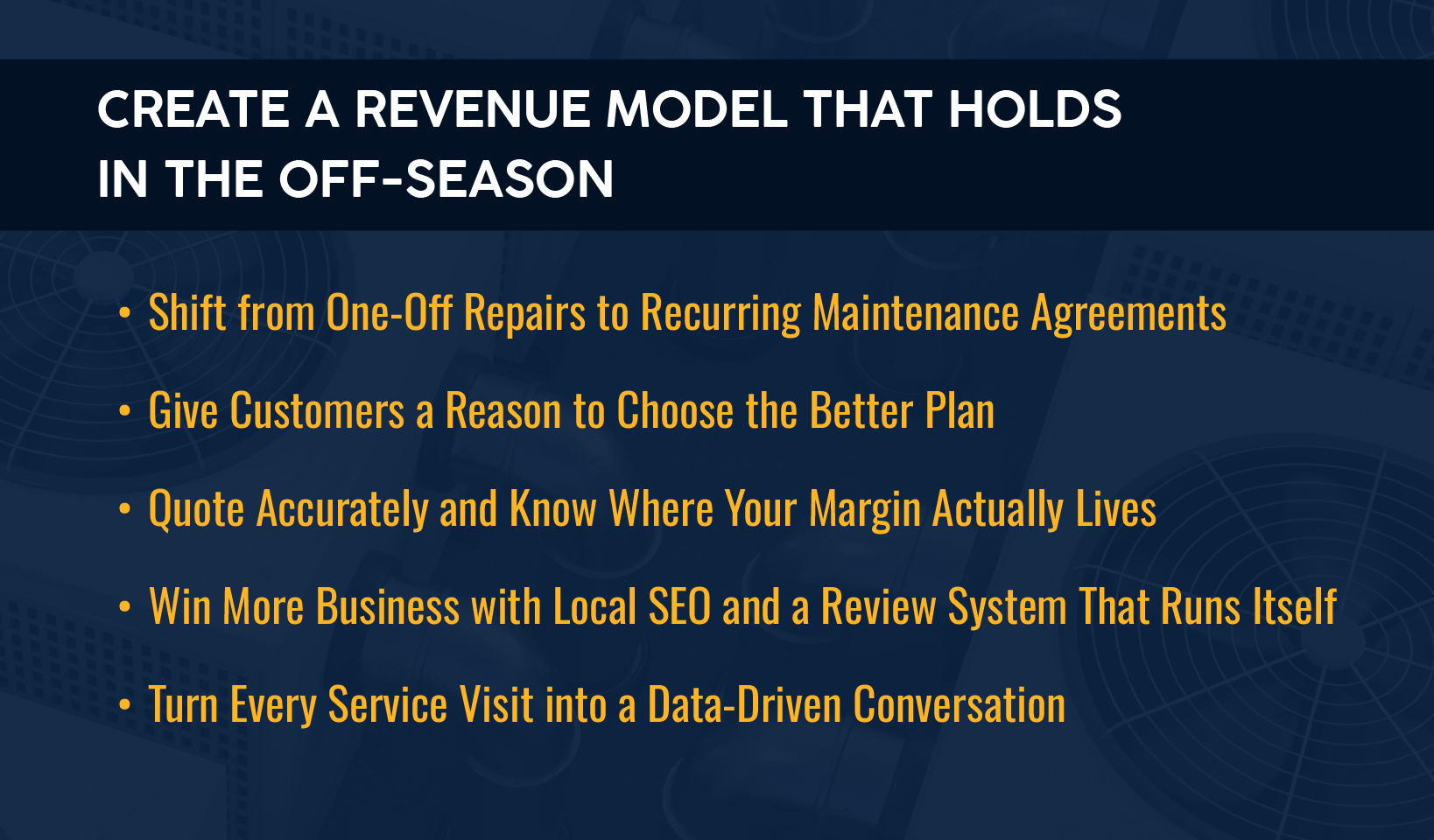
Shift from One-Off Repairs to Recurring Maintenance Agreements
Recurring maintenance contracts change the unit economics of an HVAC business in a way that one-off repair calls simply can't. A customer on a maintenance plan generates predictable revenue, keeps HVAC technicians utilized during shoulder seasons, and converts to replacement work at a significantly higher rate than a cold-call customer who found you in search results.
Offer an annual or monthly agreement that includes scheduled tune-ups, priority service, and a discount on repairs. Bill monthly to reduce friction — potential customers are more likely to say yes to $25/month than $300 upfront. Present the agreement at every install and every major repair.
Businesses that build this revenue base find their slow seasons get shorter and their estimate-to-close rate for replacement jobs improves materially. There's also a longer-term case: HVAC companies with 40% or more of revenue in recurring contracts sell for 6–10x EBITDA. Demand-only businesses sell for 2–4x. The customer who's been on a maintenance plan for two years already trusts you when the unit needs replacing. For more on building out the maintenance delivery workflow, the HVAC preventative maintenance checklist is worth reviewing.
Give Customers a Reason to Choose the Better Plan
Presenting a single flat-rate maintenance package leaves revenue on the table at both ends. A Good/Better/Best structure lets customers self-select into a tier that matches their budget and risk tolerance — and consistently moves a meaningful portion toward the middle or premium option.
A basic tier might cover one annual tune-up and a 10% parts discount — benchmark pricing for residential plans at this level typically runs $149–199 per year. A standard tier adds priority scheduling and a second seasonal visit, landing most customers in the $249–299 range. A premium tier includes everything plus an extended labor warranty and a dedicated emergency line, typically priced at $399–499. The value difference between tiers needs to be tangible — not a list of incremental features, but a meaningful shift in what the customer actually gets.
Simpro supports standardized pricing and estimate templates so every salesperson presents the same package structure consistently. Customers trust a structured offer more than a quote that looks assembled on the fly. The guide to good/better/best HVAC proposals goes deeper on how to structure and present those options.
Quote Accurately and Know Where Your Margin Actually Lives
Equipment cost fluctuations are a quiet margin killer. A quote built with catalog prices from three weeks ago can lose $200–$400 on a mid-range residential install if wholesale costs moved in the interim — and at volume, that variance adds up fast.
Standardized estimates with pre-built catalogs protect margins by keeping material costs current, and they speed up the quoting process. Simpro customers report building estimates up to 10x faster when working from templated rates rather than building from scratch.
The bigger issue is visibility after the job closes. Most HVAC companies track gross revenue without tracking job-level profitability. Gross margin on installations should typically run 42–52%; if you're consistently below 35%, you're likely buying jobs you shouldn't be taking. A blended margin number masks that entirely — it looks fine until you realize your commercial maintenance work is carrying losses on residential installs. Real-time job costing — comparing estimated vs. actual labor and materials per job — shows you where margin actually lives and where it's leaking. The post on how to price HVAC jobs covers the mechanics in detail, and HVAC profit margins is worth benchmarking against your own numbers.
Win More Business with Local SEO and a Review System That Runs Itself
Roughly 95% of customers read reviews before booking HVAC services. Most HVAC business owners know this — and most still leave the process to chance, hoping a satisfied customer thinks to post one on their own.
The HVAC companies that consistently accumulate reviews have a system: a touchpoint right after job completion, before the tech leaves the driveway, with a direct link to the review platform. Not a follow-up email three days later when the moment has passed. Automated post-job SMS through Simpro's notification system makes this repeatable without adding anything to anyone's plate — the tech completes the job, the system sends the message, the customer gets the link.
Those reviews do more than build trust. Search engines rank HVAC contractors with a strong volume of recent, relevant reviews higher in local search results, which means potential customers searching for HVAC services in your area find you first. And 97% of consumers who read reviews also read business responses — yet 63% of businesses never respond to theirs. That's a free competitive advantage most HVAC contractors leave sitting on the table. Keeping your Google Business Profile current — accurate hours, updated services, recent photos — compounds that visibility further. A solid HVAC marketing strategies approach ties both together: the review loop feeds the search results, and the search results bring in leads that word of mouth alone never would.
Turn Every Service Visit into a Data-Driven Conversation
A maintenance visit where the tech only does what's on the work order is a missed revenue opportunity. Customers on site are already in a service relationship with you — the highest-trust audience in the business. An HVAC professional who notices an aging capacitor, mentions it plainly, and explains what failure looks like isn't being pushy. They're being useful.
That shift — from "complete the job" to "complete the job and report what you observed" — takes ongoing training to stick. Not a one-time conversation, but a standard your whole team holds to consistently. The goal isn't upselling for its own sake; it's giving customers the information they need to make a good decision about their equipment before it fails on a 95-degree Friday afternoon.
Simpro's mobile field tools give HVAC technicians access to full asset and job history on site — previous maintenance records, equipment age, prior notes — so they can have that conversation with context, not guesswork. Businesses that equip their teams this way typically see a 30% improvement in field productivity and a measurable lift in average ticket from service visits.
Capital Planning Starts Before the Crunch
Most HVAC operators think about financing when they're already under pressure — a slow month, a truck that needs replacing, a tech they can't afford to hire fast enough. At that point the options are worse, the terms are harder, and the decision gets made reactively. The operators who avoid that trap treat capital access the same way they treat maintenance agreements: something you set up before you need it, not after.
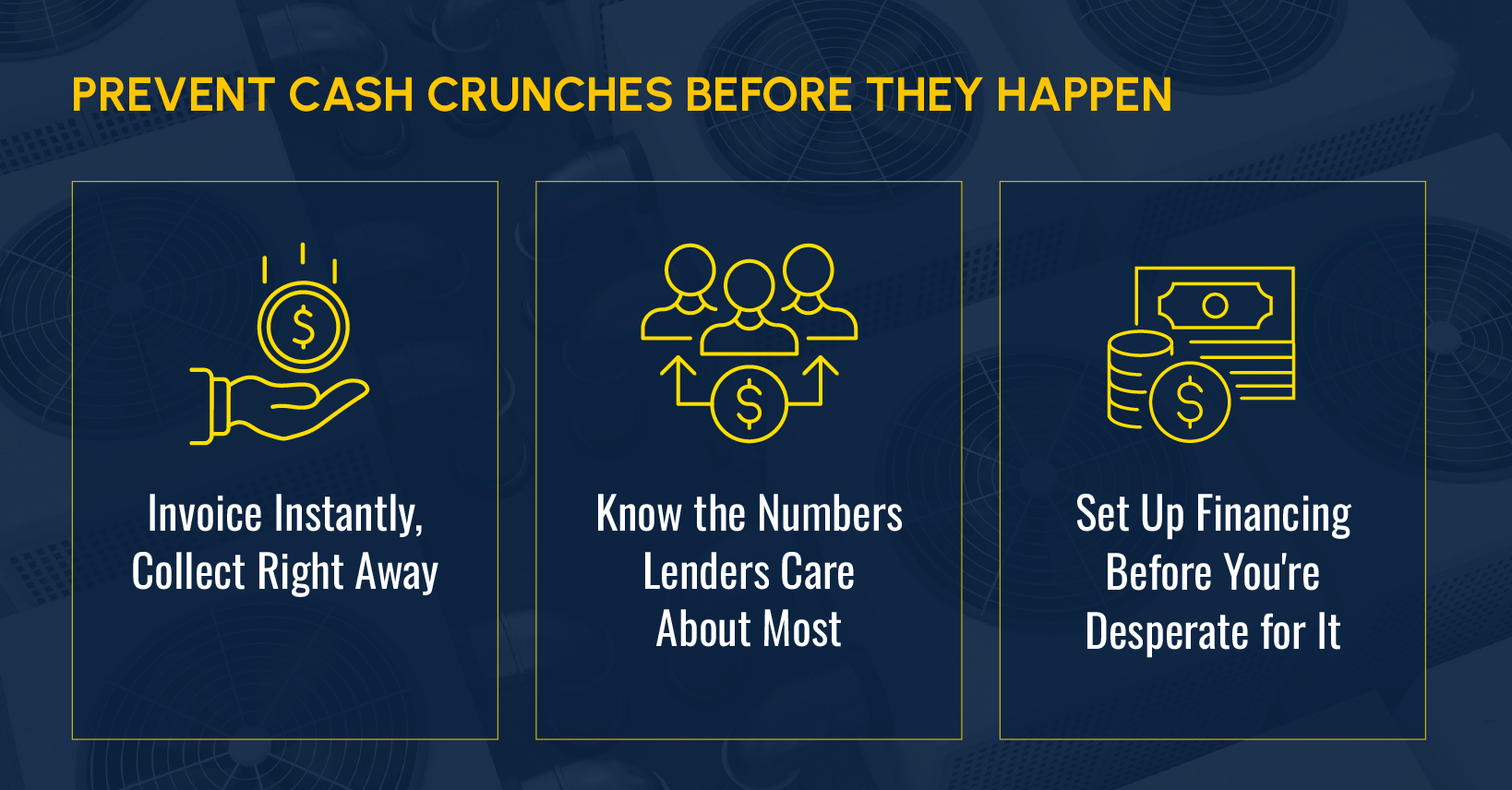
Get Paid Before the Gap Becomes a Problem
Cash flow is an operations problem before it's a finance problem. The single fastest lever most HVAC operators have is tightening the invoice-to-payment cycle — and most are leaving significant time on the table. Same-day invoicing from the field, where the tech triggers the invoice the moment a job closes, can compress a 7–10 day billing lag to under 24 hours. For larger installs, requiring a 30–50% deposit before work begins keeps the business ahead of material costs rather than chasing reimbursement after the fact.
Automated payment reminders do the follow-up without anyone on your team spending time on collections. The goal is removing every step between job completion and payment that requires a trip back to the office or a manual follow-up — because each of those steps is a place where cash gets delayed. HVAC invoicing best practices covers the full workflow in detail.
Know Your Numbers Before You Need a Lender
Banks and equipment lenders aren't just evaluating your credit — they're evaluating your business's predictability. Clean job costing, consistent margins, and documented revenue history make the case that you're a manageable risk. Most HVAC operators can't produce that picture cleanly when they walk into a bank. They know their top-line revenue. They don't know their margin by job type, their recurring revenue as a percentage of total, or how their cash flow looks month over month outside of peak season.
Businesses that can show that data get better terms, faster approvals, and more options. Businesses that can't get generic offers or outright rejections. Real-time job costing and reporting — the same data that helps you grow your business operationally — is also what makes you fundable. Build that visibility now, before you need a lender, and you walk into that conversation with leverage instead of desperation.
Set Up Financing Before You're Desperate for It
Lines of credit, equipment financing, and supplier payment terms are dramatically easier to establish when the business is healthy than when you're in a cash crunch. The time to apply for a line of credit is when you don't need it — when margins are solid, revenue is documented, and you have recurring contracts that demonstrate forward cash flow.
When growth creates a bottleneck — a truck that's at capacity, a technician shortage in a busy season — having financing already in place means you can move in days rather than weeks. Reactive capital deployment almost always costs more: higher rates, tighter terms, and decisions made under pressure. The HVAC operators who grow steadily are the ones who treat capital access as infrastructure, not a last resort.
Scale the Business, Not Just the Workload
The HVAC business owners who build something worth owning aren't necessarily running the most trucks or spending the most on ads. They're the ones who've figured out how to scale an HVAC business without scaling the chaos with it — handling more volume cleanly, with a revenue model that doesn't require a perfect season to hit their numbers.
Growth is optional. Profitability isn't. The goal isn't a bigger HVAC company — it's a better one.
Simpro® is purpose-built for trades businesses ready to make that shift. More than 24,000 businesses use it to manage jobs, automate admin, protect margins, and build the operational foundation that makes HVAC business growth sustainable rather than stressful.
If the calls are coming in but the profit isn't matching, it's time to look at the machine underneath. Schedule a demo to see what a tighter operation looks like in practice.
Just getting started? Check out our guide on how to start an HVAC business.


 Back to top