
What separates electrical contractors who keep scaling from those who don’t? They successfully operationalize the business. They also avoid the scheduling chaos, owner-dependent operations, and billing delays that cap revenue long before the market does.
The U.S. electrical services market is on track to hit $294.6 billion by 2034, fueled by data centers, EV infrastructure, and grid modernization. But riding this growth wave isn’t easy.
Every electrical business owner faces a version of this challenge: you're busy, the electrical leads are coming in, but you can't seem to grow your business past the ceiling you're hitting.
Let’s explore how to grow an electrical business at every stage: Getting the foundation right, running efficiently, and building the systems that let you scale without burning out.
Case Study: What Scaling an Electrical Business Looks Like
Southwest Industrial Electrical has been operating for over 40 years, playing a vital role in the manufacturing and production sector.
Despite steady growth, double-handling and outdated manual processes made it difficult to service customers quickly and efficiently. They didn't need more work, they needed to produce more with the people they already had.
After implementing Simpro®, they increased production and overall efficiency, leading to double-digit growth.
"Before we had Simpro, we were billing about half of what we billed last year, so we have doubled since our implementation of Simpro," said Kristin Larson, CEO.
That growth allowed them to expand out of California into Arizona, Nevada, and Texas.
If used correctly, the strategies and tools covered in this article can help you scale like a legacy electrical company that doubled their billing volume in a single year.
Setting Up an Electrical Business the Right Way
Whether you're starting an electrical business or formalizing what you've done for years, the early decisions determine how difficult everything becomes. Your business structure (sole proprietor, LLC, S-corp) affects your taxes, liability exposure, and how you present yourself to potential customers and commercial clients. Get that sorted before you're too busy to think about it.
Choose Your Electrical Business Model (Residential, Commercial, or Specialty)
Your service mix shapes your margins, crew requirements, and how you price work. Picking a lane early gives you focus, which translates into better quoting, staffing, and marketing.
| Model | Gross Margin Target | Revenue Per Job | What to Know |
|---|---|---|---|
| Residential service | 65–67% | Lower | Higher volume, faster cycles |
| Commercial projects | 30–50% | Higher | Larger scope, longer payment terms |
| Specialty (EV, solar, smart home) | Varies, often premium | Highest | Less competition, growing fast |
Specialty verticals, including EV charger installation, solar tie-ins, and data center electrical, are growing segments with real pricing power — and fewer contractors have built the expertise to compete in them.
DC Electrical used Simpro's multi-company function to spin off and manage 3 distinct businesses (DC Electrical, DC Smoke Alarms, and Air DC).
In doing so, they were able to cleanly manage a wider service mix and maintain accurate reporting across all of their jobs, crews, and businesses. As a result, they successfully grew from a modest team of two into a thriving team of over 60 employees in just a few years.
Explore Electrical Business Ideas That Differentiate Your Services
Most electrical companies are competing for the same residential panel upgrades and commercial tenant fit-outs. But the contractors add services that their local competition doesn’t offer. A few differentiators worth considering:
- EV charger installation. Demand is accelerating with EV adoption; residential and commercial clients alike need qualified installers.
- Solar and battery storage tie-ins. This electrical work pairs naturally with what solar companies are already selling.
- Smart home and building automation. Lighting control, smart panels, and security integration command premium pricing.
- Annual electrical inspections. This straightforward, recurring service opens the door to maintenance agreement conversations.
- Commercial maintenance contracts. This offers predictable monthly revenue that doesn't depend on winning new jobs.
These aren't moonshots. They're adjacent services that use your existing license and crew — and potentially turn a one-time customer into a long-term relationship.
Review Licensing, Insurance, and Legal Requirements for Electricians
Requirements vary by state and, in some cases, by municipality. Get this locked down before you take on work. An insurance gap or licensing issue can shut down a job site and create personal liability. At a minimum, you'll need:
- Electrical contractor's license: Required in most states and some local jurisdictions
- General liability insurance: Protects against third-party property damage and injury claims
- Workers' compensation: Required in most states once you have employees
- Business insurance add-ons: Errors and omissions, commercial auto, tools and equipment coverage
- Bonding: Often required for commercial work
- Multi-jurisdiction licensing: Especially important when operating across state lines
If your contract business involves service agreements or multi-phase projects, have an attorney review your contract template. The cost of that review is nothing compared to a billing dispute on a $50,000 job.
Build Out Your First Team and Tools
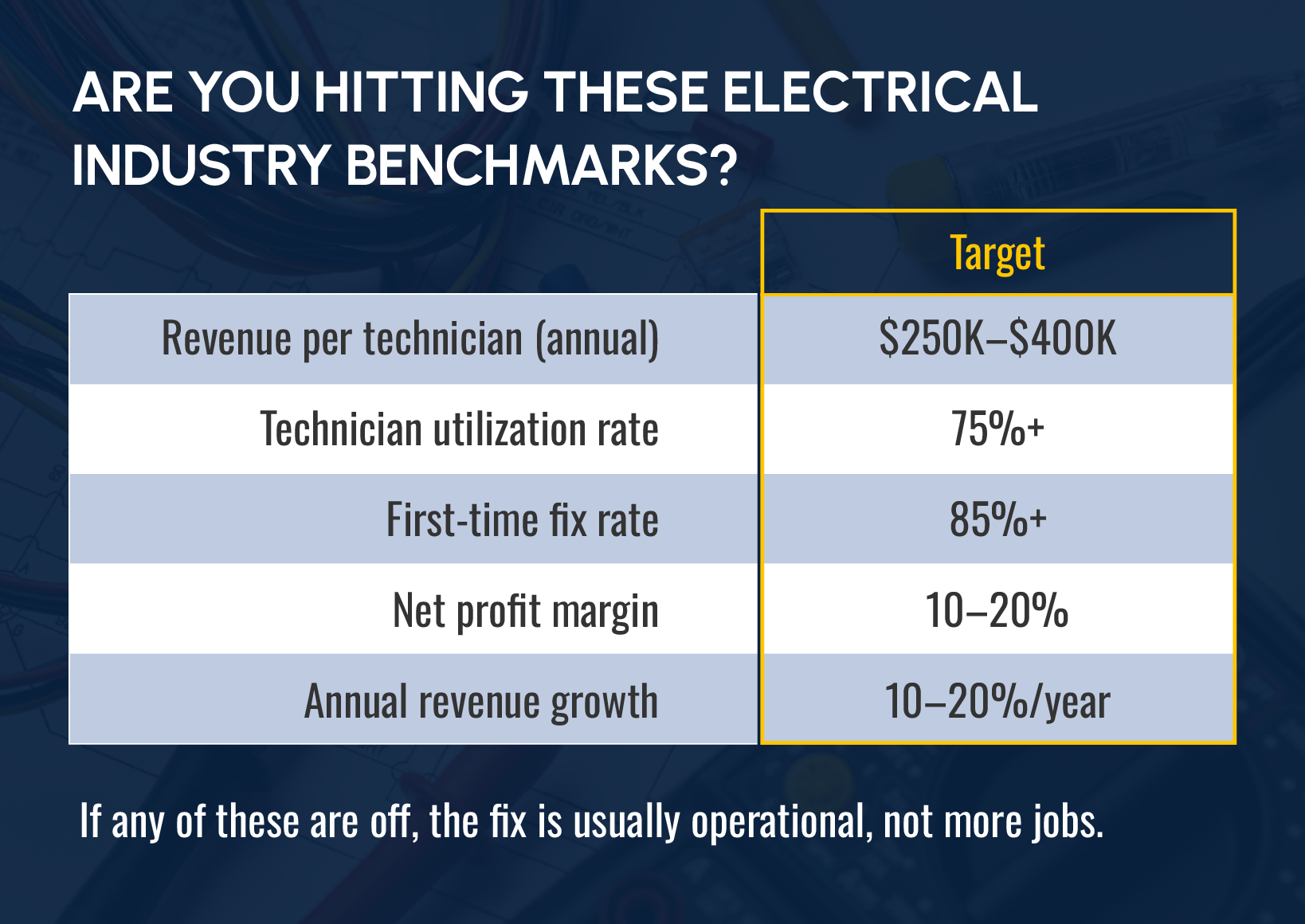
Your first hire as a solo operator changes everything. Before you add a technician, make sure you have enough consistent work to keep them billable at least 75% of the time — the floor for productive utilization. Anything lower means you're carrying overhead without the revenue to match.
On the tools side, don't wait until you're overwhelmed to invest in electrician apps for scheduling, quoting, and job tracking. Set these up before you need them so new hires walk into a working system instead of scattered spreadsheets.
Set Up Systems Early (Scheduling, Quoting, Invoicing)
When you start an electrical business, the temptation is to handle everything informally while you're small. But the workflows you build in year one will follow you into year five. Likewise, relying on manual processes might work for five technicians but will have you drowning at 15.
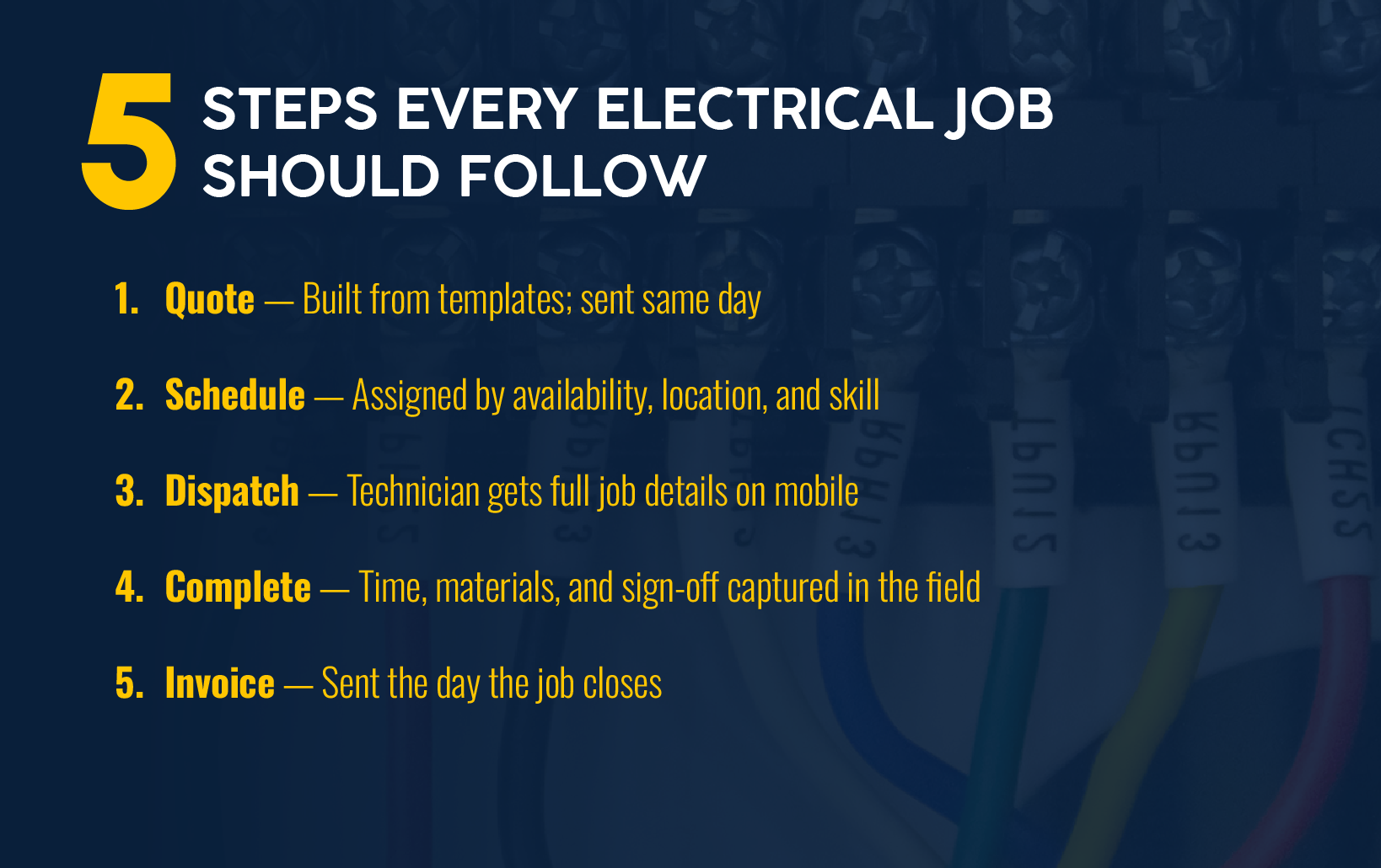
Business operations that run on human memory and text messages don't scale. Build the quote → schedule → complete → invoice cycle into software from the start. Same-day invoicing alone can cut days sales outstanding (DSO) by a week or more — and for a growing business, that cash flow difference can have a massive impact.
How to Run a Successful Electrical Business
Once you're operational, running a successful electrical business means maximizing output from your existing team before spending more money.
Create Efficient Job Workflows
Every job should move through the same sequence: quote, schedule, dispatch, complete, invoice. When quotes sit in someone's inbox or job completions don’t trigger invoices, you lose time and money at every handoff.
Route optimization alone can recover 45 minutes of drive time per technician per day, which translates to roughly one additional billable job. At $300 to $500 per service call, that's $1,500 to $2,500 per technician per week in potential recoverable revenue.
Manage Electricians and Field Teams Effectively
Strong-performing service electrical businesses run $250,000 to $400,000 in revenue per technician annually. If you're significantly below that range, the likely problem is utilization.
When technicians are limited to three to four jobs a day because of inefficient dispatching or unclear job details, you’re leaving revenue on the table. Create real-time visibility into your crew’s location and current assignment. Then, you can fill schedule gaps before the day slips away.
At the same time, burnout is an operational risk. Exhausted crews make more mistakes, with potentially severe consequences. Part of running a successful business is workload visibility — recognizing who's overloaded before they hit the wall.
Audem Electrical began as a two-brother team and scaled rapidly to 20 core staff while sustaining 30% year-over-year growth. Because Simpro automated much of their administrative burden, they only needed to hire one additional office staff member to manage this larger field crew. No burnout and no massive payroll burden, either.
Track Job Profitability and Project Costs
You might feel like you're busy and profitable, but if you're blending residential and commercial margins into one number, you don't know which jobs make you money. Track margin by job type, by crew, and by service line. The resulting patterns will show you where to focus.
Pricing electrical jobs starts with knowing your real cost per hour — not just labor, but overhead allocated across the jobs that carry it.
By utilizing detailed job costing and pre-builds linked directly to supplier prices, Audem Electrical also successfully identified unprofitable jobs (like small air conditioning installations), adjusted their pricing, and achieved a massive 5x increase in profitability.
Deliver Excellent Customer Experience
First-time fix rate (FTFR) is your most immediate proxy for customer satisfaction. An 85%+ FTFR means your technicians arrive with the right parts, the right information, and a clear scope. Below that, you're scheduling callbacks, re-dispatching crews, and absorbing unplanned costs.
Poor customer service at this level shows up directly in your review profile, which potential customers read before they book. To fix a low FTFR, start with job data. Make sure technicians have complete job histories and asset information about the electrical system they're servicing before they pull into the driveway.
Using Technology to Reduce Admin Work
Manual admin time in field service businesses typically runs 15 to 20 hours per week. With the right electrical software, that drops to around 5 hours. The time savings can go back into operations instead of paperwork.
When one platform handles dispatching, quoting, asset tracking, and reporting, you get fewer errors, faster billing cycles, and less time chasing down information because it’s already in the system.
How to Grow a Small Electrical Business
Growth stalls when the owner becomes the bottleneck. If every estimate, client call, and scheduling decision runs through you, you've built a job, not a business.
Build a Strong Local Reputation and Referral Network
Referrals and repeat business drive most small electrical business revenue, but they don't just happen. They're built through consistent follow-up and a deliberate review strategy. Word of mouth gets you started, but it's not a marketing strategy. After every completed job, ask for a Google review. A strong Google Business Profile puts you in front of customers searching "electrician near me" or "panel upgrade [city]" at exactly the moment they need you.
As you figure out how to get electrical leads, consider partnerships with general contractors, property managers, and HVAC companies. They can create a steady referral stream that doesn't require marketing spend. Long-term success in any local business means building a reputation that generates inbound leads alongside referrals.
Hire and Train the Right Electricians
Add technicians in phases, and verify the model before you accelerate. This is especially important given the trades labor shortage, where finding technicians can be difficult, much less replacing them.
Revenue per technician is the number to watch. If it's growing, you have room to hire. If it's flat or declining, adding bodies just spreads the problem.
Standardize Processes So You Can Scale
Standard operating procedures (SOPs) are how your business can thrive without involving the owner in every decision. Document the processes for quote creation, dispatch, job completion sign-off, and customer follow-up. When a process exists in someone's head, it leaves with them. When it's written down, it can be trained, measured, and improved.
Marketing for electricians works the same way. Achieving consistent lead follow-up requires a repeatable system, not an ad hoc approach that changes every week and with every person.
Expand Into High-Value Verticals
The contractors who will create competitive advantage in the next three to five years are building expertise in job types such as EV charger installation, solar tie-ins, and commercial data infrastructure. Knowing how to use AI in electrical businesses can help electrical businesses qualify and win the right work in these verticals.
Contractors who can credibly serve high-growth verticals will have both pricing power and less competition — five experienced electricians are retiring this year for every two entering the field, according to CSG Talent. Transitioning from residential-only to commercial work typically increases revenue per project substantially and can bring more predictable job volume.
Add Recurring Maintenance and Inspection Contracts
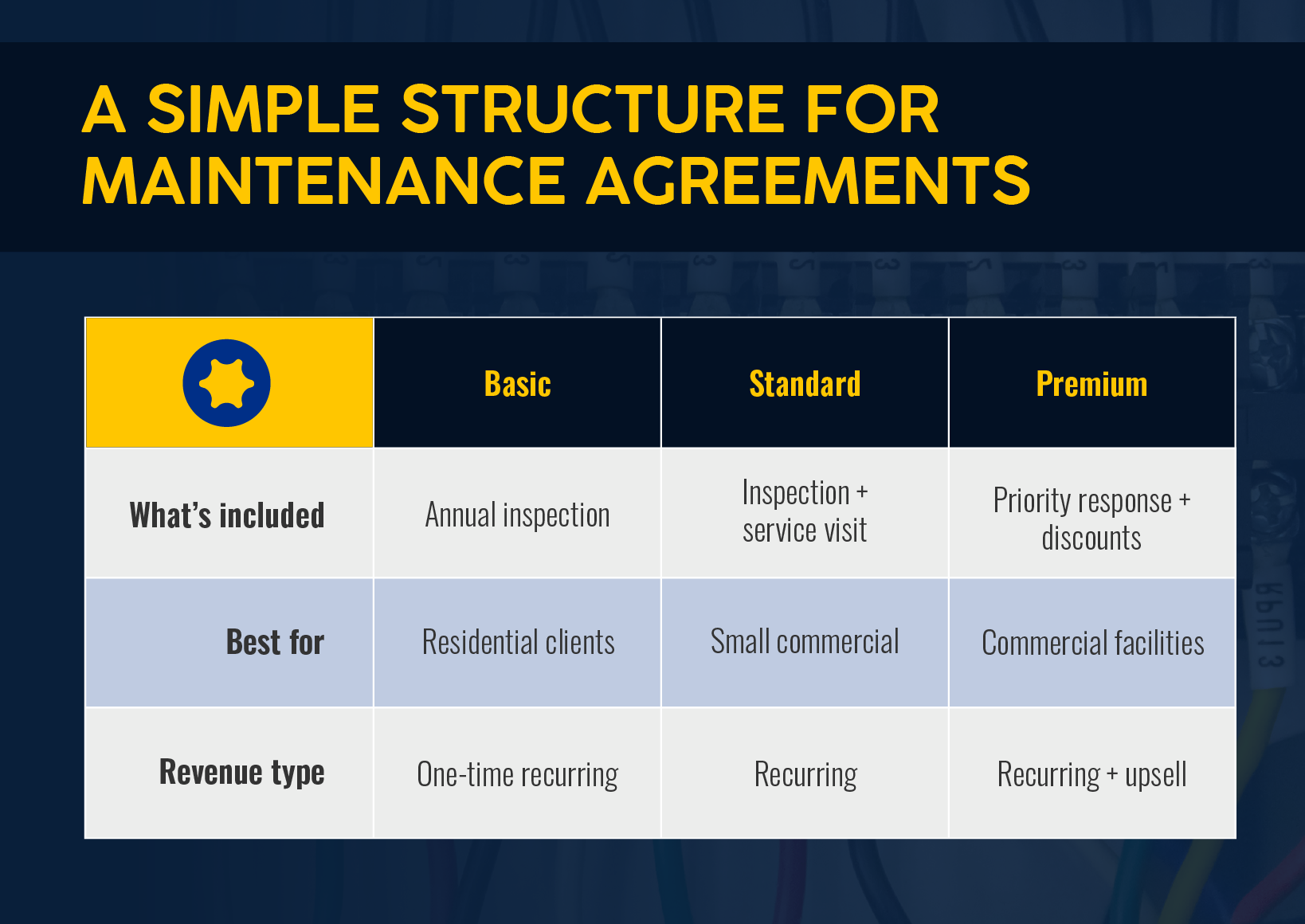
Maintenance agreements are the highest-leverage revenue tactic available to most electrical contractors. Annual electrical inspections, panel maintenance programs, commercial facility contracts, and EV charger maintenance agreements — all of these generate predictable, recurring revenue during slower seasons and increase customer lifetime value.
A basic structure to start:
- Basic (inspection only)
- Standard (inspection + service)
- Premium (priority response + labor discounts)
Even a small portfolio of commercial maintenance agreements can stabilize cash flow enough to fund the next round of hiring without relying on project work alone.
FAQ: Growing Your Electrical Business
When is the right time to hire more electricians versus investing in technology?
If your technicians consistently run at high utilization (75%+) and you're turning down work, that's a signal to hire. But adding headcount to a broken process just makes the process more expensive.
Invest in software first if utilization is low and jobs are backed up because of scheduling or admin friction. The typical return on field service management (FSM) software comes within six months — faster than recovering the cost of a new hire.
How does AI help a trade business grow without adding more office staff?
AI in field service management handles the pattern recognition that used to require a dispatcher or office manager, such as flagging scheduling gaps, auto-populating quotes from job history, or prioritizing follow-ups on overdue invoices. With AI, your office team can support a larger field team without growing in proportion.
The U.S. FSM software market is projected to grow at a 9.54% compound annual growth rate from 2026 to 2023, suggesting your competitors are exploring this software.
How can I improve cash flow while scaling my electrical services?
Cash flow problems usually come from slow collection. Here are five actions that tighten the cycle:
- Invoice the day the job closes — not the next day, not Friday.
- Use milestone billing on larger projects — don't wait until completion to collect.
- Require deposits from new customers or high-material jobs.
- Set clear payment terms — Net 15 or Net 30, stated upfront in writing.
- Follow up on overdue invoices systematically, not when you happen to remember.
Before you push hard on growth, aim for three to six months of operating expenses in reserve. That buffer lets you hire before demand spikes.
Ready to move from reactive to scalable? Simpro is purpose-built for trade businesses with scheduling, quoting, job costing, and reporting in one platform used by 24,000+ businesses globally.
If you're still running your business from a mix of texts, spreadsheets, and memory, that's the first thing to fix. Schedule a demo to see how electrical contractors use Simpro to build businesses that don't depend on the owner being everywhere at once.


 Back to top