
A plumbing job can hit every rough-in date and keep the customer happy. Payroll clears every week. But the job is losing money the entire time without anyone noticing until it's too late. That's why knowing how to spot an unprofitable commercial plumbing job matters most when your crew is on-site, not at closeout.
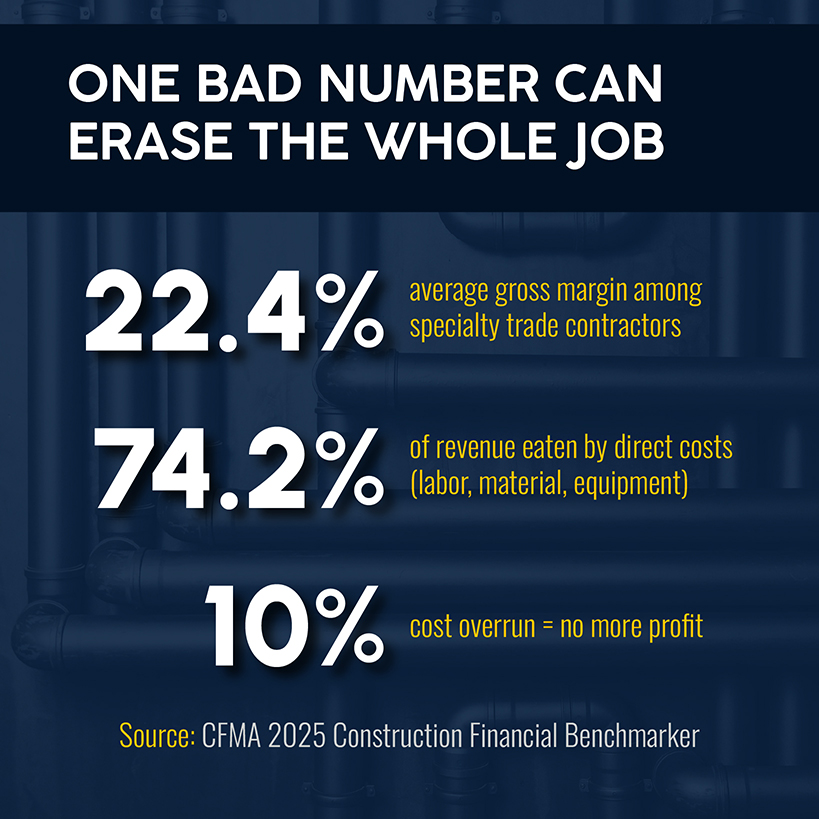
Specialty trade contractors averaged a 22.4% gross margin and 7.7% net income before taxes in fiscal 2024, with direct costs (labor costs, materials, equipment) adding up to 74.2% of revenue, according to CFMA's 2025 Construction Financial Benchmarker. That means when a job runs 10% over its direct cost budget, it's already consumed the gross profit it was supposed to generate. There's no cushion left for anything else.
The earliest signals of unprofitable jobs show up in the field, not the financial statements. This guide will highlight the patterns across the plumbing industry that separate tight jobs from those actively losing money.
What Makes a Commercial Plumbing Job Unprofitable?
Spotting unprofitable jobs becomes even more difficult if you're only focused on company-level financials. A business owner doing $8 million in annual revenue across a dozen commercial projects might have a comfortable net margin even if two or three jobs are running at a loss. The top performers make for a strong blended number that masks the problems.
Best-in-class specialty trade contractors posted 14.2% net income before taxes in fiscal 2024, nearly double the 7.7% average calculated by CFMA. The long-term difference for plumbing companies is about job-level visibility. If you want to catch a fading job in week three instead of at closeout, you need to shift from company-wide tracking to the job-level signals that predict plumbing job profitability.
This article is about project work, not the plumbing service calls that keep a dispatch board full: a drain cleaning job is priced and closed in an afternoon, while a commercial rough-in in a new office building that runs six weeks carries risk that compounds quietly for months before anyone finds out whether it made money.
Related: Plumbing profit margins depend on more than job-site output. If you're worried about overall margin health, start here.
10 Warning Signs a Commercial Plumbing Job Is Becoming Unprofitable
Each of these signals shows up in the field or the job cost report well before it reaches the P&L. Here's how contractors spot unprofitable plumbing jobs early, along with the metrics or documents worth pulling in response.
1. The Scope Is Incomplete or Keeps Changing
Bids built on incomplete drawings aren't effective. Neither is a scope with gaps in demolition, trade coordination, existing conditions, or unspecified equipment like water heaters. Once the crew is on-site, those gaps get filled with verbal direction from the general contractor (GC) or owner's representative about how the plumbing system should tie into what's already there. This new work begins before anyone prices it.
Every hour on undefined scope comes from somewhere else in the budget. It appears in job costs as labor and material variance that doesn't map to the estimate's line items, because the work was never in the estimate.
Pull the request for information (RFI) log and the drawing revision history. A rising count of open RFIs, or verbal scope additions without a paper trail, is the earliest form of this problem. Require written scope confirmation before the crew executes anything ambiguous.
Related: Bid commercial plumbing jobs with a built-in step for confirming scope.
2. Actual Labor Hours Run Ahead of the Estimate
Your estimate assigns a labor unit to every fixture, drain, waste, and vent connection, and linear foot of pipe in the takeoff. The honest productivity check is doing that math in reverse: Take the budgeted hours for the quantity installed and divide it by hours actually charged.
Imagine a crew earning 850 hours of installed work against 1,000 hours charged has a 0.85 cost performance index. That ratio is unfavorable, according to the U.S. Department of Energy's earned value framework, and projects a final cost of budget divided by 0.85. On a 10,000-hour rough-in package, that's roughly 1,765 hours of overrun and is visible by week three if anyone runs the math.
The operational fix: Pull earned hours against actual hours by cost code, not by job total. Do this every week the job is active. A blended job-wide number hides which phase and crew are struggling.
3. Material Costs or Quantities Exceed the Takeoff
This problem manifests in two different ways. One is a takeoff that undercounts fixtures, fittings, or footage. The other is a takeoff that's accurate on quantity but priced against a market that's shifted since the bid went out.
Producer prices for copper and brass mill shapes are up 18.4% from a year ago, and fixtures and trim are up 5.1%, according to the Bureau of Labor Statistics data. For a job bid nine months ago on unpurchased material, you're carrying a loss before anything gets delivered to the jobsite, regardless of field performance.
The operational fix: Reconcile committed costs against the original material estimate before the buyout window closes. If material runs long on quantity, too, the takeoff itself needs a second look.
Related: Learn how you can price plumbing jobs with current material pricing built into the estimate.
4. Site Conditions Reduce Crew Productivity
Labor hours get taxed by countless factors that don't appear as line items, including trade stacking, undersized crews, mid-job reassignments, thinning supervision, forced overtime, and a learning curve on unfamiliar building systems.
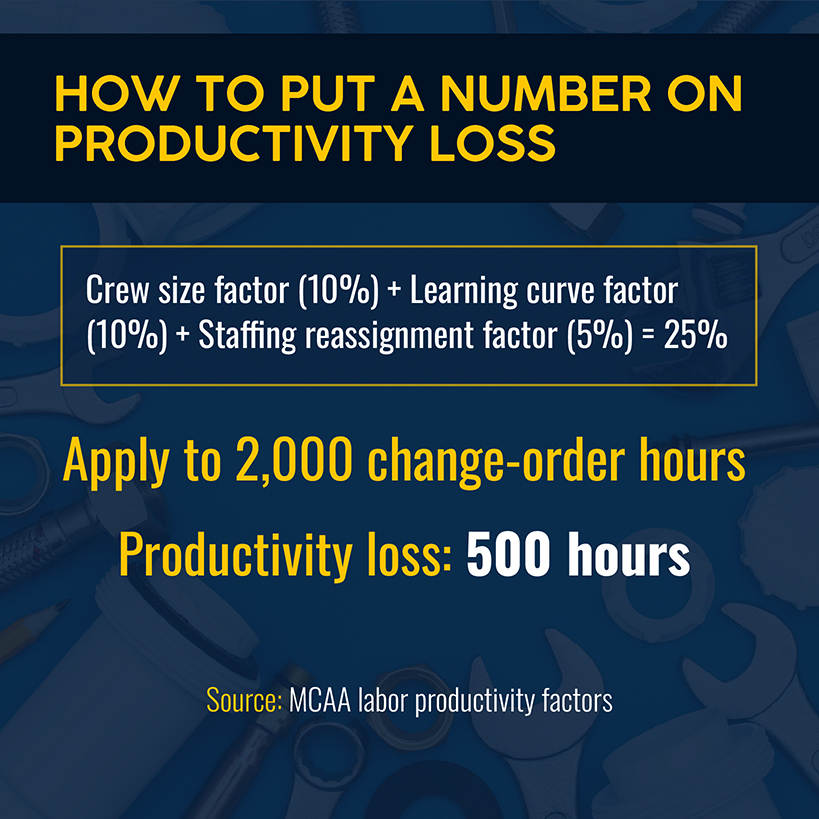
The MCAA's labor productivity factors quantify this productivity drain. In a worked example, three factors (crew size, the learning curve, and staffing reassignments) add up to a 25% effect. Applied against 2,000 change-order hours, that's a loss of 500 hours.
The operational fix: Use three to six factors, and apply them to the affected time window rather than the whole project. Document it in your foreman's daily log as it happens.
5. Extra Work Begins Before the Change Order Is Approved
Scope that's verbally approved but unpriced is dangerous for margin, as work gets added to the schedule and labor is charged before anyone agrees on the costs. This is a common driver of underbilling, as every hour on an unpriced scope isn't earning revenue and might never if the change order gets negotiated down.
The operational fix: Review outstanding change order requests at least monthly, in the same way you'd chase an unpaid invoice. Document the trigger, whether that's a site-access restriction, a late ceiling release, or a missing coordination drawing, in your foreman's daily log the day it happens. Contemporaneous records make claims more defensible.
6. Rework, Failed Inspections, and Callbacks Are Increasing
Rework on a commercial plumbing job means paying twice for the same linear foot of pipe or fixture connection.
Research prepared by Navigant Construction Forum puts total rework cost at 7.25%-10.89% of construction cost, including indirect impacts, leading to 9.82% of associated schedule growth. Underground and slab rough-in is generally the least recoverable version for plumbing contractors, as a missed sleeve under poured concrete requires demolition rather than a punch-list fix.
The operational fix: Track failed inspections and callback counts by phase and by crew, not as a single tally across the job. A cluster in one phase points to a process or supervision failure you should address immediately.
7. The Schedule Slips Without a Revised Cost Forecast
A slipped schedule always costs money, as extended overhead, equipment rental, and supervision time keep accruing even without an updated forecast.
CFMA's guidance on work-in-progress (WIP) review describes a monthly cycle where project managers (PMs), general managers, and finance examine the feasibility of revised cost estimates, confirm that change orders have been submitted, and check whether forecasts capture the full fade of over-budget labor codes, not just the actuals to date.
The same scrutiny applies when a job's numbers look better than expected: Check why before accepting the win.
The operational fix: If your schedule moved and the forecast hasn't, fix that before the next monthly review locks in an incorrect number.
8. Progress Billing Falls Behind the Work Completed
Percent complete, or percentage complete, is costs incurred to date ÷ total estimated cost. Multiply that by contract value for earned revenue, which is the amount you should have billed by now.
Underbilled jobs fall short of that number, and that's a warning sign. Plumbing contractors should generally be able to bill for work actually performed, so an underbilled job is often not making what the estimate assumed. Watch this weekly, not monthly. Overbilling, meanwhile, delays the reckoning on a money-losing job rather than preventing it.
The operational fix: Track the trend more than the snapshot. Is the overbilled or underbilled position on your job shrinking as the percent complete climbs? Or is it getting worse?
9. Payment Delays, Retainage, or Backcharges Are Increasing
Specialty trade contractors carry just 22 days of cash on hand on average, according to CFMA's 2025 Construction Financial Benchmarker. A slow-to-collect job ties up working capital the rest of the business needs.
A job can perform in the field and still lose money in accounts receivable. Retainage, disputed invoices, and backcharges for cleanup or corrective work can reduce what lands in your bank account, even when the pay application matches the schedule of values. Meanwhile, a pattern of backcharges can suggest a documentation problem, not a performance issue.
The operational fix: Track days sales outstanding (DSO) by job, and log every backcharge with the GC's stated reason attached. If patterns emerge, the fix is likely in your documentation, not in collections.
10. The Forecasted Gross Margin Declines at Every Review
The occasional margin drop between reviews is normal, as estimates get refined when new information comes in. But if the margin fades at every review and in the same direction, your estimate or the execution plan is wrong and needs to be fixed.
Consistent fade can show up outside the company, too. Sureties and lenders also watch for margin that trends up or down across a contractor's job list. A history of jobs that only fade can affect bonding capacity on the next bid, not just the profit on this one.
The operational fix: Analyze gain and fade at least monthly. Treat consecutive fades on the same job as a trigger for a full re-forecast.
How to Confirm Whether a Plumbing Job Is Losing Money
Any of these signs is a reason to look closer, but it's not a verdict. Pull your metrics together to uncover a pattern or determine that it just looked that way for a week.
| Metric | What to Compare | What the Result Shows |
|---|---|---|
| Cost Performance Index (CPI) | Earned value (budgeted hours for work installed) against actual cost | Below 1.0 means you're spending more than the completed work is worth. |
| Schedule Performance Index (SPI) | Earned value against planned value | Below 1.0 means the job is behind schedule, dragging cost with it. |
| % Complete vs. % Billed | Costs incurred to date against billings to date | A growing gap toward underbilled means revenue isn't keeping pace. |
| Committed cost vs. budget | Purchase orders and subcontracts against the original material and sub budget | Costs exceeding budget before buyout closes signals a locked-in loss. |
| Forecast gross margin trend | This month's projected margin against last month's | Two or more consecutive declines suggest a genuine fade, not normal refinement. |
| DSO by job | Job-level collection time against the company average | A job well above average suggests a documentation or dispute problem. |
When reviewed together regularly, these metrics can validate your hunch about an unprofitable job and help you make a case for corrective action, renegotiated change order, or cutting your losses before they compound.
Related: These are just some of the plumbing KPIs you need to know about, especially if job-level tracking is new territory.
Track Commercial Plumbing Job Profitability With Simpro®
Simpro is built around job-level discipline, using real plumbing job costing that captures cost data by phase and cost code, not by job total. Any fade will show up in the field instead of at closeout.
With Simpro, rough-in, trim, riser, and test each get their own cost code, split by floor or zone. That's the detail required to catch a productivity slip on floor three before it spreads to floor four. Field-captured timesheets tie hours directly to those codes, providing the input required for an earned-hours calculation. Untracked labor is the single most common reason a job's productivity numbers are unusable.
Purchase orders and subcommitments roll up into committed costs against the revised budget, with forecast-to-complete updated monthly so the margin movement is visible before closeout. Change order workflows require the scope to be priced and approved before crews start work. Margin-by-job and margin-by-PM reporting show which estimators and job types are fading against CFMA benchmarks.
Simpro supports 250,000+ users worldwide, with job-level tracking contributing to a 30% productivity increase, on average. Heron Plumbing, for example, tripled its turnover without having to add office staff after implementing Simpro's software.
Related: Our job costing formula breaks down how percent complete, earned value, and forecast cost fit together.
Protect Plumbing Margin Before the Job Becomes a Write-Off
This advice isn't for companies responding to a same-day callback on a failed water heater. It applies to the commercial job that's supposed to carry six figures of margin but instead needs an intervention in month two. If you're running these jobs on spreadsheets, you can't flag a productivity slip in the same week it happens, much less tell a PM running six jobs which one needs attention today.
Want to fix jobs instead of writing them off? You need the right tools and tactics to catch a fade in week three versus at closeout. A stable, profitable business depends on you knowing, job by job, which plumbing work makes money and which doesn't.
Schedule a demo to see how Simpro brings job-level cost visibility into your daily workflow, not just the month-end report.


 Back to top