
Moving into commercial work can feel like a real step up. But knowing how to bid commercial plumbing jobs also requires a new set of business skills.
It’s easy to see the appeal. The jobs seem more stable, and the contracts can be massive. Commercial rough-in alone typically runs $4 to $8 per square foot, which means even a mid-size office buildout can be a six-figure plumbing contract.
This is a guide to bidding commercial plumbing jobs the right way. Learn what makes commercial work price differently than residential, walk through a step-by-step process that protects your margin (and your sanity), and how to spot the mistakes that quietly turn a winning bid celebration into a money-losing job of despair.
Why Commercial Plumbing Bidding Is Different From Residential
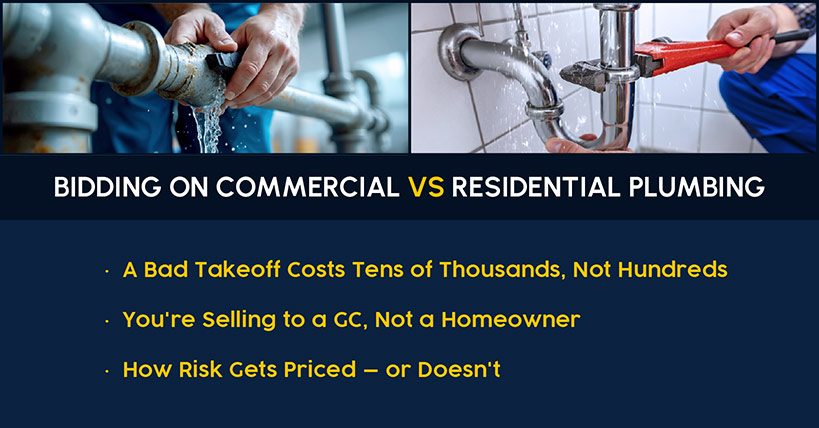
The fundamentals of the plumbing work on commercial and residential are the same. But that’s where it ends.
A Bad Takeoff Costs Tens of Thousands, Not Hundreds
A residential job might involve a handful of fixtures and a straightforward rough-in. A commercial project — think medical office, multi-family building, shopping center — can involve hundreds of fixtures across multiple floors, pressure zones, mechanical rooms, and coordination with mechanical, electrical, and structural trades, with plumbing systems that serve multiple buildings.
The blueprints alone can run dozens of pages. Specifications reference code sections, material standards, and installation requirements that don't show up in residential plumbing jobs. A miscalculated takeoff doesn't cost you a few hundred dollars. It costs you tens of thousands. That gap is why plumbing industry veterans treat commercial estimating as a discipline of its own.
The complexity also compounds in ways that aren't obvious upfront. Phased construction timelines mean your crews may need to mobilize, demobilize and return to the same site multiple times. Backcharges for delays caused by other trades can be passed to you if the contract language allows it. Off-hours work requirements, common in occupied commercial buildings, can add 20 to 30 percent to your labor costs before you've touched a single fitting.
Commercial plumbers bill at a premium for a reason: market rates for commercial work run around $100 per hour versus $80 for residential, reflecting the additional complexity, code knowledge, and coordination those jobs require.
You're Selling to a GC, Not a Homeowner
In residential work, you're selling to the person who will live in the space. In commercial work, you're selling to a general contractor, a developer or a property manager, and they have different (frequently competing) priorities.
They're managing multiple trades, a hard delivery date, and a budget that's already been committed to a building owner or lender. They want plumbing services delivered on schedule and without surprises, and they're choosing between plumbing companies largely on the strength of the proposal in front of them.
That means your proposal isn't just a price. It's a signal about whether you understand the project, whether your scope matches theirs, and whether working with you will be easy or difficult. A sloppy proposal with a low number rarely wins over a clean proposal with a competitive number. And when it does win, it usually ends badly.
How Risk Gets Priced — or Doesn't
Commercial projects carry risk that doesn't exist in residential work: concealed conditions, coordinated shutdowns, inspection dependencies, liquidated damages clauses, and warranty terms that can outlast the original contract. Most contractors who struggle with commercial bidding aren't bad at estimating materials, labor, and logistics. They're bad at pricing risk, or they ignore it entirely to stay competitive, then absorb it later.
Pricing risk starts before the estimate. It shows up in your bid/no-bid decision, in your site visit, in your contract review, and ultimately in the contingency line you either include or don't. Every commercial job carries unknowns. The question is whether you're getting paid to carry them.
How to Bid Commercial Plumbing Jobs: A Step-by-Step Process
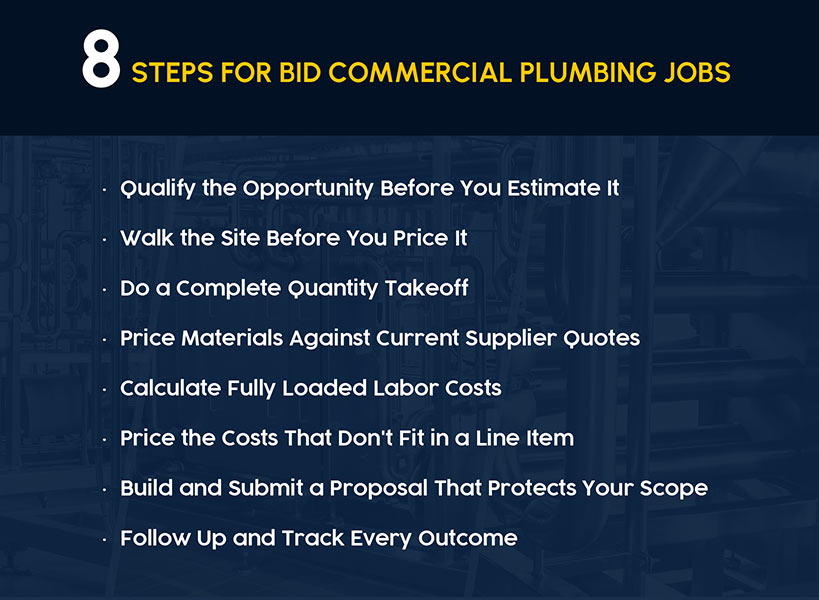
Most estimating failures happen before the plumbing estimate starts. Here’s how to turn the odds into your favor.
Step 1 — Qualify the Opportunity Before You Estimate It
Not every Invitation to Bid is worth your time. Knowing how to bid plumbing jobs profitably starts with knowing which ones to skip. Bidding a commercial job you're unlikely to win or that doesn't fit your operational capacity costs you hours of estimating time you could spend on better opportunities.
Before you commit to building an estimate, ask: Do you have the crew capacity to execute this during the projected build window? Have you done this type of work before — medical, institutional, multi-family, retail buildout? Do you have a relationship with this GC, or are you bidding cold into a field of five contractors? What was your win rate on similar work over the last 12 months, and what were the margins on the jobs you actually won?
Tracking why you've lost past bids — too expensive, missed scope, unfamiliar building type — gives you a real filter for qualifying new opportunities rather than bidding everything and hoping something lands. A close rate above 85% isn't a sign you're good at bidding. It's a sign you're pricing too low or only going after easy work. Healthy commercial close rates typically run 25 to 40 percent.
Pro Tip: Build a bid qualification checklist you run before opening the drawings. If you're using Simpro®, Quote Activity Reports and custom Archive Reasons let you track win/loss patterns and the reasons behind them, so your qualification filter gets sharper over time.
Step 2 — Walk the Site Before You Price It
Drawings are a design document. They're not field reality. The gap between the two is where contingency costs live.
Site visits on commercial projects reveal things that never appear on blueprints: existing infrastructure you'll need to work around, access limitations that affect equipment and crew, ceiling heights that change your scaffold requirements, slab conditions that affect core drilling cost, and mechanical room configurations that affect your rough-in sequence.
On renovation or tenant improvement work, you may also find legacy plumbing that's not correctly documented, and that becomes your problem the moment you sign the contract.
Document everything. Photographs with notes tied directly to your estimate keep your bid defensible and your team informed when they mobilize weeks or months later. What looks obvious during a site walk becomes ambiguous when you're pulling permits in February for a job you walked in October.
Pro Tip: Use the Simpro mobile app during site visits to capture photos and attach them directly to the quote. Your office estimator and field lead see the same conditions, without a separate email thread.
Step 3 — Do a Complete Quantity Takeoff
The takeoff is the foundation of the estimate. Everything downstream — material cost, labor hours, subcontractor scope logistics — depends on getting this right.
Work through the drawings systematically: fixtures, rough-in assemblies, pipe runs by size and material, valves, fittings, hangers, sleeves, insulation, and connections to mechanical and equipment.
On larger jobs, use takeoff software or structured spreadsheets to prevent double-counting and missed items. Extract model numbers from specifications when they're called out, because substitutions require approval and create delays if they happen after bid submission.
Group your takeoff into logical assemblies rather than individual line items where possible. A commercial toilet rough-in assembly, for example, should include carrier, closet flange, shutoff, supply, and waste — not five separate items you manually verify each time.
Pre-built assemblies speed up the takeoff and reduce the risk of missing components that only become visible when your plumber is standing in front of the wall.
Pro Tip: Simpro's Pre-Builds let you create reusable assemblies for common commercial rough-in configurations. They save time on every estimate — what takes 30 minutes to price individually can populate in seconds — and the labor fit times come with them.
Step 4 — Price Materials Against Current Supplier Quotes
Don't price a commercial job against your standard catalog rates if you haven't checked the market recently. Material costs on copper, cast iron, PVC, and fixtures fluctuate, and the spread between your catalog and current supplier pricing can be significant on a large job, enough to swing the total cost of your bid by several percentage points.
Send your material list to multiple suppliers simultaneously. For major equipment — commercial water heaters, backflow preventers, booster systems — ask about manufacturer buydowns and package pricing. A $40,000 equipment package that you price at list when a competitor gets a buydown is a bid you lose before the comparison sheet is even built.
Lock pricing before you finalize the bid. Supplier quotes that expire before your bid submission date create exposure you don't want to carry.
Pro Tip: Simpro's Supplier Quotes module lets you send your full material list to multiple wholesalers in one step and pull confirmed pricing back into the estimate. No copy-paste. No version control problems.
Step 5 — Calculate Fully Loaded Labor Costs
The most common pricing mistake in commercial bidding is using the wrong labor rate. Most business owners who struggle to price plumbing jobs accurately have the materials math right. What trips them up is the labor rate itself. Field pay is not your labor cost. Your actual cost includes workers' compensation, payroll taxes, benefits, employer contributions, and a share of the overhead that supports every person in the field.
If your plumber earns $38 per hour and your fully loaded cost is $58 per hour, bidding at $42 because that's what you can charge without losing doesn't make you competitive. It makes you lose money on every hour worked. If you don't know your labor burden rate, you cannot price a commercial job accurately, and you won't know it until the job is done.
Commercial sites also carry labor inefficiencies that don't exist in residential work: travel time between floors, waiting on inspections, coordination delays with other trades, and restricted work windows. Budget for these explicitly. A 15 to 25 percent productivity buffer on commercial projects isn't padding.
Pro Tip: Good plumbing software builds every cost component directly into the Labour Rate, so your estimates automatically reflect what it actually costs to put someone on commercial job sites, not just what you're paying them on Friday. Simpro does exactly that.
Step 6 — Price the Costs That Don't Fit in a Line Item
Commercial projects generate costs that don't show up in residential work and don't fit cleanly into your material or labor buckets: equipment rentals (scissor lifts, pipe threading machines, core drill rigs), temporary pipe runs, debris removal, permit fees, inspection costs, bonds, and insurance certificates specific to the GC's requirements.
These costs are real, they're predictable, and they're routinely underestimated or forgotten entirely. Build them into the estimate as explicit line items rather than assuming they'll wash out in your overhead percentage.
Overhead itself deserves the same rigor. If you don't know what percentage of revenue you need to recover overhead — your trucks, your office, your estimating time, your management hours — you cannot accurately price a commercial job. The overhead percentage you apply to a $50,000 service job is not the same as what a $400,000 new construction bid requires.
Contingency is separate from overhead. It's a buffer against known unknowns: concealed conditions, weather impacts, scope creep at the edges of your trade. Five to ten percent is a reasonable starting range on commercial new construction; renovations and occupied buildings typically warrant more.
Pro Tip: Add site logistics and equipment rentals as One-Off Items in Simpro so they appear in the estimate without inflating your standard catalog. The Breakdown Table gives you a full view of margin before the bid goes out, so you're not finding out at job closeout.
Step 7 — Build and Submit a Proposal That Protects Your Scope
The proposal is where a lot of the legal and commercial risk gets locked in, and where contractors who know how to get plumbing contracts separate themselves from those who just know how to estimate them. A price without a clearly defined scope is a liability document.
Your proposal should include a written scope of work that matches what's in your estimate, explicitly named exclusions (excavation, concrete, electrical connections, equipment furnished by others), a list of clarifications and assumptions you made in lieu of complete information, payment terms and milestones, an expiration date on the pricing, and any conditions that affect your ability to perform on the stated schedule.
"Concealed conditions" clauses deserve special attention. They establish that conditions not visible at the time of bid — buried pipe, uncharted infrastructure, undisclosed hazardous materials — constitute a change in scope, not your problem to absorb. Without that language, you're bidding open-ended risk.
Pro Tip: Simpro's Form Builder turns your estimate into a structured proposal automatically. Scripts let you pull pre-written scope language, exclusions and terms directly into the document, so your legal protections don't get forgotten when the deadline is close.
Step 8 — Follow Up and Track Every Outcome
Submitting the bid is not the end of the process. GCs frequently ask clarifying questions after submission, issue addenda that affect scope, or run informal negotiation rounds before awarding. Contractors who respond quickly and clearly have an advantage that has nothing to do with price.
After the award decision, get feedback regardless of outcome. If you won, understand what made your bid competitive. If you lost, find out whether it was price, scope, relationship, or capacity. That information, tracked over time, is the most valuable input you have for improving your bidding process.
Close rate, average margin on awarded jobs, average time to estimate, and percentage of bids where you had to clarify scope after submission are the metrics that tell you whether your bidding operation is actually working. Without tracking them, you're running on intuition.
Pro Tip: Simpro's Status Codes and Automatic Triggers can queue follow-up reminders the moment a quote is submitted, so the follow-up happens consistently, not only when someone remembers.
The Most Common Pitfalls When Bidding Commercial Plumbing Projects
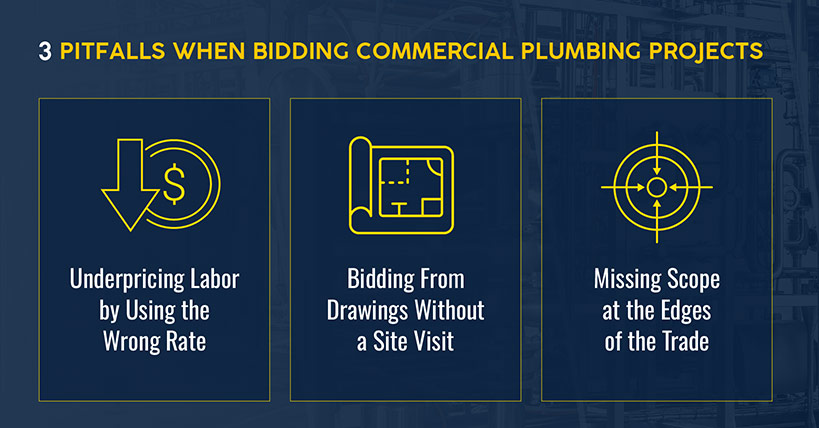
Every contractor who's done commercial work has a version of these stories. The specifics differ; the underlying mistakes are the same.
Underpricing Labor by Using the Wrong Rate
This is the most common and most expensive mistake in commercial plumbing bidding. Contractors who price labor at field pay rather than fully loaded cost are guaranteeing a loss on every hour worked. They just don't see it until job closeout, when the margin they thought they had is gone.
The second version of this mistake is using average labor rates across a crew when the job actually requires your more expensive journeymen for the majority of hours. A project with significant hours in tight mechanical rooms, phased rough-in, and coordination-heavy fit-off is not an apprentice-weighted job. Bidding it that way gets you the contract and a bad result.
Bidding From Drawings Without a Site Visit
On competitive commercial bids, the site visit feels like time you don't have. Skip it and you're pricing drawings, not a building. The two are not the same.
Hidden infrastructure, access constraints, and conditions that differ from the architectural intent will find you during construction whether or not you found them during estimating. The difference is whether you've priced them. Contractors who skip site visits aren't being efficient. They're transferring cost discovery from the bid phase to the execution phase, where it can't be recovered.
Missing Scope at the Edges of the Trade
Commercial plumbing has scope boundaries that aren't always clearly drawn in the contract documents: connections to equipment furnished by others, sleeve and penetration responsibilities, commissioning and startup requirements, temporary utilities during construction. These items live at the intersection of trades, and they frequently end up unpriced by everyone, until the GC needs them done and looks for the contractor to absorb them.
Read the specifications, not just the drawings. Read the Division 1 general conditions. Review the coordinated MEP drawings if they're available. The scope gaps that blow up commercial jobs are almost always visible before bid day.
Build a Process That Scales
The difference between plumbing contractors who grow profitably on commercial work and those who stay stuck isn't talent or relationships. It's process. A disciplined bidding process produces consistent estimates and margins you can actually predict. Without it, every bid is a fresh start, and every win is a guess.
The business owner who treats bidding as an operational function — documented and measured — knows their close rate, their margin by job type, and where the work is actually profitable.
If your bidding process is still running on spreadsheets and instinct, there's a more reliable way to do it. Simpro is purpose-built for trade contractors who want to price accurately and win work at the right margin — from takeoff and supplier quotes to margin review and proposal generation. More than 24,000 businesses use it to run tighter operations and win more of the right work.
Ready to see what that looks like in practice? Schedule a demo and see how Simpro handles takeoff, supplier quotes, labor costing, and proposal generation in one connected workflow.


 Back to top