
A plumbing subcontractor finishes underground rough-in by week six of the project. But if the schedule of values is structured around three lump-sum phases, the business won't see that cash until the rough-in line closes out eight weeks later.
The lesson is that a plumbing schedule of values should be built around how the work happens on-site, line by line, as risers get set and floors get sign-off.
For commercial construction projects like a $4.2 million hospital mechanical package or a core-and-shell job at a 60,000-square-foot office, the stakes are high with your schedule of values. It determines whether payroll gets covered in month four or whether the company floats labor costs on a line of credit, all while a payment application sits in architect review long after the job went from the estimator to the field.
Mastering the schedule of values and progress billing for commercial plumbing jobs comes down to the same eight-step structure, whether the contract is $400,000 or $4 million. This guide shows you how to build a schedule of values, structure it against AIA G702 and G703 pay application requirements, calculate the percent complete, and get your applications approved instead of kicked back for revision.
What Is a Plumbing Schedule of Values?
A schedule of values is the line-item breakdown that allocates the full contract sum across the work that a plumbing subcontractor is responsible for delivering. Some billing templates still label it as a singular “schedule of value,” although “schedule of values” (SOV) is the term used by the American Institute of Architects (AIA) and Construction Specifications Institute (CSI).
Under AIA A201-2017 Section 9.2, which applies to construction contracts based on a stipulated sum or guaranteed maximum price, a contractor must submit an SOV to the architect, in whatever form the architect requires, before the first application for payment. Section 9.3.1 ties subsequent monthly applications to that original document, requiring each pay app to be itemized in accordance with the SOV and supported by lien releases and requisitions from subs and suppliers.
CSI's guidance describes the same document from the reviewing side. The SOV should contain a detailed tabular breakdown of the contract price that’s apportioned by geographic area, spec section, type of work, and/or material and installation cost. Overhead and profit should be distributed across the line items. CSI MasterFormat 2020 adds its own section, 01 29 73, emphasizing the central role of project financial administration. It works as a project management tool as much as a billing one, tying schedule, scope, and cash together.
For plumbing contractors, the practical stakes are simple: A schedule of values for plumbing contractors that's too coarse, improperly sequenced, or backloaded in late-stage line items creates a cash-flow problem across the entire job.
How you structure an SOV dictates how disputes will be addressed. If an architect questions the percent complete on a $95,000 rough-in line, your SOV will be the go-to document for project owners and architects alike. A schedule built with verifiable line items resolves the dispute with a phone call. A schedule built around catch-all phases escalates the dispute, wasting time and delaying your invoice.
Related: Understanding plumbing profit margins helps you see how overhead and profit get distributed across your SOV lines.
What to Review Before Building the Schedule of Values
Before you commit line items, pull together the documents and numbers that drive them. Skip this step, and you'll end up revising the SOV before the architect will certify it. Here are items that belong in the SOV and require your review:
- Signed subcontract or prime contract
- Approved plumbing estimate
- Scope of work and exclusions
- Project drawings, specifications and addenda
- Construction schedule and key milestones
- Required cost codes or billing categories
- AIA G702 and G703 requirements, when applicable
- Rules for stored materials, retainage and change orders
- General contractor's billing deadlines and approval process
Related: Review how to bid commercial plumbing jobs so your estimate properly informs the schedule of values.
How to Create a Commercial Plumbing Schedule of Values in 8 Steps
Once that review is done, building the SOV follows a repeatable sequence across the construction industry, whether the job is a single-floor tenant improvement or a multi-phase hospital addition.
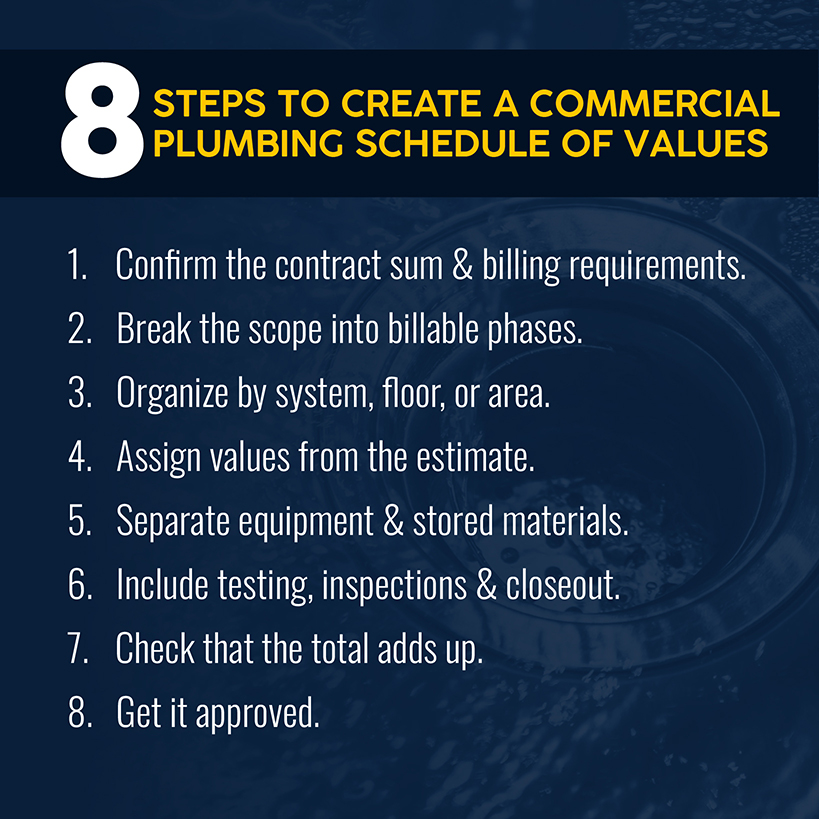
1. Confirm the Contract Sum and Billing Requirements
Start by matching your SOV total to the signed contract sum, not an early draft estimate. Confirm which billing forms your general contractor (GC) requires, which payment schedule they follow, and whether retainage is calculated on the full value or on labor only.
AIA A201-2017 requires the SOV before the first payment application goes in, so don’t leave this step until week three of the job. Another caution: Most GC billing portals lock the SOV structure once the first application is submitted, so whatever format you decide on will be what you rely on throughout the job’s duration.
2. Break the Plumbing Scope Into Billable Work Phases
Split your scope in the same way plumbing gets built, including:
- Underground and site utilities
- Below-slab rough-in
- Above-ground rough-in by system (waste, vent, domestic water, storm, gas, and medical gas where applicable)
- Fixture setting
- Trim
- Insulation
- Testing and disinfection
- Closeout.
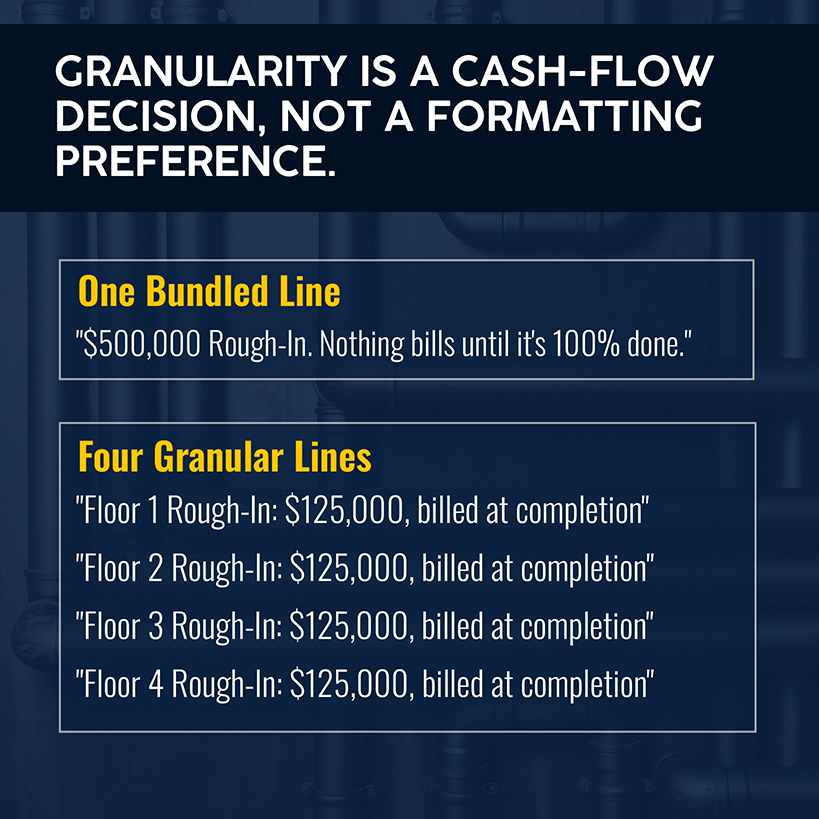
On a 220-bed hospital addition, that might mean billing six risers as separate lines instead of one $380,000 "rough-in" item that can't be billed until every riser is finished.
3. Organize Line Items by System, Floor, or Project Area
Your cash flow will benefit from granularity and specificity in your reporting. Coarse lines lead to monthly arguments over percent complete, as no one can say with certainty whether a $500,000 "rough-in" line is 40% or 55% done. Fine lines that are organized by floor, building, or spec section will allow you to cleanly bill for each completed riser or finished floor instead of waiting on a bundle of items
4. Assign Values Using the Approved Estimate and Job Costs
Pull line values from your approved estimate and current job costs, not from a spreadsheet built separately for billing purposes. When your estimate and your SOV come from the same numbers, overhead and profit are distributed consistently across items rather than being parked wherever is convenient at bid time.
Related: Check out the best plumbing estimating apps if your estimate and SOV are still living in separate files.
5. Separate Major Equipment and Stored Materials
Water heaters, pumps, valves, and cast iron are often ordered months before installation, which means they need their own lines. AIA A201-2017 Section 9.3.2 allows billing for materials stored on-site. Billing for off-site requires advance written agreement from the owner on the storage location, along with procedures satisfying the owner's claim to the materials and the cost of applicable insurance and storage. In practice, contracts often add further safeguards, including a bonded warehouse, surety consent, or forgoing overhead and profit on stored value.
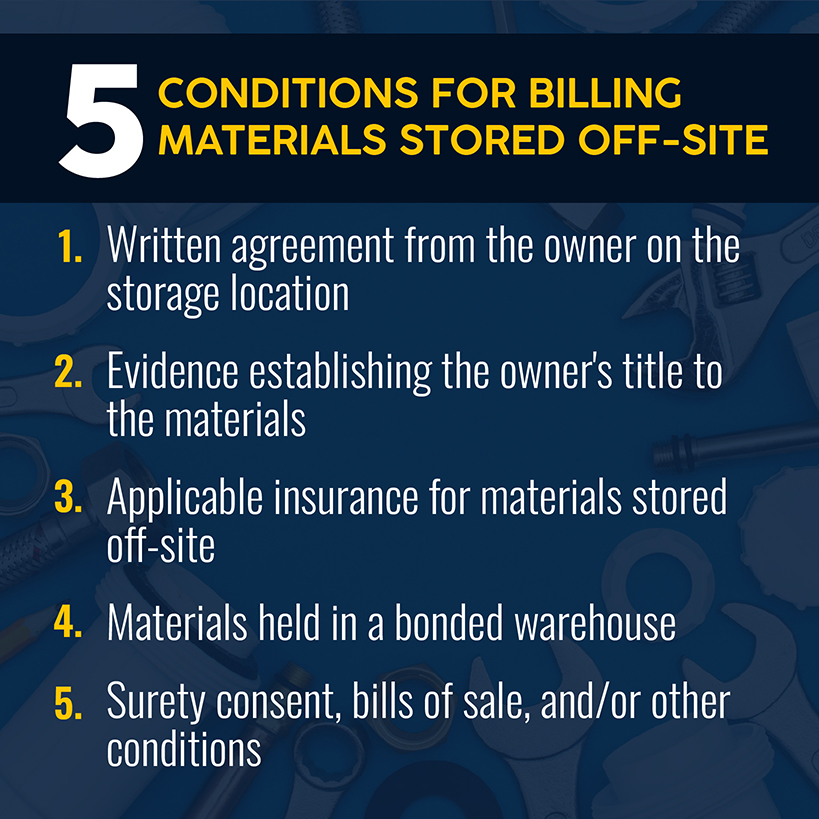
On a nine-month job with $140,000 in pumps and water heaters ordered early, this line can be the difference between paying out of pocket for procurement and getting paid to buy it.
6. Include Testing, Inspections and Project Closeout
Some contractors skip or condense line items for testing, inspections and closeout, which can cause problems later. The costs of testing, balancing, and disinfection should be reflected, not relegated to a $500 placeholder.
Closeout needs to cover as-builts, operations and maintenance (O&M) manuals, and training. It also needs enough weight that contractors get paid for finishing the paperwork, rather than treating it as free work tacked onto the end of the job.
7. Check That Every Line Adds Up to the Contract Total
Contractors might front-load line items to pull cash ahead of the work, while architects review Division 01 substantiating data specifically to catch it.
A separate failure carries its own risk. When an SOV’s line items are too coarse to track the work happening on-site, the contractor's days revenue outstanding (DSO) gets stretched. That creates hardship for subs and suppliers further down the chain.
The operational fix: Tie every line back to a real cost, and make sure the full SOV sums exactly to the total contract amount, rather than “close enough.”
8. Get the Schedule Approved Before Progress Billing Begins
AIA A201-2017 gives the architect several grounds to withhold certification, including unresolved third-party claims and unpaid lower-tier subs. An SOV is important enough to the payment process that any gaps or delays can also create certification risks.
The operational fix: Submit the SOV early enough that revisions happen before the first billing cycle, not during it. Otherwise, a rejected application means payroll waits another 30 days.
Commercial Plumbing Schedule of Values Example
Here's what that structure looks like on a $1.85 million plumbing subcontract for a six-story medical office building that takes 14 months with an eight-person field crew:
| Line Item | Scheduled Value |
|---|---|
| Underground Utilities & Site Rough-In | $210,000 |
| Below-Slab Rough-In (Waste & Vent) | $185,000 |
| Above-Ground Rough-In, Floors 1-3 | $320,000 |
| Above-Ground Rough-In, Floors 4-6 | $295,000 |
| Domestic Water Riser & Distribution | $240,000 |
| Medical Gas System | $175,000 |
| Fixture Sets, Floors 1-6 | $210,000 |
| Insulation | $65,000 |
| Testing, Balancing & Disinfection | $60,000 |
| Stored Materials Allowance | $50,000 |
| Closeout (As-Builts, O&M, Training) | $40,000 |
| Total | $1,850,000 |
There are a few lessons to draw from this list:
- Stored materials and closeout carry real dollar values instead of getting folded into rough-in
- The upper and lower floors bill as separate lines instead of one combined "above-ground rough-in" item that can't close out until every floor is finished.
- There are 11 billable lines instead of the four or five you’d see on a coarse SOV would use for the same scope. That's the difference between waiting on the whole building and billing floor by floor.
How Plumbing Progress Billing Works With an Approved SOV
Once the SOV is approved, monthly progress billing runs off AIA G703, the continuation sheet that itemizes value completed against each SOV line. G703 rolls up into G702, the application and certificate for payment.
Applications are typically due at least 10 days before the established date for progress payments, but check your contract for the specifics. Each app should document retainage, approved change orders, and billing from subs and suppliers below the plumbing contractor.
With the $1.85 million medical office example, each monthly application totals billed work across all 11 lines that period, subtracts retainage, and carries forward the running total billed to date, not just that month's draw. When the crew completes the domestic water riser and half the fixture sets in month seven, you’d bill those two lines at their actual percentage complete. But insulation and closeout stay untouched until the work reaches them.
Lien waivers move on the same schedule. Conditional progress waivers go out with every application except the final one. Unconditional progress waivers follow once the check clears. If these fall out of sync with your billing cycles, you risk the pay application getting kicked back for revision, potentially with math errors and change orders that aren’t reflected in the SOV.
Related: A cash flow forecasting model built around your billing cycle shows where retainage and stored materials are tying up cash before it becomes a payroll problem.
How to Calculate Percentage Complete Accurately
Percentage complete (or percent complete) is how each SOV line tracks project progress, and it comes down to one calculation:
Percentage complete = Total value completed to date ÷ Scheduled value × 100
Accountants sometimes call this the percentage of completion method, but on a jobsite it's just percent complete. The number must match what's physically true on-site.
A riser that's roughed in, pressure-tested, and signed off is 100% complete. But call it "roughly done" at 80%, and you’re only delaying the potential dispute. Timing matters, too. Bill ahead of actual completion, and you create overbilling that has to unwind later. Bill behind completion, and you run short on cash you’ve already earned.
The operational fix: Tie every percent complete entry to a specific, verifiable condition, such as “pressure test passed,” “riser signed off,” or “fixtures set,” rather than a foreman's estimate of progress. If the condition isn't documented, the line doesn't move.
Connect Commercial Plumbing Costs and Billing Data with Simpro
None of this works if your SOV and job costs live in different spreadsheets and you're rebuilding the billing application by hand every month.
Simpro® carries cost-code sections — underground, rough-in, fixtures, trim, testing, and closeout — directly from your estimate into the project as billable schedule sections. Your monthly progress claim is generated from the same structure you priced, with no re-keying required.
Retention gets tracked as its own receivable with a release trigger, so you're not guessing when months-ago retainage actually shows up at project closeout. Job costs, committed costs from purchase orders and subcontracts, and actual labor hours track against budget in real time at the same line-item level as your SOV. This gives you a defensible percent-complete billing figure rather than an estimate.
Photos, inspection records, delivery dockets for stored material, and lien waiver status attach directly to the claim package, closing the documentation gaps that cause most pay applications to bounce back for revision in the first place.
Simpro users report a 30% productivity increase on average, and much of it comes from eliminating manual reentry of job costs across estimating, tracking, and billing.
Related: Quoting and invoicing software built for trade contractors keeps the estimate, SOV, and invoice connected instead of living in three separate tools.
Build Every Progress Billing Application on Reliable Project Data
You get paid on time when your billing application matches, line for line, what an architect can verify happened on-site that month. Simpro connects your estimate, job costs, and schedule of values into one structure, so every application is built from data you've already tracked in the field, not reconstructed from memory.
Schedule a demo to see how Simpro ties commercial plumbing job costing to progress billing.
Frequently Asked Questions
What should be included in a plumbing schedule of values?
Your SOV should break down the contract sum into line items for the following: underground and site utilities, below-slab and above-ground rough-in by system, fixture setting, trim, insulation, testing and disinfection, stored materials, and closeout. Instead of placeholders, give each line a real dollar value that’s tied to your approved estimate.
How is plumbing progress billing calculated from an SOV?
Each month, you enter the value of work completed on every SOV line onto AIA G703, which calculates percentage complete and totals into G702, the application for payment. Your application reflects retainage, approved change orders, and any stored materials billed that period.
Can stored plumbing materials be included in progress billing?
Yes, you can bill stored materials under AIA A201-2017 Section 9.3.2, with conditions. Billing for off-site materials requires written agreement from the owner, along with procedures satisfying the owner's claim to the materials and the cost of insurance and storage. Contracts often include terms related to bonded warehouses, surety consent, or forgoing overhead and profit on stored value.
How should retainage and change orders be recorded in the SOV?
Calculate retainage as a percentage of each line item's billed value. Track it separately from the scheduled value itself, as release timing and statutory caps vary by state and by whether the project is public or private. Add approved change orders as new SOV lines or adjustments to existing ones, all supported by the same substantiating data you used for the original schedule.


 Back to top