
Roughly 40% of an electrician's time goes to material handling that doesn't add value: waiting for parts, sorting van stock, correcting delivery errors, and running to the supply house mid-job. Multiply that by several crews, and you’ve got a lot of unproductive labor that multiplies by the day.
The best electrical inventory management software closes this gap by connecting your warehouse to the job site. Parts are tracked from purchase order to installation. Work orders automatically update when materials are consumed. Reorder triggers fire before a crew runs out. Your office and field teams are looking at the same numbers in real time.
As electric businesses scale, they need software that’s user-friendly and manages everything in one place. The right platform connects what you own (parts, stock, materials) to what your customers own (installed equipment, service history, warranty status).
This guide covers the nine best electrical inventory management software options in 2026, including top features, pricing, and which types of electrical businesses will benefit most.
Related: Find out how electrical job management software can improve your operations.
Electrical Inventory Software at a Glance
Here's a quick look at each of the top options before we get into the full reviews.
| Tool | Best for | Starting Price |
|---|---|---|
| Simpro® | Midsize and large electrical businesses, mixed workflows, $1M+ revenue | Priced for your workflow |
| Workiz | Multi-trade contractors managing diverse service portfolios | From $225/mo |
| FieldEdge | Residential and light commercial electrical | Tier-based pricing |
| BuildOps | Commercial electrical, multi-crew, large-scale projects | Custom quote |
| Zoho Inventory | Small shops upgrading from spreadsheets | Free limited plan; paid from $29/mo |
| Sortly | Small teams needing simple visual parts tracking | Free limited plan; paid from $24/mo |
| Asset Panda | Asset life cycle tracking, equipment-heavy businesses | Custom quote |
| EZO | Tool and equipment check-in/check-out tracking | From $44.75/mo |
| inFlow Inventory | Multi-location warehouse control where an FSM isn't needed | From $129/mo |
Best Electrical Inventory & Asset Management Software Options
Each of these software options can help electrical contractors better track inventory, manage assets, or both. We’re featuring full-fledged platforms that handle everything, as well as the best electrical asset management apps for specialized uses.
The first half of this list features field service management (FSM) platforms with native inventory built in. The second half of the list highlights some of the best electrical inventory management apps. The difference matters. Standalone tools can be effective for electrical businesses under $1 million in revenue that manage parts from a single location. Larger businesses will want a full-service platform in addition to or in lieu of such tools.
1. Simpro
Best for: Midsize and large electrical businesses managing a mix of service calls, project work, and maintenance contracts, particularly those with warehouse operations and 5+ field technicians.
Materials are one of the biggest costs for electrical contractors, usually surpassed only by labor. Keeping that number in check is only possible when every material gets tracked, billed, and reconciled.
Simpro® is a cloud-based FSM platform that’s purpose-built for trade contractors. It connects every workflow from quoting through to invoicing, including inventory in the middle. When a quote is built in Simpro, material costs pull from live supplier catalog data. As a job progresses, actual material consumption is tracked against the quoted bill of materials. When the job closes, everything reconciles.
As Brian LaFrance of All Electric said, “With Simpro, we no longer have multiple documents in multiple places. Everything for an asset is attached in one section, and it’s all there under the customer file. You can’t get any easier than that."
An all-in-one platform offers compounding benefits for electrical businesses that run commercial project work, service calls, and maintenance contracts simultaneously. Job costing is accurate at the job level, not just at month-end accounting review. Businesses get real-time stock visibility across warehouses, offices, and service vehicles simultaneously, with field technicians updating stock from the job site on their phones.
Watch how Keece Electrical Services used Simpro to scale its operations.
Key Features
- Real-time stock visibility across warehouses, offices, and service vehicles, accessible from the field via Simpro Mobile
- Inventory, quoting, and job costing together for tracking material consumption versus estimates
- Supplier catalog sync to compare supplier pricing, auto-populate quotes with live pricing
- Barcode scanner support for accurate, audit-ready stocktakes
- Purchase order management, with automatic stock updates on receipt
- Stock transfer between locations (warehouse to van, van to job site)
- Minimum stock level alerts, with automated reorder triggers
- Inventory forecasting with usage trend reporting
- Pre-built support for common job types (panel upgrades, lighting retrofits, service call packages)
- Integration with Xero, QuickBooks, and MYOB
Pricing
Custom pricing based on team size and requirements. Designed for teams of 5 or more. Contact Simpro for a quote tailored to you.
Related: Find new customers with these electrician marketing strategies.
2. Workiz
Best for: Multi-trade contractors managing electrical, plumbing, or general service work from a single platform.
Workiz is a flexible FSM platform that handles scheduling, invoicing, and basic inventory across multiple trades. For contractors managing a diverse service portfolio from a single dashboard, it offers solid operational breadth, including instant stock updates across your business. Smaller electrical service businesses can also benefit from mobile access for field technicians, job-based part assignment, and basic tracking tools.
Key Features
- Real-time inventory tracking with job-based part assignment
- Scheduling, dispatch, and invoicing in one platform
- Customer portal and call tracking
- Mobile app for field teams
- QuickBooks integration
Pricing
Tiered plans start at $225/mo for three users.
3. FieldEdge
Best for: Residential and light commercial electrical contractors wanting job-linked inventory with strong accounting software integration.
FieldEdge is built for HVAC and home service trades, including electrical. Its inventory module ties parts directly to work orders. The QuickBooks integration is a core strength, as materials consumed on a job flow directly into billing and accounting.
For contractors already running QuickBooks and focused on residential service calls, FieldEdge reduces the data entry gap. Advanced features for commercial project workflows are limited.
Key Features
- Job-linked parts tracking
- Reorder signals to prevent stockouts on service calls
- Multi-location inventory tracking
- Real-time integration with QuickBooks
- Mobile access for field technicians
Pricing
Custom quote based on tiers.
4. BuildOps
Best for: Commercial electrical contractors managing large-scale, multi-crew projects across multiple sites.
BuildOps is purpose-built for commercial contractors, making it a strong fit for electrical businesses doing commercial, industrial, and institutional work. Its inventory module connects to quoting, dispatch, and invoicing, so every material used on a job ties automatically to the right work order. Serialized inventory tracking by serial number supports warranty management on high-value electrical equipment.
The platform is built for commercial project management workflows and is less suited to residential service volume.
Key Features
- Real-time material visibility, connected to jobs
- Serialized inventory tracking for warranty management
- Inventory tracking across service trucks and warehouse locations
- Job-based material assignment and usage reporting
- Mobile app for field crews
Pricing
Custom pricing. Contact BuildOps for a quote.
5. Zoho Inventory
Best for: Small electrical shops upgrading from spreadsheets that need structured stock tracking without trade-specific overhead.
Zoho Inventory isn’t trade-specific, but it offers multiwarehouse tracking, barcode scanning, purchase order management, and reporting at an accessible price. It requires customization to fit electrical contractor workflows and lacks a native connection to jobs, technicians, or field operations. Some features are only available on more expensive tiers.
For businesses managing active crews and job-level material tracking, a trade-specific FSM platform is a better fit.
Key Features
- Multilocation warehouse tracking
- Barcode scanning support
- Purchase order and vendor management
- Cloud-based access with mobile support
- Integration with the Zoho suite and select accounting tools
Pricing
Free plan for a single user. Tiered plans start at $29/mo.
6. Sortly
Best for: Small electrical teams needing simple, visual parts tracking without FSM complexity.
Sortly is a standalone inventory tracking tool, not an FSM platform. It doesn't manage jobs, work orders, dispatch, or job costing. What it does well is visual organization: photo-based item identification, barcode and QR scanning via a mobile app, low-stock alerts, and multiuser access.
For a solo operator or small team that needs to track truck inventory and when to restock, Sortly is accessible and affordable. For electrical businesses tracking job-level material costs or managing purchasing against active work orders, you'll need a separate FSM platform.
Key Features
- Photo-based inventory tracking for easy part identification
- Barcode and QR code scanning via mobile app
- Multiuser access, with controlled permissions
- Low-stock alerts and customizable notifications
- Cloud-based access from any device
Pricing
Free tier available. Paid plans start at $24/mo for two users.
7. Asset Panda
Best for: Electrical businesses with high-value equipment needing full asset life cycle tracking and audit trails.
Asset Panda tracks physical assets throughout the full life cycle: acquisition, maintenance, depreciation, and disposal. For electrical contractors managing expensive shared tools (multimeters, megohmmeters, knockout sets, cable pullers), Asset Panda provides check-in/checkout workflows, maintenance scheduling, and depreciation tracking.
While it’s one of the best electrical asset management software options, it’s not a materials inventory tool or FSM, and it lacks job-costing capabilities. Asset Panda works best as a complement to an FSM platform.
Key Features
- Full asset life cycle tracking, from acquisition to disposal
- Check in/checkout workflows for shared tools and equipment
- Maintenance scheduling and service history logging
- Barcode and QR code scanning via mobile app
- Customizable reporting and alerts
Pricing
Custom pricing. Contact Asset Panda for a quote.
8. EZO
Best for: Electrical contractors needing structured tool and equipment checkout tracking across multiple crews.
EZO, formerly EZOfficeInventory, is designed for tool and equipment management, with a focus on accountability: who has what, where it is, and when it's due back.
EZO provides check-in/checkout workflows, low-stock alerts, and maintenance scheduling. Like Asset Panda, it tracks equipment assets rather than consumable materials inventory, and it can’t manage job costing, dispatch, or work orders.
Key Features
- Equipment check-in/checkout with user accountability
- Barcode, QR code, and RFID scanning via mobile app
- Low-stock alerts and reservation management
- Maintenance scheduling and service history
- Custom reporting and audit trails
Pricing
From $44.75/mo for unlimited users but limited stock units.
9. inFlow Inventory
Best for: Electrical businesses needing strong multi-location inventory control and purchasing workflows without an FSM platform.
inFlow Inventory is a standalone inventory management system with multi-location warehouse tracking, purchase order management, barcode scanning, and sales order workflows.
If your challenge is warehouse organization and vendor management rather than field-level job tracking, inFlow can handle it. For electrical contractors managing active crews and job-level materials, a separate FSM platform is required.
Key Features
- Inventory tracking across warehouses and storage sites
- Purchase order and vendor management
- Barcode scanning support
- Sales order and basic invoicing workflows
- Mobile access for warehouse staff
Pricing
From $129/mo for two users.
Key Features to Look For in Electrical Inventory Software
A lengthy feature list is nice, but what’s most important is finding the right features for your business. Here are six features you should expect from the best electrical asset management software.
Job-Level Material Tracking
Untracked materials are silent margin killers. When an electrician pulls wires or breakers without logging them, the costs disappear from the job. Across a fleet of crews running multiple jobs per day, those unlogged pulls add up to significant margin leaks each month.
The right software will connect each material pull to a specific work order and automatically create consumption records, ensuring your job costing reflects what actually happened. This feature is what separates FSM platforms from standalone inventory tools.
Real-Time Visibility Across All Locations
If your system shows yesterday's stock levels, your technicians are dispatching with bad information. Real-time visibility across warehouses, vans, and job sites ensures you’re operating based on what really exists, not guesses. The ideal jobsite stock level is three days of materials, according to ELECTRI International. More than that creates handling that doesn’t add value; less than that causes labor waste from stoppages. You can only hit the sweet spot with accurate, live data.
Automated Reorder Points and Purchase Order Management
Field supervisors can easily spend one or more hours per week talking with the office and vendors about materials. Automated reorder triggers and purchase-order generation eliminate most of this effort. You can automatically resupply before stock runs out without requiring a supervisor to chase people down.
Supplier Catalog Sync
Price lists can change quickly for copper wire, cables, and other materials, especially in a volatile, inflation-heavy economy. Quoting from last month's price list can have you undercharging on materials before you even start the job. Software with live supplier catalog sync ensures your estimates reflect current pricing, while side-by-side supplier price comparison gives you the data needed to buy smarter.
Related: Learn how to estimate electrical jobs even when material costs are changing.
Mobile Access for Field Technicians
Your system is only as accurate as the data inside it. Much of that data comes from field technicians, and they’re less likely to deliver timely or accurate logs if they have to fill out paperwork or call the office. Mobile apps with barcode scanning make logging simple, empower techs to log quickly and accurately, and relieve your office team of admin work.
Asset Tracking and Service History
Electrical businesses with maintenance contracts need to know precisely what equipment is installed at each customer site. Asset tracking lets you log installed panels, switchgear, and other equipment, record service history against individual units, and flag warranty status before a technician arrives on site. This keeps your crews informed and creates natural renewal conversations when equipment approaches its end of life.
Electrical Contractors Are Moving to All-in-One Platforms
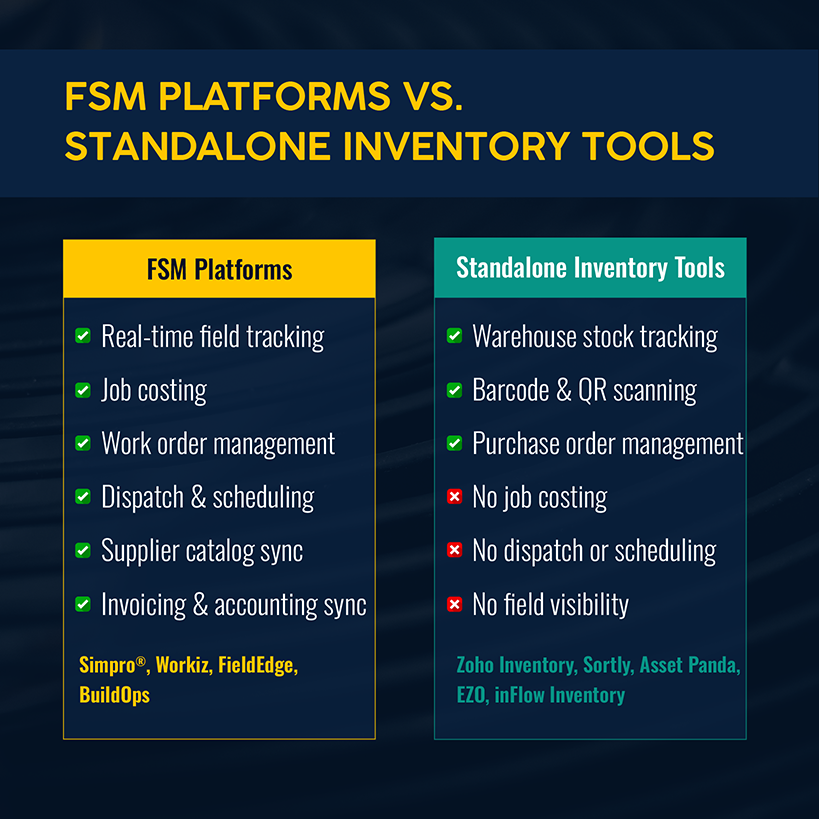
The best electrical inventory management software for your business depends on your stage of growth. At $500,000 in revenue, a spreadsheet or a basic tracking app covers most needs. At $1 million+, the gaps start forming: Job costs drift, van stock becomes a mystery, and emergency supply trips eat into margins. Past $2 million in revenue, businesses can’t realistically manage inventory separately from jobs, dispatch, and invoicing.
Standalone tools handle one piece of the puzzle well. They track what's in your warehouse, manage your equipment checkout, or illustrate your parts inventory. What they don't do is connect that information to your field teams, active work orders, or job costing. And those are the areas where you keep or leak margin.
The contractors getting this right are consolidating their software into a single platform that handles quoting, scheduling, inventory, job costing, invoicing, and accounting sync. They aren’t just saving time; they’re also getting better, real-time data that unlocks smarter decisions about pricing, staffing, and growth.
Over 24,000 businesses use Simpro to manage this type of complexity. Customers report an average 25% revenue increase and 30% improvement in field technician productivity after implementation. That's what happens when your operations stop leaking margin.
If your inventory, asset, and job management are running on separate tracks, it's worth seeing what they look like connected within Simpro's electrical contractor software. Schedule a demo to see how Simpro handles the full workflow, from purchase order to paid invoice.


 Back to top