
Your best estimator just walked away from a $400,000 tenant improvement bid because she didn't have three days to spend counting receptacles off a PDF. Learning how to use AI for electrical estimating is how you get those three days down to one afternoon, all without handing pricing judgment to software that's never stood in front of a panel schedule.
Takeoffs are where electrical contractors quickly lose hours, making it the place where AI makes the most sense. This guide explains the full workflow: how to use AI for electrical takeoffs and reduce counting time, how to turn those counts into a priced bid, and where a licensed estimator still has to sign off before anything goes out the door.
Where AI Fits Into the Electrical Estimating Process
Artificial intelligence (AI) shows up in electrical estimating in two different ways, and knowing which one you're evaluating saves you from buying the wrong tool.

- AI-powered takeoff: This is software that reads a set of drawings and counts devices, fixtures, and conduit runs in minutes instead of hours. Most commercial and industrial bidding runs on this.
- AI-generated, scope-based quoting: A service tech describes a job or photographs a panel, and the software prices it on the spot, no blueprint required. Most residential and light-commercial service work runs on this.
Both versions are solving the same underlying problem: Estimating is a skilled, judgment-heavy job that doesn't scale with revenue in the same way as adding a technician. Simpro® CEO and Chairman Fred Voccola puts the average profit margin across trade contracting businesses at about 10%. A slow or careless estimate can erase the margin on jobs you already won that month.
The labor market isn't giving anyone room to absorb that risk, either. The U.S. Bureau of Labor Statistics projects electrician employment to grow 9% through 2034, with roughly 81,000 openings each year. The labor squeeze affecting your field crews doesn't stop at the estimating department.
There is an upside, however, especially for electrical contractors trying to grow past $1 million in revenue without adding headcount: AI can scale estimating from one person’s tribal knowledge into a process your entire team can run. That's the advantage worth building around, rather than saving time on any single bid.
Related: The fundamentals of the electrical estimating process haven't changed. Learn how to build estimates before adding AI.
How to Use AI for Electrical Estimating: A Step-by-Step Workflow
The steps below hold regardless of which tool you’re using. Each step assumes AI runs the first pass before a person signs off, not the other way around.
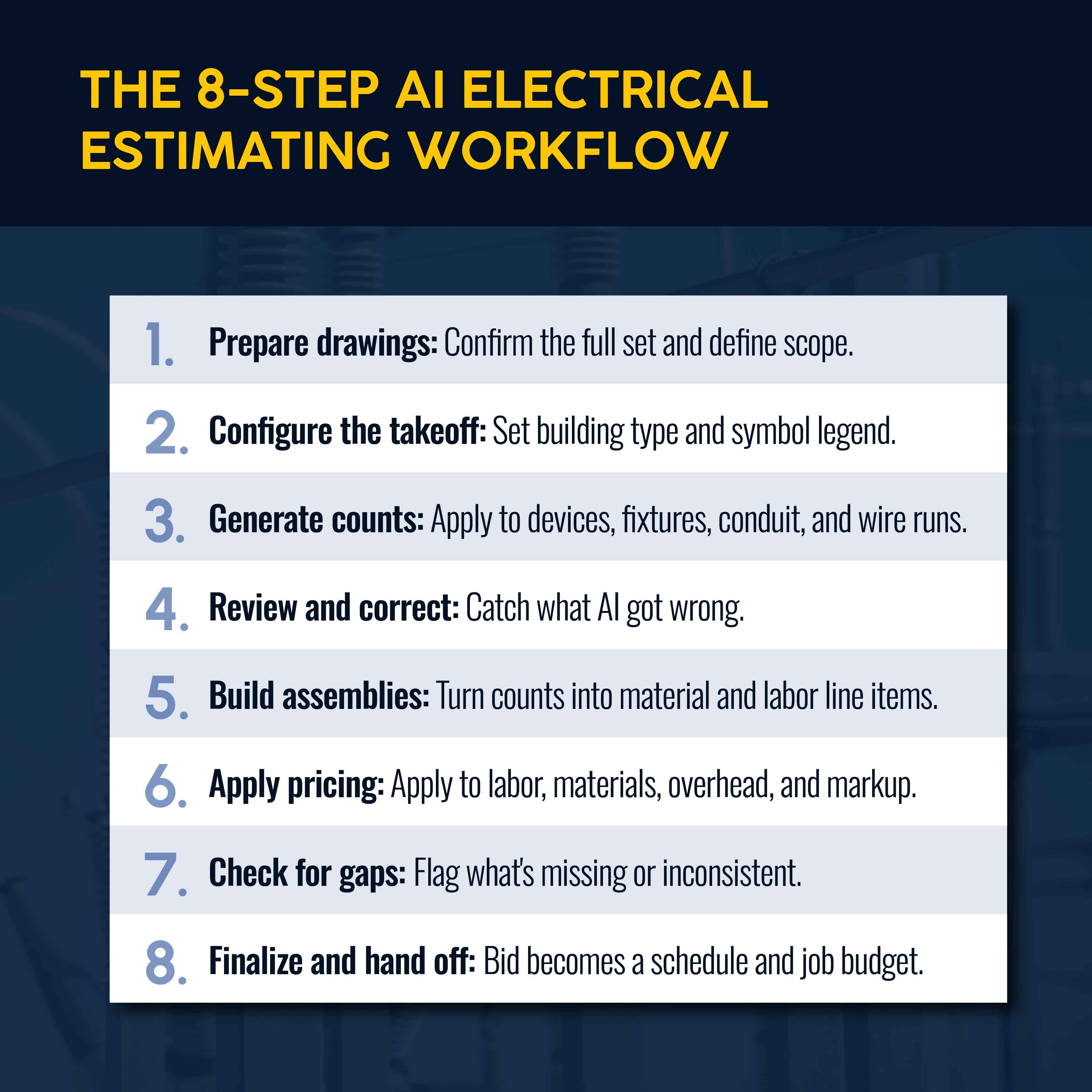
1. Prepare the Drawings and Define the Bid Scope
Before any drawing touches an AI tool, define what you're actually bidding. Confirm you have the full set: current drawings, specs, and every addendum issued during the bid period. Electrical scope usually lives in Division 26 of the spec, but scope hides in other places, such as low-voltage (or limited-energy) runs that display on a communications sheet instead of an electrical one.
An AI takeoff tool only counts what's in front of it. It has no way to tell you a sheet is missing from the set, and it doesn't know whether the design meets National Electrical Code requirements.
The operational fix: Confirm the full drawing set and check for open addenda before you upload anything. That single check does more to reduce the risk of a wrong number than anything you do downstream.
2. Upload the Plans and Configure the AI Takeoff
Once the set is confirmed, upload the drawings and set up the project: building type, symbol legend, and which sheets are electrical versus architectural or structural. Tools like Simpro Takeoffs read electrical, plumbing, and generic symbols in all orientations. That detail matters: A receptacle symbol rotated 90 degrees on a reflected ceiling plan will trip up takeoff software more often than you'd expect.
3. Generate Device Counts and Linear Measurements
Run the takeoff and let the software handle the counting: receptacles, switches, fixtures, panels, plus linear measurements for conduit and wire runs. All this occurs in minutes, not hours. AI compresses this step because it's matching symbols against a legend across every sheet simultaneously instead of clicking through them individually.
Picture a 180-page hospital addition with electrical scope spread across 50 of those sheets. Counted by hand, that's most of a week for one estimator. Run it through AI takeoff first, and it's closer to a same-day pass, which leaves the rest of the week for pricing and value engineering instead of clicking through PDFs.
4. Review and Correct the AI-Generated Takeoff
Nothing from this step goes into a bid until someone checks it. AI struggles most with custom or manufacturer-specific symbols that don't match a standard legend. For example, AI can double-count a device that shows up on an enlarged plan and the base floor plan. Treat the estimator's role here as quality control, not data entry. They're not re-counting from scratch. They're spot-checking a first pass and correcting what doesn't hold up.
5. Convert Quantities Into Electrical Assemblies
A device count isn't an estimate on its own. A duplex receptacle on a drawing represents a box, a cover plate, wire, connectors, and the labor to set and terminate all of it. A commercial electrical job can carry 40–80 different assembly types once you account for device grade, conduit type, and mounting height.
For this step, go with a live, electrical-specific pricing database instead of a generic construction one. Simpro's SPARX integration integrates with Simpro to provide you with pre-populated pre-builds. Because it pulls from current supplier costs, device counts expand into full material and labor line items instead of a spreadsheet you have to build manually.
6. Apply Labor, Material Pricing, and Project Overhead
After building assemblies, apply labor units from a source you trust, current material costs instead of a price list from last quarter, and your overhead, markup, and contingency on top. Watch for blended numbers here. If you price commercial and residential work off the same labor rate, you're probably overcharging one and underpricing the other without knowing which.
Deloitte Access Economics research commissioned by Autodesk found that preconstruction professionals spend an average of 13.4 hours a week researching and analyzing data. And there’s no guarantee of accuracy: Longstanding research suggests nearly 90% of spreadsheets contain formula errors, often undetected. If your pricing still runs through a spreadsheet somebody built three years ago, the odds aren't in your favor.
7. Use AI to Check the Estimate for Gaps and Inconsistencies
Before the bid goes out, run it through AI as a second set of eyes to catch missing panel schedules, quantities that don't reconcile between sheets, or line items that price differently than similar ones on the same job. Think of AI as a first filter, catching the obvious misses so humans can spend their time on the subtle errors. The peer review still happens after.
8. Finalize the Bid and Hand It Off to Operations
Submitting the bid doesn't finish the job. The numbers still have to turn into a schedule, purchase order, and job-cost budget — ideally without re-keying. A faster takeoff doesn't count for much if the win still has to be manually re-entered into scheduling and inventory before dispatching a crew.
Speed on the front end pays off when the numbers hold up on the back end. Accuracy matters.
What AI Can and Cannot Reliably Handle
AI estimating is good at some parts of this workflow and weak at others. Knowing which is which prevents your business from sending indefensible bids. The table below is a rough map of when to trust software and when to keep a person in the loop.
| AI Handles Well | Still Needs Your Estimator |
|---|---|
| Counting devices and fixtures across large drawing sets | Reading custom or manufacturer-specific symbols outside a standard legend |
| Linear measurements for conduit and wire runs | Judgment calls on electrical code compliance and local amendments |
| First-pass assembly buildup from device counts | Resolving conflicts between drawings, specs, and addenda |
| Flagging inconsistencies and missing items across sheets | Final pricing, contingency, and margin decisions |
| Speed and consistency on clean, well-organized drawing sets | Accuracy on renovations or jobs with poorly defined scope |
AI has a role here, but it shouldn’t run the whole process. Successful estimators will understand that tradeoff rather than letting AI create the entire bid without supervision.
Choosing an AI Setup That Works With Your Existing Process
The estimating tools you need depend more on what you sell than on which vendor has the flashiest demo. A residential and light-commercial service operation quoting off a photo or a phone call needs scope-based AI that prices a job on the spot. But a commercial or industrial shop bidding off full drawing sets needs a dedicated takeoff tool that’s supported by a deep, trade-specific database. Buy the wrong one, and you're either paying for capability you'll never use, or you’re missing the features you actually need.
When your service techs are standing in front of a homeowner's panel, they don’t need blueprint-reading software. They need a tool that turns a photo and a five-minute conversation into a priced quote before leaving the jobsite. A chief estimator bidding a $2 million industrial job off of 200 sheets needs something very different: symbol recognition, assembly logic, and a pricing database built specifically for electrical work, rather than a generic construction tool where electrical symbols are an afterthought.
A vendor’s demo file isn’t enough. Test AI tools on your drawings and completed projects before you commit. A vendor demo is built to make the software look good. But applying your last three bids will tell you whether the tool does what you need.
Related: A price book built around real assemblies matters, too. Building an electrical contractor price book is essential to success, no matter which AI takeoff tool you’re using.
Standardizing AI-Assisted Estimating Across the Team
Good use of AI by one estimator doesn't scale the business on its own. Scaling requires every estimator on the team running the same process and producing bids that look like they came from the same company, whether the job is $50,000 or $2 million.
A multi-location contractor running four estimators across three offices needs consistency more than speed. When estimators count device types differently or price labor off stale rates, AI doesn’t catch those inconsistencies. It just makes inaccurate bids generate faster.
Centralize the source of truth. Drawings, specs, count files, and pricing should live in one place everyone pulls from, not four estimators' individual folders. Add checklists to every bid so steps happen in the same order, regardless of who's running the takeoff. Treat every drawing revision as a trigger for a defined review instead of a judgment call.
The operational fix: If two estimators can't explain why similar jobs came in with different labor rates, standardize the pricing source before you add headcount.
Related: See how a connected AI operating platform for electrical contractors closes the gap between winning a bid and running the job.
How to Measure Whether AI Is Improving Electrical Estimating
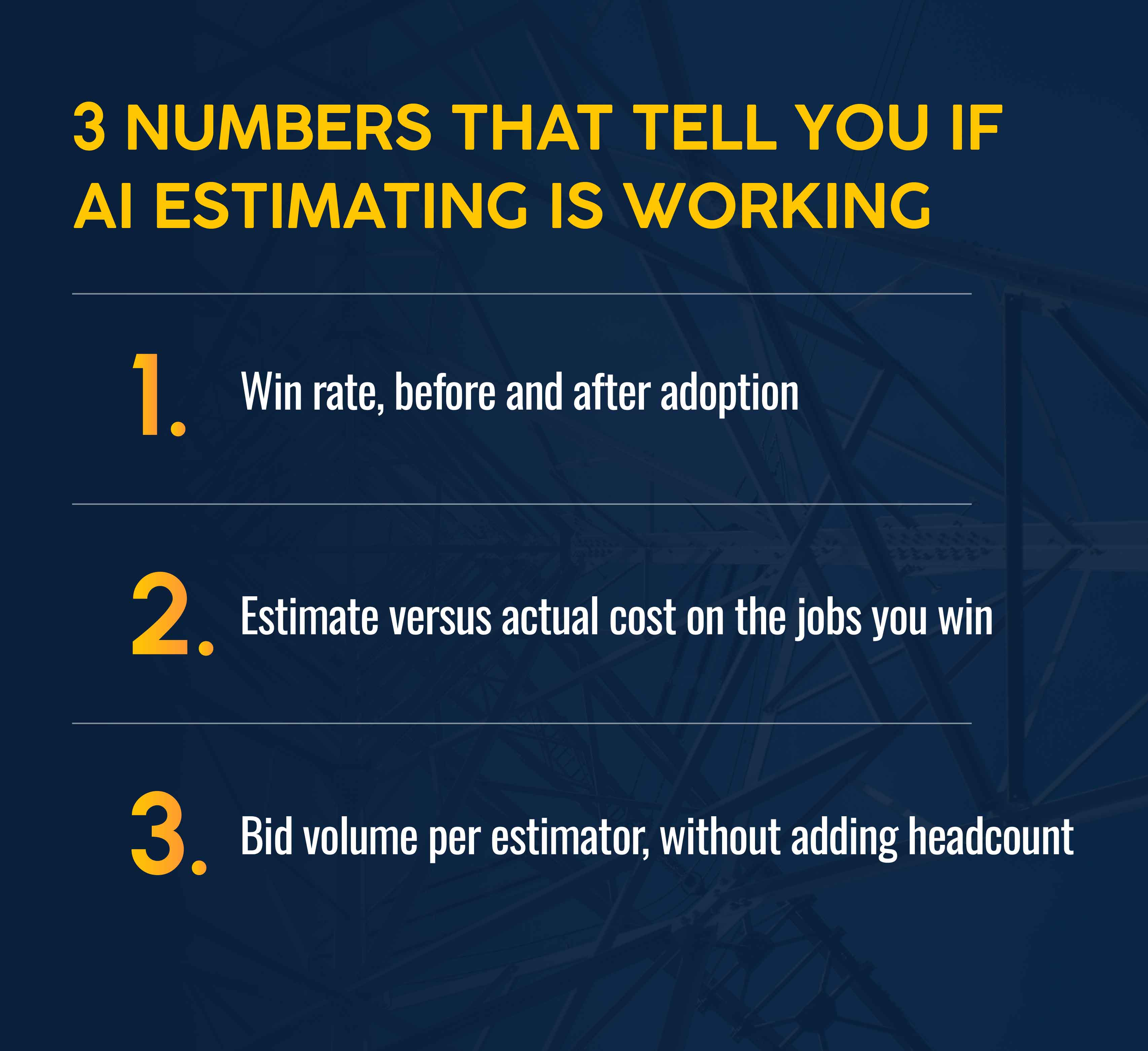
Speed is a good thing, but simply going faster doesn't tell you whether AI is actually working for your business. Three KPIs tell you more:
- Win rate before and after you adopt AI software.
- Estimate versus actual cost on the jobs you win. A fast bid that's wrong in the field isn't saving you anything.
- Bid volume per estimator. The real test of AI-assisted estimating is whether your team can handle more bids without hiring another estimator to do it.
Simpro's own data puts AI-assisted estimating at up to 10x faster than manual, spreadsheet-based quoting. That number has a real impact on your ability to win business. If your bid goes out the same day instead of three days later, you're already in more conversations, especially when the customer is likely to go with the first reasonable price.
Related: Win rate and bid volume are lagging indicators. Learn which electrical KPIs preserve electrical job costing accuracy.
Turn Approved Estimates Into Profitable Electrical Jobs With Simpro
The workflow above gets you a fast, accurate bid. But those gains can quickly become undone if the numbers built in estimating don't carry through to scheduling, job costing, and invoicing.
Simpro Takeoffs handles the front end. Smart symbol recognition reads electrical, plumbing, and generic symbols in any orientation and counts materials in seconds. Liam Peet at AC Electrical says Simpro Takeoff “accelerates tendering, counting, and estimating. I’m able to get more bids out the door.”
On the pricing side, SPARX gives you an electrical-specific database with more than 8,200 pre-builds and 20,700 parts across close to 300 categories, kept current with supplier costs automatically.
Related: Protecting electrical project margins with AI starts with pricing that's current.
Because the estimate lives in the same system that runs scheduling, job costing, and invoicing, an approved bid doesn't have to be re-typed into a second platform before a crew can be dispatched.
Ben Edwards, a Simpro estimating software customer, puts it plainly: Simpro gets him "a quote out ten times quicker than what we were doing from spreadsheets." That speed holds because nothing needs re-entry between winning the job and starting work.
Build an Estimating Process Without Giving Up Control
When you use the AI field service management platform in Simpro Lightning, you’re not handing everything off to software. Instead, you’re freeing up your best estimators to spend their time on scope review and judgment calls, not symbol counts.
If your estimating process still depends on one person's expertise and a stack of PDFs, that's the risk to solve before taking on more volume. Schedule a demo to see how Simpro handles takeoffs, pricing, and the job handoff — in one system that’s purpose-built for electrical contracting businesses.


 Back to top